





The cause of the altercation could not be immediately ascertained as of press time.
Trending
Ukraine hopes its incursion into Russia changes outcome of war


Story by James Waterhouse – Ukraine Correspondent, in the Sumy region
“All wars end with negotiations. It’s not the soldiers in the trenches who decide when.”
Arni joined the Ukrainian army in 2022 to fight for his country’s survival. When we bump into him 30 months later, he describes a new motivation. “Peace.”
“No-one likes war, we want to finish it,” he says while leaning against his camouflaged pick-up truck.
For the troops we encounter close to Russia’s border, there’s a desire to end Russia’s invasion on acceptable terms.
That is not to say survival isn’t a core driver – it is – but they seem to be striving for a finish line.
“For Ukraine, our people, we’ll stand until the end,” adds Arni.
Until 6 August, Ukraine’s sole objective was one of liberation. The complete repelling of Russian forces to its borders from before Russia first invaded in 2014.
Albeit at a grinding pace, the reverse has been happening for the past year-and-a-half with Moscow eroding Ukrainian territory.
Then came the “all in” poker play which surprised everyone apart from the battle-hardened Ukrainian soldiers who carried it out: a counter-offensive into Russia’s Kursk region.

Arni says Ukraine’s military objectives have shifted from survival to peace
© BBC
“It was undeniably successful and daring,” observes Serhii Kuzan, chairman of the Ukrainian Security and Co-operation Centre, a think tank.
Now, Kyiv can’t reference its offensive often enough, with countless pictures of troops giving out aid as they tear down Russian flags.
“It also changes the narrative,” says Alina Frolova, security expert and former deputy defence minister of Ukraine. “A situation where we’re losing territory step by step is not a good one.
“Ukraine’s strategic position has changed.”
Despite parallels with Russia’s initial invasion, Kyiv claims its goal is not to occupy.
So what is the aim? Well, there’s more than one.
Buffer zone
“This attack was partly carried out so the city of Sumy was better protected,” explains Serhii Kuzan, who thinks it is often forgotten that the border is still a front line.
Since the start of this summer, President Volodymyr Zelensky says there were more than 2,000 strikes on the Sumy region from the Kursk region alone, including 250 glide bombs.
For months it was feared Russian troops were preparing for a cross-border attack of their own, and by pushing them back, Serhii believes defending Ukraine in general will be easier.
“The [now captured] Russian city of Sudzha is on a commanding height. The Russians are already in a less advantageous position because we control the approach routes.”
While Russia has had to react to Ukraine on the battlefield, it has also had its supply lines targeted. Key roads have been seized and a strategically important bridge destroyed.
Which leads us to:
The redeployment of Russian forces
“The main purpose of this offensive into Kursk is to divert Russia’s attention from its occupied territories in Ukraine,” says Ivan Stupak, who worked for Ukraine’s security service (SBU) between 2004-2015.
The good news for Ukraine is that is what appears to be happening. The bad news is that Russian advances, notably towards the town of Pokrovsk, are not slowing.
“The Russian army has been redeploying some troops from different directions – the Kherson, Kharkiv and Donetsk regions, for example,” Ivan says. He believes around 10,000 personnel are being diverted, mostly from other parts of Russia.
The ‘exchange fund’
It is how President Zelensky describes Ukraine’s collection of captured Russian soldiers.
Historically, when Ukraine has momentum, it captures more and consequentially negotiates the release of their own more easily.
The Kursk offensive has been no exception. Kyiv says hundreds of Russian troops were taken prisoner. Several could be seen surrendering in drone footage and being taken back to Ukraine with tape blindfolds.
“Moscow is actually offering to start negotiations to exchange prisoners of war,” says Serhii Kuzan.
“It is no longer us, enlisting the support of Qatar and the United Arab Emirates to ask Russia to hand over our prisoners of war.”
Pressure
This is a huge part of it for Kyiv.
On a civilian level, you had the horror and anger felt in the Kursk region in response to the blistering Ukrainian assault on their homes.
There were mass evacuations, pleas for help and criticisms of some authorities for not preventing the attack.

Ukraine hopes its incursion into Russia changes outcome of war
© BBC
On a political level, you had Russian President Vladimir Putin publicly processing events in Moscow while being briefed by his security chiefs.
And of course there is the military level.
“The influence of this Ukrainian incursion could be quite substantial,” concludes Alina Frolova. “That’s why using highly professional troops was specifically the right decision.”
Future bargaining chips
If Ukraine does not plan to keep hold of its captured Russian territory in the long term, but can hang on long enough, it hopes to leverage it for the release of its own land.
But it’s a big “if”.
When fighting slows, that has always suited Russia with its superior size. Misdirection and surprise has often worked for Ukraine.
“In a symmetric war, we have no chances with Russia,” points out Alina Frovola. “We need to make asymmetrical actions”.
Slowing advances in the Kursk region may leave Kyiv with difficult decisions.
But there are benefits for as long as there is movement, Serhii Kuzan argues.
“An advance rate of 1-3km a day is normal for swapping forward units with reserves,” he says. “In Ukraine’s Donbas region, the average advance rate for the Russians is 400m.
“Our pace in the Kursk region is five times faster than a 100,000-strong army!”
But the problem for Kyiv, is that Russians are still going forward in Ukraine.
However, don’t expect Ukraine to withdraw from its Russian attack anytime soon.
It is committed now.
And what about Vladimir Putin?
Russia’s president initially labelled the offensive as a “terrorist attack” and “provocation”, but in the days since he has barely referenced it publicly.
That’s despite it fitting into his narrative that Russia’s invasion is a defensive war to protect his people.
Perhaps he doesn’t want the alarm felt by many in the Kursk region to spread, or for it to appear like his military doesn’t have control of the situation.
Also, as with the Kursk submarine disaster and failed coup of last year, Vladimir Putin doesn’t always act quickly to regain the initiative.
Ukraine will be hoping he’s not this time because he can’t.
Additional reporting by Hanna Chornous, Sophie Williams and Hanna Tsyba
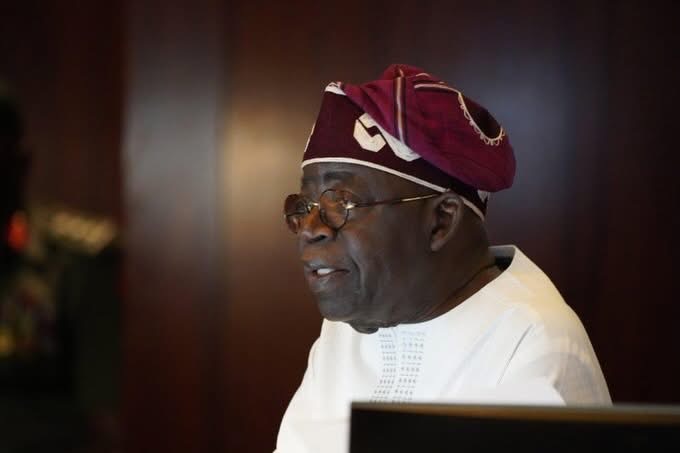
President Bola Tinubu has condemned the reported “barbaric” killing of one of the abducted teachers from the Esiele community in Ogbomoso, Oyo state.
In a statement released issued by his media aide, Bayo Onanuga, on Monday, May 18, President Tinubu said the teacher was k!lled when “rescue operation is underway.”
While conveying his sympathy the government and people of the state, President Tinubu assured that security operatives are “working around the clock” to rescue the victims and arrest the bandits as well as their collaborators within the community.
He further assured that the federal government would collaborate with the state government to rescue the victims.
‘’”I am saddened by the reported killing of one of the teachers kidnapped by the gunmen who invaded the community. I sympathise with Governor Seyi Makinde and commend the steps he has taken on the matter. I sympathise with the families of the kidnapped victims.
The Federal Government is working with the Oyo State government to rescue all the victims. I commend the Inspector-General of Police and the Commissioners of Police in Oyo and Kwara States for their quick intervention and the deployment of a tactical and the Intelligence Response Team (IRT) team to rescue the victims.
The IGP, following my instructions, is personally leading the tech-driven operation. We expect a breakthrough soon. The bandits and all their local collaborators will be fished out and made to face the full wrath of the law.
Cases of kidnapping further make imperative the establishment of state police to man some of our underserved areas. The National Assembly should accelerate the enactment of the law creating state police” the President said

May 14, 2026
The Rule of Law and Accountability Advocacy Centre (RULAAC) expresses deep concern over the decision by the Nigeria Police Force to disband the notorious “Tiger Base” in Owerri, Imo State, only to inaugurate another tactical police unit operating from the same facility, under substantially the same command structure and reportedly with many of the same operatives.
This development raises serious questions about the sincerity of ongoing police reform efforts in Nigeria and reinforces fears that what is being presented as reform may merely be a cosmetic rebranding exercise designed to deflect public criticism without addressing the underlying culture of abuse and impunity.
Tiger Base became widely associated with allegations of torture, enforced disappearances, arbitrary detention, extortion, and extrajudicial killings. Over the years, victims, families, lawyers, journalists, and civil society organizations documented disturbing patterns of abuse linked to the operations of the unit.
Ordinarily, the disbandment of such a notorious tactical outfit should have marked an opportunity for genuine institutional reform. It should have included:
– Independent investigation into allegations of abuse;
– Accountability for officers implicated in violations;
– Justice and reparations for victims;
– Structural reforms and strengthened oversight;
– Human rights-centered retraining and professionalization.
Instead, the establishment of another tactical formation under substantially similar conditions suggests continuity rather than reform.
RULAAC is particularly concerned that retaining personnel or leadership figures associated with serious allegations of abuse sends a dangerous message that misconduct within the policing system carries no real consequences. This undermines public trust, weakens accountability, and emboldens further violations.
The situation also raises broader concerns regarding political interference in policing. Tactical police units must never become instruments for political intimidation, repression, or the advancement of partisan interests. Professional policing requires operational independence, transparency, accountability, and strict adherence to constitutional and legal standards.
The controversy inevitably recalls the aftermath of the #EndSARS protests, when the disbandment of SARS was quickly followed by the creation of SWAT, generating widespread fears that abusive policing structures were merely being renamed rather than fundamentally transformed.
RULAAC reiterates that genuine police reform cannot be achieved through changes in nomenclature alone. Meaningful reform requires accountability, transparency, civilian oversight, institutional culture change, and justice for victims.
Accordingly, RULAAC calls for the following urgent measures:
1. A transparent and independent investigation into allegations against Tiger Base operatives and leadership;
2. Prosecution and disciplinary action against officers implicated in torture, unlawful killings, and other abuses;
3. Justice, compensation, and support for victims and affected families;
4. Strengthened civilian oversight involving the National Human Rights Commission, judicial institutions, and civil society organizations;
5. Clear operational guidelines and publicly accountable rules of engagement for tactical police units;
6. Measures to insulate policing from political interference and abuse.
The people of Imo State and Nigerians generally deserve a policing system founded on professionalism, legality, accountability, and respect for human rights – not the recycling of abusive structures under new labels.
Signed:
Okechukwu Nwanguma
Executive Director
Rule of Law and Accountability Advocacy Centre (RULAAC)
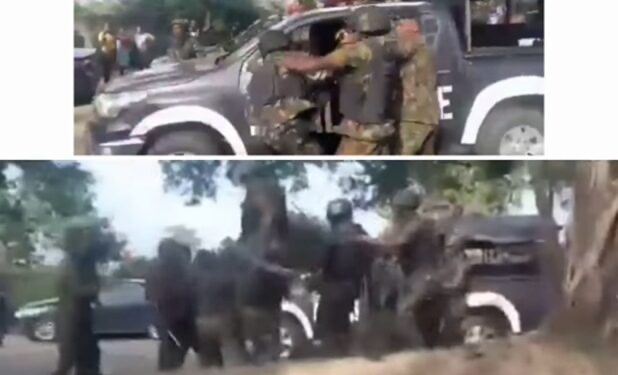
Personnel of the Nigerian military were seen engaging in a fight during the visit of President Bola Ahmed Tinubu to Bayelsa on Friday.
In a video spotted on social media, the driver of a Hilux vehicle marked “Naval Police” was seen stepping down from his vehicle and exchanging words with another driver.
After returning to his vehicle, another driver with a rifle approached him and threw a punch at the Naval Police driver, triggering a brawl.
The incident quickly escalated into a free-for-all, with personnel attached to both vehicles exchanging blows, while stunned civilians watched in disbelief.

Politics58 minutes ago
Desmond Elliot Withdraws from APC Lagos Assembly Primaries, Cites Intimidation

Politics1 hour ago
Political Shockwave in Rivers as Fubara Pulls Out of APC Governorship Race, Backs Party’s Candidate

Politics1 hour ago
Ugochukwu Obodo wins Owerri Municipal APC ticket again as APC Elects 27 Imo Assembly Candidates After Successful Primaries

-
Business2 years ago
US court acquits Air Peace boss, slams Mayfield $4000 fine
-

 Trending2 years ago
NYA demands release of ‘abducted’ Imo chairman, preaches good governance
-

 Politics2 years ago
Mexico’s new president causes concern just weeks before the US elections
-

 Politics2 years ago
Putin invites 20 world leaders
-

 Politics2 years ago
Russia bans imports of agro-products from Kazakhstan after refusal to join BRICS
-
Entertainment2 years ago
Bobrisky falls ill in police custody, rushed to hospital
-
Entertainment2 years ago
Bobrisky transferred from Immigration to FCID, spends night behind bars
-
Education2 years ago
GOVERNOR FUBARA APPOINTS COUNCIL MEMBERS FOR KEN SARO-WIWA POLYTECHNIC BORI