
Politics
Tech war: China advocates use of local AI chips over those from US powerhouse Nvidia

AI chip users on the mainland have been informally advised to prioritise local alternatives, including those from Huawei, sources say
Chinese authorities have informally advised local companies to use domestic-made artificial intelligence (AI) chips over those from Nvidia, according to two sources familiar with the matter, as alternative suppliers on the mainland look to catch up with the US tech giant.
While there is no official ban on Nvidia’s China-tailored H20 graphics processing unit (GPU), the sources said mainland AI chip users have been informed to prioritise deployment of local alternatives, including those developed by Huawei Technologies.
A third source said H20 orders made by mainland enterprises had not been restricted as of August.
Do you have questions about the biggest topics and trends from around the world? Get the answers with SCMP Knowledge, our new platform of curated content with explainers, FAQs, analyses and infographics brought to you by our award-winning team.
Reports about China’s tacit rules against the American chip design firm first emerged in May, when US tech media The Information reported that regulators had asked local companies to cut back purchases of Nvidia chips and buy more from domestic suppliers like Huawei. A Bloomberg report last week said that China has called on local buyers to stay away from Nvidia.
The country’s Ministry of Industry and Information Technology, which oversees the domestic semiconductor and AI sectors, has not made any public announcement regarding that matter. The agency did not reply to a request for comment.
Nvidia did not also respond to a request for comment on the reported China restrictions.
The lack of any official confirmation about the matter somehow reflects the highly sensitive nature of the world’s AI chip market, which Taiwan Semiconductor Manufacturing Co chief executive Hsu Ming-chi has projected to grow annually at a much higher rate than the overall semiconductor industry.
When asked about his views on US trade restrictions on China, Nvidia chief executive Jensen Huang told American media in Washington on September 28 that the US government is “doing a wonderful job” in finding the right balance between controls and exporting American technology to the world.
“It is really terrific that the world is built on American standards,” Huang said, “Nvidia is an American company and our government and administration would love to see us succeed.”
Nvidia’s H20 remains popular among users in China, despite its reduced capacity to comply with US sanctions. Sales of the tailor-made chip have steadily picked up since its release earlier this year, as demand from large Chinese cloud services providers enabled them to access Nvidia’s technical support and maintenance services.
Nvidia is expected to deliver more than 1 million H20 GPUs in China this year, racking up US$12 billion in sales.
State-owned China Telecom is a major user of domestic-made artificial intelligence chips. Photo: Shutterstock
Still, adoption of alternative Chinese-made AI chips is growing.
State-owned carrier China Telecom, for example, said in a statement on September 28 that it has developed two large language models – the technology behind generative AI applications like ChatGPT – that were trained entirely on locally produced AI chips. While it did not identify the local supplier, China Telecom has a track record of partnering with Huawei.
A week earlier, Huawei had started offering samples of its Ascend 910C processor to large Chinese server companies for hardware testing and configuration, according to a South China Morning Post report. That put the company a step closer to the commercial roll-out of its upgraded version of the 910B, which is on par with Nvidia’s popular A100 chips.
Nvidia was initially barred from selling its A100 and H100 GPUs – two of the most in-demand chips for training and running AI models – to clients in China in August 2022. It later modified those chips to create the A800 and H800 to get around those restrictions, which Washington barred from being exported to China under tightened curbs announced last October.
Nvidia has since developed the H20, L20 and L2 GPUs to maintain its market share in China. Despite several rounds of US restrictions, Nvidia said China was its third-largest market in its financial year ended January 28.
More Articles from SCMP
Port workers’ protest against automation will only hurt US competitiveness
Write a funny caption for this woman having some fun at an art exhibit
Replicas of Kowloon Walled City film sets to be exhibited at Hong Kong airport
Sky’s the limit as Hong Kong enters the space age
This article originally appeared on the South China Morning Post (www.scmp.com), the leading news media reporting on China and Asia.








Politics
FEDERAL HIGH COURT STOPS INEC FROM RESTRICTING DEFECTION TO ANOTHER PARTY AFTER CONTESTING PRIMARY

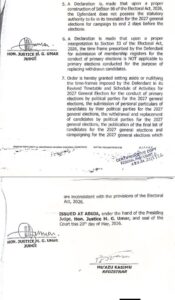
Here is the judgement from the Federal High Court, Abuja today
1. INEC can only monitor 2027 primaries but cannot fix timetable for when a political party should conduct its primaries for this election
2. INEC cannot give a shorter timeframe or abridge the period in which a political party can provide information of their candidates for 2027 election
3. INEC cannot give a shorter timeframe to political parties as regards withdrawal or replacement of candidates (Placeholders)
4. INEC cannot publish any final list of candidates for 2027 elections before 60 days to election.
5. INEC cannot fix 2027 campaigns to end 2 days to elections.
6. This is AN ORDER nullifying and setting aside the timeframes imposed by INEC for 2027 General Election for:
– the conduct of primary elections by political parties for the 2027 general elections
– the submission of personal particulars of candidates by their political parties for the 2027 general elections
– the withdrawal and replacement of candidates by political parties
– the publication of the final list of candidates for the 2027 general elections and campaigning.



Is this a trap or a game changer for some aspirants???

A Rivers State politician, Blessing Fubara, has declared his intention to contest the 2027 governorship election in Rivers State under the platform of the Nigeria Democratic Congress.
The politician has already obtained both the nomination and expression of interest forms needed to participate in the governorship race ahead of the 2027 election.
Blessing Fubara shares the same surname and local government area with the current Rivers State Governor, Siminalayi Fubara.
Both men are from Opobo/Nkoro Local Government Area. However, there has been no confirmation that they are family members.
The Chairman of the NDC in Rivers State, Success Jack, confirmed that Blessing Fubara is among those seeking the party’s governorship ticket.
He also stated that he could not confirm whether the governorship aspirant is related to Governor Siminalayi Fubara.
According to him, the party is preparing seriously for the 2027 general elections and hopes to win not only the governorship seat but other elective positions in Rivers State.
The development comes weeks after Blessing Fubara left the All Progressives Congress and joined the NDC.
Following his defection in Abuja, he was received by former Bayelsa State Governor, Seriake Dickson, alongside other leaders and members of the party.
After joining the NDC, Blessing Fubara said his decision was taken for the interest of Rivers people.
He also stated that the future of the state must be protected ahead of the next general election, expressing confidence that the state would experience positive changes after the 2027 polls.

Surulere I lawmaker Desmond Elliot has withdrawn from the All Progressives Congress Lagos House of Assembly primaries, citing intimidation across multiple zones.
In a viral video posted online, the lawmaker said he was stepping out of the race despite seeking re-election under the APC. He alleged that his supporters faced intimidation during the process in several parts of the constituency.
Elliot’s decision came as the primaries held across Lagos on Tuesday. Chief of Staff to the President Femi Gbajabiamila, who represents Surulere Federal Constituency, praised the conduct of the exercise in Surulere, describing it as peaceful.
The withdrawal narrows the contest for the APC ticket in Surulere I ahead of the 2027 general election. Party officials in Lagos have not yet responded to Elliot’s claims, and the APC state chapter has not announced whether the primary in the constituency will proceed with other aspirants.
Elliot has represented Surulere I in the Lagos State House of Assembly since 2015.
https://www.instagram.com/reel/DYkCaAiMxxt/?igsh=ZWw5czl6MHJhNnRy

FEDERAL HIGH COURT STOPS INEC FROM RESTRICTING DEFECTION TO ANOTHER PARTY AFTER CONTESTING PRIMARY

OBOWO LOCAL GOVERNMENT AUTHORITY CONDEMNS GRUESOME MURDER OF STUDENT OF COLLEGE OF NURSING SCIENCE, UMULOGHO

“It Was Sweet Blue Candy” – Hon Doguwa debunked rumour he’s a drvg add!ct

-
Business2 years ago
US court acquits Air Peace boss, slams Mayfield $4000 fine
-

 Trending2 years ago
NYA demands release of ‘abducted’ Imo chairman, preaches good governance
-

 Politics2 years ago
Mexico’s new president causes concern just weeks before the US elections
-

 Politics2 years ago
Putin invites 20 world leaders
-

 Politics2 years ago
Russia bans imports of agro-products from Kazakhstan after refusal to join BRICS
-
Entertainment2 years ago
Bobrisky falls ill in police custody, rushed to hospital
-
Entertainment2 years ago
Bobrisky transferred from Immigration to FCID, spends night behind bars
-
Education2 years ago
GOVERNOR FUBARA APPOINTS COUNCIL MEMBERS FOR KEN SARO-WIWA POLYTECHNIC BORI