
Tech
Were trebuchets built in situ and then abandoned after a siege?

- Is there a question to which you want to know the answer? Or do you know the answer to a question here?
- Write to: Charles Legge, Answers To Correspondents, Daily Mail, 9 Derry Street, London W8 5HY; or email charles.legge@dailymail.co.uk
Early trebuchets were built on site. As they grew increasingly large and powerful, wagons carrying sections of prefabricated trebuchets were brought to a siege and assembled in situ.
A trebuchet was a medieval siege weapon, operated using a counterweight to propel a long arm, attached to a sling, which could hurl a projectile with great force and accuracy at enemy fortifications.
Invented in China in around the fourth century BC, by the 12thcentury, improved counterweight trebuchets were in use in Europe.
Historian Michael S. Fulton offered the best examination of the machines in his book Development Of Prefabricated Artillery During The Crusades (2015).
He concluded that while smaller weapons were built on site, large trebuchets were not only assembled but also disassembled afterwards for transport so they could be reused at later sieges.
Perhaps the largest and most famous trebuchet of them all was Edward I’s Warwolf.
In 1304, he ordered his engineers to build this great piece of artillery for the siege of Stirling Castle in Scotland.
Assembled by five master carpenters and 49 labourers, the Warwolf could hurl rocks weighing as much as 300lb.
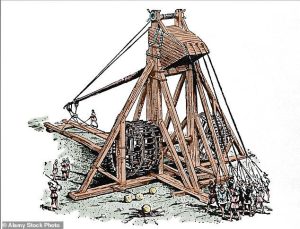
Early trebuchets were brought on site. As they grew larger and more powerful, wagons carried prefabricated section to a siege and assembled in situ
The Scots, watching the Warwolf being assembled, offered to surrender, but Edward reputedly refused to let anyone leave the castle until the great engine had bombarded it, which it did, successfully levelling the curtain wall.
Jon Francis, Norwich, Norfolk
QUESTION: What did the Keeper of the King’s Conscience do?
The Keeper of the King’s Conscience was a role of the Lord Chancellor. Historically, the Lord Chancellor was head of the Chancery, a court of equity (using fairness to resolve disputes) that originated in medieval England.
In its earliest form, those who were unable to obtain an adequate common law remedy (law derived from judicial decision), or felt they had been treated unfairly, could petition the King of England directly. Rather than making the judgment himself, he would refer the case to his ‘Conscience’, i.e. the Lord Chancellor.
Up until the Reformation the Chancellors were almost always churchmen, versed in civil and canon law. The Chancellor could thus bring legal and spiritual judgment to bear upon the case.Afterwards, the Chancellors were usually trained lawyers used to the process of reasoning.
Sarah Westwood, Birmingham
QUESTION: Was Gustav Holst the first composer to write about the planets?
Before Holst, there were works that explored celestial or planetary themes, though not in such a thorough or systematic manner as The Planets (1914-1917).
Orlando di Lasso (c.1532-1594) was a Catholic composer born in Mons in the Habsburg Netherlands (modern-day Belgium).
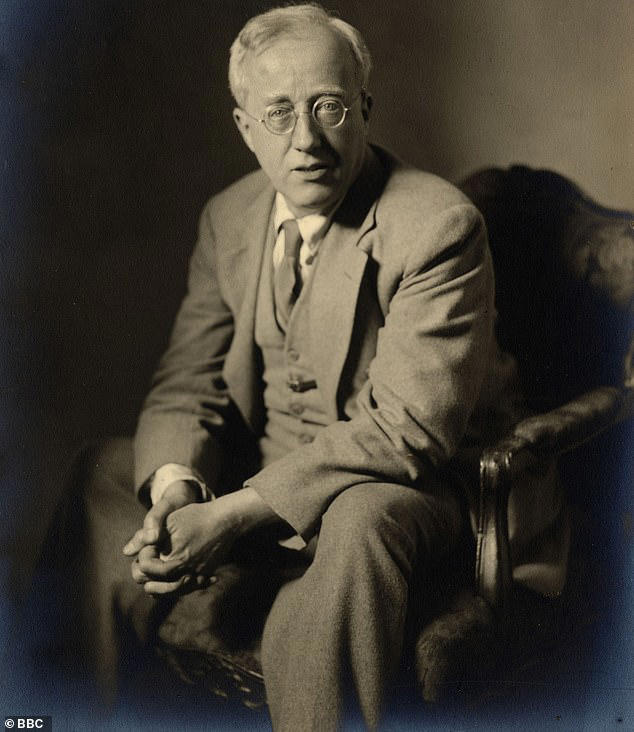
While many classical pieces explored celestrial or planetary themes before Holst (pictured), few were as thorough or systematic as The Planets
One of the most prolific, versatile and universal composers of the Renaissance, Lasso wrote more than 2,000 songs in Latin, French, Italian and German. Among his works was In Me Transierunt Irae Tuae (Your Wrath Swept Over Me), which directly inspired the German mathematician Johannes Kepler (1571-1630) to write Harmonices Mundi (Harmonies Of The World).
Harmonices Mundi captured the Pythagorean idea of planetary motion and the ‘music of the spheres’: the philosophical concept that celestial bodies such as the Sun, the Moon and the planets form music as they move through the solar system.
Austrian composer Joseph Haydn’s great oratorio The Creation (1798) celebrated the formation of the Universe. Although the lyrics were based on the biblical books of Genesis and Psalms, and John Milton’s Paradise Lost, Haydn was intensely interested in the astronomical discoveries of the day.
He is believed to have read Immanuel Kant’s Universal Natural History And Theory Of The Heavens (1755), which introduced Nebular Theory, the idea that the planets coalesced from gas and dust orbiting the Sun. The theory, as refined by French mathematician Pierre-Simon Laplace in the 1790s, was popular in the intellectual salons of the era.
Haydn also visited William Herschel’s astronomical observatory in Slough in June 1792. Peering through Herschel’s 40ft telescope may have provided the cosmic inspiration for The Representation of Chaos, the famous opening of The Creation.
It brilliantly captures the formation of celestial spheres from chaos, and it is clear from Haydn’s sketches that he took unprecedented pains over this composition.
Dr Ken Bristow, Glasgow










A jury in Los Angeles has ruled that tech giants YouTube and Meta are liable for negligence in a closely watched case involving a young woman who said she became addicted to their platforms from childhood.
The panel awarded the plaintiff $3 million in compensatory damages, assigning 70 percent of the liability to Meta. Jurors also determined that both companies could face additional punitive damages, with a decision on that yet to be made.
The lawsuit, filed in 2023, alleged that platforms such as Instagram were deliberately designed to create addictive user experiences, particularly for young audiences. According to court filings, the plaintiff began using YouTube at age six and Instagram at nine.
During the trial, a therapist who treated the woman testified that prolonged social media exposure contributed to significant mental health challenges, including social phobia and body image issues.
Both companies have rejected the verdict. Meta argued that teen mental health is influenced by multiple factors and cannot be attributed to a single platform. YouTube, meanwhile, maintained that its service is not inherently addictive.
Legal experts expect both companies to appeal the decision, setting the stage for a potentially influential battle over the responsibility of tech platforms in safeguarding young users.

Google is acquiring energy infrastructure company ‘Intersect’ for $4.75 billion (approximately 7 trillion Korean won) to secure the power needed for its AI (artificial intelligence) data centers. The move aims to address the power issue, the biggest hurdle in expanding data centers. Google, which developed the ‘Gemini’ AI, is a so-called ‘AI full-stack’ company equipped with all AI-related technologies and services, including AI chips and cloud (virtual servers). The strategy is to directly manage the energy infrastructure needed to actually operate AI as well.
Reuters reported on the 22nd (local time) that Google is acquiring Intersect for $4.75 billion in cash. Google already holds a minority stake in Intersect, and through this acquisition, it will also secure the gigawatt (GW)-level energy and data center projects that Intersect is developing and constructing. Intersect is expected to be responsible for building Google’s data center power infrastructure in the U.S., based on its technology linking power generation facilities and power grids.
Sundar Pichai, CEO of Google and Alphabet, said, “Intersect will enable us to build power infrastructure more quickly and flexibly in line with the increasing demand for AI data centers,” adding, “It will also be an important partner in strengthening America’s energy innovation and technological leadership.”
Bloomberg reported that Intersect’s energy assets currently in operation or under construction in the U.S. amount to $15 billion (approximately 22.2 trillion Korean won).
◇Google increasing energy investments
Google has recently been increasing its investments in the energy sector. Although the company possesses AI chips (TPUs), Gemini, and search and cloud services, stable energy supply is essential to support these businesses.
To this end, Google is also investing in nuclear power technology. In October of last year, it signed a long-term cooperation agreement with small modular reactor (SMR) startup ‘Kairos Power’ to secure up to 500 MW (megawatts) of power. It is noted as the first case among big tech companies to publicly declare securing SMR-based power. Additionally, in August, Google and Kairos Power announced plans to build the next-generation SMR ‘Hermes 2’ in Oak Ridge, Tennessee. The goal is to commence operation in 2030.
Google is also restarting previously shut-down nuclear power plants to secure energy. In October, it announced that it will collaborate with ‘NextEra Energy’ to restart the Duane Arnold Nuclear Generating Station in Iowa, which was closed in 2020. The target restart period is between 2028 and 2029.
Google is also investing in renewable energy such as geothermal power. Since 2023, it has been supplying power to data centers through geothermal power generation with ‘Fervo Energy’ in Nevada, U.S.
Google is also actively investing in next-generation energy technologies that are not yet commercialized. In 2022, it made a large-scale investment in ‘TAE Technologies,’ which possesses nuclear fusion technology. Nuclear fusion power generation is a technology that applies the principle of energy creation in the sun, combining atomic nuclei to produce energy. It is called the ‘dream energy’ because it has abundant fuel resources, emits no carbon, and, unlike conventional nuclear power plants, does not produce high-level nuclear waste. However, it is assessed that more time is needed for commercialization due to technical challenges. Recently, TAE Technologies has accelerated the commercialization of fusion energy by merging with Trump Media Group (TMTG).
Tech
“I Lost $1.2 Million To Hackers On One Of My Apps. I Caught One Of The Hackers, And Instead Of Handing Him Over To The Police, I Employed Him To Work For Me.”- BLord

Anambra Born tech entrepreneur and businessman Linus Williams, popularly known as BLord, has shared an unusual story about how he handled a major cyberattack on one of his applications.
According to BLord, he lost $1.2 million to hackers who infiltrated one of his digital platforms. In the course of tracking the incident, he successfully identified one of the individuals involved in the breach.
Rather than handing the suspect over to security agencies, BLord said he made a strategic decision: he employed the hacker.
He explained that the hacker’s skills, though misapplied, were exceptional and could be redirected towards strengthening his company’s cybersecurity systems.
BLord noted that the decision was driven by a desire to turn a negative experience into an opportunity for growth and to better secure his business infrastructure.

2027: More Than 50 Lawmakers Lose APC Reps Tickets in Major Primary Election

Bandits behind Ogbomoso school abduction will face full wrath of the law- President Tinubu

PDP to screen Goodluck Jonathan on Tuesday as its sole Presidential aspirant For 2027 race

-
Business2 years ago
US court acquits Air Peace boss, slams Mayfield $4000 fine
-

 Trending2 years ago
NYA demands release of ‘abducted’ Imo chairman, preaches good governance
-

 Politics2 years ago
Mexico’s new president causes concern just weeks before the US elections
-

 Politics2 years ago
Putin invites 20 world leaders
-

 Politics2 years ago
Russia bans imports of agro-products from Kazakhstan after refusal to join BRICS
-
Entertainment2 years ago
Bobrisky falls ill in police custody, rushed to hospital
-
Entertainment2 years ago
Bobrisky transferred from Immigration to FCID, spends night behind bars
-
Education2 years ago
GOVERNOR FUBARA APPOINTS COUNCIL MEMBERS FOR KEN SARO-WIWA POLYTECHNIC BORI