




The cause of the altercation could not be immediately ascertained as of press time.
Trending
Coming Soon: Compulsory Voting For APC, By SOS/Sonala Olumhense

Mandatory voting, the idea that a citizen must cast a ballot in an election, is not new. Of the Inter-Parliamentary Union’s 181 members, about 20currently practice some form of it.
Compulsory voting ensures a higher voter turnout. Where they feel that they have something to lose, voters obey the law to avoid the consequences.
A law such as the one sought by Abbas Tajudeen and Daniel Asama Ago in “A Bill for an Act to Amend the Electoral Act, 2022 to make it Mandatory for Nigerians of Maturity Age to Vote in All National and State Elections and for Related Matters” (HB.1930), will, in principle, empty more Nigerians into the streets on election day.
What this law aims at is that Nigerians would no longer vote as a matter of choice, which is the essence of democracy, but because of the consequences of not voting. It will basically criminalize even the act of staying in your own home in disgust for disgusting politicians. Little wonder it has been received with general revulsion.
HB. 1930, which passed the second reading last week in the House of Representatives, appears to beimportant to the Nigerian political establishment. I conclude that from seeing that it is led by the Speaker, Abbas Tajudeen, a man with no legislative honour: even his own page on the House website shows noLegislative Interests, no Target Achievements, no Awards & Honors, and no other bills sponsored.
There is no record of the Zaria Federal Constituency representative being outraged about the age-long killings in his Southern Kaduna neighborhood or the insecurity that has now grounded Nigeria, threatening to make hunger our story.
Abbas does not have a National Assembly phone number by which Nigerians, particularly his constituents, can reach him. His email, embarrassinglyenough, is a Yahoo address. While he is in office through the 1999 constitution; twenty years earlier in Lagos, even as a reporter taking his first steps, I walked into the office of Speaker David Ume-Ezeoke and interviewed him. Today, no reporter can simply walk through the gates of the National Assembly.
Abbas’s personal immortality comes from his swearing-in as Speaker when he brought the tumult of his own life to the stage with his two wives jostling for a place with him in the limelight. This is the man who wants every adult Nigerian to vote in elections.
I have reported the national legislature for 46 years. That includes: “How to Buy A Senator” (2002), “Is the House of Reps for Sale, or Rent?” (2021), and The National Assembly is in Decay (2022). Only recently, I argued that the legislature was no longer an arm of governance in Nigeria, having morphed into the executive. That is what the current focus of the Abbas’ House on compulsory voting vindicates. And this misguided focus reminds Nigerians why they are reluctant to vote in the first place: that when they send people to Abuja, they are mis-representatives.
Think about it: Among the most populous democracies, Indonesia in February 2024 held the world’s largest single-day election to produce a president. Indonesia is an archipelago: the world’s largest: over 18,000 islands and islets, of which 6,000 are inhabited, straddlingthree time zones of often treacherous terrain.
For the election, in that one day, the General Elections Commission had to manage over 204 million registered people, including Diaspora voters, who speak about 150 languages. Voter turnout was still a remarkable81.78%.
Later in November, the Simultaneous Regional Elections were held in one day to elect 37 governors and vice-governors, 415 regents and vice-regents, and 93 mayors and vice-mayors across the country’s 545 regions.
Similarly, in the 2024 India elections, the world’s most populous country featured over 960 million eligible voters and over 2,700 political parties, including six national and more than 70 state parties. Because of distances and terrains and cultures and religions and climates, the electoral commission faced tricky scheduling that it overcame in six weeks of implementation.
India’s voting is also electronic. Unlike ours, however, theirs involved over one million polling stations and 15 million election workers who traveled by air, rail, road, boats and camels to make sure that every eligible voter could vote. With the voting calendar concluded on June 1, the votes were tallied on June 4 and the results announced the following day. Voter turnout: 65.7%.
Compare that, then, to Nigeria’s 2023 election whichsaw Bola Ahmed Tinubu taking the presidency in a mismanaged election in which voter turnout was an abysmal 25.7 per cent. According to Chatham House, “President-elect Bola Tinubu received the least number of votes, and lowest winning percentage, of any victor in the Fourth Republic (1999 to date), taking just 36.6 per cent of the total votes cast.”
In other words, Tinubu sits in the presidency on the weakness of a rather humiliating 8.8 million votes, about one-half of what his predecessor, Muhammadu Buhari, received in 2015.
If their APC truly cared, this is the question to which the federal legislature would be responding: that government and key institutions such as the electoral commission, have no credibility.
The challenge is: how do we establish public trust and make voting attractive? Sadly, APC thinks that, instead, it can beat voting into the electorate.
In 2015, the poor, the hungry, the sick, and the dispossessed dragged themselves to the polls nationwide for the APC seeking to defeat the ruling PDP. Over the decade which followed, APC has responded by being the filthiest a party can be. Citizens who could leave, did.
In the next two weeks, the party will step up preparations for the 2027 elections when it celebratesTinubu’s two years in control.
In these 10 years, Nigeria has become increasingly insecure, and is listed among the Most Dangerous Countries in 2025. Throughout the land, people are afraid to go to their markets or the next village. Children are afraid to go to school. Farmers cannot farm, let alone harvest.
But for the deluded APC, it is the harvest season on the journey to a one-party state where every Nigerian will mandatorily vote for its candidates. That is the objective, and they are preparing for that by encouraging every defective politician elsewhere to defect to it.
The Patron-Saint of political defection, Senator Adams Oshiomhole, who announced this Sinner-to-Saint philosophy in 2019—here is the proof—was last week blaming Buhari for Tinubu’s troubles, a blame Tinubu has never found the courage to admit, having been theNational Leader.
APC seems to believe that if they inflict this dagger blow, voters who cannot feed their families will drag themselves through blood and hunger and forests and poverty and kidnappers and militia to vote for it.
The bill proposes a six-month imprisonment or a fine of up to N100,000 for defaulters. But they forget two things: to recruit millions of new soldiers and build thousands of prisons. The first will be to ransack all of Nigeria, including Sambisa Forest, on election day, and the other to house those arrested.
In 2023, there were 67.4 million voters in 2023, with 29.4 million votes cast. At the same rate of attrition, there will be over 60 million refusing to vote in 2027.
Come arrest us!
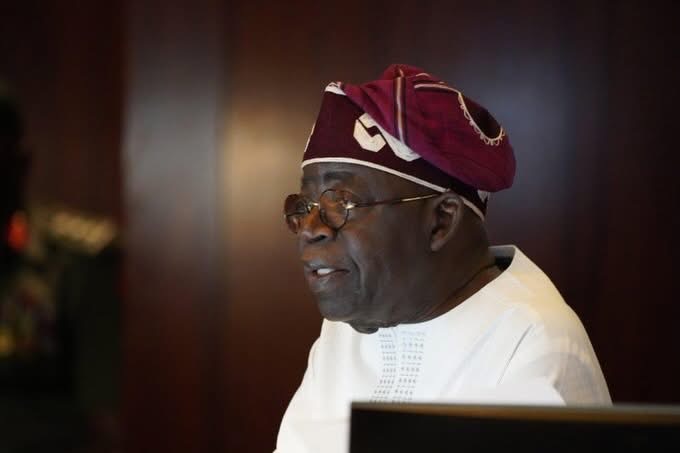
President Bola Tinubu has condemned the reported “barbaric” killing of one of the abducted teachers from the Esiele community in Ogbomoso, Oyo state.
In a statement released issued by his media aide, Bayo Onanuga, on Monday, May 18, President Tinubu said the teacher was k!lled when “rescue operation is underway.”
While conveying his sympathy the government and people of the state, President Tinubu assured that security operatives are “working around the clock” to rescue the victims and arrest the bandits as well as their collaborators within the community.
He further assured that the federal government would collaborate with the state government to rescue the victims.
‘’”I am saddened by the reported killing of one of the teachers kidnapped by the gunmen who invaded the community. I sympathise with Governor Seyi Makinde and commend the steps he has taken on the matter. I sympathise with the families of the kidnapped victims.
The Federal Government is working with the Oyo State government to rescue all the victims. I commend the Inspector-General of Police and the Commissioners of Police in Oyo and Kwara States for their quick intervention and the deployment of a tactical and the Intelligence Response Team (IRT) team to rescue the victims.
The IGP, following my instructions, is personally leading the tech-driven operation. We expect a breakthrough soon. The bandits and all their local collaborators will be fished out and made to face the full wrath of the law.
Cases of kidnapping further make imperative the establishment of state police to man some of our underserved areas. The National Assembly should accelerate the enactment of the law creating state police” the President said

May 14, 2026
The Rule of Law and Accountability Advocacy Centre (RULAAC) expresses deep concern over the decision by the Nigeria Police Force to disband the notorious “Tiger Base” in Owerri, Imo State, only to inaugurate another tactical police unit operating from the same facility, under substantially the same command structure and reportedly with many of the same operatives.
This development raises serious questions about the sincerity of ongoing police reform efforts in Nigeria and reinforces fears that what is being presented as reform may merely be a cosmetic rebranding exercise designed to deflect public criticism without addressing the underlying culture of abuse and impunity.
Tiger Base became widely associated with allegations of torture, enforced disappearances, arbitrary detention, extortion, and extrajudicial killings. Over the years, victims, families, lawyers, journalists, and civil society organizations documented disturbing patterns of abuse linked to the operations of the unit.
Ordinarily, the disbandment of such a notorious tactical outfit should have marked an opportunity for genuine institutional reform. It should have included:
– Independent investigation into allegations of abuse;
– Accountability for officers implicated in violations;
– Justice and reparations for victims;
– Structural reforms and strengthened oversight;
– Human rights-centered retraining and professionalization.
Instead, the establishment of another tactical formation under substantially similar conditions suggests continuity rather than reform.
RULAAC is particularly concerned that retaining personnel or leadership figures associated with serious allegations of abuse sends a dangerous message that misconduct within the policing system carries no real consequences. This undermines public trust, weakens accountability, and emboldens further violations.
The situation also raises broader concerns regarding political interference in policing. Tactical police units must never become instruments for political intimidation, repression, or the advancement of partisan interests. Professional policing requires operational independence, transparency, accountability, and strict adherence to constitutional and legal standards.
The controversy inevitably recalls the aftermath of the #EndSARS protests, when the disbandment of SARS was quickly followed by the creation of SWAT, generating widespread fears that abusive policing structures were merely being renamed rather than fundamentally transformed.
RULAAC reiterates that genuine police reform cannot be achieved through changes in nomenclature alone. Meaningful reform requires accountability, transparency, civilian oversight, institutional culture change, and justice for victims.
Accordingly, RULAAC calls for the following urgent measures:
1. A transparent and independent investigation into allegations against Tiger Base operatives and leadership;
2. Prosecution and disciplinary action against officers implicated in torture, unlawful killings, and other abuses;
3. Justice, compensation, and support for victims and affected families;
4. Strengthened civilian oversight involving the National Human Rights Commission, judicial institutions, and civil society organizations;
5. Clear operational guidelines and publicly accountable rules of engagement for tactical police units;
6. Measures to insulate policing from political interference and abuse.
The people of Imo State and Nigerians generally deserve a policing system founded on professionalism, legality, accountability, and respect for human rights – not the recycling of abusive structures under new labels.
Signed:
Okechukwu Nwanguma
Executive Director
Rule of Law and Accountability Advocacy Centre (RULAAC)

Personnel of the Nigerian military were seen engaging in a fight during the visit of President Bola Ahmed Tinubu to Bayelsa on Friday.
In a video spotted on social media, the driver of a Hilux vehicle marked “Naval Police” was seen stepping down from his vehicle and exchanging words with another driver.
After returning to his vehicle, another driver with a rifle approached him and threw a punch at the Naval Police driver, triggering a brawl.
The incident quickly escalated into a free-for-all, with personnel attached to both vehicles exchanging blows, while stunned civilians watched in disbelief.

Politics15 hours ago
2027: More Than 50 Lawmakers Lose APC Reps Tickets in Major Primary Election

Trending2 days ago
Bandits behind Ogbomoso school abduction will face full wrath of the law- President Tinubu

Politics2 days ago
PDP to screen Goodluck Jonathan on Tuesday as its sole Presidential aspirant For 2027 race

-
Business2 years ago
US court acquits Air Peace boss, slams Mayfield $4000 fine
-

 Trending2 years ago
NYA demands release of ‘abducted’ Imo chairman, preaches good governance
-

 Politics2 years ago
Mexico’s new president causes concern just weeks before the US elections
-

 Politics2 years ago
Putin invites 20 world leaders
-

 Politics2 years ago
Russia bans imports of agro-products from Kazakhstan after refusal to join BRICS
-
Entertainment2 years ago
Bobrisky falls ill in police custody, rushed to hospital
-
Entertainment2 years ago
Bobrisky transferred from Immigration to FCID, spends night behind bars
-
Education2 years ago
GOVERNOR FUBARA APPOINTS COUNCIL MEMBERS FOR KEN SARO-WIWA POLYTECHNIC BORI