
News
Inside Abuja’s ‘business centres’ disguised as schools


In what is fast becoming an eyesore in Abuja, the nation’s seat of power, sub-standard schools built primarily for money-making now dot the landscape of most satellite towns in the FCT. With the education inspectorate doing little or nothing to address the menace, stakeholders fear that the practice may harm a system already struggling with the scourge of multi-layered neglect. DIRISU YAKUBU reports!
education is seen largely as both a service and a right. It is the responsibility of the government across all tiers to dispense education to the citizenry, whose right it is to embrace. Difficult as it is to enumerate its mileage in a single report, it suffices to suggest that the biggest weapon in the armoury of Nigeria’s foremost nationalists and Africa’s freedom fighters was the education they had, which enabled them to dare the colonial imperialists, forcing the latter to relinquish power reluctantly.
So big is the harvest of a good quality education that the Sage, Chief Obafemi Awolowo, the then Premier of the Western Region, made education compulsory and free for children, many of whose parents could not afford fees and other payments required to keep their wards within the four walls of an educational institution.
The near collapse of governance at all levels in subsequent years culminated in the fall of education standards, forcing well-to-do parents to withdraw their children and wards from public schools for enrollment in private institutions.
With improved earnings over the years, many parents took the private schools’ option, given their ability to pay more remuneration to teachers while exposing pupils and students to better-teaching models and other extra-curricular activities.
The patronage of private schools, needless to state here, has seen education morph from a service to business ventures. Across major cities in Nigeria, including Abuja, the seat of power, those who have no expertise in school administration have, with a combination of greed and crass opportunism, set up schools, targeting the children of low-income earners, to earn a living.
In most of the satellite towns in the FCT, schools lack basic infrastructure, and qualified manpower and recreational facilities are a common sight today. With government officials either playing the ostrich or abdicating their duties, enforcement of standards has thus been relegated to the background.
In a tour of some ‘schools’ in Abuja, The PUNCH uncovered a litany of rot, ranging from the engagement of semi-literate teachers to the absence of libraries, laboratories, sports facilities, to name just a few.
Findings revealed that the school proprietors, while charging relatively high fees, pay their teachers peanuts, citing the harsh economic realities of the times.
At Leaders Academy Drive, off Tiga Street, Kurudu, Abuja Municipal Area Council, is a three-bedroom apartment housing a family of four. It is a middle-class residential building, plastered but not painted. On this fateful Tuesday morning, a sharp voice emanating from a store in this building got the attention of this correspondent.
To his surprise, a young lady reading out Nigerian States and their capitals announced to a class of four children an impending examination to test their mastery of what she had taught them thus far.
Surprised that a school was being run in such a location, this reporter took a few steps in the direction of the young teacher, and this conversation ensued.
“Good morning, madam. How are you doing today? You run a school here?,” I asked her.
Good morning, sir. Yes, we are just starting,” she replied. “Our target is the young children who are old enough to be in school now, but due to one reason or another, are not. Things are tough for many families, and we are trying to make sure that we have in place a system that can be of assistance to these young children and their parents.”
Then I went further by asking to know if it was a conventional school she set out to run.
“Interesting! I will be right to say this is not a formal school but an arrangement to get these young minds engaged, preparatory to having them enrolled in a conventional school.”
She replied, “It is a conventional setting, sir. From here, their parents can take them straight to basic four or five and after a year or two, they will proceed to junior secondary school. I have ten pupils here of different ages. They did not start at the same time, and I don’t teach them the same thing.”
When I asked which curriculum they used in teaching the kids, she added, “I teach them the things I believe they should know. I teach them English, Mathematics, Civics Education, Christian Religious Studies and Basic Science. We are not using any curriculum for now.”
On the affordability of her arrangement, she replied, “We have an agreement with the parents. I am also a bit careful because there are basic requirements for setting up a school. The parents love what I do here, and they support me. I don’t want to speak in detail about fees or whatever you call it.”
She refused to state whether she was a trained teacher or not, when this correspondent asked to know. Instead, she stated her love for teaching endeared her to the project.
“I will go back to school. It is my love for teaching that inspired me to start this. I will go back to school soon. Like I said, these children are very young. I am just trying to teach them basic things they should know at this stage of their lives,” she added.The story of this unnamed “school” resonates across many communities in the Federal Capital Territory. Taking advantage of a system with a near-zero disposition to the enforcement of basic standards, individuals with little or no training in education set up ‘schools’ that can best be described as business centers.
Still in the Kurudu District, the story is slightly better at the Lifespring Academy, which runs nursery/primary and secondary schools.
At Lifespring, the school lacks a modest space required for the sporting needs of the students. As it were, students here make use of public fields at the Local Education Authority Primary School for their interhouse sports and other outdoor activities.
A man who simply identified himself as Mr Joshua told our correspondent that though Lifespring is an upgrade on other schools in the vicinity, it suffers from a lack of adequately trained manpower needed for imparting knowledge.
He said, “Everything is turning to business, and we should be worried. Here (Lifespring), one is surprised to see that they have an SSCE and NECO accreditation centre. That is their biggest bargaining chip. They will tell you that their accreditation status indicates the high rating they enjoy in the books of the Federal Capital Territory Administration authorities.
“We must not manage two things: education and health. If health and education facilities are substandard, let us not expect much to reap thereafter. What is happening is that business is winning, but services are neither here nor there.”
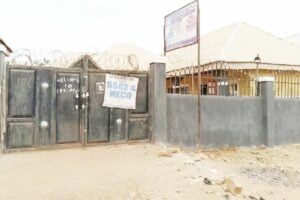
Lifespring Academy, Kurudu, Federal Capital Territory
A trip to the Ivy Academy, Kpeyegi, revealed a similar pattern of poor standards and lack of trained manpower. A pre-nursery, nursery, and primary school, Ivy Academy boasts a handful of skilled teachers and several school certificate holders.
At the Graceland International Academy, Orozo, a magnificent edifice, paints a phoney picture of efficiency on how things ought to be done.
The PUNCH’s findings, however, revealed a litany of shady deals, including the poor payment of teachers, some of whom have complained to no avail.
“While the management of the institution frequently announces an increment in the fees paid by the students, the same does not reflect in the remuneration of teachers who do the bulk of the work,” a young woman who declined to be named told our correspondent.
According to her, “These people see themselves as destiny helpers and in a way, they are right. They make you feel that you are indebted to them for life for allowing you to earn a living. So, you have no power to influence things and a staff member, you also have to be careful because colleagues who are into eye service can betray you,” she added, without providing further explanation.
Perhaps, the worst of these private schools is the Potter’s Legacy Ville Academy, Anka. Located along the Karu/Orozo/Karshi expressway, one can be carried away with the allure of its beautiful name.
Exposed to multiple dangers, including security threats and noise pollution, the unfenced school is certainly where everything happens except conducive learning. Without a gate, the school, as well as its pupils and teachers, are exposed to the threat of abduction, invasion, and all forms of criminal activities.
Needless to state here, the school is an employer of poorly-trained teachers, who are only too glad to be earning a living with the little knowledge they can dispense.
At the City Royal Junior and Secondary Schools, Nyanya, Abuja, the major challenge identified by our correspondent is the lack of a playing field for extra-curricular activities for both teachers and students.









Alaoji Plant Returns To National Grid
The Niger Delta Power Holding Company has restored the 450-megawatt Alaoji Open Cycle Power Plant in Abia State after it remained shut for three years.
The facility had stopped operations due to gas supply problems, debt issues and disagreements over metering.
The shutdown had affected output from the national grid for more than 36 months.
Officials explained that efforts were made to resolve the long-running disputes and stabilise gas supply before restarting operations at the plant.
The restoration is also expected to support businesses and industries relying on stable electricity.
The Alaoji facility is one of the major power plants in the country and plays a role in boosting energy distribution across several regions.
Its return comes as authorities continue pushing for better electricity generation nationwide.
News
𝗛𝗢𝗡. 𝗧𝗢𝗦𝗞𝗔 𝗖𝗢𝗡𝗗𝗘𝗠𝗡𝗦 𝗧𝗛𝗘 𝗞𝗜𝗟𝗟𝗜𝗡𝗚𝗦, 𝗞𝗜𝗗𝗡𝗔𝗣𝗣𝗜𝗡𝗚𝗦 𝗔𝗡𝗗 𝗥𝗔𝗣𝗘𝗦 𝗜𝗡 𝗜𝗛𝗜𝗔𝗚𝗪𝗔, 𝗢𝗕𝗜𝗕𝗜𝗘𝗭𝗘𝗡𝗔, 𝗘𝗭𝗜𝗢𝗕𝗢𝗗𝗢, 𝗘𝗠𝗘𝗔𝗕𝗜𝗔𝗠, 𝗢𝗞𝗢𝗟𝗢𝗖𝗛𝗜, 𝗨𝗠𝗨𝗚𝗨𝗠𝗔, 𝗔𝗩𝗨 𝗔𝗡𝗗 𝗢𝗧𝗛𝗘𝗥 𝗖𝗢𝗠𝗠𝗨𝗡𝗜𝗧𝗜𝗘𝗦: 𝗖𝗔𝗟𝗟𝗦 𝗙𝗢𝗥 𝗜𝗠𝗠𝗘𝗗𝗜𝗔𝗧𝗘 𝗖𝗘𝗦𝗦𝗔𝗧𝗜𝗢𝗡

Hon. Sir Tochukwu Okere(TOSKA), Member Representing Owerri Federal Constituency, has strongly condemned the incessant gruesome killings, kidnappings, rapes and violent attacks carried out by unscrupulous and criminal elements terrorizing communities within Owerri Federal Constituency, especially in Ihiagwa, Obibiezena, Eziobodo, Emeabiam, Okolochi, Umuguma, Avu and other neighbouring communities.
The recent killings of vigilante operatives and innocent constituents at Umuguma and Ihiagwa call for urgent and deterrent response by our security agencies.
In a passionate motion raised before the Federal House of Representatives, Hon. Okere called on the Federal Government of Nigeria and relevant security agencies to immediately deploy adequate security personnel to the affected communities and take decisive actions against the worsening insecurity threatening the lives and properties of his people.
According to him, the continuous attacks on harmless villagers, farmers, women and youths can no longer be tolerated under any guise.
“I urge the Federal Government of Nigeria to urgently look into this motion and act swiftly before more innocent lives are lost. Our people deserve to live and to live in peace without fear of being kidnapped, raped or butchered in their own communities,” Hon. TOSKA stressed.
The lawmaker further emphasized that the people of Owerri Federal Constituency will not fold their arms and watch criminals continue to unleash terror across Ihiagwa, Obibiezena, Eziobodo, Emebiam, Okolochi, Umuguma, Avu and other communities while families continue to mourn their loved ones daily.
This courageous move by Hon. Sir Tochukwu Okere has continued to attract commendations from constituents who describe his intervention as timely, bold and people-oriented.
Hon. Okere is the light and the voice of Owerri Federal Constituency.
May God keep him to keep standing for us and for our interest.
News
TENSIONS RISE IN OGUTA LGA AS CHAIRMAN MOVED AHEAD WITH Town UNION ELECTIONS AGAINST STATE DIRECTIVE

By Nwauwa Ikedi Justice
An emerging standoff between the Oguta Local Government Area executive and the Imo State Government has sparked concerns of unrest in several communities, after the council chairman proceeded with plans to conduct Town Union elections in defiance of a statewide directive from Governor Hope Uzodimma.
Last week, Hon. Ifeanyi Nnani, Executive Chairman of Oguta LGA, initiated steps to organize elections in five autonomous communities, an action seen by observers as a direct challenge to the governor’s order prohibiting local government chairmen from interfering in Town Union affairs.
The controversy stems from earlier complaints by traditional rulers across the state, who alleged that some local government chairmen had been imposing proxies as Town Union executives in their domains.
In response, Governor Uzodimma convened a statewide stakeholders’ meeting on January 17, 2026, at the Eze Imo Palace. Citing the Imo State Town Union Law No. 6 of 2003, as amended, the governor lifted the existing ban on Town Union elections and ruled that the process should be conducted in line with each community’s established customs. He also transferred supervisory responsibility from local government chairmen to the Ministry of Local Government and Chieftaincy Affairs, designating it the appropriate authority for such matters. The directive has since been credited with restoring relative peace across the state.
Despite this, sources indicate that Hon. Nnani’s administration has quietly begun conducting elections in villages within Oguta LGA without consulting the affected Town Unions or seeking clearance from the supervising ministry.
A letter dated last week and personally signed by the chairman to the Commissioner for Local Government and Chieftaincy Affairs has since come to light. Rather than seeking approval, the correspondence served as notification of the council’s intent to proceed with elections in Ndiuloukwu, Mgbala, Uworie, and Mgbele autonomous communities—a move that appears to contradict the state government’s directive.
The emergence of the letter has alarmed traditional rulers, with reports of growing unease in the affected communities. Community leaders have vowed to resist what they describe as an unlawful intrusion into their internal affairs.
Attempts to reach Hon. Nnani for comment have so far been unsuccessful, as calls to his office went unanswered.

ALAOJI PLANT RETURNS TO NATIONAL GRID

Fubara To Contest Rivers Governorship Seat Under NDC

Breaking: Tinubu Appoints 39 Year Old Professor As New Jamb Registrar

-
Business2 years ago
US court acquits Air Peace boss, slams Mayfield $4000 fine
-

 Trending2 years ago
NYA demands release of ‘abducted’ Imo chairman, preaches good governance
-

 Politics2 years ago
Mexico’s new president causes concern just weeks before the US elections
-

 Politics2 years ago
Putin invites 20 world leaders
-

 Politics2 years ago
Russia bans imports of agro-products from Kazakhstan after refusal to join BRICS
-
Entertainment2 years ago
Bobrisky falls ill in police custody, rushed to hospital
-
Entertainment2 years ago
Bobrisky transferred from Immigration to FCID, spends night behind bars
-
Education2 years ago
GOVERNOR FUBARA APPOINTS COUNCIL MEMBERS FOR KEN SARO-WIWA POLYTECHNIC BORI