
Education
Mathematics: New admission policy stirs controversy as Varsity lecturers, students take positions


The Federal Government’s decision to remove Mathematics as a mandatory admission requirement for arts and humanities students has stirred conversations across Nigeria’s academic circles.
For decades, Mathematics and English have been the two immovable pillars of admission into Nigerian universities.
However, the Federal Ministry of Education, in a statement by its spokesperson, Folasade Boriowo, on Tuesday, said senior secondary school students in the arts and humanities will no longer be required to present a credit in mathematics in their Senior School Certificate Examination, SSCE, for tertiary admissions.
While the reform aims to make tertiary education more inclusive, lecturers are divided on whether it strengthens or weakens academic standards.
Removing Mathematics requirement is a mistake – Dr. Ashir T Inuwa
A lecturer in the Department of Mass Communication at Bayero University, Kano, Dr. Ashir Tukur Inuwa, in an exclusive interview with Ekwutosblog on Wednesday faulted the Federal Government’s decision to exclude Mathematics as a compulsory subject for admission into arts and humanities programmes.
He said the policy could worsen students’ poor attitude toward the subject and discourage them from making efforts to learn basic mathematical concepts.
“To be honest, it is not right. Before now, we all knew that art students were quietly admitted even when Mathematics wasn’t emphasized. But for the government to officially announce that Mathematics is no longer required is a problem.”
He explained that the decision could lead to complacency among secondary school students who already struggle with “maths phobia.”
“Once they know they don’t need it for admission, most of them won’t even pay attention in class. The truth is, Mathematics is not as hard as they think; they only find it difficult because of fear.”
Dr. Inuwa added that Mathematics remains an essential life skill that should not be discarded in any field of study.
“Mathematics is very important in our lives whether you are in the sciences or the arts. It shouldn’t be removed from the list of compulsory subjects.”
Students may regret skipping mathematics later in life – Ibrahim Shittu
A lecturer at Ahmadu Bello University (ABU), Zaria, Mr. Ibrahim Shittu, has expressed concern over the Federal Government’s new admission policy, warning that the decision to exclude Mathematics for arts and humanities students could have long-term consequences.
“The funny part is that after graduating, these students are very likely to engage in jobs that require some level of computational competence,” Mr. Shittu said.
“By then, they’ll realise they’ve been cheated by not being allowed to take the subject seriously at some point in their life.”
He added that the reform might also create inconsistencies for courses like Economics, which often attract arts students but still rely heavily on mathematical understanding.
“Courses like Economics that are largely applied for by art students would find it difficult to accommodate this compromise in entry requirements,” he noted.
Mr. Shittu advised students not to see the policy as an easy escape but to think critically about its implications.
“Students should be wise to know that not all government policies that seem to be in their favour are actually beneficial to them,” he said.
“At a time when the global landscape of education is transcending disciplines, we’re underplaying critical subjects that open the mind, boost imagination, and advance problem-solving skills.”
“Prospective freshers need to be guided not to fall for the policy,” Mr. Shittu cautioned.
Removing maths from Arts is like treating headache by cutting off the head – Dr. Lawanti
Dr. Kabiru Danladi Lawanti, a senior lecturer in the Department of Mass Communication at Ahmadu Bello University, Zaria, said the decision quietly erodes something far more precious than numbers; our ability to think.
Recalling his own experience as a student, Lawanti said his earliest encounter with Mathematics was enjoyable because his teacher in Junior Secondary School made the subject engaging and relatable.
“I remember my first encounter with numbers. It was interesting because our Mathematics teacher in JSS Akko made the subject come alive. He was patient, imaginative, and deeply human. He showed us that Mathematics was not just about numbers but about patterns, relationships, and reasoning,” he said.
However, he noted that things changed when he reached senior secondary school.
“By the time we moved to Senior Secondary School, the story changed. With poor teaching and growing fear, Mathematics became a nightmare. We ran from the subject, skipped classes, and hated the teacher by implication, we hated the subject,” he recalled.
Lawanti said this memory resurfaced when he heard about the new policy. While many students may celebrate the reform, he cautioned that it could have dangerous long-term implications.
“Many students will rejoice. But I am worried because this decision quietly erodes something far more precious than numbers — our ability to think.”
He argued that Mathematics goes beyond arithmetic or equations.
“Mathematics is not about finding x or y. It is about how to think. It is the discipline of logic, the grammar of reasoning, and the architecture of problem-solving,” he explained.
“When we remove it from the educational foundation of the arts and humanities, we are not making life easier for students, we are simply making their minds weaker.”
The lecturer stressed that every field from arts to law is rooted in mathematical thinking, whether expressed in numbers or patterns.
“The artist balancing symmetry in a painting, the poet weaving rhythm into verse, the musician composing harmony, the lawyer building logical arguments, the historian discerning patterns- all of them are using Mathematics in thought, if not in symbol,” he said.
“The ability to reason systematically, to detect patterns, to separate emotion from evidence, is Mathematics at work.”
According to Lawanti, Mathematics rightly taught is not a wall but a window that helps students move from intuition to structured reasoning.
“It disciplines creativity without killing it. A well-trained artist who understands proportion, sequence, and logic creates more compelling art. A philosopher who reasons like a mathematician writes clearer arguments. A journalist who thinks sharply writes accurate reports with facts,” he added.
He lamented that Nigeria’s education system has misunderstood this truth for years due to inconsistent and imported policies that fail to consider local realities.
“Our education policies are often shaped by where policymakers studied; some in the UK, others in the US or Asia and they return preaching ‘international best practices’ that ignore our cultural and educational context,” he said.
Lawanti faulted the government’s approach to fixing the problem of poor performance in Mathematics by eliminating it instead of improving how it is taught.
“Now, instead of fixing how we teach Mathematics, we are simply abandoning it. This is like treating a headache by cutting off the head,” he said.
“The problem was never that arts and humanities students don’t need Mathematics; it is that they were never shown why they need it.”
He argued that removing Mathematics from the humanities divides knowledge and weakens intellectual growth.
“It reinforces the false dichotomy between those who think and those who feel. But human progress depends on the marriage of both. The great thinkers of history from Leonardo da Vinci to Chinua Achebe combined precision with imagination, structure with story.”
Lawanti added that mathematical reasoning builds both intellectual and moral virtues; honesty, patience, and humility before evidence which are essential for good governance and civic responsibility.
“A society that cannot reason clearly cannot govern wisely. The corruption, impulsive policymaking, and shallow debate that dominate our public life are symptoms of a deeper deficit, the inability to think in structured, evidence-based ways.”
He concluded that rather than removing Mathematics, Nigeria should reform how it is taught to make it more imaginative and relevant to real life.
“Teach Mathematics not as punishment but as perspective. Teach it as a way to organise thought, to interpret information, and to connect ideas.”
“The removal of Mathematics as a compulsory subject may appear like a relief, but it is, in truth, a retreat from rigour. No nation can grow by producing graduates who can feel deeply but think shallowly. The goal should not be to make Mathematics optional, but to make it meaningful.”
Meanwhile, there is ongoing jubilation among students and young people who believe the subject is not needed in the field of arts and humanity.
Aliu Ibrahim said it’s unnecessary to include Mathematics for admission into arts and humanity courses. According to him, “ How do we apply Maths in our field? Basic counting knowledge is what we need as students of humanity and arts. The rest is waste of time,” he said.










The National Association of Nigerian Students (NANS) has vowed to take urgent action against some persons it said are cooking up and sponsoring falsehood against the Federal University of Technology, Owerri (FUTO) and its leadership.
NANS took the position in a release signed by Comr. Olushola Oladoja, NANS President, and Comr. Nduka Chibueze (Paparazzi), NANS Director of Travel and Exchange, and made available to the media on Saturday.
“The leadership of the National Association of Nigerian Students (NANS) has observed with deep concern the activities of some unscrupulous and mischievous elements who appear to be acting in concert to tarnish the image and credibility of our institution, the Federal University of Technology, Owerri (FUTO), and its leadership through the circulation of false, misleading and malicious information across various online platforms.
“These individuals, whose actions clearly suggest a calculated agenda driven by selfish interests and external influence, have continued to propagate unfounded claims capable of bringing the institution into disrepute and misleading members of the public.
“It is unfortunate that certain persons have chosen to allow themselves to be used as instruments of propaganda and destabilization against an institution that represents the collective pride and aspiration of thousands of students and alumni.
“We wish to state categorically that such coordinated attempts to blackmail, ridicule, or undermine the institution and its leadership will not be tolerated henceforth. The university’s integrity and reputation must not be sacrificed on the altar of personal interest, sponsored misinformation, or politically motivated attacks.
“The leadership of the National Association of Nigerian Students (NANS) remains committed to protecting the image, unity, and values of the Federal University of Technology, Owerri (FUTO), and will continue to resist every desperate attempt aimed at causing disaffection within the institution, using every legitimate mechanism and arsenal within our disposition.
“We have activated the forces of Aluta to identify and expose the charlatans involved. Our aim is to deal with them in a manner that serves the overall interest of our institution. This should act as a deterrent to anyone whose actions are aimed at destroying the institutional reputation we all worked to build. Forewarned is forearmed,” NANS maintained.

An official of the National Youth Service Corps (NYSC) in Ogun State, Abass Olalekan, has been arrested in connection with the de@th of a female corps member.
The corps member, Victoria Ariyo, serving under the Abeokuta South Local Government Area (LGA) of the NYSC, reportedly d!ed last Tuesday after undergoing abortion.
It was gathered that the corps member had terminated her pregnancy and d!ed from complications that followed the procedure.
Her remains were buried at Kobape Cemetery on Kobape-Sagamu Road in Abeokuta.
According to Daily Trust, Ariyo’s d3ath came barely a month after another female corps member, Adeleye Mary, d!ed in what has been described as mysterious circumstance.
Mary, who was serving under the same Abeokuta South LG, was attached to the Ogun State Television (OGTV) as her Place of Primary Assignment (PPA).
A source told the publication that both deceased corps members were friends.
“The first lady d!ed at her residence, which is not far from her PPA. They found her lifeless body in the apartment and, up till now, nobody can tell the cause of her d3ath,” the source said.
However, the second corps member who d!ed on Tuesday was said to have died from complications arising from an abortion procedure.
It was alleged that the NYSC official, who is the Local Government Inspector (LGI) for Abeokuta South, Abass Olalekan was culpable in the process leading to the corps member’s d3ath.
Sources told the publication that the LGI was allegedly involved in a romantic relationship with the deceased, which eventually led to pregnancy, and it was the termination that led to her d3ath.
“That is the fact in issue,” a police source who confirmed the NYSC official’s arrest told Daily Trust on Thursday.
The police source said the development raises questions about the legality of romancing “someone that should be in your care.”
Confirming Olalekan’s arrest, the source said, “He is in our custody at the command’s headquarters, Eleweran, Abeokuta.”
The police source, however, said there is no connection between the current incident and the one that occurred last month.
Spokesperson for the police in the state, DSP Oluseyi Babaseyi, confirmed death of Ariyo and said that the investigation was ongoing.
However, he failed to respond to questions on the arrest of the LGI and the alleged involvement.
“I can confirm that the case of the demise of Victoria Ariyo is under investigation by the State Criminal Investigation Department,” Babaseyi said in a terse statement.
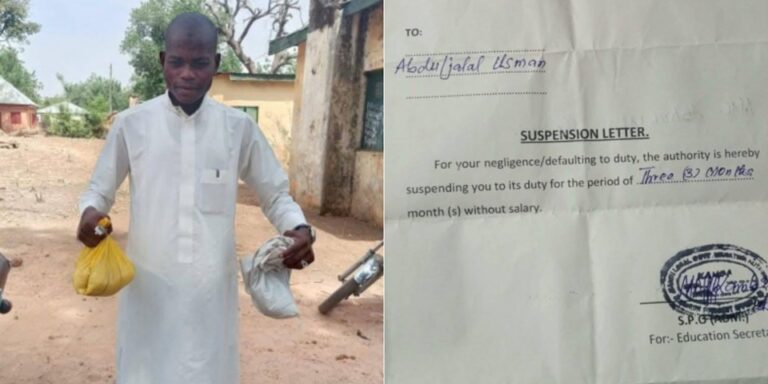
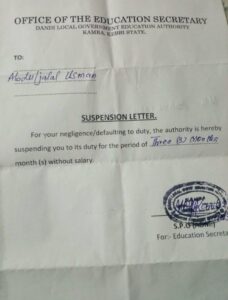
A classroom teacher in Kebbi State, Abduljalal Usman, has reportedly been suspended for three months without salary after rejecting a Ramadan palliative reportedly distributed by the state government.
The teacher allegedly declined the offer of one mudu of maize and one mudu of millet and also criticized what he described as poor governance in the state.
According to claims circulating online, the action was taken under the administration of Nasir Idris, prompting criticism from some commentators who described the suspension as an attempt to silence dissent and punish a public worker for speaking out.
Critics argue that educators deserve better working conditions, fair compensation, and respect, rather than disciplinary action for expressing their views.
@Mallam_jabeer who shared the report, said …
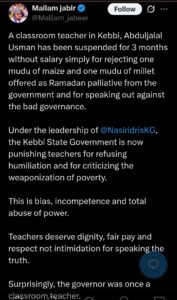
“A classroom teacher in Kebbi, Abduljalal Usman has been suspended for 3 months without salary simply for rejecting one mudu of maize and one mudu of millet offered as Ramadan palliative from the government and for speaking out against the bad governance.
Under the leadership of
@NasiridrisKG
, the Kebbi State Government is now punishing teachers for refusing humiliation and for criticizing the weaponization of poverty.
This is bias, incompetence and total abuse of power.


Bandits behind Ogbomoso school abduction will face full wrath of the law- President Tinubu

PDP to screen Goodluck Jonathan on Tuesday as its sole Presidential aspirant For 2027 race

Oshiomhole wins Edo APC senatorial primaries unopposed

-
Business2 years ago
US court acquits Air Peace boss, slams Mayfield $4000 fine
-

 Trending2 years ago
NYA demands release of ‘abducted’ Imo chairman, preaches good governance
-

 Politics2 years ago
Mexico’s new president causes concern just weeks before the US elections
-

 Politics2 years ago
Putin invites 20 world leaders
-

 Politics2 years ago
Russia bans imports of agro-products from Kazakhstan after refusal to join BRICS
-
Entertainment2 years ago
Bobrisky falls ill in police custody, rushed to hospital
-
Entertainment2 years ago
Bobrisky transferred from Immigration to FCID, spends night behind bars
-
Education2 years ago
GOVERNOR FUBARA APPOINTS COUNCIL MEMBERS FOR KEN SARO-WIWA POLYTECHNIC BORI