
News
At 85, Obi of Onitsha’s Ancient Throne Sparks Fresh Debate Over Government Authority

By Olisemeka Sony
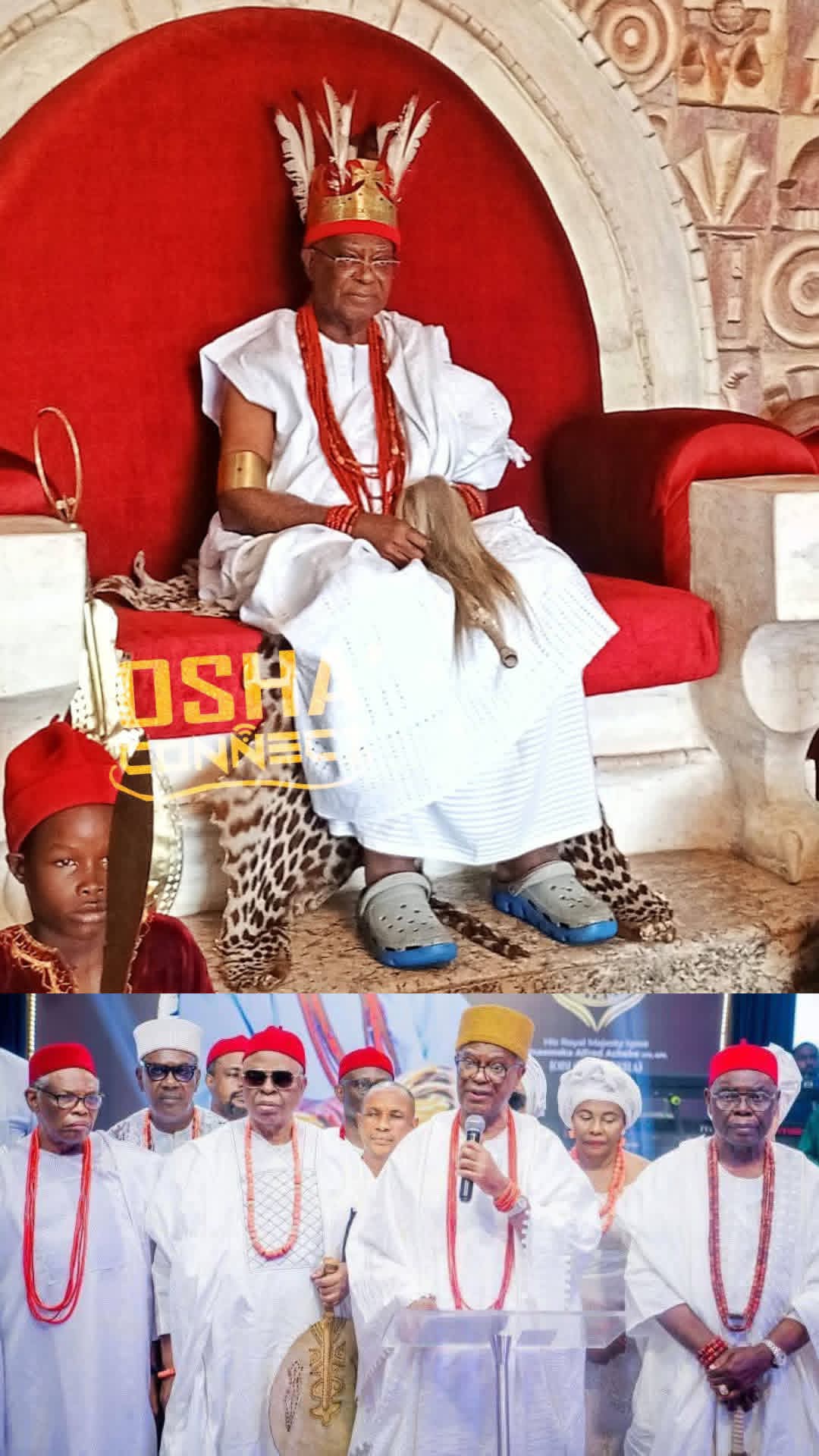
As the Obi of Onitsha, Igwe Alfred Nnaemeka Achebe, celebrated his 85th birthday, a fresh debate has emerged over the constitutional and historical status of the Onitsha monarchy within Nigeria’s traditional institution framework.
The debate followed the publication of an opinion article by legal practitioner, historian, journalist and public affairs commentator, Mr. Ejiofor Umegbogu, who argued that the Obi of Onitsha remains the only traditional ruler in the South-East whose authority does not derive from government recognition.
In the article published as part of activities marking the monarch’s birthday celebration, Umegbogu stated that the Onitsha royal institution predates both colonial administration and the Nigerian state by several centuries.
“The Obi of Onitsha predates the government,” he wrote. “It is the only traditional institution in the South-East that was not established by government authority.”
According to him, the throne belongs to the class of ancient African monarchies comparable to the Ooni of Ife, Alaafin of Oyo, Oba of Benin, Obong of Calabar, Attah of Igala and Shehu of Borno, which he described as institutions that existed independently before colonial rule.
Umegbogu claimed that British representatives who arrived east of the Niger encountered a fully organized monarchy in Onitsha under Obi Akazue and subsequently entered into treaties with the kingdom in 1863 and 1884.
“The British government met an already well-established monarchical system in Onitsha,” he stated, adding that the agreements reflected “mutual cooperation between two organized authorities.”
He further argued that the unique historical relationship between the British Crown and the Onitsha monarchy distinguished the throne from many traditional institutions later absorbed into the colonial indirect rule system.
According to him, this historical background explains why the Obi of Onitsha does not hold a Certificate of Recognition issued by the Anambra State Government.
“The government cannot withdraw what it did not create,” Umegbogu declared. “The Obi of Onitsha is the only traditional ruler in the South-East who cannot be dethroned by a governor.”
The commentator also maintained that many traditional stools in the South-East were formalized under the 1976 chieftaincy reforms introduced during the administration of the former East Central State, while the Onitsha monarchy had existed independently long before then.
He identified the Eze Nri as the only likely exception within Igboland, describing the institution as primarily spiritual rather than political.
“Eze Nri was fundamentally a spiritual leader,” he wrote, noting that the institution historically focused on ritual obligations, oath administration and spiritual mediation.
By contrast, he described the Obi of Onitsha as combining both temporal and spiritual authority.
“It is an obvious fact of history that the Onitsha traditional stool is clothed with both sociopolitical influence as ‘Lord Temporal’ and divine influence as ‘Lord Spiritual,’” he stated.
Umegbogu also questioned the rotational leadership arrangement within the Anambra State Traditional Rulers Council, arguing that the historical stature of the Onitsha monarchy places it above parity with other traditional institutions in the state.
He wrote: “The leadership amongst traditional rulers in Anambra should not be rotational as if they are equals, which they are not.”
The article has since generated renewed discussions among historians, cultural scholars and political observers over the place of ancient traditional institutions within Nigeria’s modern constitutional order.

Court dismisses suit seeking to uphold Kingibe’s suspension, fines plaintiffs and counsel N20m
The Federal High Court in Abuja has struck out a suit filed to validate the indefinite suspension of Senator Ireti Kingibe by the Wuse Ward chapter of the African Democratic Congress (ADC).
Delivering judgment on Friday, Justice Peter Lifu held that disciplinary matters within political parties are internal affairs that do not require judicial intervention.
The judge questioned why party officials who initiated the suspension sought a court order to affirm their own decision, stating that any legal challenge should ordinarily come from the suspended member if dissatisfied with the process.
According to the court, the plaintiffs’ attempt to obtain judicial endorsement for the suspension reflected a lack of confidence in their own action.
Justice Lifu described the suit as “frivolous, baseless and unfounded.”
Relying on Sections 82 and 83 of the Electoral Act, the court awarded N10 million costs against the plaintiffs in favour of Kingibe. An additional N10 million fine was imposed on the plaintiffs’ counsel for filing what the court considered a frivolous suit, with the amount also payable to the senator.
Kingibe, who represents the Federal Capital Territory in the Senate, was reportedly suspended on March 10 by executives of the ADC’s Wuse Ward over allegations of anti-party activities and disregard for the party constitution.
Ward executives claimed the suspension was ratified by a two-thirds majority of the leadership.
The suit, marked FHC/ABJ/CV/539/2026, was filed by Okezuo Kanayo and Isaiah Samuel on behalf of themselves and other ward members, with Kingibe named as the sole defendant.
Through their counsel, Kolawole Olowookere (SAN), the plaintiffs sought an interim injunction restraining the senator from presenting herself as a member of the ADC pending the determination of the substantive motion.
They also asked the court to bar her from attending party meetings, carrying out functions reserved for party members, or interfering in ward administration, including access to official records.
The plaintiffs alleged that Kingibe continued to hold parallel meetings and issue statements as an ADC member despite being notified of her suspension. They further claimed she used security personnel to intimidate ward executives.
Counsel to the senator, Marshall Abubakar, argued that the matter was purely an internal party dispute and therefore not justiciable.
He told the court that the party’s disciplinary procedures were not followed and maintained that Kingibe was neither invited nor formally confronted with any complaint before the suspension.
Abubakar also argued that the plaintiffs lacked the legal standing to institute the action because they had themselves been suspended by the party.
He urged the court to dismiss the case and award punitive costs against the plaintiffs.
In response, counsel to the plaintiffs, I.G. Ogugua, argued that internal party affairs cease to be protected from judicial scrutiny where constitutional procedures are breached.
The court, however, dismissed the suit in its entirety.

He said, “The claim that I was taking drvgs or p;lls is nothing but the work of the d£vil and my political en3mies. What was actually in my mouth was just sweet blue candy.”
Hon. Alhassan Ado Doguwa is a Member of the House of Representatives representing the Tudun Wada/Doguwa Federal Constituency in Kano State under the All Progressives Congress (APC)..
What do you think???

Alaoji Plant Returns To National Grid
The Niger Delta Power Holding Company has restored the 450-megawatt Alaoji Open Cycle Power Plant in Abia State after it remained shut for three years.
The facility had stopped operations due to gas supply problems, debt issues and disagreements over metering.
The shutdown had affected output from the national grid for more than 36 months.
Officials explained that efforts were made to resolve the long-running disputes and stabilise gas supply before restarting operations at the plant.
The restoration is also expected to support businesses and industries relying on stable electricity.
The Alaoji facility is one of the major power plants in the country and plays a role in boosting energy distribution across several regions.
Its return comes as authorities continue pushing for better electricity generation nationwide.

Guardiola Bids Emotional Farewell to Manchester City After Historic Era

Ireti Kingibe wins ADC FCT Senate ticket

After Winning Presidential Primaries, APC Fixes Date To Present Tinubu With Certificate Of Return

-
Business2 years ago
US court acquits Air Peace boss, slams Mayfield $4000 fine
-

 Trending2 years ago
NYA demands release of ‘abducted’ Imo chairman, preaches good governance
-

 Politics2 years ago
Mexico’s new president causes concern just weeks before the US elections
-

 Politics2 years ago
Putin invites 20 world leaders
-

 Politics2 years ago
Russia bans imports of agro-products from Kazakhstan after refusal to join BRICS
-
Entertainment2 years ago
Bobrisky falls ill in police custody, rushed to hospital
-
Entertainment2 years ago
Bobrisky transferred from Immigration to FCID, spends night behind bars
-
Education2 years ago
GOVERNOR FUBARA APPOINTS COUNCIL MEMBERS FOR KEN SARO-WIWA POLYTECHNIC BORI