
Education
BREAKING: ASUU rejects new university governing councils approved by President Tinubu, says most people on the list are “retired politicians” and not technocrats

ASUU’s national president, Prof Emmanuel Osodeke in an interview with Nigerian Tribune, said it is obvious that the composition in the new list is worse than the previous one.
“Go and look at the list again, you will see that most of them are retired politicians. They are honorable this and honorable that. What does that tell us?
“That is how terrible the thing has become. And we can’t run our universities like this if we truly want genuine development to take place,” he said.
He contended that Nigeria cannot manage the universities as it is doing, appointing politicians to governing councils of educational institutions and expecting real development to happen.
ASUU had earlier argued that it was totally illegal for the FG to constitute new councils when the old ones it dissolved over 10 months ago were yet to complete their tenures in line with the University Act upon which they were constituted for the first instance.










An official of the National Youth Service Corps (NYSC) in Ogun State, Abass Olalekan, has been arrested in connection with the de@th of a female corps member.
The corps member, Victoria Ariyo, serving under the Abeokuta South Local Government Area (LGA) of the NYSC, reportedly d!ed last Tuesday after undergoing abortion.
It was gathered that the corps member had terminated her pregnancy and d!ed from complications that followed the procedure.
Her remains were buried at Kobape Cemetery on Kobape-Sagamu Road in Abeokuta.
According to Daily Trust, Ariyo’s d3ath came barely a month after another female corps member, Adeleye Mary, d!ed in what has been described as mysterious circumstance.
Mary, who was serving under the same Abeokuta South LG, was attached to the Ogun State Television (OGTV) as her Place of Primary Assignment (PPA).
A source told the publication that both deceased corps members were friends.
“The first lady d!ed at her residence, which is not far from her PPA. They found her lifeless body in the apartment and, up till now, nobody can tell the cause of her d3ath,” the source said.
However, the second corps member who d!ed on Tuesday was said to have died from complications arising from an abortion procedure.
It was alleged that the NYSC official, who is the Local Government Inspector (LGI) for Abeokuta South, Abass Olalekan was culpable in the process leading to the corps member’s d3ath.
Sources told the publication that the LGI was allegedly involved in a romantic relationship with the deceased, which eventually led to pregnancy, and it was the termination that led to her d3ath.
“That is the fact in issue,” a police source who confirmed the NYSC official’s arrest told Daily Trust on Thursday.
The police source said the development raises questions about the legality of romancing “someone that should be in your care.”
Confirming Olalekan’s arrest, the source said, “He is in our custody at the command’s headquarters, Eleweran, Abeokuta.”
The police source, however, said there is no connection between the current incident and the one that occurred last month.
Spokesperson for the police in the state, DSP Oluseyi Babaseyi, confirmed death of Ariyo and said that the investigation was ongoing.
However, he failed to respond to questions on the arrest of the LGI and the alleged involvement.
“I can confirm that the case of the demise of Victoria Ariyo is under investigation by the State Criminal Investigation Department,” Babaseyi said in a terse statement.
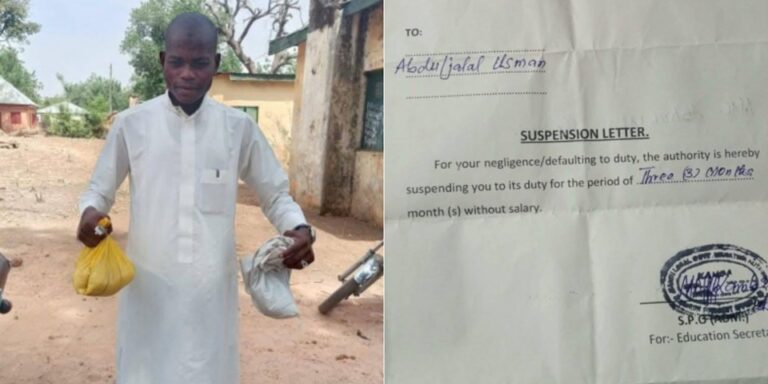
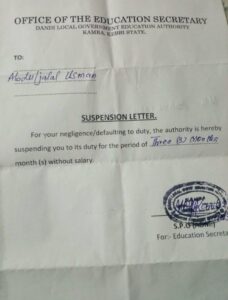
A classroom teacher in Kebbi State, Abduljalal Usman, has reportedly been suspended for three months without salary after rejecting a Ramadan palliative reportedly distributed by the state government.
The teacher allegedly declined the offer of one mudu of maize and one mudu of millet and also criticized what he described as poor governance in the state.
According to claims circulating online, the action was taken under the administration of Nasir Idris, prompting criticism from some commentators who described the suspension as an attempt to silence dissent and punish a public worker for speaking out.
Critics argue that educators deserve better working conditions, fair compensation, and respect, rather than disciplinary action for expressing their views.
@Mallam_jabeer who shared the report, said …
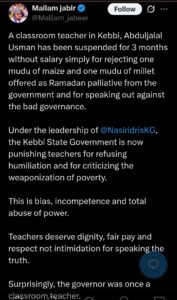
“A classroom teacher in Kebbi, Abduljalal Usman has been suspended for 3 months without salary simply for rejecting one mudu of maize and one mudu of millet offered as Ramadan palliative from the government and for speaking out against the bad governance.
Under the leadership of
@NasiridrisKG
, the Kebbi State Government is now punishing teachers for refusing humiliation and for criticizing the weaponization of poverty.
This is bias, incompetence and total abuse of power.


President Bola Tinubu has approved the appointment of Dr. Makoji Stephen as the new Rector of Federal Polytechnic Ugep in Cross River State.
The approval was granted by the Federal Government, and the appointment will take effect from March 17, 2026.
Dr. Stephen will serve a single term of five years in line with the Polytechnic Act 2019 as amended.
The decision is seen as part of efforts to strengthen leadership and improve the academic and administrative structure of the institution.
Before this new role, Dr. Stephen worked as a Chief Lecturer in the Department of Public Administration at Federal Polytechnic, Idah.
He also served as an Adjunct Faculty member in the Department of Public Policy and Administration at Miva Open University, Nigeria.
Dr. Stephen began his academic journey at Ahmadu Bello University, where he earned a Bachelor of Science degree in Public Administration in 1998 with Second Class Upper Division.
He later obtained a Master of Science degree in Public Administration from Benue State University.
In 2009, he earned another Master of Science degree in Human Resource Management from the University of Salford in the United Kingdom.
He further completed a Ph.D. in Business and Management with a focus on Human Resource Management at the University of Salford Business School in 2016.
His doctoral studies were supported by the Tertiary Education Trust Fund.

Benita Enwonwu in the 1970s: Model, Actress, and Daughter of Ben Enwonwu

Kidnappers Took Loan With My Phone – Victim Recounts Ordeal

11 more arrested over Ozoro “r@ping festival”

-
Business1 year ago
US court acquits Air Peace boss, slams Mayfield $4000 fine
-

 Trending1 year ago
NYA demands release of ‘abducted’ Imo chairman, preaches good governance
-

 Politics1 year ago
Mexico’s new president causes concern just weeks before the US elections
-

 Politics1 year ago
Putin invites 20 world leaders
-

 Politics1 year ago
Russia bans imports of agro-products from Kazakhstan after refusal to join BRICS
-
Entertainment1 year ago
Bobrisky falls ill in police custody, rushed to hospital
-
Entertainment1 year ago
Bobrisky transferred from Immigration to FCID, spends night behind bars
-
Education2 years ago
GOVERNOR FUBARA APPOINTS COUNCIL MEMBERS FOR KEN SARO-WIWA POLYTECHNIC BORI