
Politics
How Rivers Govt can approach S’Court judgement on allocation stoppage – Farah Dagogo

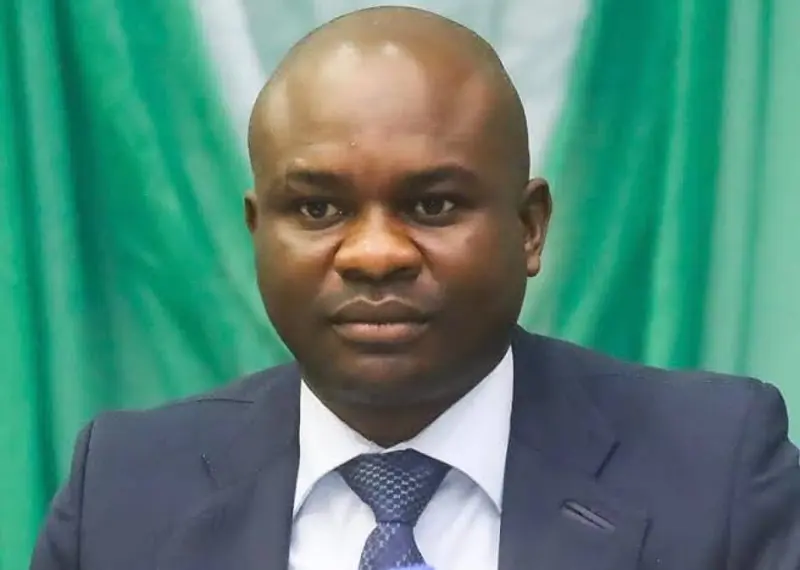
Hon. Farah Dagogo was a former governorship aspirant in the 2023 Rivers State election. He was at different times a member of the National Assembly (House of Representatives) and State House of Assembly.
In this interview with Ekwutosblog, he gives insight into the recent Supreme Court judgement on Rivers State political crises, steps that the Governor and the House of Assembly need to take for lasting peace. He also advised against tenure elongation of Local Government chairmen just as he gave instances on how the judgement on stoppage of allocations can be challenged. Excerpts!
Is the Supreme Court order on seizure of allocations to Rivers State justified?
The principle that a smaller panel of judges cannot overrule a larger panel within the same court is fundamental to maintaining judicial consistency and stability. In the context of the Nigerian Supreme Court, this doctrine ensures that legal precedents are respected unless reconsidered by an equal or larger bench.
In Nigeria, the doctrine of stare decisis mandates that decisions of higher courts bind lower courts, and courts of equal standing should follow established precedents. Specifically, a smaller panel, such as a five-justice bench, should not overrule the decision of a larger panel, like a seven-justice bench. This hierarchy preserves the integrity and predictability of the legal system. For instance, in Sodeinde Bros. Ltd v. ACB Ltd, the Supreme Court emphasized that a five-person panel cannot overrule or depart from the decision of a panel of equal or larger number.
The recent events in Rivers State have brought this principle into sharp focus.
The crisis began when 27 members of the Rivers State House of Assembly allegedly defected from the Peoples Democratic Party (PDP) to the All Progressives Congress (APC). Under Nigerian law, specifically the 1999 Constitution (as amended) lawmakers are expected to vacate their seats upon defection unless their original party is factionalized. However, the Supreme Court found no evidence supporting the claim that these lawmakers had defected, thereby rejecting the assertion that they had lost their seats.
You recall that a five-justice panel of the Supreme Court ruled that there was no evidence of defection by the 27 lawmakers, effectively restoring their positions in the House. This decision raises concerns about adherence to judicial hierarchy, as it appears to conflict with the established precedent that a smaller panel cannot overrule a larger one. The ruling also ordered the Central Bank of Nigeria to withhold federal allocations to Rivers State until the budget was passed by the reinstated lawmakers, a move that has been criticized as punitive towards the state’s populace.
This brings to bear analysis of Judicial Authority and Case Law. The Supreme Court’s decision to have a five-justice panel address an issue previously settled by a seven-justice panel contradicts the established judicial practice of panel hierarchy and overruling precedents. Such actions can undermine the consistency and reliability of legal precedents. As noted in legal analyses, the present panel size weakens the institutional voice of the Supreme Court and is potentially harmful to its integrity.
The 1999 Constitution (as amended) stipulates that lawmakers who defect from their political parties without justifiable reasons, such as a division within the party, must vacate their seats. In this case, the Supreme Court found no evidence of defection, thereby allowing the lawmakers to retain their positions. This interpretation aligns with the constitutional mandate but raises questions about the court’s consistency in applying these provisions. I am giving all these backgrounds so you have an idea of how the law works or operates.
To your question on withholding of Federal Allocations to the state, the Supreme Court’s directive to withhold federal allocations to Rivers State introduces a complex constitutional issue. While the court aims to enforce legislative compliance, such financial sanctions could be seen as overreach, potentially violating the principles of federalism and the financial autonomy of state governments.
To surmise it, the Supreme Court’s handling of the Rivers State legislative crisis highlights critical issues concerning judicial hierarchy, adherence to constitutional provisions, and the balance of powers within Nigeria’s federal structure. Departing from established precedents without convening an appropriate panel size undermines the judiciary’s credibility and the doctrine of stare decisis. Moreover, punitive measures affecting state finances may set a concerning precedent for federal-state relations. It is imperative for the judiciary to uphold its foundational principles to maintain public trust and ensure the rule of law.











March 20, 2026
The All Progressives Grand Alliance in Abia State has called on the Senate to declare the seat of the Senator representing Abia South, Enyinnaya Abaribe, vacant following his resignation from the party.
The party made the call on Thursday during a press briefing in Umuahia, where its leadership, led by a former member of the Abia State House of Assembly, Obinna Ichita, insisted that Abaribe voluntarily resigned from APGA and was not sacked, contrary to his claim at the Senate.
Ichita argued that Abaribe’s exit from the party that sponsored his election violates constitutional provisions, stressing that there was no leadership crisis within APGA to justify his defection.
“The senator resigned in his ward. He did so voluntarily, which is his right. However, if you leave the party that gave you the platform for another party when there is no leadership crisis, that seat must be declared vacant,” he said.
He further alleged that Abaribe misrepresented the circumstances of his exit by claiming he was sacked.
“The party has documentary evidence to show that Senator Abaribe was not sacked. He resigned three months after disciplinary measures were taken against him over actions the court did not consider appropriate,” Ichita added.
According to him, the mandate belongs to the people and the party, not the individual office holder.
“They gave him the mandate on the platform of APGA, not any other party. There was nothing like ADC when he was elected. He cannot take the mandate elsewhere without consulting the people who gave it to him,” he said.
Ichita maintained that the constitution is clear on defection, noting that any lawmaker who leaves a party without a valid internal crisis must vacate the seat.
“My message to Senator Abaribe is to honourably vacate the seat instead of waiting for the National Assembly to declare it vacant. That would amount to national embarrassment,” he added.
Also speaking, the APGA State Chairman, Sunday Onukwubiri, and the party’s Public Relations Officer, Chukwuemeka Nwokoro, reiterated that Abaribe had distanced himself from the party’s activities at various levels in the state.
They insisted that he neither holds dual membership nor was he expelled, maintaining that his resignation was voluntary.
“He was invited by the party but failed to appear and was subsequently suspended in line with the party’s constitution. Three months later, he resigned,” the officials said.
Reacting, Abaribe defended his position, insisting that he acted within his constitutional rights.
“When you are no longer a member of a party by virtue of being sent away, you have the fundamental right of association to join another party,” he said.
He argued that his indefinite suspension by APGA effectively amounted to expulsion.
“If a party places you on indefinite suspension for more than six months, what does that mean? It means you have been told to go elsewhere, and that is exactly what I did,” he stated.
The senator added that the proper constitutional procedure for removing him from office would be through a recall process by his constituents.
“If the people who elected me no longer want me, the right thing to do is to initiate a recall. That is the position of the law,” he said.
Politics
Tinubu’s Reforms May Be Challenging, but They’ve Boosted Nigeria’s Global Respect — Information Minister Mohammed Idris
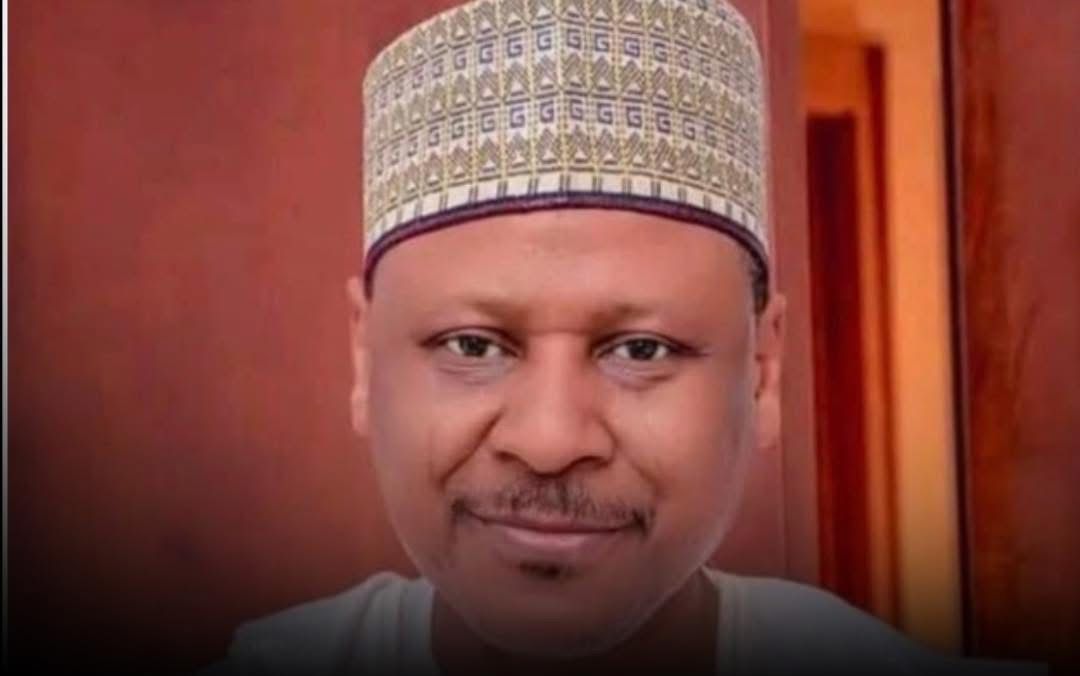
The Minister of Information and National Orientation, Mohammed Idris, has stated that Nigeria is receiving greater respect internationally under the leadership of President Bola Tinubu.
Speaking on Friday after attending Jumaat prayers at Yahaya Road Mosque in Kaduna, Mr Idris said, “Nigeria is indeed taking its rightful place. The country is respected more than ever before on the international scene. The reforms that the president has instituted, as challenging as they are, are meant for the benefit of all Nigerians.”
He urged Nigerians to stay calm as the government continues its efforts to restore security across the nation. Referring to the recent multiple b%mb att@cks in Maiduguri, Borno State, the minister assured that such incidents would not be allowed to recur.
“Indeed, our country is facing challenges, and the government is working tirelessly to ensure security throughout Nigeria. We have seen what has happened, particularly in Borno State. We pray to Allah to make this the last one, as the government is committed to preventing any repetition of such incidents,” he said.
Mr Idris also stressed the importance of citizens being prayerful and working together to address the country’s challenges. He encouraged both Muslims and non-Muslims to unite in the interest of Nigeria’s growth and development.
“This is a time for reflection for all Nigerians. We pray that everyone will consider this moment and recognize the need for unity, progress, and national development. All hands must be on deck for the unity of the country. As we earn respect internationally, we also hope and pray that unity will strengthen within our nation,” he added.
By Dan Opara
Following the successful conduct of the Imo State APC Congress held in Owerri, Imo State, on March 3rd, 2026, the leadership of the party has officially released the list of victorious candidates who emerged from the exercise.
The announcement, made on Friday, March 20th, 2026, came 17 days after the Congress, as gathered by ThePressman Newspaper.
According to the released list, Chief Austin Onyedebelu emerged as the Imo State APC Chairman, while Arc. Allen Enwerem was elected as the State Deputy Chairman. Hon. Onyekachi Ibezim secured the position of State Secretary, alongside 33 other members who now constitute the State Party Executive Committee, including Ex-Officio members in Imo State.
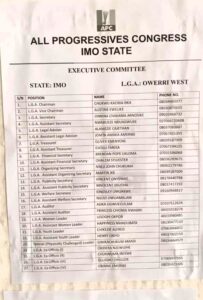
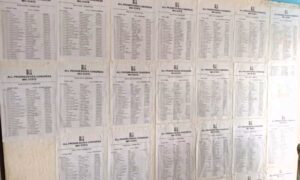
In addition, the leadership of the ruling APC across the 27 Local Government Areas of Imo State has also been announced.
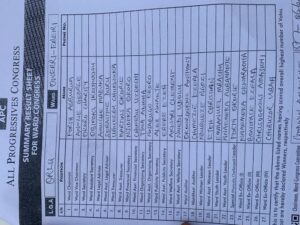
The Ward Party Executive Committee Members for the 305 wards are, however, yet to be fully confirmed.
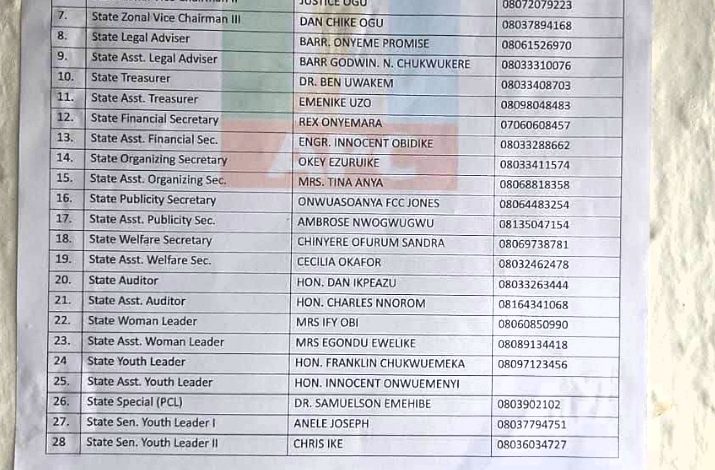
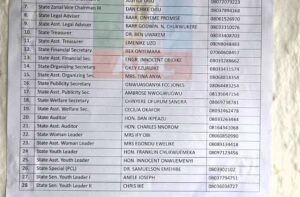
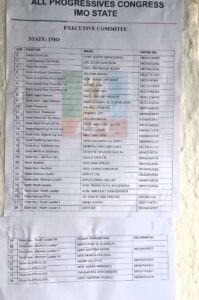
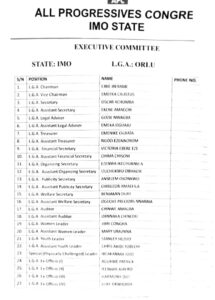
Below is the comprehensive list of the All Progressives Congress State Executive Committee Members for Imo State, including their respective telephone numbers.
ALL PROGRESSIVES CONGRESS
STATE: IMO STATE EXECUTIVE COMMITTEE
State Chairman, Chief Austin Onyedebelu, 08033101685.
State Deputy Chairman, Arc. Allen Enwerem, 08036301966.
State Secretary, Hon. Onyekachi Ibezim, 08033416291.
State Assistant Secretary, Nzenwa Nwoju, 08037717167.
State Zonal Vice Chairman I, Hon. Frank Onyejiaka, 0803314564.
State Zonal Vice Chairman II, Justice Ogu, 08072079223.
State Zonal Vice Chairman III, Dan Chike Ogu, 08037894168.
State Legal Adviser, Barr. Onyeme Promise, 08061526970.
State Assistant Legal Adviser, Barr. Godwin N. Chukwukere, 08033310076.
State Treasurer, Dr. Ben Uwakem, 08033408703.
State Assistant Treasurer, Emenike Uzo, 08098048483.
State Financial Secretary, Rex Onyemara, 07060608457.
State Assistant Financial Secretary, Engr. Innocent Obidike, 08033288662
State Organizing Secretary, Okey Ezuruike, 08033411574.
State Assistant Organizing Secretary, Mrs. Tina Anya, 08068818358.
State Publicity Secretary, Onwuasoanya FCC Jones, 08064483254.
State Assistant Publicity Secretary, Ambrose Nwogwugwu, 08135047154.
State Welfare Secretary, Chinyere Ofurum Sandra, 08069738781.
State Assistant Welfare Secretary, Cecilia Okafor, 08032462478.
State Auditor, Hon. Dan Ikpeazu, 08033263444.
State Assistant Auditor, Hon. Charles Nnorom, 08164341068.
State Woman Leader, Mrs. Ify Obi, 08060850990.
State Assistant Woman Leader, Mrs. Egondu Ewelike, 08089134418.
State Youth Leader, Hon. Franklin Chukwuemeka, 08097123456.
State Assistant Youth Leader, Hon. Innocent Onwuemenyi.
State Special (PCL), Dr. Samuelson Emehibe, 0803902102.
State Senatorial Youth Leader I, Anele Joseph, 08037794751.
State Senatorial Youth Leader II, Chris Ike, 08036034727.
State Senatorial Youth Leader III, Ifeanyi Nwannenna, 08020988164.
State Senatorial Women Leader I, Mrs. Iheako O. Elizabeth.
State Senatorial Women Leader II, Lady Martina Okere, 08036689003.
State Senatorial Women Leader III, Mrs. Franca Onuoha.
State Ex Officio I, Henry Oguguo, 08035001354.
State Ex Officio II, Hon. Alban Amasiatu, 08060564561.
State Ex Officio III, Chukwuma Onyedindere, 08037756307.
State Ex Officio IV, Chief Monday Ikokwu, 08086803626.
Meanwhile, the leadership structure of the All Progressives Congress (APC) in Imo State has been duly constituted, with officials elected across the State, Local Government Area, and Ward levels, reflecting a comprehensive and well-organized party framework.
At the Local Government Area level, notable individuals have emerged as party chairmen in various LGAs.
In Owerri West LGA, Mr. Chikadibia Okpe, was elected as the APC Local Government Chairman.
Similarly, in Orlu LGA, Mr. Ejike Iberame, emerged as the duly elected Party Chairman, while in Oguta LGA, Mr. Obed Onyebuchi, was elected as the APC Chairman, alongside 24 LGA Party Chairmen, to further strengthening the party’s grassroots leadership.
These developments extend across other Local Government Areas and wards, where Party Chairmen and Ward Chairmen have also been elected to provide leadership and coordination at their respective levels.
The successful emergence of party executives at the State, LGA, and Ward levels underscores the APC’s commitment to internal democracy, effective organization, and sustained grassroots mobilization across Imo State.
The release of the list marks a significant step in consolidating the party’s structure across the state, as the newly elected executives are expected to steer the affairs of the APC in Imo State moving forward.

Benita Enwonwu in the 1970s: Model, Actress, and Daughter of Ben Enwonwu

Kidnappers Took Loan With My Phone – Victim Recounts Ordeal

11 more arrested over Ozoro “r@ping festival”

-
Business1 year ago
US court acquits Air Peace boss, slams Mayfield $4000 fine
-

 Trending1 year ago
NYA demands release of ‘abducted’ Imo chairman, preaches good governance
-

 Politics1 year ago
Mexico’s new president causes concern just weeks before the US elections
-

 Politics1 year ago
Putin invites 20 world leaders
-

 Politics1 year ago
Russia bans imports of agro-products from Kazakhstan after refusal to join BRICS
-
Entertainment1 year ago
Bobrisky falls ill in police custody, rushed to hospital
-
Entertainment1 year ago
Bobrisky transferred from Immigration to FCID, spends night behind bars
-
Education2 years ago
GOVERNOR FUBARA APPOINTS COUNCIL MEMBERS FOR KEN SARO-WIWA POLYTECHNIC BORI