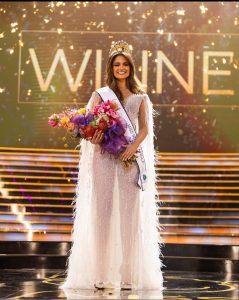
The Miss South Africa event at the weekend was an exercise in hypocrisy — by the politicians who bullied a young woman; the Home Affairs Ministry, which stoked the fires of prejudice; and the organisers of the pageant, who surely enjoyed the publicity that this ugly controversy elicited. At the centre is how we define ourselves as South Africans and our country as part of Africa.
Last week, the Patriotic Alliance, led by the minister of sport, arts and culture, Gayton McKenzie, publicly claimed that 23-year-old Chidimma Adetshina did not qualify for the finals of the Miss South Africa beauty pageant.
This was because both of her parents were not born in South Africa. Later, the home affairs minister, the DA’s Leon Schreiber, issued a statement confirming that his department was investigating whether Adetshina’s mother had committed fraud in 2001.
To his credit, he said that Adetshina had played no part in any wrongdoing — she was an infant in 2001.
The PA then approached a court, arguing that Adetshina should not compete in the competition, and she withdrew from it.
It is hard to escape the sense that the PA and its leaders, McKenzie and Kenny Kunene, are guilty of plain bullying here. They would have known, and not cared, that this would cause Adetshina pain even as she has played no part in our public life or committed any wrongdoing in connection with her legal citizenship.
If it turns out that she was not legally granted South African citizenship she would not be the first — former DA MP Phumzile van Damme found out through a very difficult and public process that she had been born in Eswatini, while official documents had proclaimed that she was born in Mbombela.
Other politicians have found themselves in a similar position. In Australia, 15 MPs were found to be occupying their office illegally after it emerged that they held dual citizenship.
Targets of xenophobia
Our current political situation is such that issues around identity and nationality are likely to be contested in many ways for some time.
Only about 3% of the people living in South Africa are from other countries.
However, the fact they are visible and may have higher levels of economic activity than many South Africans has made them targets of xenophobia.
Perhaps the first public figure to use xenophobia for political gain was Herman Mashaba while he was DA mayor of Joburg.
He was followed by the PA, the ATM and several other parties.
Even the DA once claimed it would make the issue of immigration a major part of its election manifesto, but then stepped back from doing so. It was their home affairs minister who made a public statement.
While Schreiber may have felt he had no choice in going public with the decision to investigate Adetshina’s citizenship, this could well blow up in his face.
It could be that Adetshina’s mother lied when she was registered. Or that she, in good faith, asked someone else to register her child (perhaps through an agent or agency) who then lied to her.
As the immigration lawyer Stefanie de Saude-Darbandi wrote this weekend, there have been many cases when officials have given citizenship applicants the wrong advice. She pointed out that it would be impossible for any foreign national to break the law without the connivance of a South African Home Affairs official.
It may be impossible to prove what happened. Schreiber might well be asked why he decided to make a public statement if it turns out there was no wrongdoing. Without his statement, Adetshina could argue that she may have won the contest.
Nationality and the law
This gets to the heart of very difficult questions about nationality and the law.
The Department of Home Affairs — and its counterparts around the world — is at the centre of so many controversies because it is the department where human behaviour, such as sexual identity, falling in love, having children and moving around the world in a non-binary way, has to be defined in a binary way under the law.
But to judge, or in any way change the way you treat a person because of where they were born is the height of absurdity and prejudice.
Our grandchildren might one day find it as difficult to understand why people were treated so differently based on where they were born, as do many young children to understand racism today.
This is also a useful reminder of the southern African experience of nationality.
Since long before the colonial era, people have moved around southern Africa. The discovery of diamonds in what is now Kimberley and then the gold rush in what is now Gauteng led to a huge movement of people into what is now South Africa.
The upshot was that some people who were born in other countries played an immense role in our history and some people born here played major roles in the history of other countries.
For example, the ANC leader and Nobel Peace Prize winner Albert Luthuli was born in Zimbabwe; the founder of the National Union of Mineworkers, James Motlatsi, was from Lesotho; and the late Zimbabwean president Robert Mugabe’s wife Grace Mugabe was born in Benoni, as was the Oscar-winning actress Charlize Theron. Springbok prop Tendai Mtawarira, known to the rugby world as “The Beast”, was born in Zimbabwe.
It seems strange to suggest to voters that people from other countries must be treated differently, while our government has publicly celebrated the success of the Ndlovu Youth Choir in a television competition called America’s Got Talent.
Jean Ping, who had a Chinese father, was the chair of the African Union Commission.
In the UK, the fact that a former prime minister, the current mayor of London, and the immediate past leader of the Scottish National Party were all of Asian descent has been rightly celebrated as proof that ethnic identity should not be a factor in anyone’s life.
Such are the vagaries of the legalities of citizenship that at least six pairs of brothers have played football for the national teams of different countries.
Miss SA organizers
Unfortunately, politicians are not the only hypocrites in the Miss South Africa debacle.
The Miss South Africa organisers was one of the groups who first approached the Department of Home Affairs asking for clarity about Adetshina’s citizenship.
While they might say this was out of concern or because they were determined to ensure no law was broken, they should have known that the controversy would bring much more attention to their event.
The fact that the event was held over the Women’s Day long weekend suggests an attempt to link beauty with the value of a woman.
Such a claim defies rationality, but this is an organisation with a long history of hypocrisy.
In 2021, it proclaimed that its acceptance of a contestant who identified as transgender was proof it was inclusive.
However, just a year before, its rules stated: “The applicant shall not ever have been married, nor had a marriage annulled… Miss South Africa titleholders are also required to remain unmarried throughout their reign… It is accepted that while an applicant may be in a committed relationship or engaged, they must adhere to the rule of not getting married … during the year of reign.”
They were also not allowed to become pregnant or to be the legal guardian of a child.
Irrational
There is no rational reason for these requirements — if the objective is to assess “beauty”, what possible influence could a contestant’s marital status have? And why would it be such a mortal sin to become pregnant?
This is in complete defiance of the reality of our society, where many young women find themselves the de facto parents of young children through no choice of their own.
Without the incredible efforts of these young women, hundreds of thousands, perhaps millions, of young children would be left uncared for.
While the Miss South Africa competition may claim to be inclusive, over the years it has appeared to ensure that the winner has not been married, a parent, pregnant, short or skinny.
It has no bearing on our country or the lived existence of almost everybody in SA.
The furore over Adetshina has been closely watched in Nigeria, where politicians have been rightly concerned about xenophobia against their people in South Africa.
One of the responses was from the Miss Universe Nigeria competition inviting Adetshina to be a part of their contest.
While the rules of participation in that pageant are not clear on its website, it seems unlikely that contestants who have already qualified will welcome this. This appears to be an attempt to benefit from the controversy.
Even the Puebla International Literature Festival in Mexico said it had rescinded South Africa’s status as the Country in Focus as a result of this furore.
It says this is a statement against injustice.
Its organisers had conferred this status on our nation despite our unjust inequality and the appearance that it supports Russia’s invasion of Ukraine.
Somehow, the organisers of the event decided that this furore over a young beauty contestant was more unjust than anything else our government had done before.
Beauty pageants are magnets for hypocrisy. For people who watch them, they are an exercise in confirming their own biases, an opportunity to claim that their “standards of beauty” are correct.
Like xenophobia, this debacle holds nothing of value for anyone.