
News
I found secret tunnels below Egypt’s Giza pyramids… and they may lead to a forgotten underworld


On the northeastern edge of the Giza Plateau, I discovered three perfectly cut shafts hidden beneath the sands.
They sit in the triangle between the Great Sphinx, Khufu’s Pyramid and Khafre’s Pyramid, and may open into a long-forgotten underground world.
These are not water wells. They bear no inscriptions, no signs of casual digging, and their geometry is too precise, their walls too smooth, their design too deliberate.
Could these shafts be the keys to the network of hidden chambers the Greek philosopher Herodotus once whispered about, possibly connected to the Nile?
Herodotus described a massive ‘labyrinth’ in Egyptwith 3,000 chambers, many hidden below ground, which included and a large underground pyramid.
Explorers in the 1800s, like Giovanni Caviglia and Henry Salt, recorded strange wells near the Sphinx and Khafre’s causeway.
French archaeologist Pierre-Jean Mariette mapped additional anomalies in 1864 and 1885, and scholars like George Reisner, Hermann Junker, and Selim Hassan traced a line of cavities between the Sphinx and Khafre’s Pyramid between 1929 and 1939.
After that, the area was largely forgotten. Fragments of those old reports hinted at a larger pattern, one pointing to a vast, interconnected world beneath the plateau.
Now, the three shafts I rediscovered may unlock that hidden map.
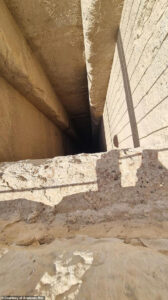
The first shaft, northeast of the Sphinx, has a square limestone mouth and plunges 130 feet—the height of a 12-story building. Its walls are precisely squared and lined with limestone and sandstone blocks, resembling the structure of some ancient machine

Egyptologist Armando Mei and his team with the Khafre Project have been studying Egypt’s Giza Plateau for years, using advanced technologies to uncover hidden structures below the surface
I came across the shafts while conducting fieldwork with the Khafre Research Project, where I serve as a researcher.
Our team, including Professor Corrado Malanga and engineer Filippo Biondi, used Synthetic Aperture Radar (SAR) satellite technology to investigate subsurface structures beneath Giza.
Guided by these spectral traces, we located the shafts, still standing, perfectly cut and utterly enigmatic.
The first shaft lies northeast of the Sphinx. Its square mouth, framed by limestone blocks, plunges 130 feet, about the height of a 12-story building.
Its walls are squared with astonishing precision, lined with limestone and sandstone blocks that resemble the walls of some ancient machine.
At a depth of 40 feet, an 80-foot-wide cavity encircles the shaft, too intentional to be natural erosion.
Satellite imaging suggested it continues even deeper beneath the rubble.
Just feet away, the second shaft mirrors the first. Located beside Khafre’s processional causeway, a covered ramp linking the Valley Temple to the area near his pyramid, it features the same smooth precision and perimeter channel.
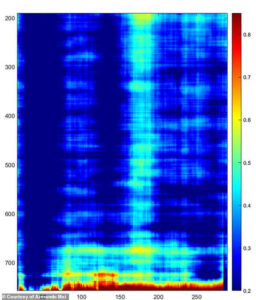
Scans of the first shaft (pictured) revealed a long passage way leading to what appeared to be other structures deep below the surface
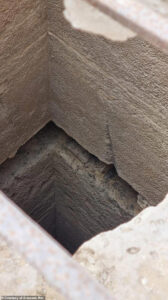
Forty feet down, an 80-foot-wide cavity encircles the first shaft, clearly too deliberate to be natural. Satellite imaging indicates it extends even deeper beneath the rubble

Just feet away, the second shaft mirrors the first. Beside Khafre’s processional causeway, a covered ramp connecting the Valley Temple to his pyramid, it shows the same smooth precision and perimeter channel.
Two shafts built to identical specifications suggest a deliberate system rather than randomness.
The third shaft, on the eastern side of Khufu’s Pyramid, is the most intriguing. Its entrance was once reinforced with retaining blocks, hinting at frequent access.
A recess cut into the west wall appears designed to lift or guide objects from below. The surrounding cavity again appears, perfectly measured.
Less than 165 feet separate the three, forming a pattern too deliberate to ignore. When mapped, their alignment mirrors the three great pyramids themselves, with a resemblance to Orion’s Belt that is uncanny.
Two smaller, rougher shafts nearby seem to be later additions. They lack the depth and polish of the originals, suggesting imitation rather than original intent.
Even so, they hint at the underground’s complexity, reminding us that Giza is far from fully explored.
The purpose of these shafts remains uncertain. Were they for ritual offerings, hydraulic systems, or vertical transport chambers?
Modern imaging, including Ground-Penetrating Radar, Electrical Resistivity Tomography and our own SAR technology, reveals further anomalies near the Sphinx, hinting at interconnected cavities beneath the plateau.

Might these shafts unlock the hidden network of chambers that Herodotus once spoke of, perhaps even linked to the Nile? The Greek historian described a vast ‘labyrinth’ in Egypt, containing some 3,000 underground chambers, including a massive subterranean pyramid
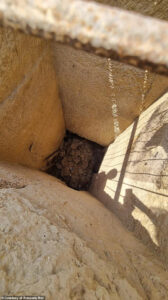
The third shaft, on the eastern side of Khufu’s Pyramid, is the most compelling. Its entrance was reinforced with retaining blocks, suggesting frequent use, while a recess in the west wall seems built to lift or guide objects from below
If confirmed, these shafts could be entry points to a vast, engineered network aligned with the pyramids themselves.
Beneath the plateau, trenches and sockets carved in the limestone, along with deep rock-cut shafts and wells, show that the builders engineered the underground with the same care as the monuments above.
This hidden dimension has fueled speculation about subterranean chambers and hydraulic systems, possibly connected to the Nile, and suggests a purpose far beyond what conventional archaeology has recognized.
The precision and alignment of these shafts, coupled with their mirrored pattern of the pyramids, hint at a cosmic and terrestrial plan interwoven above and below ground.
For decades, the true extent of Giza’s underground world has been overlooked, but these shafts may finally reveal a lost chapter of ancient engineering and ceremonial practice.
What lies at the bottom of these shafts remains a mystery. Yet every measurement, every radar image, points to a singular conclusion: the Giza Plateau still holds secrets that could reshape our understanding of ancient Egypt.
The shafts are more than anomalies; they are doorways into a subterranean world waiting to be explored.

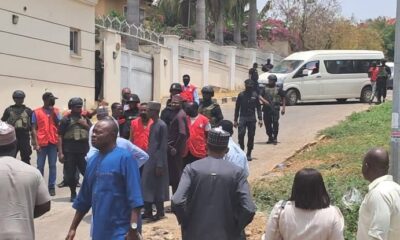






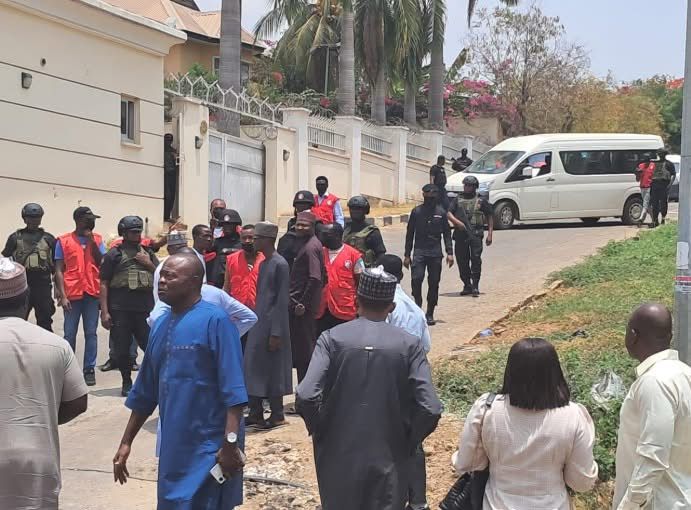
Former Attorney-General Abubakar Malami says Economic and Financial Crimes Commission operatives forcefully evicted him and his family from their Abuja residence despite ongoing court proceedings over the property’s forfeiture.
He described the action as unlawful and vowed to challenge it in court.

The governor of Oyo state, Seyi Makinde, has approved a N10,000 transportation allowance as a palliative for the state workforce to cushion the effects of the increase in the pump price of Premium Motor Spirit, otherwise known as petrol.
The Chairman of the Nigeria Labour Congress (NLC), Oyo State chapter, Kayode Martins, in a statement released on Monday, March 23, disclosed that the governor has granted the request of the union on the issue of transportation allowance.
The statement read
“Following the intervention and formal request made by the State Council of the Nigeria Labour Congress (NLC) earlier this morning, the state government has approved a N10,000 transportation allowance for all workers in the state.
The newly approved allowance is set to take effect from April 2026, providing much-needed relief to workers grappling with rising transportation costs amid current economic challenges.
This development comes as a direct response to sustained advocacy by the state NLC, aimed at cushioning the impact of increased living expenses on the workforce.
Further details on implementation are expected to be communicated by the relevant government authorities in due course.”
News
Former Acting Accountant-General of the Federation bags 72years imprisonment for diverting N868.46 million security funds
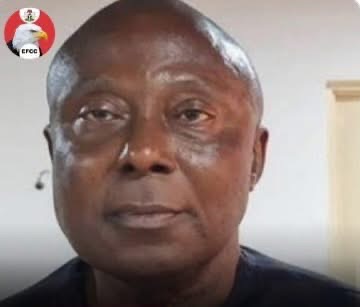
Justice James Omotosho of the Federal High Court in Abuja, on Monday, March 23, convicted and sentenced Chukwunyere Nwabuoku, former acting Accountant-General of the Federation (AGoF), to a 72-year jail term without an option of fine.
DailyTrust reports that in the judgment delivered, Justice Omotosho held that the Economic and Financial Crimes Commission (EFCC) had been able to prove the nine-count money laundering charge beyond reasonable doubt.
According to the judge, the defendant is hereby convicted as charged.
Justice Omotosho convicted Nwabuoku in all the nine counts and sentenced him to eight years imprisonment in each of the counts, making 72 years.
The judge, however, ordered that the counts shall run concurrently.
Justice Omotosho, who described Nwabuoku’s act of diverting funds meant for security and defence while he served as Director of Finance and Account in the Ministry of Defence as “appalling,” commended the EFCC for being detailed in its prosecution.
The judge observed that the evidence of the 9th prosecution witness that Nwabuoku voluntarily refunded part of the siphoned money of over N200 million during investigation was not controverted by the defence.
Nwabuoku served as the Director of Finance and Accounts in the Ministry of Defence between 2019 and 2021. He became acting Accountant General of the Federation in May 2022.

IMO STATE LABOUR PARTY DESCENDS INTO FACTIONAL WAR

EFCC evicts Malami from Abuja home amid forfeiture dispute

Fuel price hike: Gov Makinde announces N10,000 transport support for workers

-
Business1 year ago
US court acquits Air Peace boss, slams Mayfield $4000 fine
-

 Trending1 year ago
NYA demands release of ‘abducted’ Imo chairman, preaches good governance
-

 Politics1 year ago
Mexico’s new president causes concern just weeks before the US elections
-

 Politics1 year ago
Putin invites 20 world leaders
-

 Politics1 year ago
Russia bans imports of agro-products from Kazakhstan after refusal to join BRICS
-
Entertainment1 year ago
Bobrisky falls ill in police custody, rushed to hospital
-
Entertainment1 year ago
Bobrisky transferred from Immigration to FCID, spends night behind bars
-
Education2 years ago
GOVERNOR FUBARA APPOINTS COUNCIL MEMBERS FOR KEN SARO-WIWA POLYTECHNIC BORI