
Watch the video below..
News
Legacy of Empire: How British Military Traditions Shaped the Nigerian Army

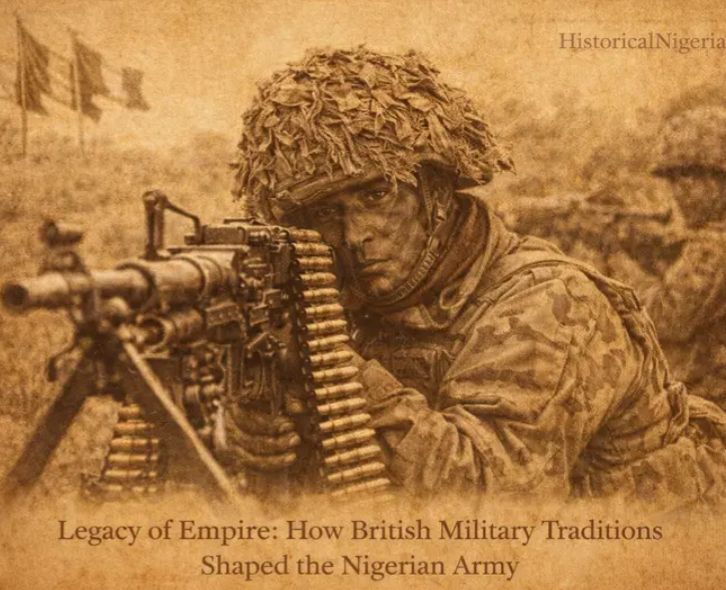
From Colonial Forces to Modern Soldiers: The Lasting Influence of British Military Structures in Nigeria
The Nigerian Army owes much of its foundation and organisational culture to British colonial military traditions. Formed to enforce imperial authority, protect trade interests, and maintain internal order, these colonial forces established the structures, training norms, and leadership patterns that continue to influence Nigerian soldiers. Understanding this history provides insight into the institutional foundations, recruitment practices, and professional culture of the Nigerian Army.
Colonial Beginnings: The Glover Hausas and Lagos Constabulary
The origins of the Nigerian Army can be traced to 1863, when Lieutenant John Hawley Glover of the Royal Navy raised a small group of Hausa recruits in Lagos. Known as the Glover Hausas, they were tasked with protecting British trade routes and assisting in expeditions against communities resisting colonial authority. This force evolved into the Hausa Constabulary and later the Lagos Constabulary, functioning as both a military and policing body. These early formations laid the groundwork for a structured military force in Nigeria and introduced principles of discipline, hierarchy, and organisation that would persist for decades.
The Formation of the West African Frontier Force and Nigeria Regiment
In 1901, the British established the West African Frontier Force, consolidating various local and regional units under central command. In Nigeria, this created the Northern and Southern Nigeria Regiments, which merged by 1914 to form the Nigeria Regiment. The regiment participated in imperial campaigns, including operations in German West Africa during the First World War, while simultaneously maintaining internal security and supporting colonial administration. This dual role helped instil operational flexibility and loyalty to command structures among Nigerian soldiers, characteristics that remain part of the army’s professional ethos.
Recruitment Practices and Regional Composition
Colonial recruitment policies were influenced by regional considerations, leading to a higher representation of northern communities in the Nigerian Regiment. Soldiers from different regions were trained under British command, fostering a culture of discipline, hierarchy, and obedience. This early recruitment system established patterns that influenced the composition and internal dynamics of the army even after independence.
Training, Leadership, and Officer Development
Initially, British officers held the majority of senior positions, while African soldiers served as enlisted personnel or non-commissioned officers. Training followed British military standards, including drill, discipline, leadership, and tactical instruction. By the late 1940s, Nigerian soldiers began receiving commissions, marking the transition toward indigenous leadership. Officers trained in Nigerian institutions and British military academies established professional norms that guided the Nigerian Army after independence, ensuring continuity and organizational cohesion.
Colonial Operations and Internal Security Roles
Under colonial rule, the Nigerian Regiment and other units of the West African Frontier Force were engaged in internal security operations and imperial campaigns. They suppressed uprisings such as the Bussa Rebellion of 1915, ensured compliance with colonial taxation, and maintained order across various protectorate regions. This dual function as both a policing and military force reinforced operational discipline and responsiveness to command, traits that persisted in the independent army.
Transition to Independence and Nigerianisation
During the 1950s, as Nigeria approached independence, the process of Nigerianisation gradually replaced British officers with Nigerian commanders. This culminated in the formation of the independent Nigerian Army in 1960. Despite the change in leadership, the army retained British-derived organisational structures, rank systems, and training methodologies. These foundations allowed the Nigerian Army to develop a professional identity while maintaining continuity with its historical roots.
Enduring Legacy of British Military Traditions
British colonial military traditions continue to shape the Nigerian Army in multiple ways. Rank hierarchies and command systems reflect British influence, while drill, discipline, and professional standards follow historical norms. Early Nigerian officers trained under British systems set the tone for subsequent generations, and the army’s dual role in national security and internal stability traces back to colonial practices. This legacy highlights the long-lasting impact of British military structures on Nigeria’s armed forces.
Conclusion: Understanding the Institutional Heritage
The development of the Nigerian Army from colonial forces into a modern military institution demonstrates the importance of historical continuity in shaping organisational culture. Early recruitment patterns, officer training, operational roles, and structural organisation all reflect British military influence. Tracing this history provides insight into the army’s professional identity, discipline, and operational effectiveness, showing how institutional legacies continue to shape Nigeria’s soldiers today.
Author’s Note
This article demonstrates how British colonial military traditions formed the foundation of the Nigerian Army, influencing recruitment, training, operational roles, and officer development from the 19th century to independence. Readers are shown how historical continuity shaped the army’s professional culture, organisational structure, and operational ethos, providing insight into the forces that guide Nigerian soldiers in modern times. The legacy of colonial structures explains both the strengths and institutional characteristics of the Nigerian Army, and understanding this history is essential for appreciating its contemporary role.
References
Nigerian Army – Ministry of Defence. Official history of the Nigerian Army’s origin and structure. Historical documentation on the Nigeria Regiment and West African Frontier Force. E.C. Ejiogu, Colonial Army Recruitment Patterns and Post-Colonial Military Coups d’État in Africa: The Case of Nigeria. Officer commissioning history and early Nigerian officers. Bussa Rebellion historical records and WAFF operations.
Continue Reading

The police in Delta state have arrested eleven more suspects over the sexu@l ass@ults recorded during what was described as a “r@ping festival” in Oramudu Quarters in Ozoro last Thursday, March 19.
In a statement released on Saturday, March 21, the spokesperson of the command, SP Bright Edafe, said the CP Special Assignment Team (CP-SAT) was tasked with conducting a detailed investigation into the incident.
Edafe said operatives of CP-SAT conducted a thorough analysis of available video evidence and intelligence, leading to the arrest of eleven additional suspects identified as Samson Atukpodo, Steven ovie, Ugbevo Samson, Afoke Akporobaro, Evidence Oguname, and six others. Edafe mentioned that these latest arrests bring the total number of suspects currently in police custody in connection with the incident to fifteen (15)
“The Command reiterates that preliminary findings indicate that the unfortunate incident was perpetrated by criminal elements who exploited the situation to engage in acts of sexu@l v!olence, which are in no way representative of any legitimate cultural practice.
The Commissioner of Police, Delta State Command, CP Aina Adesola, condemns these acts in totality and reassures the public that the Command remains resolute in its determination to ensure that all those involved are identified, arrested, and prosecuted in accordance with the law. Members of the public, particularly victims and witnesses, are once again encouraged to come forward with credible information that will aid ongoing investigations. The Command assures that all information provided will be treated with strict confidentiality.”the statement in part reads
News
So Sad: Father Dies While Rescuing Daughter From Midnight Fire, Both Perish in Minna Tragedy (Photos)

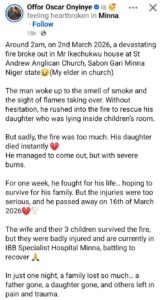
A father’s ultimate act of love has ended in heartbreak after a devastating midnight fire claimed both his life and that of his six-year-old daughter in Minna, Niger State, leaving a family shattered and a community in mourning.
The tragedy struck at approximately 2am on March 2, 2026, when fire broke out at the residence of Ikechukwu Michael Njoku, 45, situated within the premises of St. Andrew Anglican Church in the Sabon Gari area of Minna.
According to accounts shared on Facebook by family acquaintance Offor Oscar Onyinye, Njoku was jolted awake by the smell of smoke and the sight of flames rapidly engulfing his home. Without pause for his own safety, he plunged into the inferno to rescue his young daughter, Esther, who was trapped inside the children’s room. Though he managed to pull himself out of the blaze, little Esther did not survive — she died instantly.
Njoku himself emerged from the fire with severe burns across his body. For nearly two weeks, he clung to life, battling his injuries at the IBB Specialist Hospital in Minna. His struggle ended on March 16, 2026, when he succumbed to his wounds — fourteen days after he had thrown himself into the flames for his child.
His wife and three other children survived the inferno but sustained serious injuries and remain hospitalised at IBB Specialist Hospital, where they continue to fight for recovery.
Father and daughter are to be laid to rest on March 27, 2026, in their ancestral hometown of Mebiokpa Okposi Ohozara in Ebonyi State.
“In just one night, a family lost so much — a father gone, a daughter gone, and others left in pain and trauma,” Onyinye wrote in a tribute that has since resonated widely across social media, with many describing Njoku as a hero whose love for his child knew no bounds.

News
I Thought It Was A Joke — Nigerian Man Recounts What He Witnessed During “R@ping Festival” In Delta (Video)

A video making rounds on social media has triggered widespread reactions after capturing a disturbing incident reportedly occurring in Ozoro, Delta State.
According to multiple posts online, there are claims that several women have been ass@ulted in the area during what some users are describing as a local gathering.
There are also warnings being shared online advising women and girls in the area to stay indoors, with concerns that those outside may be at risk. Some posts further allege that individuals who are unaware of the situation, including visitors and students, may have been affected.
Ozoro is home to Delta State University, and many online users have expressed concern about the safety of students and residents.
The situation has triggered widespread outrage, with many calling for urgent attention, proper investigation, and protection for those in the community.
Delta state police command, SP Bright Edafe, said the police has begun arresting some of the defaulting men.

Columns24 hours ago
Benita Enwonwu in the 1970s: Model, Actress, and Daughter of Ben Enwonwu

Trending1 day ago
Kidnappers Took Loan With My Phone – Victim Recounts Ordeal

News1 day ago
11 more arrested over Ozoro “r@ping festival”

-
Business1 year ago
US court acquits Air Peace boss, slams Mayfield $4000 fine
-

 Trending1 year ago
NYA demands release of ‘abducted’ Imo chairman, preaches good governance
-

 Politics1 year ago
Mexico’s new president causes concern just weeks before the US elections
-

 Politics1 year ago
Putin invites 20 world leaders
-

 Politics1 year ago
Russia bans imports of agro-products from Kazakhstan after refusal to join BRICS
-
Entertainment1 year ago
Bobrisky falls ill in police custody, rushed to hospital
-
Entertainment1 year ago
Bobrisky transferred from Immigration to FCID, spends night behind bars
-
Education2 years ago
GOVERNOR FUBARA APPOINTS COUNCIL MEMBERS FOR KEN SARO-WIWA POLYTECHNIC BORI