
Politics
Nigeria Guild of Editors Conf’: Hope Uzodimma Tackles Editors on Electoral Integrity

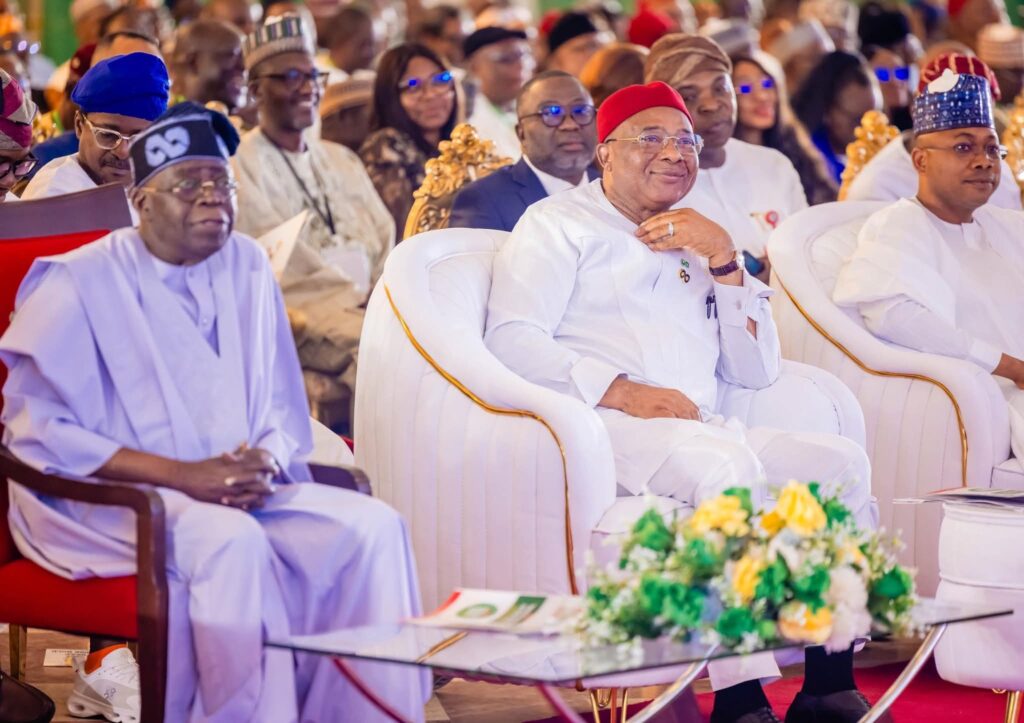
I am deeply honoured to be here to address this gathering of gatekeepers; the men and women who decide what becomes news, what gets amplified, and what fades into silence. For me, this meeting offers an opportunity for a great reunion with highly esteemed editors whom I now call friends. Given my frequent interface with you, even before the election of the current executive, I suspect that you may soon consider making me a fellow of the guild.
I must say that I appreciate the privilege to deliver this keynote address. After reading your letter nominating me as the keynote speaker, I was at a loss as to why the conference should at once have a theme, ‘Democratic Governance and National Cohesion: The Role of Editors,’ and a sub-theme: ‘Electoral Integrity and Trust Deficit: What Nigerians Expect in 2027.’ But on closer scrutiny of the theme and sub-theme, I came to the informed suspicion that, as the wordsmiths that you are, you were cleverly playing with words to downplay your public accountability to electoral integrity and trust deficit.
Obviously, you accept to be held accountable for ‘democratic governance and national cohesion’; hence, you added the rider, “the role of editors,” which is a clear indication of your willingness to accept public scrutiny. But you cleverly avoided that rider in the sub-theme, “electoral integrity and trust deficit, what Nigerians expect in 2027”. That was very smart. But I have news for you. I will not let you escape accountability for electoral integrity, trust deficit, and what Nigerians expect in 2027.
Here is why. If you have a role to play in “Democratic Governance and National Cohesion,’ then you also have a role to play in ‘Electoral Integrity and Trust Deficit.’ Without electoral integrity, there can be no democracy. Electoral integrity begets democracy, and democracy begets good governance, and good governance fast-tracks the exorcism of trust deficit. In all of these, your role as facilitator, amplifier, or catalyst is key. Your reports and comments paint a picture of tomorrow. Therefore, the picture you paint of 2027 is what Nigerians should expect.
So I hold it to be true that as editors, you should be held accountable for both the theme and the sub-theme. And since you asked me to speak on the theme and the sub-theme, I have used the privilege you conferred on me as the keynote speaker to come up with a hybrid lecture topic: So, for my keynote, the topic is “2027: Editors as Catalyst of Democracy, National Cohesion and Electoral Integrity.” I do not doubt that you will agree with me that, in the context of this conference, there can be no better description of your role as editors. As I proceed with my speech, you will find more reasons to agree with my position. To start with, let me say that editors are very powerful influencers of society because you wield the most powerful weapon on earth: the Pen!
The weighty words of the celebrated English author Edward Bulwer-Lytton in his 1839 play Cardinal Richelieu, to wit, “the pen is mightier than the sword,” say it all. It was a metonymic statement. The significance is that the pen can change and shape society faster and more permanently than the sword. The pen represents intellect, written ideas, and diplomacy, while the sword represents physical violence and military might. And that powerful instrument, the pen, is your symbol of trade and work tool. As a matter of fact, it is proudly displayed on your logo.
I know that, as editors, you will be quick to remind me that, as powerful as your pen may be, you are professionally restrained from giving impartial and objective reports of events and that you are not participants in the events. That is one side of the coin. The other side is contained in the providential words of Stephen Ward, a leading scholar of journalism ethics, who reminds us that “journalism objectivity is both an epistemic and an ethical principle.” Epistemologically, it is part of the pursuit of knowledge. Ethically, it is a moral requirement. But objectivity is not simply neutrality. It is not the mechanical transcription of events as if such transcription were even possible. Every editorial choice, what story leads, which voice gets prominence, which narrative dominates, is interpretative.
Objectivity, properly understood, carries a solemn responsibility. It must be calibrated by overriding considerations of national cohesion and editorial integrity. When your editorial framing treats every electoral challenge as evidence of systemic fraud rather than contextualising it within an imperfect but improving process, you are not being objective; you are making a choice. And that choice has consequences.
So, as I speak today about editorial responsibility, I am not asking you to abandon objectivity. I am asking you to practice it at its highest level: accuracy over speed, verification over virality, and context over clickbait. Does that amount to restriction? No. On the contrary, it is a call to rigour.
THE POWER EDITORS WIELD
What editors actually do is akin to a pastoral duty. You decide what becomes urgent and what disappears. You choose the lens through which millions of Nigerians see their country, their leaders, and each other.
That is how the media is structured. A policy shift is either “Government U-Turn” or “Strategic Adaptation.” A land border closure is either “Economic Protectionism Impoverishing the People” or “National Security Imperative.” Same facts, different frames. Entirely different public perception.
The 2023 elections demonstrated this better than any example I can conjure. Editorial choices shaped how Nigerians experienced that election; not just what they knew, but also how they felt about its legitimacy. Some newsrooms framed every electoral challenge as evidence of systemic fraud. Others emphasised resilience and reform. Both could cite facts. But the editorial architecture determined whether readers saw a flawed but improving process or a collapsing democracy.
When we look at the performance of the media in the 2023 elections, we find that it was actually below expectations. While some were truly professional in their reportage, some took it upon themselves to even undermine the integrity of the electoral body. Under the guise of calling the election results based on returns from a few polling units, the credibility of the election was undermined. The people were lured by such reports to believe that the election was not free, fair, and credible. Unlike other professionals, editors can not claim to be merely executing mandates. They are actively responsible for how the citizens rate the electoral process.
A civil servant implements policy. A police officer enforces the law. But you actively choose the lens. In doing so, you shape public opinion, public trust, and ultimately, public behaviour. That is the power you wield. The question is whether you are wielding it with the weight it deserves.
THE TRUST DEFICIT AND WHO BEARS RESPONSIBILITY
There is a trust deficit in Nigeria’s information ecosystem, and it is corrosive. The 2023 Edelman Trust Barometer is revealing enough.
Look at the numbers: 51% of Nigerians trust the media. That sounds neutral, perhaps even acceptable, until you realise what it actually means: it means that nearly half of Nigerians, 49%, actively distrust the media. Not “have concerns about” or “are sceptical of.” Distrust! As in, they do not believe what the media reports.
And here is what should trouble you even more: According to the Barometer, Nigerians’ trust in NGOs is at 71%. Their trust in businesses is at 66%. Their trust in the media is at 51%, and their trust in the government is at 35%.
Think about what that hierarchy reveals. Nigerians trust non-governmental organisations; many of them are foreign-funded and operate with minimal democratic accountability; more than they trust the Fourth Estate. They trust corporations seeking profit more than they trust journalists seeking truth. This is an institutional crisis.
And it gets worse. When asked directly, 56% of Nigerians say the government is “a source of false or misleading information.” Only 28% say it is trustworthy. The 2023 Edelman Trust Barometer goes further. It identifies the primary drivers of societal polarisation in Nigeria, and two variables stand out: distrust in government and distrust in the media. That amounts to distrust in the very institutions meant to inform and govern.
This creates a vicious cycle. When government credibility collapses, media coverage of the government becomes suspect. When the media frames every electoral challenge as evidence of systemic fraud rather than contextualising it within an imperfect but improving process, it reinforces the very distrust that fragments society. When you (editors and gatekeepers) choose narratives that amplify division because division drives sales, you feed the polarisation and make your own work harder.
Post-2023, trust fractured because the narratives around the election became tribal, fragmented, and in some cases, inflammatory. Coverage didn’t stop at reporting division; it amplified it. Headlines displayed polarisation and deepened it.
I do understand the constraints you operate under. Many proprietors have political alignments. Advertisers have interests. Engagement metrics reward sensationalism: division drives clicks, outrage drives sales. These are real pressures, and I don’t dismiss them. But constraints are not excuses. Every profession operates under pressure. Doctors face resource shortages. Judges face political influence. Governors face fiscal limits. But we don’t say, “Because the constraints are real, the failures are justified.” Professionalism is tested within constraints, not in their absence.
The bitter truth is that while INEC, security agencies, and political parties have been relentlessly scrutinised for their roles in electoral integrity, editors have largely escaped that examination. You have critiqued everyone else’s responsibility for public trust, but you have not interrogated your own.
Electoral integrity does not begin and end with ballot security or INEC transparency. It includes public confidence in the process. Public confidence lives or dies in the narratives you control. If your coverage leads citizens to believe elections are fundamentally rigged, turnout drops, legitimacy erodes, and democracy weakens, regardless of what actually happened at polling units. So you see the editorial choices you make contribute to the trust deficit you report on?
NOW SPEAKING TO THE ROLE OF EDITORS IN SHAPING PUBLIC OPINION TOWARD 2027
We are about seventeen months from the next presidential election. What you do between now and then will determine not only what Nigerians know about 2027 but how they experience it. You will have to choose whether to frame candidates as threats or alternatives. You will choose whether to emphasise differences that divide or principles that unite. You choose whether editorial silence on certain stories suggests they don’t matter or whether relentless focus on some issues could pose existential threats.
These days, a leadership tussle within a political party gets reported as a sign that our democracy is failing. Why does this happen? Because when your coverage consistently treats political disagreement as existential conflict, when every policy debate becomes a “battle,” every electoral or party contest a “crisis,” every compromise a “betrayal”,; you train citizens to see democracy as perpetually contested rather than a shared process of decision-making. Check out some of these prototype headlines: CRISIS ROCKS PARTY “A”. PARTY “B” IS DEAD. POVERTY INDEX: NIGERIA IS THE WORST COUNTRY IN THE WORLD. Etc. These types of sensational headlines, which are commonplace in our media space, fast-track the downfall of a country.
I know the commercial trap. Sensationalism drives engagement. “Candidate X Accused of Fraud” gets more attention than “Candidate X Releases Policy blueprint.” Division sells. Outrage travels faster than nuance. But editors are not mere traffickers in outrage. You have codes of practice. You have standards. The question is whether those standards are being applied to electoral coverage with the rigour you apply elsewhere.
National interest must be your editorial north star. And national interest, in an election year, means coverage that informs without inflaming, that holds power accountable without treating every contest as a catastrophe, that allows citizens to make choices without making them believe that the process is irredeemably broken.
ELECTORAL INTEGRITY BEGINS WITH EDITORIAL INTEGRITY
So, there is a need to understand what electoral integrity means in every sense. It can not be only about ballots, security, and logistics. It must include the integrity of the information Nigerians consume about those processes.
If your newsrooms allow misinformation, rumour, and tribalism to masquerade as journalism, electoral integrity is already compromised even before a single vote is cast. If unverified claims about rigging circulate unchecked on your pages or platforms, you have undermined the process, regardless of INEC’s competence.
This is where I challenge what I see as an abdication. Editors often treat electoral integrity as someone else’s responsibility –INEC, Executive, Security agencies, and Civil society. But it is yours too! That is why I am happy with the lecture topic. Arguably, you have more power to shape it than most other actors because you shape the information environment in which citizens form opinions and reach judgments.
Answer these questions in your heart, and you will get closer to the truth: Do you, as a professional, do your honest best to protect electoral integrity through the discharge of your duties based on national interest? Have commercial, political, or proprietary considerations sometimes informed your editorial choices? In 2027, will your editorial practice contribute to a credible election, or will it contribute to the perception of a flawed one?
NATIONAL COHESION: THE EDITOR’S UNFINISHED BUSINESS
In all fairness, Nigerian editors have accomplished much that deserves recognition. Your newsrooms have produced investigative journalists who exposed corruption. You have published reports that held power accountable. Through your coverage, you have amplified marginalised voices. These contributions matter, and they are essential to democracy. But what is often missing is journalism that actively builds cohesion, not just reports on its absence.
There is a difference between neutrally documenting division and actively choosing narratives that remind Nigerians of shared values, shared stakes, and a shared future. You report on ethnic tension, regional disparities, and religious conflict; as you should. But how often do your editorial choices highlight what binds us rather than what divides us?
When you choose to run “Northern Leaders Reject Southern Candidate” as your banner instead of “Consensus Forms Around Economic Agenda,” for instance, you have made a choice about what matters. That choice shapes whether readers and listeners see politics as a tribal contest or a democratic process.
The reality heading into 2027 is that elections are won and lost not only on policies or candidates but on whether voters believe the outcome will be legitimate. That belief is shaped by whether they have been hearing fragmented, tribal narratives or cohesive, nation-building ones. And that is an editorial choice you make daily.
Let me give you a concrete example of what editorial integrity in the service of national cohesion looks like. Most recent reports indicate that Nigeria’s $2.35 billion Eurobond was oversubscribed by $10.65 billion. That is 453 per cent oversubscription. The Nigerian Stock Exchange recorded N2.7 trillion in transactions in the first four months of 2025, which is a 43 per cent increase year-on-year. Foreign portfolio investment surged 162 per cent. The Sovereign Investment Authority now holds assets worth N4.42 trillion. Our GDP grew by 4.23% – the highest in a decade.
These are real market outcomes. Investors do not oversubscribe bonds out of sentiment; they do so because they expect returns, and returns require stability and policy coherence. President Bola Ahmed Tinubu’s economic reforms are clearly generating the confidence that is producing these investment-fostering results.
So when you amplify the reality and the facts, that President Tinubu’s reform policies are yielding fruits and that a robust economic future is manifesting, you are using facts for nation-building and inspiring narratives ahead of 2027. You are building confidence in the future. You are making Nigerians look towards 2027 with optimism and patriotism.
None of this requires abandoning your watchdog function. You can hold the government accountable and avoid framing every accountability story as evidence of irredeemable dysfunction. You can report electoral irregularities and avoid suggesting that the entire system is corrupt. You can cover political competition and remind citizens that competitors will govern the same country afterwards. The question is, ahead of 2027, will you be passive chroniclers of division or active catalysts of the cohesion that democracy requires to function?
IN CLOSING
Your Excellency, distinguished editors, ladies, and gentlemen, let me say this as part of my closing remarks. The administration of President Bola Ahmed Tinubu understands what is at stake. His presence at this conference is a huge statement of priority. When a sitting president dedicates time to a gathering of editors and communication professionals, it signals that the battle against disinformation and the project of national cohesion are treated as matters of national importance.
Besides, the President has backed that commitment with structure. The establishment of multiple strategic communication channels, from the National Orientation Agency to the weekly Ministerial Briefing Series, reflects a systematic effort to ensure that the government does not cede the information space to speculation and rumour. They are transparency mechanisms designed to ensure that policy decisions are explained, defended, and open to scrutiny.
You are not spectators in 2027. You are active participants. You are catalysts and facilitators, whether you acknowledge it or not. The narratives you shape between now and the election will determine whether Nigerians approach 2027 with hope or cynicism, with trust or suspicion, with a sense of shared stake or through a tribal lens.
I am not asking you to become a propagandist for the state. I am rather asking you to become custodians of information integrity, which sits well with electoral integrity.
Let 2027 be the election year where the Nigerian media became architects of a shared democratic future; where you demonstrated that journalism can be rigorous, engaging, commercially viable, and work in the service of national cohesion; where you accept that you are not only accountable for ‘Democratic Governance and National Cohesion’ but also for ‘Electoral Integrity and Trust Deficit.’
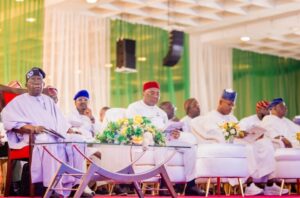
What you choose to do or not to do has enormous consequences for our dear country.
And always remember this: even in the medieval age, when the clergy was the first estate, the nobility the second, and the commoners the third, the press was the fourth estate. In the modern age, the Legislature is the first estate, the executive is the second, and the judiciary is the third. The media is still the fourth estate! Now yo






March 20, 2026
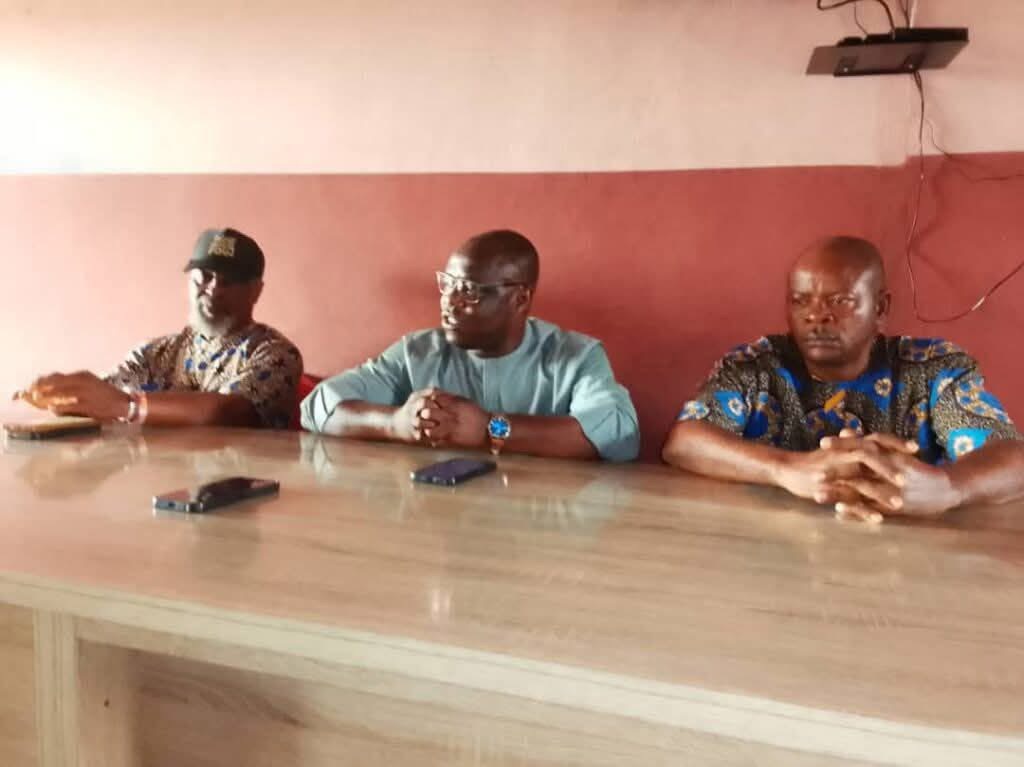
The All Progressives Grand Alliance in Abia State has called on the Senate to declare the seat of the Senator representing Abia South, Enyinnaya Abaribe, vacant following his resignation from the party.
The party made the call on Thursday during a press briefing in Umuahia, where its leadership, led by a former member of the Abia State House of Assembly, Obinna Ichita, insisted that Abaribe voluntarily resigned from APGA and was not sacked, contrary to his claim at the Senate.
Ichita argued that Abaribe’s exit from the party that sponsored his election violates constitutional provisions, stressing that there was no leadership crisis within APGA to justify his defection.
“The senator resigned in his ward. He did so voluntarily, which is his right. However, if you leave the party that gave you the platform for another party when there is no leadership crisis, that seat must be declared vacant,” he said.
He further alleged that Abaribe misrepresented the circumstances of his exit by claiming he was sacked.
“The party has documentary evidence to show that Senator Abaribe was not sacked. He resigned three months after disciplinary measures were taken against him over actions the court did not consider appropriate,” Ichita added.
According to him, the mandate belongs to the people and the party, not the individual office holder.
“They gave him the mandate on the platform of APGA, not any other party. There was nothing like ADC when he was elected. He cannot take the mandate elsewhere without consulting the people who gave it to him,” he said.
Ichita maintained that the constitution is clear on defection, noting that any lawmaker who leaves a party without a valid internal crisis must vacate the seat.
“My message to Senator Abaribe is to honourably vacate the seat instead of waiting for the National Assembly to declare it vacant. That would amount to national embarrassment,” he added.
Also speaking, the APGA State Chairman, Sunday Onukwubiri, and the party’s Public Relations Officer, Chukwuemeka Nwokoro, reiterated that Abaribe had distanced himself from the party’s activities at various levels in the state.
They insisted that he neither holds dual membership nor was he expelled, maintaining that his resignation was voluntary.
“He was invited by the party but failed to appear and was subsequently suspended in line with the party’s constitution. Three months later, he resigned,” the officials said.
Reacting, Abaribe defended his position, insisting that he acted within his constitutional rights.
“When you are no longer a member of a party by virtue of being sent away, you have the fundamental right of association to join another party,” he said.
He argued that his indefinite suspension by APGA effectively amounted to expulsion.
“If a party places you on indefinite suspension for more than six months, what does that mean? It means you have been told to go elsewhere, and that is exactly what I did,” he stated.
The senator added that the proper constitutional procedure for removing him from office would be through a recall process by his constituents.
“If the people who elected me no longer want me, the right thing to do is to initiate a recall. That is the position of the law,” he said.
Politics
Tinubu’s Reforms May Be Challenging, but They’ve Boosted Nigeria’s Global Respect — Information Minister Mohammed Idris
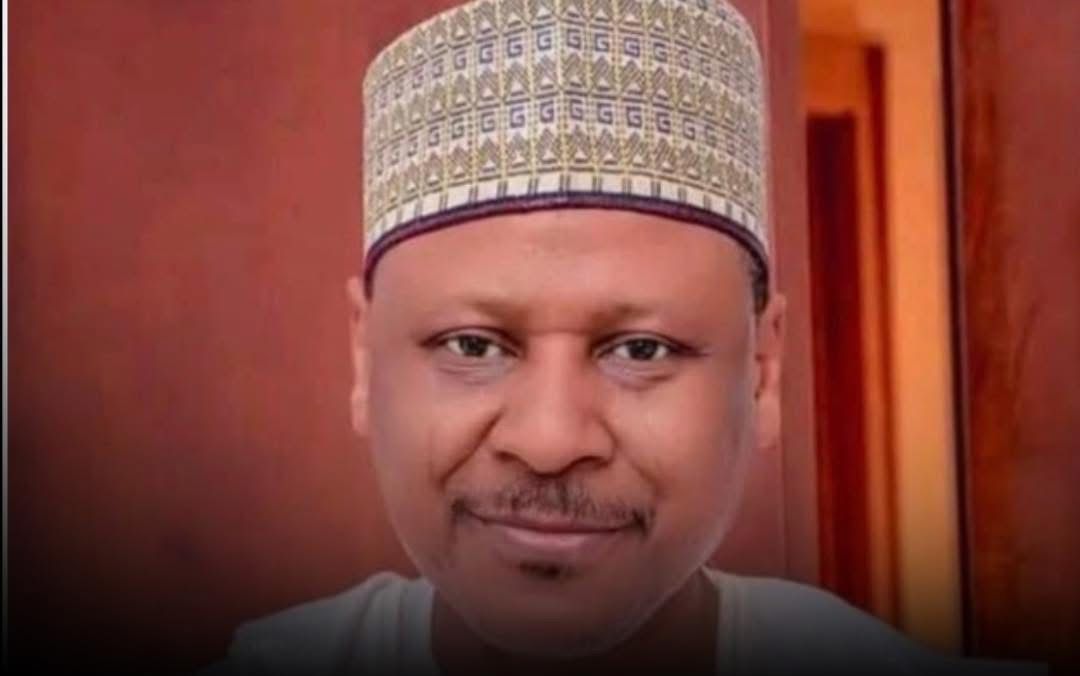
The Minister of Information and National Orientation, Mohammed Idris, has stated that Nigeria is receiving greater respect internationally under the leadership of President Bola Tinubu.
Speaking on Friday after attending Jumaat prayers at Yahaya Road Mosque in Kaduna, Mr Idris said, “Nigeria is indeed taking its rightful place. The country is respected more than ever before on the international scene. The reforms that the president has instituted, as challenging as they are, are meant for the benefit of all Nigerians.”
He urged Nigerians to stay calm as the government continues its efforts to restore security across the nation. Referring to the recent multiple b%mb att@cks in Maiduguri, Borno State, the minister assured that such incidents would not be allowed to recur.
“Indeed, our country is facing challenges, and the government is working tirelessly to ensure security throughout Nigeria. We have seen what has happened, particularly in Borno State. We pray to Allah to make this the last one, as the government is committed to preventing any repetition of such incidents,” he said.
Mr Idris also stressed the importance of citizens being prayerful and working together to address the country’s challenges. He encouraged both Muslims and non-Muslims to unite in the interest of Nigeria’s growth and development.
“This is a time for reflection for all Nigerians. We pray that everyone will consider this moment and recognize the need for unity, progress, and national development. All hands must be on deck for the unity of the country. As we earn respect internationally, we also hope and pray that unity will strengthen within our nation,” he added.
By Dan Opara
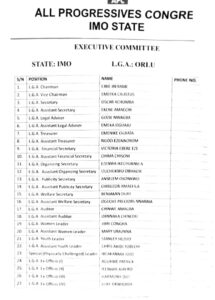
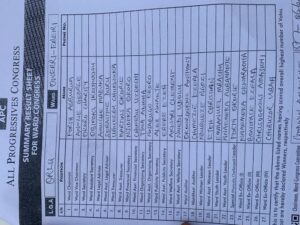
Following the successful conduct of the Imo State APC Congress held in Owerri, Imo State, on March 3rd, 2026, the leadership of the party has officially released the list of victorious candidates who emerged from the exercise.
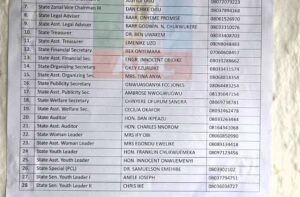
The announcement, made on Friday, March 20th, 2026, came 17 days after the Congress, as gathered by ThePressman Newspaper.
According to the released list, Chief Austin Onyedebelu emerged as the Imo State APC Chairman, while Arc. Allen Enwerem was elected as the State Deputy Chairman. Hon. Onyekachi Ibezim secured the position of State Secretary, alongside 33 other members who now constitute the State Party Executive Committee, including Ex-Officio members in Imo State.
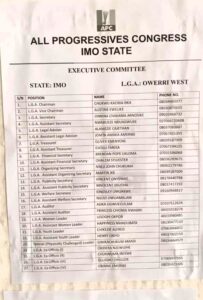
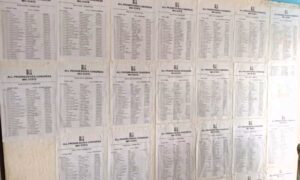
In addition, the leadership of the ruling APC across the 27 Local Government Areas of Imo State has also been announced.
The Ward Party Executive Committee Members for the 305 wards are, however, yet to be fully confirmed.
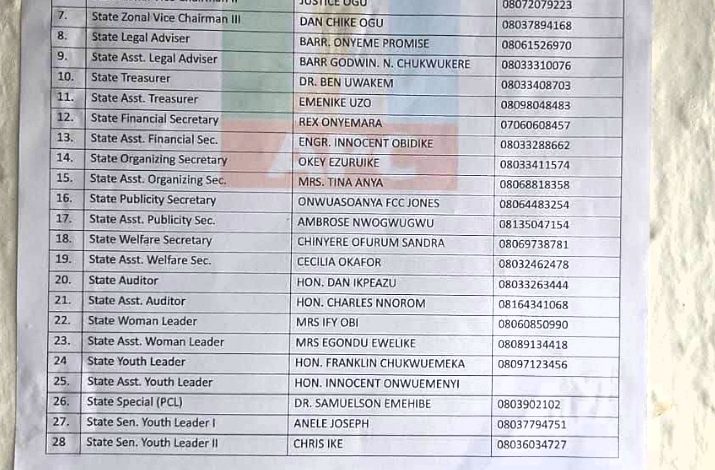
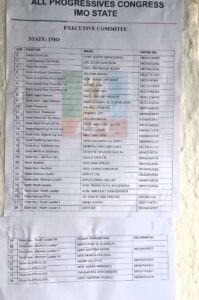
Below is the comprehensive list of the All Progressives Congress State Executive Committee Members for Imo State, including their respective telephone numbers.
ALL PROGRESSIVES CONGRESS
STATE: IMO STATE EXECUTIVE COMMITTEE
State Chairman, Chief Austin Onyedebelu, 08033101685.
State Deputy Chairman, Arc. Allen Enwerem, 08036301966.
State Secretary, Hon. Onyekachi Ibezim, 08033416291.
State Assistant Secretary, Nzenwa Nwoju, 08037717167.
State Zonal Vice Chairman I, Hon. Frank Onyejiaka, 0803314564.
State Zonal Vice Chairman II, Justice Ogu, 08072079223.
State Zonal Vice Chairman III, Dan Chike Ogu, 08037894168.
State Legal Adviser, Barr. Onyeme Promise, 08061526970.
State Assistant Legal Adviser, Barr. Godwin N. Chukwukere, 08033310076.
State Treasurer, Dr. Ben Uwakem, 08033408703.
State Assistant Treasurer, Emenike Uzo, 08098048483.
State Financial Secretary, Rex Onyemara, 07060608457.
State Assistant Financial Secretary, Engr. Innocent Obidike, 08033288662
State Organizing Secretary, Okey Ezuruike, 08033411574.
State Assistant Organizing Secretary, Mrs. Tina Anya, 08068818358.
State Publicity Secretary, Onwuasoanya FCC Jones, 08064483254.
State Assistant Publicity Secretary, Ambrose Nwogwugwu, 08135047154.
State Welfare Secretary, Chinyere Ofurum Sandra, 08069738781.
State Assistant Welfare Secretary, Cecilia Okafor, 08032462478.
State Auditor, Hon. Dan Ikpeazu, 08033263444.
State Assistant Auditor, Hon. Charles Nnorom, 08164341068.
State Woman Leader, Mrs. Ify Obi, 08060850990.
State Assistant Woman Leader, Mrs. Egondu Ewelike, 08089134418.
State Youth Leader, Hon. Franklin Chukwuemeka, 08097123456.
State Assistant Youth Leader, Hon. Innocent Onwuemenyi.
State Special (PCL), Dr. Samuelson Emehibe, 0803902102.
State Senatorial Youth Leader I, Anele Joseph, 08037794751.
State Senatorial Youth Leader II, Chris Ike, 08036034727.
State Senatorial Youth Leader III, Ifeanyi Nwannenna, 08020988164.
State Senatorial Women Leader I, Mrs. Iheako O. Elizabeth.
State Senatorial Women Leader II, Lady Martina Okere, 08036689003.
State Senatorial Women Leader III, Mrs. Franca Onuoha.
State Ex Officio I, Henry Oguguo, 08035001354.
State Ex Officio II, Hon. Alban Amasiatu, 08060564561.
State Ex Officio III, Chukwuma Onyedindere, 08037756307.
State Ex Officio IV, Chief Monday Ikokwu, 08086803626.
Meanwhile, the leadership structure of the All Progressives Congress (APC) in Imo State has been duly constituted, with officials elected across the State, Local Government Area, and Ward levels, reflecting a comprehensive and well-organized party framework.
At the Local Government Area level, notable individuals have emerged as party chairmen in various LGAs.
In Owerri West LGA, Mr. Chikadibia Okpe, was elected as the APC Local Government Chairman.
Similarly, in Orlu LGA, Mr. Ejike Iberame, emerged as the duly elected Party Chairman, while in Oguta LGA, Mr. Obed Onyebuchi, was elected as the APC Chairman, alongside 24 LGA Party Chairmen, to further strengthening the party’s grassroots leadership.
These developments extend across other Local Government Areas and wards, where Party Chairmen and Ward Chairmen have also been elected to provide leadership and coordination at their respective levels.
The successful emergence of party executives at the State, LGA, and Ward levels underscores the APC’s commitment to internal democracy, effective organization, and sustained grassroots mobilization across Imo State.
The release of the list marks a significant step in consolidating the party’s structure across the state, as the newly elected executives are expected to steer the affairs of the APC in Imo State moving forward.

EFCC evicts Malami from Abuja home amid forfeiture dispute

Fuel price hike: Gov Makinde announces N10,000 transport support for workers

Former Acting Accountant-General of the Federation bags 72years imprisonment for diverting N868.46 million security funds

-
Business1 year ago
US court acquits Air Peace boss, slams Mayfield $4000 fine
-

 Trending1 year ago
NYA demands release of ‘abducted’ Imo chairman, preaches good governance
-

 Politics1 year ago
Mexico’s new president causes concern just weeks before the US elections
-

 Politics1 year ago
Putin invites 20 world leaders
-

 Politics1 year ago
Russia bans imports of agro-products from Kazakhstan after refusal to join BRICS
-
Entertainment1 year ago
Bobrisky falls ill in police custody, rushed to hospital
-
Entertainment1 year ago
Bobrisky transferred from Immigration to FCID, spends night behind bars
-
Education2 years ago
GOVERNOR FUBARA APPOINTS COUNCIL MEMBERS FOR KEN SARO-WIWA POLYTECHNIC BORI