
Business
Nigerian Fuel Prices on Track to Crash to N500 Per Litre in 2025

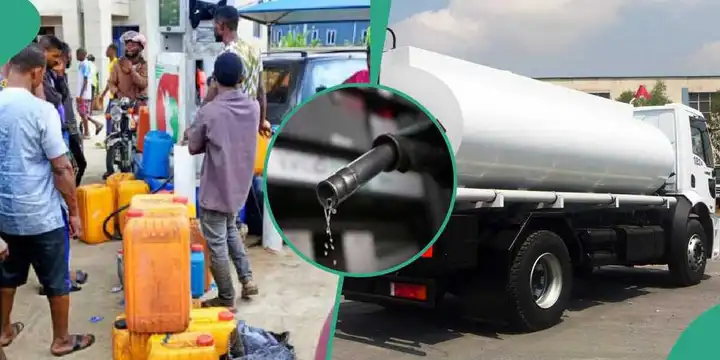
Oil marketers and other petroleum industry experts have forecast a reduction in petrol prices in 2025 to as much as N500/litre The resumption of operations of the Port Harcourt and Warri refineries will drive this anticipated crash in price They highlighted that a steady supply of petroleum products would encourage competition, leading to further price reductions
Petroleum product marketers and other stakeholders in Nigeria have projected a significant reduction in petrol prices by 2025. They highlighted that petrol, currently priced between N900 and N950 per litre at many filling stations, could drop to as low as N500 per litre during the year.
According to industry experts, this anticipated decline is attributed to the strengthening of the downstream sector, driven by the federal government’s deregulation policy.
Other factors contributing to the expected price reduction include a stable foreign exchange rate, increased price competition, the Naira-for-crude initiative, and the expected operations of the Port Harcourt, Warri, and Dangote refineries.
Stakeholders also noted that if these refineries supply the domestic market and accept payments in naira, it would further drive down petrol prices. Marketers share why fuel prices may reduce further The national publicity secretary of the Independent Petroleum Marketers Association of Nigeria (IPMAN), Ukadike Chinedu, described the upcoming operations of the Port Harcourt and Warri refineries as transformative for the downstream sector.
In an interview with Saturday Sun, he emphasised that these refineries would foster healthy price competition, a trend already becoming evident. He noted that both the Nigerian National Petroleum Company Ltd (NNPC) and Dangote have reduced petrol prices in recent weeks, highlighting the benefits of having multiple production sources rather than a monopoly. Ukadike expressed optimism that this development could drive petrol prices below N500 per litre by 2025 as more players enhance refining capacity. He also identified the federal government’s naira-for-crude policy as a critical factor in shaping petrol prices, predicting that it would curb inflation and ease pressure on foreign exchange.
The president of the Petroleum Products Retail Owners Association of Nigeria (PETROAN), Billy Gillis-Harry, expressed agreement with Ukadike’s views. He assured that the operational launch of the Port Harcourt and Warri refineries would result in more affordable fuel options for Nigerians.
Gillis-Harry emphasised that achieving lower petrol prices for consumers is a realistic prospect in 2025. Gillis-Harry said: ‘’As you can see, NNPC has reduced its ex-depot price from N1,045 per litre to N899 per litre for marketers, translating to N925 per litre at the pumps for the end users. This, I must say, is very commendable. These are not small drops, but massive drops from N1,045 to N899 ex- depot is a lot of drop.” He highlighted that a steady supply of petroleum products would encourage competition, leading to further price reductions in the coming year.
On his part, the publicity secretary of the Crude Oil Refiners Association of Nigeria (CORAN), Iche Idoko, stated that Nigerians would soon start experiencing the benefits of a deregulated market.
Idoko said: “Price drop is one of the characteristics of deregulation we had highlighted. As the industry settles in to the regime of full deregulation, we are bound to see competitions amongst players, which ultimately will benefit the consumers.”
He explained that competition would emerge in pricing, product quality, and credit facilities offered to bulk purchasers.
Marketers import 2.3bn litres of petrol In related news, Legit.ng reported that oil marketers have continued to import petrol into the country despite earlier agreements to patronise local refineries. Documents obtained from the Nigerian Ports Authority revealed that marketers have persisted in petrol importation. The data collected showed that imported petrol was docked at the Apapa Port, Tin Can Port and the Calabar Port.










The governor of Oyo state, Seyi Makinde, has approved a N10,000 transportation allowance as a palliative for the state workforce to cushion the effects of the increase in the pump price of Premium Motor Spirit, otherwise known as petrol.
The Chairman of the Nigeria Labour Congress (NLC), Oyo State chapter, Kayode Martins, in a statement released on Monday, March 23, disclosed that the governor has granted the request of the union on the issue of transportation allowance.
The statement read
“Following the intervention and formal request made by the State Council of the Nigeria Labour Congress (NLC) earlier this morning, the state government has approved a N10,000 transportation allowance for all workers in the state.
The newly approved allowance is set to take effect from April 2026, providing much-needed relief to workers grappling with rising transportation costs amid current economic challenges.
This development comes as a direct response to sustained advocacy by the state NLC, aimed at cushioning the impact of increased living expenses on the workforce.
Further details on implementation are expected to be communicated by the relevant government authorities in due course.”
The Central Bank of Nigeria (CBN), has declared that banks and financial institutions must establish and maintain a temporary watch-list for Bank Verification Numbers (BVN) implicated in suspected fraudulent transactions.
According to the CBN in a circular dated March 12, 2026 and signed by its Director of Payments System Policy Department, Musa I. Jimoh, the apex bank said such a suspected BVN may remain on the temporary watchlist for a maximum period of twenty-four (24) hours during which the owner would be contacted to make clarifications.
The circular explained that the move is part of several new measures under a revised regulatory framework aimed at enhancing financial system stability.
“A BVN may remain on this temporary Watchlist for a maximum period of twenty-four (24) hours, during this period, the BVN owner shall be contacted to provide clarification regarding the identified transaction(s),” the circular stated.
The circular also sets an age requirement for BVN enrolment, restricting registration to individuals who have attained eighteen (18) years and above.
The CBN also added that amendments to phone numbers linked to a BVN shall be allowed only once.
“Amendments to phone numbers linked to a BVN shall be allowed only once,” the circular noted.
The apex bank stated that access to BVN databases will remain tightly controlled.
“Access to the BVN databases shall be exclusively granted to Central Bank of Nigeria (CBN) licensed financial institutions.
“Notwithstanding this provision, the Central Bank of Nigeria (the Bank) reserves the right to approve access to the BVN databases in extenuating circumstances and in accordance with the provisions of extant laws,” the circular said.
Financial institutions are expected to comply with the new requirements, and customers may be contacted by their banks if their BVNs are temporarily flagged during the new fraud monitoring process.
The new policy, as stated by the CBN, takes effect from May 1, 2026.
NNPC Reduces Fuel Price
The Nigerian National Petroleum Company Limited has reduced the pump price of Premium Motor Spirit, also known as petrol, at its retail stations in Lagos and Abuja.
The adjustment took effect on Wednesday as the national oil company reduced the price to N1,130 per litre in Lagos and N1,165 per litre in Abuja.
The new price means motorists in Lagos are now paying N100 less than the previous pump price of N1,230 per litre.
In Abuja, the new rate represents a reduction of N95 from the former price of N1,260 per litre.
Checks showed that the new price was already in place at several NNPC filling stations in Lagos, including outlets located along Isheri Oshun Road, Apple Junction and Ago Palace Way.
The same adjustment was also recorded in the Federal Capital Territory, where NNPC stations in areas such as Jabi and Wuse began selling petrol at N1,165 per litre.
The reduction comes at a time when many private oil marketers have not yet adjusted their pump prices to match the recent drop in the gantry price announced by the Dangote Petroleum Refinery.
Dangote Refinery had earlier lowered its gantry price for petrol by N100 per litre, bringing it down to N1,075 per litre.
The change followed a fall in international crude oil prices.
Global oil prices had earlier risen sharply due to tensions in the Middle East involving the United States, Iran and Israel.
The crisis raised fears of possible disruption to oil supply, especially around the Strait of Hormuz, an important route for global crude shipments.
Prices later began to fall after the President of the United States, Donald Trump, indicated that the conflict might end soon.

Fuel price hike: Gov Makinde announces N10,000 transport support for workers

Former Acting Accountant-General of the Federation bags 72years imprisonment for diverting N868.46 million security funds

Benita Enwonwu in the 1970s: Model, Actress, and Daughter of Ben Enwonwu

-
Business1 year ago
US court acquits Air Peace boss, slams Mayfield $4000 fine
-

 Trending1 year ago
NYA demands release of ‘abducted’ Imo chairman, preaches good governance
-

 Politics1 year ago
Mexico’s new president causes concern just weeks before the US elections
-

 Politics1 year ago
Putin invites 20 world leaders
-

 Politics1 year ago
Russia bans imports of agro-products from Kazakhstan after refusal to join BRICS
-
Entertainment1 year ago
Bobrisky falls ill in police custody, rushed to hospital
-
Entertainment1 year ago
Bobrisky transferred from Immigration to FCID, spends night behind bars
-
Education2 years ago
GOVERNOR FUBARA APPOINTS COUNCIL MEMBERS FOR KEN SARO-WIWA POLYTECHNIC BORI