
Politics
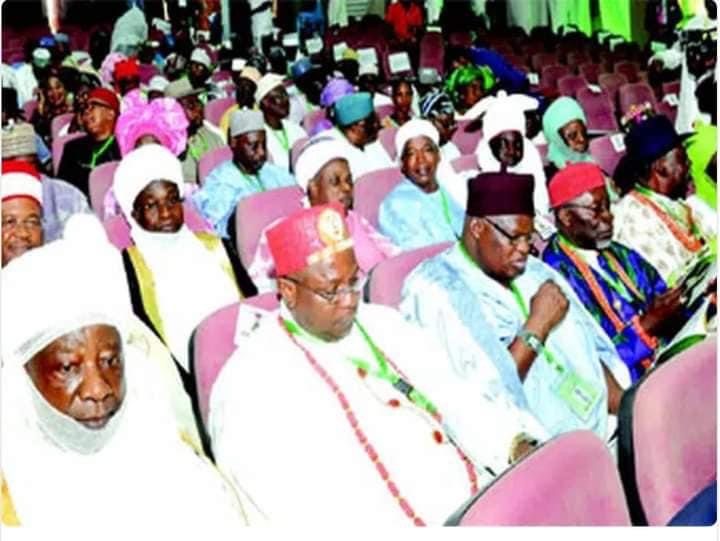
Summary Of The National Confab 2014 Recommendations

– 1. Qualification to Contest For President
Anybody aspiring to become the country’s President must be a degree holder.
– 2. Rotation of Presidency
Rotation of Presidency between the North and South and governorship among the three senatorial districts of each state.
– 3. Decamping (Cross-Carpeting)
Any elected official, executive or legislative, who carpet-cross, regardless of the reasons for such, shall automatically forfeit his seat.
– 4. Mineral Exploration
Excess revenue should be used for exploration of mineral resources in every part of the country.
– 5. Acting President
Where the President dies in office or incapacitated, impeached or where he resigns, the Vice President shall operate in acting capacity for a period of 90 days during which an election to the same office would be conducted.
– 6. Rotation of the Presidency
When a president leaves under any of the circumstances stated above, another president would be elected from the same zone where the previous one came from.
– 7. Open Grazing
Cattle routes and grazing reserves be phased out to lay emphasis on ranching.
– 8. New State For South East
There shall be created an additional state for the South-East Zone to make the zone have equal number of states with the other zones except the North West which has seven.
– 9. The States For The Regions
Creation of another 18 new states (three per geo-political zone, this means SE will now have 4).
– 10. Fiscal Sharing Formula
The sharing of the funds to the Federation Account among the three tiers of government should be done in the following manner: Federal Government – 42.5%, State Governments – 35% and Local Governments 22.5% as opposed to the prevailing 52.68 %, 26.72% and 20.60% respectively.
– 11. Form of Government
Modified Presidential System, a home-made model of government that effectively combines the presidential and parliamentary systems of government. The president shall pick the vice president from the Legislature.
– 12. Appointment of Ministers
The President should select not more than 18 ministers from the six geo -political zones and not more than 30% of his ministers from outside the Legislature. Reduce Cost of governance by pruning the number of political appointees and using staff of ministries where necessary.
– 13. Legislature
The legislature should remain Bi-cameral but all elected members of the legislative arms of all the tiers of government should serve on part-time basis.
– 14. Local Government Autonomy
Local Government will no longer be the third tier of government. The federal and states are now to be the only tiers of government. States can now create as many local governments as they want.
The Joint State/Local Government Account be scrapped and in its place the establishment of a State RMAFC with representatives of LG and a Chairman nominated by the Governor.
The Constitution should fix the tenure for Local Government Councils at three years. Conference recommends the scrapping of State Independent Electoral Commission, SIECs.
– 15. Immunity
The immunity clause should be removed if the offences attract criminal charges to encourage accountability by those managing the economy.
– 16. Independent Candidacy
Every Nigerian who meets the specified condition in the Electoral Act should be free to contest elections as an independent candidate.
– 17. Anti-corruption
Anybody arraigned before the court by EFCC, ICPC and by any law enforcement agencies, the accused person will be regarded as guilty, unlike the present situation where he is innocent until proven guilty.
Plus, complete abolition of the concept of plea bargain by the Federal government
– 18. State Police
States who want it should have it.
– 19. National Anthem
The old National Anthem should be re-introduced
– 20. Religion Taxes and Pilgrimages
Religious institutions to pay tax, abolition of pilgrimage sponsorship
– 21. Mission Schools
Public schools taken over by various state governments across the country forty two years ago would henceforth be returned to the religious missions which were the original owners






The Independent National Electoral Commission, INEC, has announced the postponement of the proposed nationwide voter revalidation exercise until after the 2027 General Election.
This follows a meeting with the Resident Electoral Commissioners, RECs, on Friday, April 10.
A statement signed by INEC’s National Commissioner, Chairman, Informationa and Voter Education Committee, Mohammed Kudu Haruna, said
“the voter revalidation exercise is a critical component of the Commission’s mandate to maintain a credible and up-to-date National Register of Voters.
It is designed to verify and review existing voter records, ensure the accuracy of personal data, eliminate duplicate and ineligible entries, and strengthen the overall integrity of the voter register.
The exercise also aims to provide an opportunity for registered voters to confirm their details and make necessary corrections where required.
INEC remains committed to the conduct of free, fair, credible, and inclusive elections.”
Following the just conducted ADC Congress, the African Democratic Congress (ADC) in Ideato South Local Government Area, Imo State, has announced its new leadership team. The team, led by Chairman Hon. Eze Chijioke, includes:
– Chairman: Hon. Eze Chijioke
– Secretary: Chief Duru Maurice
– Youth Leader: Mr. Obinwanne Okwara
– Woman Leader: Mrs. Anueyiagu Ogechi
– Organizing Secretary: Hon. Godian Egemba
The team is expected to lead the party to victory in future elections.
Politics
ADC Owerri Municipal Gets New Chairman: Hon. Success Opara Emerges Amidst State Leadership Tussle

The African Democratic Congress (ADC) in Owerri Municipal, Imo State, has concluded its Local Government Area Congress, with Hon. Success Opara emerging as the new Chairman. The congress, conducted in all wards across Owerri Municipal, saw party faithfuls voting for Opara, who is expected to lead the party to victory in future elections.
However, there’s an ongoing leadership tussle within the Imo State ADC, with Chief Emmanuel Amushie claiming to be the authentic state chairman, recognized by the Independent National Electoral Commission (INEC). On the other hand, Prof. James Okoroma has also been declared the authentic state chairman by the national leadership of the ADC.
Furthermore the Independent National Electoral Commission (INEC) has removed the faction led by Prof. James Okoroma as the recognized leadership of the African Democratic Congress (ADC) in Imo State, as of April 9, 2026. INEC recognizes only the Amuchie-led Executive as the lawful and legitimate leadership of the ADC in Imo State.
The removal follows a Court of Appeal ruling directing parties to maintain the status quo pending the determination of a substantive suit before the Federal High Court. INEC has also suspended recognition of all leadership factions of the ADC until the court reaches a final decision.

INEC postpones nationwide voter revalidation until after 2027 elections

ADC Congress Ideato South: New Leadership Team Emerges

Fuel may hit N2000/litre. Subsidize crude feedstock now – TUC tells FG

-
Business1 year ago
US court acquits Air Peace boss, slams Mayfield $4000 fine
-

 Trending1 year ago
NYA demands release of ‘abducted’ Imo chairman, preaches good governance
-

 Politics1 year ago
Mexico’s new president causes concern just weeks before the US elections
-

 Politics1 year ago
Putin invites 20 world leaders
-

 Politics1 year ago
Russia bans imports of agro-products from Kazakhstan after refusal to join BRICS
-
Entertainment1 year ago
Bobrisky falls ill in police custody, rushed to hospital
-
Entertainment1 year ago
Bobrisky transferred from Immigration to FCID, spends night behind bars
-
Education2 years ago
GOVERNOR FUBARA APPOINTS COUNCIL MEMBERS FOR KEN SARO-WIWA POLYTECHNIC BORI