
Trending
Troops’ presence renews hope for safety on Zamfara highways, but locals seek night patrols.

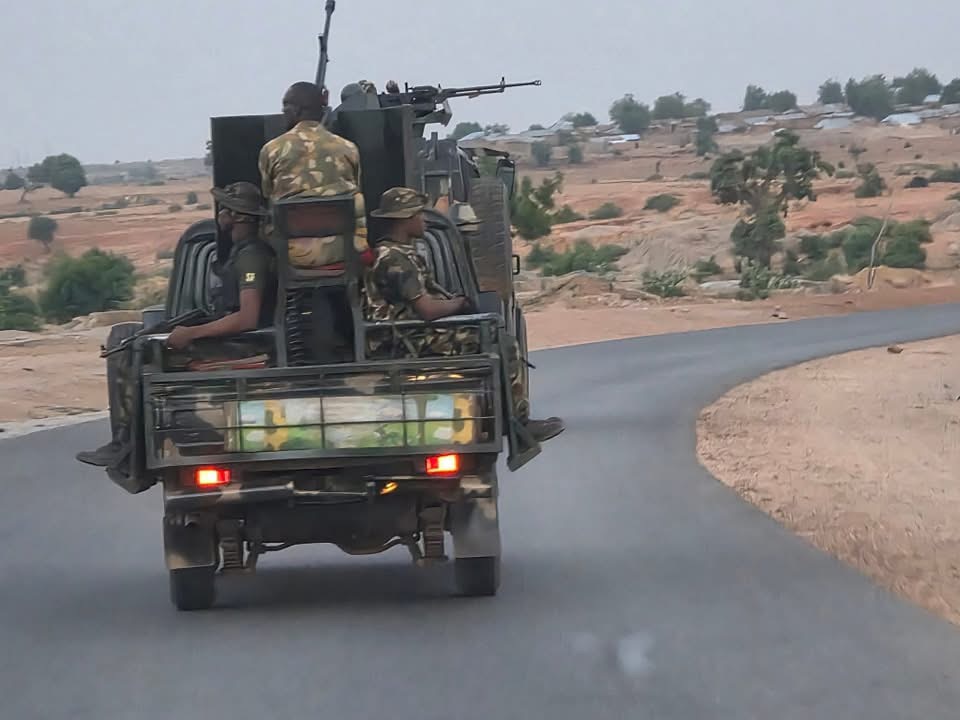
Commuters and commercial drivers plying the Gusau–Tsafe highway in Zamfara State say the enhanced military presence in the area has brought renewed hope for safe travel after years of fear and deadly bandit attacks.
Zagazola Makama report that the highway, once a corridor of terror where bandits routinely blocked roads, abducted travellers, and ransacked surrounding villages, is now seeing relative calm within the last few months due to intensified operations by Nigerian Army troops, particularly along the Tsafe- Gusau road.
Commercial driver, Usman Bala, who plies the Gusau–Funtua route daily, said that the change is noticeable.
“We used to drive with our hearts in our mouths. Anytime we passed Dan Mali or Babban Kauye, we prayed hard. But now, soldiers are stationed at key flashpoints. You feel a sense of safety you haven’t felt in years,” he said.
Another commercial driver, Musa Lawali, echoed Bala’s sentiment, noting that bandits used to operate with impunity around Makera and Asaula.
“Before, we avoided evening trips. From 4:30 p.m., the road was a death trap. But now, I can move even close to 7 p.m. because I know troops are patrolling. Their presence alone scares the criminals,” Lawali said.
Private motorist Amina Idris, who travels from Gusau to Tsafe weekly for business, said her confidence has improved with every trip.
“I used to dread the journey, especially at Bamamu and Tashan Jirgi axis. I would call my family before I left and when I arrived. Now, I see military checkpoints and even patrols. It’s encouraging,” she said.
Similarly, Dauda Garba, a truck driver who frequently passes through Tsafe, described a recent encounter where troops responded swiftly to an attempted roadblock by suspected bandits.
“They came in within minutes. We saw the gun trucks approach, and the criminals ran. That kind of quick response saves lives,” Garba said.
Another commuter, Suleiman Ibrahim, who drives a private vehicle between Tsafe and Yankara, confirmed that the fear of daytime travel has reduced significantly.
“Before now, even private motorists had to follow convoys or wait for military escort. Now, we go freely. The presence of troops has changed the game,” he said.
But despite the improvements, traditional leaders and community stakeholders are calling for additional measures particularly night patrols to tackle nocturnal attacks.
The Yandoton Tsafe, Alhaji Abubakar Muhammadu Bawa, commended the military for recent gains but warned that many villages on the fringes of Tsafe are still vulnerable to night raids.
“We have seen progress in the last few weeks. Our roads are safer by day. But the bandits now operate at night. They move through forest corridors and attack villages like Makera, Bamamu, Tashan Jirgi, Dan Mali, Asaula, and Babban Kauye under cover of darkness,” he said.
Another sources from Tsafe identified some of the notorious elements behind these attacks, including a bandit leader known as Bakin Malam, and others such as Hassan Fari, Sarki, son of notorious bandit Ado Allero, and Umaru, son of kingpin Anaruwa.
“These are not petty criminals. They are experienced and armed. We appeal to the Nigerian Army to extend their operations to night patrols. That is when these terrorists strike the most,” he added.
He urged the deployment of additional combat platforms like CSK gun trucks and surveillance drones to cover forest routes and hard-to-reach enclaves where bandits regroup after daytime setbacks.
Despite the lingering threats, residents are beginning to reclaim their confidence, a development largely attributed to the recent push by the Nigerian Army to dominate key transportation routes and neutralise armed groups.
By: Zagazola Makama
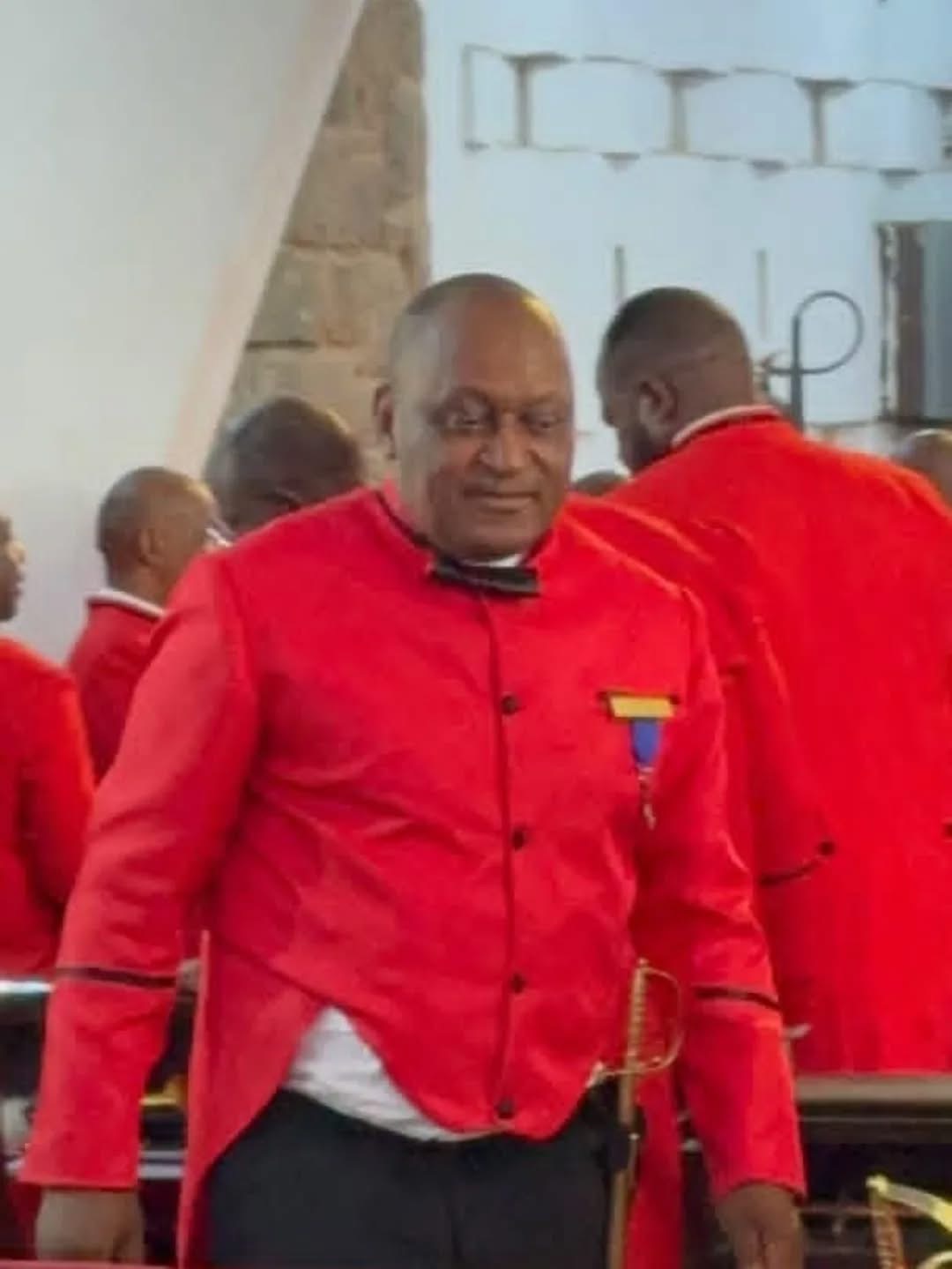
Unidentified gunmen, suspected to be cultists, have k!lled a community leader and one other person in Anambra State.
The President-General of Ogidi community in Idemili North Local Government Area of Anambra State, Ikwuka Okoye, popularly known as Anumili (pictured above), was k!lled on Friday, Feb. 6.
The attack was alleged to have been carried out by members of a rival cult group in revenge for the de@th of their leader, who was arrested and k!lled by local security operatives.
During the attack, which took place at the School Field, Ogidi, another man whose identity has yet to be ascertained was also gunned down.
The spokesman for the Anambra State Police Command, SP Tochukwu Ikenga, confirmed the incident in a press statement on Saturday.
Ikenga said the incident is allegedly linked to the recent capture and k!lling of a known notorious cultist within the community.
He said, “The Anambra State Police Command regrets the murd£r of the President-General of the Ogidi community and one other person. The incident, which occurred on the evening of February 6, 2026, at the School Field, Ogidi, is allegedly linked to the recent capture and k!lling of a known notorious cultist within the community.
“Following the report, police operatives swiftly took over the scene of the incident and commenced investigations. The command is currently working with eyewitness accounts and other available intelligence to identify and arrest the perpetrators.
“The Anambra State Police Command assures members of the public that all efforts are being intensified to bring those responsible to justice.
“Residents are urged to remain calm and cooperate with the police as investigations continue.
“Further developments will be communicated in due course.”


Men of the Police Special Fraud Unit (PSFU), Lagos, have apprehended three suspects who allegedly run a cyber blackmail and extortion scheme in the state.
According to the spokesperson of the unit, DSP Ovie Ewhubare, the suspects get a hold of their victims explicit photos and then threaten to release them if a ransom is not paid.
He said that the suspects, two males and a female, were apprehended after a petition was filed by a complainant who reported being repeatedly threatened by unknown individuals demanding money.
“The complainant received several phone calls in which the callers threatened to release her nude photographs to the public if she failed to pay them. Acting out of fear and emotional distress, she transferred money to the suspects.
The situation escalated when the suspects demanded an additional N10 million, prompting her to formally petition the police,” he said
The police imagemaker state dthat upon receipt of the complaint, the Commissioner of Police, PSFU, Mr Kayode Ojapinwa, ordered the immediate deployment of operatives to investigate the matter.
“The investigation led to the arrest of the three suspects. Investigations revealed that one of the suspects gained unlawful access to the complainant’s mobile device and fraudulently transferred her nude photographs to his own device. Further findings indicated that he conspired with the other suspects and other accomplices currently at large to demand and receive money from the complainant in several tranches,” he said
According to him, the suspects are currently in police custody and are expected to be arraigned before a court of competent jurisdiction.
The image maker said that investigations were ongoing to apprehend other fleeing members of the syndicate and to recover all proceeds of the alleged crime.
Trending
Catholic Priest Collapses And D!es In Front Of Congregation While Walking To Tabernacle To Return Holy Communion
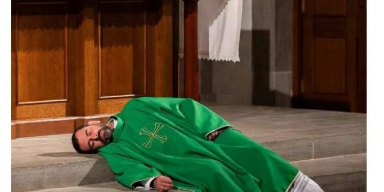
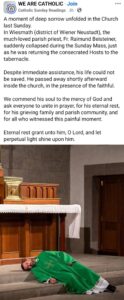
A Catholic priest has tragically passed away after suddenly collapsing in front of the congregation during Sunday mass.
The tragic incident took place last Sunday, February 1 in Wiesmath in the district of Wiener Neustadt, Austria.
Shortly after administering Holy Communion, 59-year-old priest Raimund Beisteiner was about to return the host to the tabernacle when he “suddenly” collapsed, according to a statement from the Archdiocese of Vienna.
“Despite immediate professional assistance, he di£d in the church,” the statement said.
The mayor of Wiesmath, Erich Rasner, had also attended the Mass with many other believers and witnessed the dramatic scenes.
The shock in Wiesmath at the loss of the popular priest is great. Beisteiner had shaped the spiritual life of the parish for almost two decades and was highly regarded far beyond the community.
Rasner praised him as an “extremely conscientious, sensitive priest” and also emphasized the personal loss of a friendship that had grown over many years.
A prayer service was organized at short notice for the late priest. It was attended by numerous priests from the deanery as well as Archbishop Josef Grünwidl.

Olusegun Obasanjo’s Daughter Declares For Ogun Governorship, Joins APC

Nigerian Pharmacist D!es While Donating Kidney To Save His Cousin’s Life

Two Presidents, Many Dignitaries In Attendance As Defence Minister Matawalle’s 10 Children Get Married In One Day (Photos/Video)

-
Business1 year ago
US court acquits Air Peace boss, slams Mayfield $4000 fine
-

 Trending1 year ago
NYA demands release of ‘abducted’ Imo chairman, preaches good governance
-

 Politics1 year ago
Mexico’s new president causes concern just weeks before the US elections
-

 Politics1 year ago
Putin invites 20 world leaders
-

 Politics1 year ago
Russia bans imports of agro-products from Kazakhstan after refusal to join BRICS
-
Entertainment1 year ago
Bobrisky falls ill in police custody, rushed to hospital
-
Entertainment1 year ago
Bobrisky transferred from Immigration to FCID, spends night behind bars
-
Education1 year ago
GOVERNOR FUBARA APPOINTS COUNCIL MEMBERS FOR KEN SARO-WIWA POLYTECHNIC BORI