
Politics
We Are Neither Thieves Nor Saboteurs, Mele Kyari Defend NNPCL

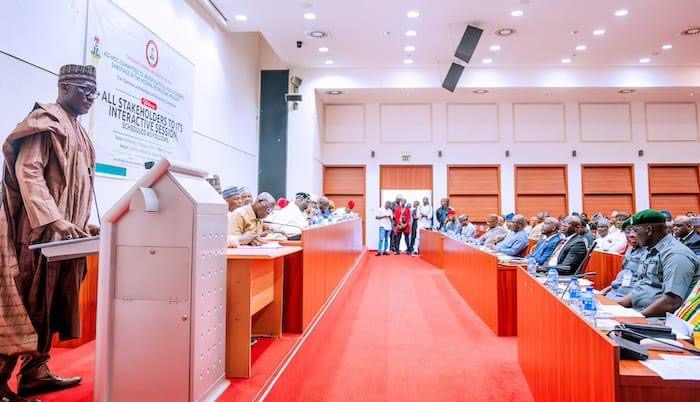
“We are not criminals. We are not thieves. But we will protect our dignity and honour,” says NNPC GCEO Kyari.
The Group Chief Executive Officer, NNPC, Mele Kyari, on Wednesday at the interactive session organised by the Senate Adhoc Committee probing sabotage in the oil and gas sector, chaired by the Senate Leader, Opeyemi Bamidele, declared that the leadership of the NNPC are neither thieves or economic saboteurs.
This was as stakeholders in the oil and gas sector of the Nigerian economy agreed to expose all forms of sabotage and criminal activities bedeviling the sector not minding whose ox is gored.
Participants at the Senate Adhoc Committee probing sabotage in the oil and gas sector, chaired by Bamidele, further agreed that the investigative public hearing should be aired live on national televisions and other media platforms.
Authorities of the Nigerian National Petroleum Company Limited (NNPC) and the Dangote Refinery and Petrochemical Company also seized the opportunity to clear the air on the recent face-off between the two establishments.
While the NNPCL management distanced the organisation from any form of sabotage and accusation of deliberately stalling the take-off of private refineries in the country, the Dangote firm denied allegation of attempt to monopolise the oil and gas sector in the country.
In his submission, the Group Chief Executive Officer, NNPC, Mele Kyari, stressed that the NNPC, “is loyal and faithful to the country,” adding that its management vowed to protect the interest of Nigeria in the petroleum industry.
He observed that most problems in the petroleum industry have nothing to do with NNPCL.
“We are faithful and loyal to the economic interest of this country. We are not criminals. We are not thieves. But we will protect our dignity and honour,” he added.
The NNPC boss said it was not possible to frustrate any private refinery because the Petroleum Industry Act had limited the roles of each regulator in the oil and gas sector.
He said, “The NNPC is a company owned by over 200 million Nigerians. And I happen to be the chief executive of this company. The law is clear around what the chief executive of this company will do.
“Our memorandum article of association, the Petroleum Industry Act, and all other enabling, including the Company and Allied Matters Act, (CAMA), which was legislated by this Honourable National Assembly had listed our roles.
“I will wait for the public hearing to reveal certain things. I also agree with the Minister that it should be broadcast live so that Nigerians will hear us. So that all the misinformation that you see today will be put to the side, so that Nigerians will know the truth.
“All of us here see what is happening in the media. Targeted personal attack on my person, on the institution, and we all know how this works. They are deliberate, they are calculated.
“It creates the impression that NNPC Limited and our leadership are doing something to create economic sabotage in our country. It is far from it.
“I assure you, Mr. Chairman, that the NNPC Limited and its board of directors and its shareholders are faithful, loyal to this country.”
Kyari added: “We do not lie to this country. And we do nothing to sabotage the economic interests of this country. As a matter of fact, NNPC is the economic interest of this country.”
In its response, Dangote Refinery, through its Group Strategy Officer, Aliyu Suleiman, said the firm had so far, bought about 50 million barrels of crude.
Sulaiman said, “About 60 per cent of that came from the NNPC, and we are thankful to them for their support. And we’re grateful to them for their support.
“About 20 per cent of that (crude) had to be imported from outside and the other 20 per cent we purchased.
“Essentially, all we are asking for, and let’s be very clear, we are happy to pay fair prices.
“We are very happy with the price that they set, the price is like supermarkets and that’s what we buy. But what we buy from others is what we think the regulator should look at and the good thing the regulator has done, is that it has published a guideline that will address some of these.
“We hope that we’ll work with the regulator and we’ll get their support so that the refinery can get 100 per cent of its crude from Nigeria and buy the crude from companies that produce it in Nigeria not from international middlemen.
“Whatever the prices, as long as it is in Nigeria, and that’s the price also that the producer will pay their tax on, we’ll be happy to pay that.
“Since the refinery started full trial production in January and then full time production started in March, since then we have processed about 50 million barrels
“We’ve produced about five million tons of petroleum products. And these petroleum products have been sold to various parts of the country.
“Jet fuel has been sold in Europe since May. It’s been sent to Europe. Other products have been sent to places as far as Asia, US, Brazil, and so on. So the refinery has been making a lot of progress.
“We have produced five million tons of products, but about 90 per cent of it had to be exported. While at the same time, the products we were producing had been imported into Nigeria.
“We find ourselves competing against Russian products that have been produced with oil that is valued at $60. “We all know that because of the cap that has been put on, put on Russian oil, the value of Russian oil today in the market is $60.
“That’s what Russia is using to produce their products and those products are being sent in large quantities into Africa to compete with products that are produced in refineries that buy crude at $90.
“We don’t think this will be a fair competitive environment. It is normal to put protective measures. The US, for example, has done that, to protect their own industries against attack by China that subsidise their own industries and then sends them to the US.”
Meanwhile, the Senate panel on the occasion raised questions over the $1.5 billion approved in 2021, for the turn-around maintenance of the Port Harcourt Refinery with little or no result.
Consequently, the upper chamber lamented that it was unfair and wrong to treat government businesses or public companies as an orphan while private businesses were flourishing and thriving.
Bamidele, who is the Leader of the Senate and Chairman, of the ad hoc panel investigating the Alleged Economic Sabotage in the Nigerian Petroleum Industry said the Federal Executive Council had approved the plan by the Ministry of Petroleum Resources to rehabilitate and turn around the Port Harcourt Refinery with a whopping sum of $1.5 billion under the administration of former President Muhammadu Buhari.
He noted that despite the huge investment, the government-owned refinery was yet to function effectively, a situation that compelled the country to depend almost entirely on the importation of petroleum products.
Bamidele, expressed grave concerns about the dysfunctionality of the government-owned refineries despite billions of dollars invested to carry out turn-around maintenance on the installation.
He observed that the federation, “is undergoing a truly challenging period,” pointing out that the distribution and supply of refined petroleum products, “has been irregular and problematic in the recent history of our fatherland.”
“In 2021, specifically, the Federal Executive Council approved $1.5 billion for the turn-around maintenance of the Port Harcourt Refinery. Yet, this investment has not yielded significant returns.
“For us, in the Senate, we believe, it is unfair and unpatriotic to treat government businesses or public corporations as an orphan while private businesses are flourishing and thriving,” Bamidele pointed out at the interactive session.
The session was attended by Minister of Finance and Coordinating Minister of the Economy, Mr. Wale Edun; Minister of State (Petroleum), Senator Heineken Lokpobiri; and Kyari. Others included the Chief Executive Officer, Nigerian Upstream Petroleum Regulatory Commission (NUPRC), Mr. Gbenga Komolafe; the Chief Executive Officer, Nigerian Midstream and Downstream Petroleum Regulatory Authority, Mr. Farouk Ahmed, major and independent oil marketers, among others
In his own remarks, Edun said the increase in the crude volume would stabilise the country’s foreign exchange market while expressing confidence in the leadership of the ad-hoc committee to conduct an unbiased and impartial investigation.
Meanwhile, the Minister of State for Petroleum Resources, Senator Heineken Lokpobiri, has pledged the full cooperation of the ministry with the senate which is investigating the sector.
“ In view of the fact that the quickest means to overcome our economic challenges lies within the petroleum sector, there is a need to keep Nigerians in the know of procedures and processes being carried out in our effort to transform and reposition our oil sector, bearing in mind the need to protect and promote our local players in the industry.
“I emphasised on this during my appearance before the Senate Adhoc Committee investigating alleged economic sabotage in the Nigerian petroleum industry, where I expressed my commitment to cooperating with the committee to put to rest some of the misinformation making rounds.
“The federal government, under President Bola Tinubu, remains committed to fostering the necessary synergy and partnerships to achieve our goals, and we are expediting efforts to complete rehabilitation works on our three refineries to ensure we meet our domestic petroleum needs efficiently,” Lokpobiri said on his X handle.
The National President of Independent Petroleum Marketers Association of Nigeria (IPMAN), Alhaji Abubakar Shettima in his presentation admonished the committee against monopoly in the petroleum sector.
“The current value chain in the downstream should be sustained to allow other investors to participate.
“NNPCL is doing its best but should please improve on supply of products to retail outlets across the country to end the incessant queue at filling stations,” he said
Follow trueTALKnija for more exclusive updates








March 20, 2026
The All Progressives Grand Alliance in Abia State has called on the Senate to declare the seat of the Senator representing Abia South, Enyinnaya Abaribe, vacant following his resignation from the party.
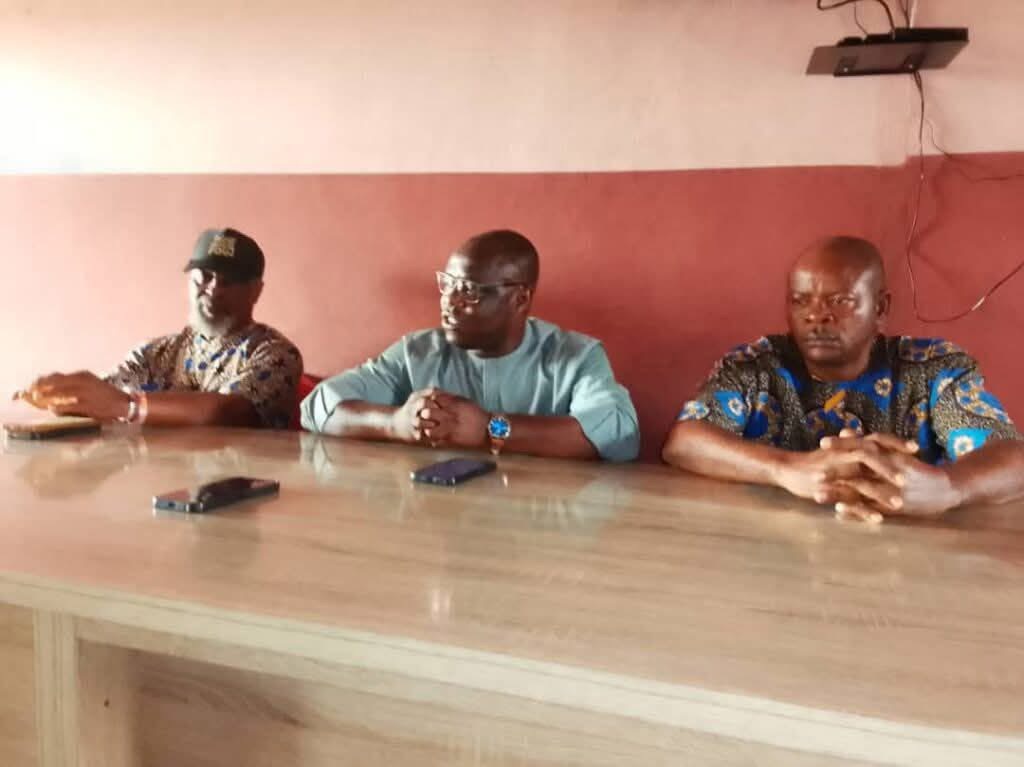
The party made the call on Thursday during a press briefing in Umuahia, where its leadership, led by a former member of the Abia State House of Assembly, Obinna Ichita, insisted that Abaribe voluntarily resigned from APGA and was not sacked, contrary to his claim at the Senate.
Ichita argued that Abaribe’s exit from the party that sponsored his election violates constitutional provisions, stressing that there was no leadership crisis within APGA to justify his defection.
“The senator resigned in his ward. He did so voluntarily, which is his right. However, if you leave the party that gave you the platform for another party when there is no leadership crisis, that seat must be declared vacant,” he said.
He further alleged that Abaribe misrepresented the circumstances of his exit by claiming he was sacked.
“The party has documentary evidence to show that Senator Abaribe was not sacked. He resigned three months after disciplinary measures were taken against him over actions the court did not consider appropriate,” Ichita added.
According to him, the mandate belongs to the people and the party, not the individual office holder.
“They gave him the mandate on the platform of APGA, not any other party. There was nothing like ADC when he was elected. He cannot take the mandate elsewhere without consulting the people who gave it to him,” he said.
Ichita maintained that the constitution is clear on defection, noting that any lawmaker who leaves a party without a valid internal crisis must vacate the seat.
“My message to Senator Abaribe is to honourably vacate the seat instead of waiting for the National Assembly to declare it vacant. That would amount to national embarrassment,” he added.
Also speaking, the APGA State Chairman, Sunday Onukwubiri, and the party’s Public Relations Officer, Chukwuemeka Nwokoro, reiterated that Abaribe had distanced himself from the party’s activities at various levels in the state.
They insisted that he neither holds dual membership nor was he expelled, maintaining that his resignation was voluntary.
“He was invited by the party but failed to appear and was subsequently suspended in line with the party’s constitution. Three months later, he resigned,” the officials said.
Reacting, Abaribe defended his position, insisting that he acted within his constitutional rights.
“When you are no longer a member of a party by virtue of being sent away, you have the fundamental right of association to join another party,” he said.
He argued that his indefinite suspension by APGA effectively amounted to expulsion.
“If a party places you on indefinite suspension for more than six months, what does that mean? It means you have been told to go elsewhere, and that is exactly what I did,” he stated.
The senator added that the proper constitutional procedure for removing him from office would be through a recall process by his constituents.
“If the people who elected me no longer want me, the right thing to do is to initiate a recall. That is the position of the law,” he said.
Politics
Tinubu’s Reforms May Be Challenging, but They’ve Boosted Nigeria’s Global Respect — Information Minister Mohammed Idris
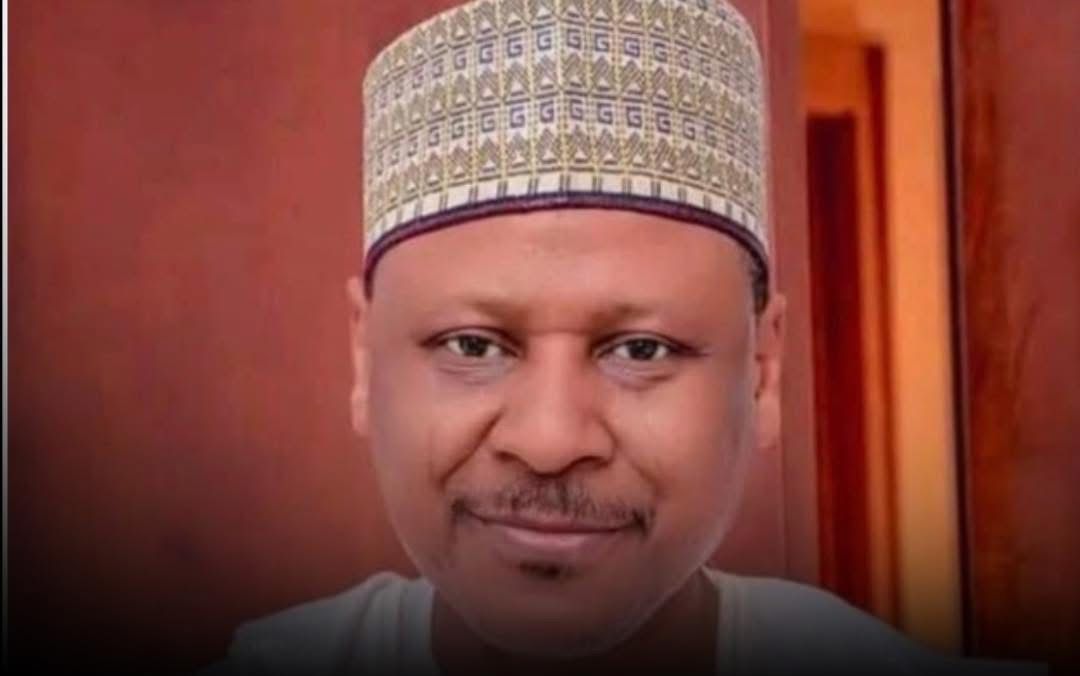
The Minister of Information and National Orientation, Mohammed Idris, has stated that Nigeria is receiving greater respect internationally under the leadership of President Bola Tinubu.
Speaking on Friday after attending Jumaat prayers at Yahaya Road Mosque in Kaduna, Mr Idris said, “Nigeria is indeed taking its rightful place. The country is respected more than ever before on the international scene. The reforms that the president has instituted, as challenging as they are, are meant for the benefit of all Nigerians.”
He urged Nigerians to stay calm as the government continues its efforts to restore security across the nation. Referring to the recent multiple b%mb att@cks in Maiduguri, Borno State, the minister assured that such incidents would not be allowed to recur.
“Indeed, our country is facing challenges, and the government is working tirelessly to ensure security throughout Nigeria. We have seen what has happened, particularly in Borno State. We pray to Allah to make this the last one, as the government is committed to preventing any repetition of such incidents,” he said.
Mr Idris also stressed the importance of citizens being prayerful and working together to address the country’s challenges. He encouraged both Muslims and non-Muslims to unite in the interest of Nigeria’s growth and development.
“This is a time for reflection for all Nigerians. We pray that everyone will consider this moment and recognize the need for unity, progress, and national development. All hands must be on deck for the unity of the country. As we earn respect internationally, we also hope and pray that unity will strengthen within our nation,” he added.
By Dan Opara
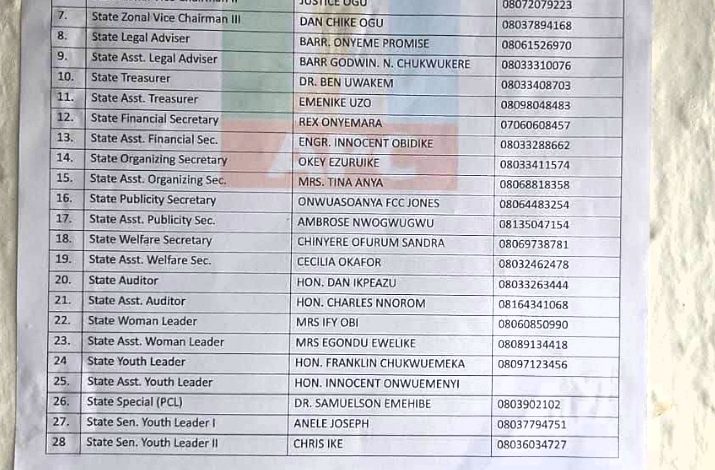
Following the successful conduct of the Imo State APC Congress held in Owerri, Imo State, on March 3rd, 2026, the leadership of the party has officially released the list of victorious candidates who emerged from the exercise.
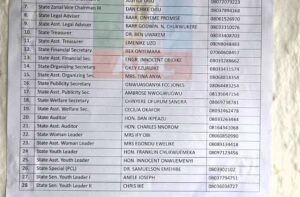
The announcement, made on Friday, March 20th, 2026, came 17 days after the Congress, as gathered by ThePressman Newspaper.
According to the released list, Chief Austin Onyedebelu emerged as the Imo State APC Chairman, while Arc. Allen Enwerem was elected as the State Deputy Chairman. Hon. Onyekachi Ibezim secured the position of State Secretary, alongside 33 other members who now constitute the State Party Executive Committee, including Ex-Officio members in Imo State.
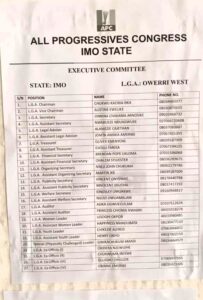
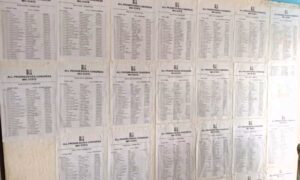
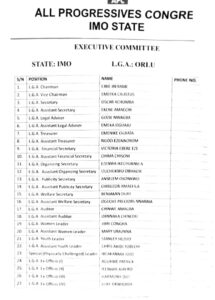
In addition, the leadership of the ruling APC across the 27 Local Government Areas of Imo State has also been announced.
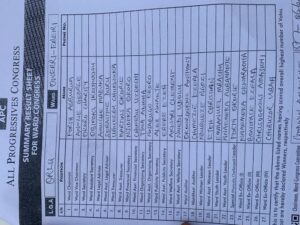
The Ward Party Executive Committee Members for the 305 wards are, however, yet to be fully confirmed.
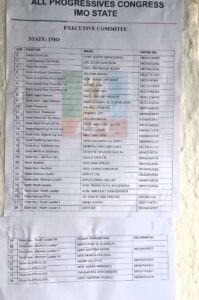
Below is the comprehensive list of the All Progressives Congress State Executive Committee Members for Imo State, including their respective telephone numbers.
ALL PROGRESSIVES CONGRESS
STATE: IMO STATE EXECUTIVE COMMITTEE
State Chairman, Chief Austin Onyedebelu, 08033101685.
State Deputy Chairman, Arc. Allen Enwerem, 08036301966.
State Secretary, Hon. Onyekachi Ibezim, 08033416291.
State Assistant Secretary, Nzenwa Nwoju, 08037717167.
State Zonal Vice Chairman I, Hon. Frank Onyejiaka, 0803314564.
State Zonal Vice Chairman II, Justice Ogu, 08072079223.
State Zonal Vice Chairman III, Dan Chike Ogu, 08037894168.
State Legal Adviser, Barr. Onyeme Promise, 08061526970.
State Assistant Legal Adviser, Barr. Godwin N. Chukwukere, 08033310076.
State Treasurer, Dr. Ben Uwakem, 08033408703.
State Assistant Treasurer, Emenike Uzo, 08098048483.
State Financial Secretary, Rex Onyemara, 07060608457.
State Assistant Financial Secretary, Engr. Innocent Obidike, 08033288662
State Organizing Secretary, Okey Ezuruike, 08033411574.
State Assistant Organizing Secretary, Mrs. Tina Anya, 08068818358.
State Publicity Secretary, Onwuasoanya FCC Jones, 08064483254.
State Assistant Publicity Secretary, Ambrose Nwogwugwu, 08135047154.
State Welfare Secretary, Chinyere Ofurum Sandra, 08069738781.
State Assistant Welfare Secretary, Cecilia Okafor, 08032462478.
State Auditor, Hon. Dan Ikpeazu, 08033263444.
State Assistant Auditor, Hon. Charles Nnorom, 08164341068.
State Woman Leader, Mrs. Ify Obi, 08060850990.
State Assistant Woman Leader, Mrs. Egondu Ewelike, 08089134418.
State Youth Leader, Hon. Franklin Chukwuemeka, 08097123456.
State Assistant Youth Leader, Hon. Innocent Onwuemenyi.
State Special (PCL), Dr. Samuelson Emehibe, 0803902102.
State Senatorial Youth Leader I, Anele Joseph, 08037794751.
State Senatorial Youth Leader II, Chris Ike, 08036034727.
State Senatorial Youth Leader III, Ifeanyi Nwannenna, 08020988164.
State Senatorial Women Leader I, Mrs. Iheako O. Elizabeth.
State Senatorial Women Leader II, Lady Martina Okere, 08036689003.
State Senatorial Women Leader III, Mrs. Franca Onuoha.
State Ex Officio I, Henry Oguguo, 08035001354.
State Ex Officio II, Hon. Alban Amasiatu, 08060564561.
State Ex Officio III, Chukwuma Onyedindere, 08037756307.
State Ex Officio IV, Chief Monday Ikokwu, 08086803626.
Meanwhile, the leadership structure of the All Progressives Congress (APC) in Imo State has been duly constituted, with officials elected across the State, Local Government Area, and Ward levels, reflecting a comprehensive and well-organized party framework.
At the Local Government Area level, notable individuals have emerged as party chairmen in various LGAs.
In Owerri West LGA, Mr. Chikadibia Okpe, was elected as the APC Local Government Chairman.
Similarly, in Orlu LGA, Mr. Ejike Iberame, emerged as the duly elected Party Chairman, while in Oguta LGA, Mr. Obed Onyebuchi, was elected as the APC Chairman, alongside 24 LGA Party Chairmen, to further strengthening the party’s grassroots leadership.
These developments extend across other Local Government Areas and wards, where Party Chairmen and Ward Chairmen have also been elected to provide leadership and coordination at their respective levels.
The successful emergence of party executives at the State, LGA, and Ward levels underscores the APC’s commitment to internal democracy, effective organization, and sustained grassroots mobilization across Imo State.
The release of the list marks a significant step in consolidating the party’s structure across the state, as the newly elected executives are expected to steer the affairs of the APC in Imo State moving forward.

Benita Enwonwu in the 1970s: Model, Actress, and Daughter of Ben Enwonwu

Kidnappers Took Loan With My Phone – Victim Recounts Ordeal

11 more arrested over Ozoro “r@ping festival”

-
Business1 year ago
US court acquits Air Peace boss, slams Mayfield $4000 fine
-

 Trending1 year ago
NYA demands release of ‘abducted’ Imo chairman, preaches good governance
-

 Politics1 year ago
Mexico’s new president causes concern just weeks before the US elections
-

 Politics1 year ago
Putin invites 20 world leaders
-

 Politics1 year ago
Russia bans imports of agro-products from Kazakhstan after refusal to join BRICS
-
Entertainment1 year ago
Bobrisky falls ill in police custody, rushed to hospital
-
Entertainment1 year ago
Bobrisky transferred from Immigration to FCID, spends night behind bars
-
Education2 years ago
GOVERNOR FUBARA APPOINTS COUNCIL MEMBERS FOR KEN SARO-WIWA POLYTECHNIC BORI