
Politics
2027 Presidency: PDP invites Jonathan as party’s fate hangs on NEC 10 Goodluck Jonathans can’t defeat Tinubu, says APC

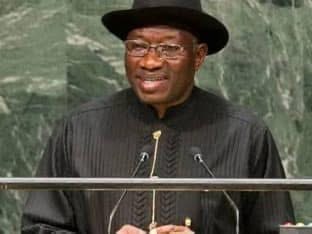
The Peoples Democratic Party has asked former President Goodluck Jonathan to contest the 2027 presidential election on its platform.
In an exclusive interview with Saturday PUNCH, the PDP’s Deputy National Publicity Secretary, Ibrahim Abdullahi, emphasised that it would be a regrettable development if Jonathan chose another party for his presidential bid.
He revealed that the PDP had been eagerly awaiting the former president’s return for a second term, stressing the party’s continued connection to Jonathan’s political rise.
Abdullahi highlighted the party’s historical role in shaping Nigeria’s leadership, citing several notable figures who had emerged from the party.
“We’ve said this about Jonathan and our governors. Even the FCT minister, is arguably the best performer in his role and he is a product of PDP. El-Rufai, Okonjo-Iweala, Dora Akunyili, Obi Ezekwesili, Akinwunmi Adesina, Amina Mohammed… these are the pride of this country, and they are all products of the PDP,” he added.
The PDP chieftain urged Jonathan to heed the call to finish what he started within the party, and warned against the “hypocrisy of the All Progressives Congress.”
If Goodluck Jonathan is seriously considering running, we have been calling him to come back and complete his term. It will not be out of place, but if he runs with another political party, it will expose the hypocrisy within the APC,” he added.
Abdullahi also advised the former president to remain cautious of the recent praise from individuals and groups who previously criticised him.
“It’s crucial for him to remember how he was derided, criticised and reduced to nothing by these same people. Now that they are suddenly calling him the messiah, he must not be swayed by their sudden affection. That would be unfortunate,” Abdullahi stated.
The PUNCH had reported that the recent sighting of Jonathan’s presidential posters for the 2027 elections across major streets in Kano sparked speculations about his possible return to the political arena and intensified conversations about other prominent figures like Peter Obi and Atiku Abubakar.
The posters, which were seen at strategic locations such as Gyadi-Gyadi/Zoo Road flyover, Kofar Nasarawa, and State Road, featured messages like, ‘Team New Nigeria 2027; The Goodluck Nigeria Needs—Dr Goodluck Jonathan.’
The recent campaign posters, our correspondents gathered, were masterminded by a political movement known as ‘Team New Nigeria’, which has been promoting its activities across Nigeria.
The emergence of the posters is similar to a development before the 2023 elections when supporters purchased nomination forms for Jonathan under the APC, but the former president distanced himself from the move.
Another permutation that raised discussions about Jonathan’s possible interest in the 2027 presidential election was the report that key political figures from northern Nigeria had begun efforts to draft Jonathan into the race.
It was reported that the move is based on the belief that Jonathan is eligible to serve another four-year term, having already served as president from 2011 to 2015.
Meanwhile, sources within the PDP have predicted that the future of the party would be determined at its upcoming National Executive Committee meeting, scheduled for February, 2025.
A member of the NEC, who spoke on condition of anonymity, emphasised that the agenda and the way discussions would be handled at the meeting would shape the party’s future.
Since assuming the role of acting National Chairman after Senator Iyorchia Ayu’s court-ordered removal, Umar Damagum has faced mounting criticism from party leaders.
Calls for his resignation have grown louder amid the ongoing turmoil within the party.
At the 98th NEC meeting held on April 18, party leaders approved the establishment of a reconciliation and disciplinary committee, alongside plans for ward and state congresses.
The North Central Caucus was also tasked with consulting to select a replacement for the acting national chairman.
Originally set for August 15, the 99th NEC meeting was first postponed to October 24, 2024, then rescheduled to November 28, 2024.
The PDP Governors Forum, led by Bauchi State Governor Bala Mohammed, later directed the National Working Committee to ensure the NEC meeting held by February at the latest.
Additionally, the Chairman of the Board of Trustees and former Senate President Adolphus Wabara, echoed this call, urging the NWC to convene the NEC meeting in February.
According to a source familiar with the situation, the NEC meeting will be critical in addressing the party’s pressing concerns.
The source stated, “The NEC, like all previous meetings, is where crucial decisions are made. The proposed February NEC meeting will decide the party’s future, whether it happens or not.”
However, logistical challenges and differing agendas have made convening the meeting difficult.
The source warned that the longer the delay in holding the meeting, the more detrimental it would be for the PDP.
“The sooner the meeting is held, the more carefully the issues must be addressed, as every decision made at the NEC carries significant consequences,” the source explained.
But the immediate past Deputy National Publicity Secretary of the PDP, Diran Odeyemi, told Saturday PUNCH that the delay in the NEC meeting was due to deeper reasons within the party.
He suggested that if the ultimate goal is to remove Damagum, he would do everything in his power to prevent the meeting where such a move could be made.
“Damagum, being a shrewd politician, is not ready to leave his post,” he stated.
Odeyemi argued that if the PDP’s intention was to seek peace, it must align with Damagum and his supporters and allow the situation to settle before pushing for further changes.
“If you cannot manage yourselves as a political party, how can you manage the country?” he questioned, cautioning that rushing into the NEC meeting could lead to more crises for the party.
As the February NEC meeting looms, the future direction of the PDP remains uncertain, with key decisions that could shape the party’s future and impact Nigeria’s political landscape listed as part of the agenda.
10 Goodluck Jonathans can’t defeat Tinubu – APC
Reacting to the invitation of the PDP to Jonathan to run on its platform, the APC said another defeat awaited the former president if he heeded the call.
In 2015, Jonathan ran on the platform of the PDP but was defeated by the APC flag bearer, Muhammadu Buhari, in the presidential election.
The former military dictator polled 15,424,921 votes to relegate the ex-president, who garnered 12,853,162 votes, to second place.
The election marked the first time an incumbent president had lost re-election in Nigeria.
In a telephone interview with our reporter, the National Director of Publicity of the APC, Bala Ibrahim, said, “There is just no way the APC will be jittery, if at all, there is such a plan to enrol former President Goodluck Jonathan into the race. The APC defeated him when he was in power. Defeating him when he’s out of power will be a walkover.
“It is something that cannot even give the party a sleepless night. So, whoever is making this permutation, if the intention is to scare the APC, I think he needs to go back to the drawing board and think again. We are not worried.
“However, I think it is too premature for us to be talking about 2027. After all, less than 40 per cent of the mandate given to the president under APC has not even been consumed. Let’s get to the river before we start thinking of crossing it. But if you bring 10 former President Jonathans, they cannot defeat the APC as of today.
“The APC defeated Goodluck Jonathan when the president was the leader of the party. The APC will defeat him again now that Tinubu is the president and the leader of the party. It is not Buhari’s cult followership that matters. It is the party arrangement. Buhari did not contest on independent candidature status.”







March 20, 2026
The All Progressives Grand Alliance in Abia State has called on the Senate to declare the seat of the Senator representing Abia South, Enyinnaya Abaribe, vacant following his resignation from the party.
The party made the call on Thursday during a press briefing in Umuahia, where its leadership, led by a former member of the Abia State House of Assembly, Obinna Ichita, insisted that Abaribe voluntarily resigned from APGA and was not sacked, contrary to his claim at the Senate.
Ichita argued that Abaribe’s exit from the party that sponsored his election violates constitutional provisions, stressing that there was no leadership crisis within APGA to justify his defection.
“The senator resigned in his ward. He did so voluntarily, which is his right. However, if you leave the party that gave you the platform for another party when there is no leadership crisis, that seat must be declared vacant,” he said.
He further alleged that Abaribe misrepresented the circumstances of his exit by claiming he was sacked.
“The party has documentary evidence to show that Senator Abaribe was not sacked. He resigned three months after disciplinary measures were taken against him over actions the court did not consider appropriate,” Ichita added.
According to him, the mandate belongs to the people and the party, not the individual office holder.
“They gave him the mandate on the platform of APGA, not any other party. There was nothing like ADC when he was elected. He cannot take the mandate elsewhere without consulting the people who gave it to him,” he said.
Ichita maintained that the constitution is clear on defection, noting that any lawmaker who leaves a party without a valid internal crisis must vacate the seat.
“My message to Senator Abaribe is to honourably vacate the seat instead of waiting for the National Assembly to declare it vacant. That would amount to national embarrassment,” he added.
Also speaking, the APGA State Chairman, Sunday Onukwubiri, and the party’s Public Relations Officer, Chukwuemeka Nwokoro, reiterated that Abaribe had distanced himself from the party’s activities at various levels in the state.
They insisted that he neither holds dual membership nor was he expelled, maintaining that his resignation was voluntary.
“He was invited by the party but failed to appear and was subsequently suspended in line with the party’s constitution. Three months later, he resigned,” the officials said.
Reacting, Abaribe defended his position, insisting that he acted within his constitutional rights.
“When you are no longer a member of a party by virtue of being sent away, you have the fundamental right of association to join another party,” he said.
He argued that his indefinite suspension by APGA effectively amounted to expulsion.
“If a party places you on indefinite suspension for more than six months, what does that mean? It means you have been told to go elsewhere, and that is exactly what I did,” he stated.
The senator added that the proper constitutional procedure for removing him from office would be through a recall process by his constituents.
“If the people who elected me no longer want me, the right thing to do is to initiate a recall. That is the position of the law,” he said.
Politics
Tinubu’s Reforms May Be Challenging, but They’ve Boosted Nigeria’s Global Respect — Information Minister Mohammed Idris
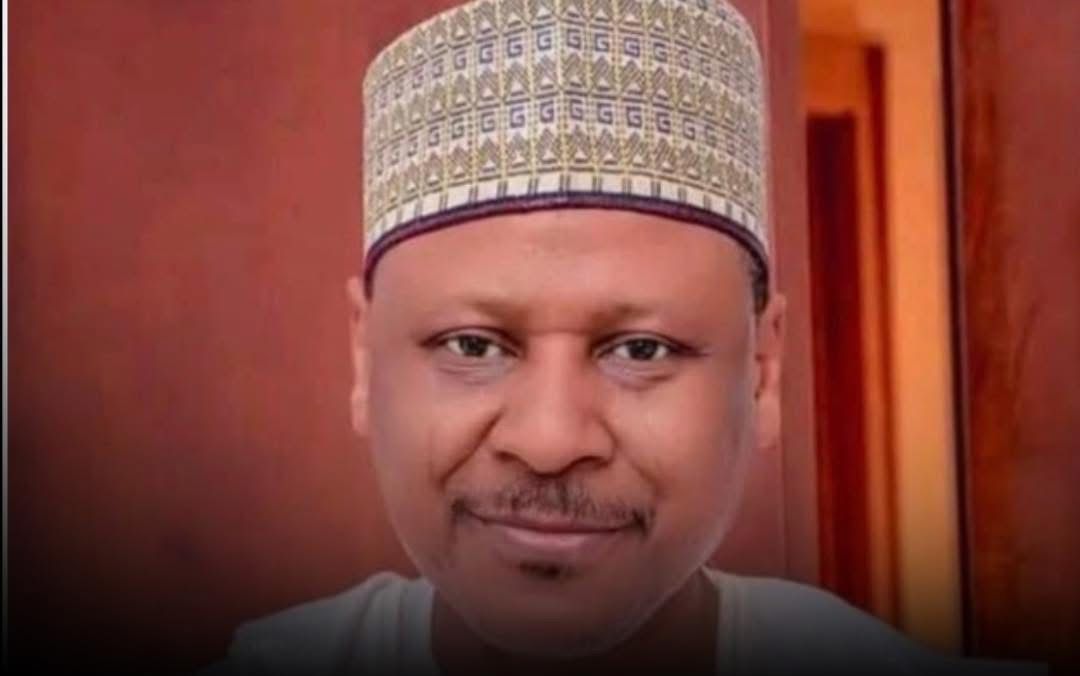
The Minister of Information and National Orientation, Mohammed Idris, has stated that Nigeria is receiving greater respect internationally under the leadership of President Bola Tinubu.
Speaking on Friday after attending Jumaat prayers at Yahaya Road Mosque in Kaduna, Mr Idris said, “Nigeria is indeed taking its rightful place. The country is respected more than ever before on the international scene. The reforms that the president has instituted, as challenging as they are, are meant for the benefit of all Nigerians.”
He urged Nigerians to stay calm as the government continues its efforts to restore security across the nation. Referring to the recent multiple b%mb att@cks in Maiduguri, Borno State, the minister assured that such incidents would not be allowed to recur.
“Indeed, our country is facing challenges, and the government is working tirelessly to ensure security throughout Nigeria. We have seen what has happened, particularly in Borno State. We pray to Allah to make this the last one, as the government is committed to preventing any repetition of such incidents,” he said.
Mr Idris also stressed the importance of citizens being prayerful and working together to address the country’s challenges. He encouraged both Muslims and non-Muslims to unite in the interest of Nigeria’s growth and development.
“This is a time for reflection for all Nigerians. We pray that everyone will consider this moment and recognize the need for unity, progress, and national development. All hands must be on deck for the unity of the country. As we earn respect internationally, we also hope and pray that unity will strengthen within our nation,” he added.
By Dan Opara
Following the successful conduct of the Imo State APC Congress held in Owerri, Imo State, on March 3rd, 2026, the leadership of the party has officially released the list of victorious candidates who emerged from the exercise.
The announcement, made on Friday, March 20th, 2026, came 17 days after the Congress, as gathered by ThePressman Newspaper.
According to the released list, Chief Austin Onyedebelu emerged as the Imo State APC Chairman, while Arc. Allen Enwerem was elected as the State Deputy Chairman. Hon. Onyekachi Ibezim secured the position of State Secretary, alongside 33 other members who now constitute the State Party Executive Committee, including Ex-Officio members in Imo State.
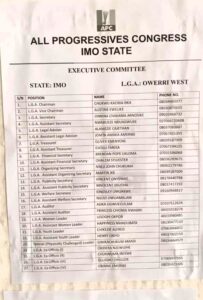
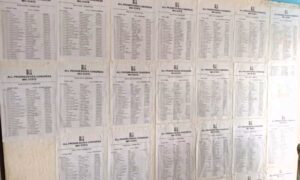
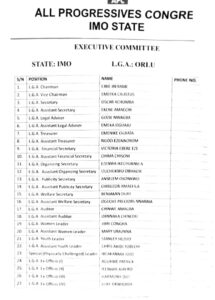
In addition, the leadership of the ruling APC across the 27 Local Government Areas of Imo State has also been announced.
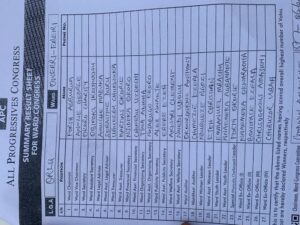
The Ward Party Executive Committee Members for the 305 wards are, however, yet to be fully confirmed.
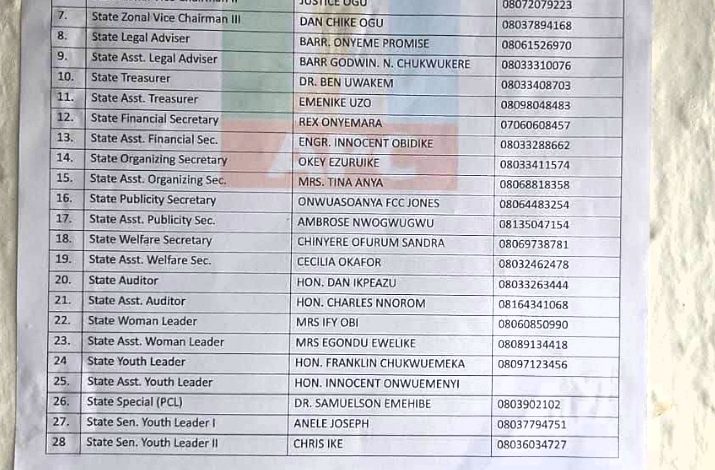
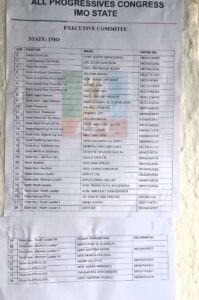
Below is the comprehensive list of the All Progressives Congress State Executive Committee Members for Imo State, including their respective telephone numbers.
ALL PROGRESSIVES CONGRESS
STATE: IMO STATE EXECUTIVE COMMITTEE
State Chairman, Chief Austin Onyedebelu, 08033101685.
State Deputy Chairman, Arc. Allen Enwerem, 08036301966.
State Secretary, Hon. Onyekachi Ibezim, 08033416291.
State Assistant Secretary, Nzenwa Nwoju, 08037717167.
State Zonal Vice Chairman I, Hon. Frank Onyejiaka, 0803314564.
State Zonal Vice Chairman II, Justice Ogu, 08072079223.
State Zonal Vice Chairman III, Dan Chike Ogu, 08037894168.
State Legal Adviser, Barr. Onyeme Promise, 08061526970.
State Assistant Legal Adviser, Barr. Godwin N. Chukwukere, 08033310076.
State Treasurer, Dr. Ben Uwakem, 08033408703.
State Assistant Treasurer, Emenike Uzo, 08098048483.
State Financial Secretary, Rex Onyemara, 07060608457.
State Assistant Financial Secretary, Engr. Innocent Obidike, 08033288662
State Organizing Secretary, Okey Ezuruike, 08033411574.
State Assistant Organizing Secretary, Mrs. Tina Anya, 08068818358.
State Publicity Secretary, Onwuasoanya FCC Jones, 08064483254.
State Assistant Publicity Secretary, Ambrose Nwogwugwu, 08135047154.
State Welfare Secretary, Chinyere Ofurum Sandra, 08069738781.
State Assistant Welfare Secretary, Cecilia Okafor, 08032462478.
State Auditor, Hon. Dan Ikpeazu, 08033263444.
State Assistant Auditor, Hon. Charles Nnorom, 08164341068.
State Woman Leader, Mrs. Ify Obi, 08060850990.
State Assistant Woman Leader, Mrs. Egondu Ewelike, 08089134418.
State Youth Leader, Hon. Franklin Chukwuemeka, 08097123456.
State Assistant Youth Leader, Hon. Innocent Onwuemenyi.
State Special (PCL), Dr. Samuelson Emehibe, 0803902102.
State Senatorial Youth Leader I, Anele Joseph, 08037794751.
State Senatorial Youth Leader II, Chris Ike, 08036034727.
State Senatorial Youth Leader III, Ifeanyi Nwannenna, 08020988164.
State Senatorial Women Leader I, Mrs. Iheako O. Elizabeth.
State Senatorial Women Leader II, Lady Martina Okere, 08036689003.
State Senatorial Women Leader III, Mrs. Franca Onuoha.
State Ex Officio I, Henry Oguguo, 08035001354.
State Ex Officio II, Hon. Alban Amasiatu, 08060564561.
State Ex Officio III, Chukwuma Onyedindere, 08037756307.
State Ex Officio IV, Chief Monday Ikokwu, 08086803626.
Meanwhile, the leadership structure of the All Progressives Congress (APC) in Imo State has been duly constituted, with officials elected across the State, Local Government Area, and Ward levels, reflecting a comprehensive and well-organized party framework.
At the Local Government Area level, notable individuals have emerged as party chairmen in various LGAs.
In Owerri West LGA, Mr. Chikadibia Okpe, was elected as the APC Local Government Chairman.
Similarly, in Orlu LGA, Mr. Ejike Iberame, emerged as the duly elected Party Chairman, while in Oguta LGA, Mr. Obed Onyebuchi, was elected as the APC Chairman, alongside 24 LGA Party Chairmen, to further strengthening the party’s grassroots leadership.
These developments extend across other Local Government Areas and wards, where Party Chairmen and Ward Chairmen have also been elected to provide leadership and coordination at their respective levels.
The successful emergence of party executives at the State, LGA, and Ward levels underscores the APC’s commitment to internal democracy, effective organization, and sustained grassroots mobilization across Imo State.
The release of the list marks a significant step in consolidating the party’s structure across the state, as the newly elected executives are expected to steer the affairs of the APC in Imo State moving forward.

Benita Enwonwu in the 1970s: Model, Actress, and Daughter of Ben Enwonwu

Kidnappers Took Loan With My Phone – Victim Recounts Ordeal

11 more arrested over Ozoro “r@ping festival”

-
Business1 year ago
US court acquits Air Peace boss, slams Mayfield $4000 fine
-

 Trending1 year ago
NYA demands release of ‘abducted’ Imo chairman, preaches good governance
-

 Politics1 year ago
Mexico’s new president causes concern just weeks before the US elections
-

 Politics1 year ago
Putin invites 20 world leaders
-

 Politics1 year ago
Russia bans imports of agro-products from Kazakhstan after refusal to join BRICS
-
Entertainment1 year ago
Bobrisky falls ill in police custody, rushed to hospital
-
Entertainment1 year ago
Bobrisky transferred from Immigration to FCID, spends night behind bars
-
Education2 years ago
GOVERNOR FUBARA APPOINTS COUNCIL MEMBERS FOR KEN SARO-WIWA POLYTECHNIC BORI