
Politics
Harris, Trump and demographics in the US election

In the US presidential election in November, roughly 244 million people are eligible to vote. What demographic groups make up the country’s voting population? And how have they voted in the past?
In 2024, election day in the United States falls on November 5 — the first Tuesday after the first Monday in November. Roughly 244 million US citizens over the age of 18 are eligible to cast their votes, according to the Bipartisan Policy Center think tank, though some states strip that right from people who have been convicted of felonies.
The US has seen an increase in voter participation in recent years. In 2016, only about 59% of eligible voters cast ballots in the presidential election. In 2020, that number stood at 66% — the highest rate for any national election since 1900, according to the Pew Research Center.

Democrats or Republicans? On November 5, millions of US voters have a choice to make.
© imago/UIG
Race in the US election
Race is a key factor in US electoral politics. And there are large disparities between different races when it comes to how many people show up to vote: In the 2020 election, almost 71% of white voters cast ballots compared to only 58.4% of non-white voters, according to the Brennan Center for Justice law and policy institute. That election saw 62.6% of Black American voters, 53.7% of Latino American voters, and 59.7% of Asian American voters cast ballots.
Over the years, the Brennan Center reports, several states have made registering to vote harder ― specifically, states that were governed by Republicans and that had seen an increase in non-white voter turnout in the years prior.
Traditionally, Black US-Americans are more likely to vote Democrat, and 2020 was no exception: In all, 87% of Black voters cast their ballot for the Democratic Joe Biden-Kamala Harris ticket. The majority of white voters in the 2020 election, 58%, cast their ballot for Republican Donald Trump and his running mate Mike Pence, while 65% of Latino voters and 61% of Asian American voters cast their ballot for Biden, according to exit polls.
While it’s unclear whether these groups will vote for the same party again in this presidential election, we do know that there will be more eligible Black voters in 2024 than there were in 2020. According to the Pew Research Center, their number will stand at an estimated 34.4 million, which is a 7% increase compared to 2020. This also means that a larger part of the US electorate is Black. In 2000, 12.1% of all eligible US voters were Black. In the 2024 election, the Pew Research Center projects that 14% of eligible voters will be Black.
Whether this will be an advantage for Kamala Harris, who was voted the Democratic candidate for president after Biden dropped out of the race, remains to be seen. As mentioned above, turnout among Black voters is lower than among white voters. And the percentage of Black voters casting their ballot for the Democratic candidate has been decreasing slightly since 2012, when Barack Obama last ran. The fact that Harris, who is Black and South Asian-American (her father is Jamaican American, her mother was Indian American; both came to the US as young adults) was on the ticket in 2020 could not reverse that trend. It’s unclear as of yet whether it will make a difference this time around, when she is the candidate for president, not just vice president.
Age of US voters
From 2016 to 2020, there was a significant increase in voter turnout among young voters, those aged 18 to 29. In 2016, an estimated 39% of them voted, while in 2020, that number went up to 50%, according to the Center for Information and Research on Civic Learning and Engagement at Tufts University in Massachusetts.
And where do young voters stand on the political spectrum? Exit polls after the 2020 election showed that 60% of all young voters cast their ballot for Biden, and only 36% for Trump. The majority of voters aged 30 to 44 also cast their ballot for Biden, though their majority was a slimmer one at 52%. Trump won the majority of voters (62%) aged 65 and over.
In 2023, 66% of registered US voters aged 18 to 24 said they were Democrat or Democrat-leaning, as did 64% of voters aged 25 to 29. Among voters in their 30s, the majority is slimmer: In all, 55% associated themselves with the Democrats, while 42% said they were Republican or Republican-leaning. Republicans have the largest majority with voters over the age of 80: Fifty-eight percent of them associated themselves with the Republicans and only 39% with the Democrats, according to the Pew Research Center.

Will young Americans be as enthusiastically involved with the 2024 election as these young voters were in the 2018 midterms?
© picture alliance/ZUMAPRESS
Female Biden and Trump voters
Since 1980, women have consistently turned out to vote at higher rates than men in presidential elections. In 2020, 68.4% of women who were eligible to vote did so, compared to 65% of men, according to the Center for American Women and Politics (CAWP) at Rutgers University in New Jersey.
CAWP also states that “in every presidential election since 1996, a majority of women have preferred the Democratic candidate.”
There are, however, differences when it comes to white women and those of other ethnicities. Since the 2000 election, the majority of white women has voted for the Republican candidate in US presidential elections, whereas a large majority of Black, Latina and Asian women has been voting for the Democratic candidate for the entire time this information has been collected.
In the 2020 election, 57% of women as a whole voted for Biden and 42% for Trump (53% of men voted for Trump and 45% of men for Biden.) Among white women, only 44% voted for Biden in 2020 and 55% for Trump, according to CAWP. The picture is starkly different for Black women. Ninety percent of them voted for Biden in 2020 and only 9% for Trump.
In a poll published in June 2024 researchers for US health charity KFF, formerly the Kaiser Family Foundation, found that among female voters, more Biden supporters seemed to be turning away from their candidate than among Trump supporters.
Of women who voted for Biden in 2020, 83% said they’d do the same again in the upcoming election. Seven percent said they’d vote for Trump this time around and 10% said they’d vote for someone else or not at all.

Trump has passionate supporters, many of them women.
© Wilfredo Lee/AP Photo/picture alliance
Of women who voted for Trump on the other hand, 92% said they’d vote for him again in the 2024 election, and none said they’d vote for Biden instead. Seven percent said they’d vote for someone else or not at all.
But Biden is, of course, not on the ballot anymore. Whether Harris can win back the female voters whose support Biden lost is one of the big questions that will be answered once November 5 rolls around.
Edited by: Timothy Jones
Author: Carla Bleiker, Jon Shelton







Politics
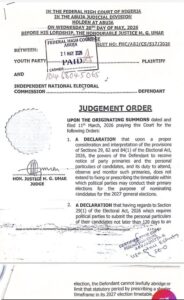
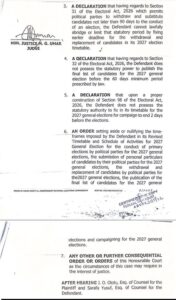
FEDERAL HIGH COURT STOPS INEC FROM RESTRICTING DEFECTION TO ANOTHER PARTY AFTER CONTESTING PRIMARY
Here is the judgement from the Federal High Court, Abuja today
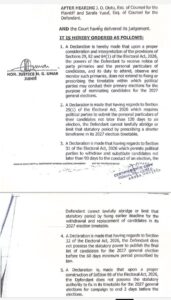
1. INEC can only monitor 2027 primaries but cannot fix timetable for when a political party should conduct its primaries for this election
2. INEC cannot give a shorter timeframe or abridge the period in which a political party can provide information of their candidates for 2027 election
3. INEC cannot give a shorter timeframe to political parties as regards withdrawal or replacement of candidates (Placeholders)
4. INEC cannot publish any final list of candidates for 2027 elections before 60 days to election.
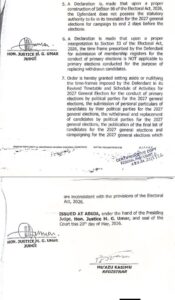
5. INEC cannot fix 2027 campaigns to end 2 days to elections.
6. This is AN ORDER nullifying and setting aside the timeframes imposed by INEC for 2027 General Election for:
– the conduct of primary elections by political parties for the 2027 general elections
– the submission of personal particulars of candidates by their political parties for the 2027 general elections
– the withdrawal and replacement of candidates by political parties
– the publication of the final list of candidates for the 2027 general elections and campaigning.
Is this a trap or a game changer for some aspirants???

A Rivers State politician, Blessing Fubara, has declared his intention to contest the 2027 governorship election in Rivers State under the platform of the Nigeria Democratic Congress.
The politician has already obtained both the nomination and expression of interest forms needed to participate in the governorship race ahead of the 2027 election.
Blessing Fubara shares the same surname and local government area with the current Rivers State Governor, Siminalayi Fubara.
Both men are from Opobo/Nkoro Local Government Area. However, there has been no confirmation that they are family members.
The Chairman of the NDC in Rivers State, Success Jack, confirmed that Blessing Fubara is among those seeking the party’s governorship ticket.
He also stated that he could not confirm whether the governorship aspirant is related to Governor Siminalayi Fubara.
According to him, the party is preparing seriously for the 2027 general elections and hopes to win not only the governorship seat but other elective positions in Rivers State.
The development comes weeks after Blessing Fubara left the All Progressives Congress and joined the NDC.
Following his defection in Abuja, he was received by former Bayelsa State Governor, Seriake Dickson, alongside other leaders and members of the party.
After joining the NDC, Blessing Fubara said his decision was taken for the interest of Rivers people.
He also stated that the future of the state must be protected ahead of the next general election, expressing confidence that the state would experience positive changes after the 2027 polls.

Surulere I lawmaker Desmond Elliot has withdrawn from the All Progressives Congress Lagos House of Assembly primaries, citing intimidation across multiple zones.
In a viral video posted online, the lawmaker said he was stepping out of the race despite seeking re-election under the APC. He alleged that his supporters faced intimidation during the process in several parts of the constituency.
Elliot’s decision came as the primaries held across Lagos on Tuesday. Chief of Staff to the President Femi Gbajabiamila, who represents Surulere Federal Constituency, praised the conduct of the exercise in Surulere, describing it as peaceful.
The withdrawal narrows the contest for the APC ticket in Surulere I ahead of the 2027 general election. Party officials in Lagos have not yet responded to Elliot’s claims, and the APC state chapter has not announced whether the primary in the constituency will proceed with other aspirants.
Elliot has represented Surulere I in the Lagos State House of Assembly since 2015.
https://www.instagram.com/reel/DYkCaAiMxxt/?igsh=ZWw5czl6MHJhNnRy

FEDERAL HIGH COURT STOPS INEC FROM RESTRICTING DEFECTION TO ANOTHER PARTY AFTER CONTESTING PRIMARY

OBOWO LOCAL GOVERNMENT AUTHORITY CONDEMNS GRUESOME MURDER OF STUDENT OF COLLEGE OF NURSING SCIENCE, UMULOGHO

“It Was Sweet Blue Candy” – Hon Doguwa debunked rumour he’s a drvg add!ct

-
Business2 years ago
US court acquits Air Peace boss, slams Mayfield $4000 fine
-

 Trending2 years ago
NYA demands release of ‘abducted’ Imo chairman, preaches good governance
-

 Politics2 years ago
Mexico’s new president causes concern just weeks before the US elections
-

 Politics2 years ago
Putin invites 20 world leaders
-

 Politics2 years ago
Russia bans imports of agro-products from Kazakhstan after refusal to join BRICS
-
Entertainment2 years ago
Bobrisky falls ill in police custody, rushed to hospital
-
Entertainment2 years ago
Bobrisky transferred from Immigration to FCID, spends night behind bars
-
Education2 years ago
GOVERNOR FUBARA APPOINTS COUNCIL MEMBERS FOR KEN SARO-WIWA POLYTECHNIC BORI