
Politics
Surge in Russian drone strikes test Ukrainian defences and devastate families

Maria Troyanivska had come home early the night a Russian drone hit her bedroom.
“It flew in through the window, right into her room,” her mother Viktoria tells the BBC. After the explosion, she and her husband Volodymyr ran from the next room to find their daughter’s room on fire.
“We tried to put it out, but everything was burning so strongly,” she says through tears. “It was impossible to breathe – we had to leave.”
The Russian Shahed drone killed the 14-year-old in her bed, in her suburban apartment in Kyiv, last month.
“She died immediately, and then burned,” her mother said. “We had to bury her in a closed coffin. She had no chance of surviving.”

A Russian drone flew through Maria’s window, killing her instantly and incinerating the room
© BBC/Kamil Dayan Khan
Russia is massively increasing drone strikes on Ukraine. More than 2,000 were launched in October, according to Ukraine’s general staff – a record number in this war.
The same report says Russia fired 1,410 drones in September, and 818 in August – compared with around 1,100 for the entire three-month period before that.
It’s part of a wider resurgence for Russian forces. The invaders are advancing all along the front lines. North Korean troops have joined the war on Moscow’s side. And with the election of Donald Trump for a second term as US president, Ukraine’s depleted and war-weary forces are facing uncertain support from their biggest military donor.
The majority of the Russian drones raining down on Ukraine are Iranian-designed Shaheds: propeller-driven, with a distinctive wing shape and a deadly warhead packed into the nose cone.
Russia has also started to launch fake drones, without any explosives, to confuse Ukraine’s air defence units and force them to waste ammunition.
Compared to missiles they are much cheaper to build, easier to fire, and designed to sap morale.
Every night, Ukrainians go to sleep to notifications pinging on their phones, as inbound drones crisscross the country, setting sirens blaring.
And every morning, they wake to news of yet another strike. Just since the start of November, drones have hit Kyiv, Kharkiv, Odesa, Mykolaiv and Zaporizhzhia.
On Sunday, Russia launched 145 drones at Ukraine, according to President Volodymyr Zelensky – a record number for a single day since the start of the full-scale invasion.
Kyiv said that day it had managed to shoot down 62 drones, and that a further 67 were “lost” – meaning they were either downed by electronic warfare, or disappeared from radar screens.
Ukrainian air defences are struggling to cope with the surging numbers.

Surge in Russian drone strikes test Ukrainian defences and devastate families
“So far we have been intercepting them. I hope we will keep intercepting them,” Sgt Mykhailo Shamanov, a spokesperson for Kyiv city military administration, told the BBC.
While he says Russia tries to hit military installations, the “general aim is terrorising civilians”.
They know the Russians will continue to ramp up these attacks, he said – it’s why his government is constantly asking for more air defence from Western allies.
It’s also why Ukraine is nervously waiting to see how US President-elect Trump will approach the war when he re-enters office.
“Even if air defence works well, drone or missile debris falls on the city. It causes fires, damage and unfortunately sometimes victims,” he explained.
“Every night it’s a lottery – where it hits, where it’s shot down, where it falls and what happens.”

Vitaliy’s mobile defence unit defends the skies around Kyiv
© BBC/Kamil Dayan Khan
Vitaliy and his men have no fixed post – their weaponry for shooting down the Shaheds is carried on the back of a flatbed truck, allowing them to manoeuvre quickly.
“We try to monitor, move, outpace the drone, destroy it,” he said.
It’s clear the job is taking its toll.
“Half a year ago, it was 50 drones a month. Now the number has risen to 100 drones, every night,” he said.
Their days are getting longer too. When the Russians used mainly missiles to bomb Ukraine, the unit commander said, the air alerts would last about six hours. “Now, it’s around 12 or 13 hours,” he said.
Vitaliy is confident in front of his men, declaring that they can handle all that the Russians can fire at them if they get weapons from Western allies. “Our guys could even deal with 250 drones [in a night],” he said.
But air defence can only do so much. Ukrainians will continue to suffer until Russia stops its invasion and its air assaults on cities.
Viktoria says their lives are now divided into before and after their daughter’s death. They are staying with a friend after the destruction of their flat; she said they sleep in the corridor at night to shelter from the constant drone attacks.

Viktoria says her life is now divided into before and after her daughter’s death
© BBC/Kamil Dayan Khan
“Of course it’s exhausting,” she said. “But it seems to me it makes people even more angry, irritates and outrages them. Because people really cannot understand, especially lately, those attacks that hit peaceful houses.”
“I don’t understand at all why this war started and for what,” Maria’s father, Volodymyr, told the BBC. “What sense does it make? Not from an economic perspective, nor human, territorial – people just die.”
“It’s just some ambitions of sick people.”
Additional reporting by Hanna Chornous and Anastasiia Levchenko

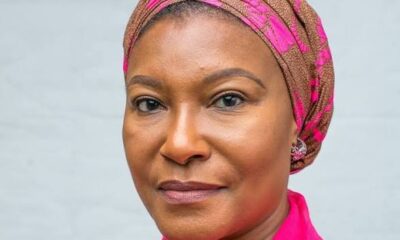








…Commends Uzodimma’s leadership
The Southeast Executive Committee of the All Progressives Congress (APC), has expressed deep appreciation to the party’s elected officials, stakeholders, and members for their unwavering support that made the State Houses of Assembly Primary Election a resounding success.
Speaking on behalf of the Southeast Executive Committee, the party’s National Vice Chairman, Southeast, Dr. Ijeomah Arodiogbu, specifically thanked Imo State Governor Senator Hope Uzodimma, who serves as the leader of the party in the region, for his guidance.
He commended the governor for his consistent support that guaranteed peaceful and successful primaries, and noted that his leadership provided the necessary framework for harmony, encouraging all participants to prioritize collective progress over individual interests.
Dr. Arodiogbu further congratulated all winners of the primaries, urging them to embrace humility in victory.
He emphasized the importance of remaining grounded as the party works to consolidate its achievements and prepare effectively for the 2027 general elections.
He also reiterated APC’s commitment to inclusive participation and strategic planning across the Southeast and said that with these successful primaries, the party signals readiness to build on its foundation, delivering impactful representation and addressing the needs of citizens in the zone.
The primaries held smoothly across the five states of the Southeast geopolitical zone on Wednesday, May 20, 2026, reflecting strong unity and commitment within the party ranks.
This achievement underscored the growing strength of the APC in the region, where diligent coordination and collective efforts translated into orderly processes free from major disruptions.
Politics
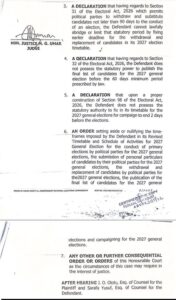
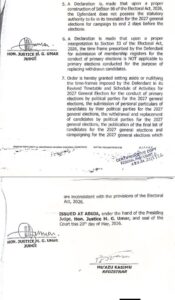
FEDERAL HIGH COURT STOPS INEC FROM RESTRICTING DEFECTION TO ANOTHER PARTY AFTER CONTESTING PRIMARY

Here is the judgement from the Federal High Court, Abuja today
1. INEC can only monitor 2027 primaries but cannot fix timetable for when a political party should conduct its primaries for this election
2. INEC cannot give a shorter timeframe or abridge the period in which a political party can provide information of their candidates for 2027 election
3. INEC cannot give a shorter timeframe to political parties as regards withdrawal or replacement of candidates (Placeholders)
4. INEC cannot publish any final list of candidates for 2027 elections before 60 days to election.
5. INEC cannot fix 2027 campaigns to end 2 days to elections.
6. This is AN ORDER nullifying and setting aside the timeframes imposed by INEC for 2027 General Election for:
– the conduct of primary elections by political parties for the 2027 general elections
– the submission of personal particulars of candidates by their political parties for the 2027 general elections
– the withdrawal and replacement of candidates by political parties
– the publication of the final list of candidates for the 2027 general elections and campaigning.


Is this a trap or a game changer for some aspirants???

A Rivers State politician, Blessing Fubara, has declared his intention to contest the 2027 governorship election in Rivers State under the platform of the Nigeria Democratic Congress.
The politician has already obtained both the nomination and expression of interest forms needed to participate in the governorship race ahead of the 2027 election.
Blessing Fubara shares the same surname and local government area with the current Rivers State Governor, Siminalayi Fubara.
Both men are from Opobo/Nkoro Local Government Area. However, there has been no confirmation that they are family members.
The Chairman of the NDC in Rivers State, Success Jack, confirmed that Blessing Fubara is among those seeking the party’s governorship ticket.
He also stated that he could not confirm whether the governorship aspirant is related to Governor Siminalayi Fubara.
According to him, the party is preparing seriously for the 2027 general elections and hopes to win not only the governorship seat but other elective positions in Rivers State.
The development comes weeks after Blessing Fubara left the All Progressives Congress and joined the NDC.
Following his defection in Abuja, he was received by former Bayelsa State Governor, Seriake Dickson, alongside other leaders and members of the party.
After joining the NDC, Blessing Fubara said his decision was taken for the interest of Rivers people.
He also stated that the future of the state must be protected ahead of the next general election, expressing confidence that the state would experience positive changes after the 2027 polls.

Tinubu Has No Plan To Rename Nigeria, Abolish Sharia Law In Northern States, Says Presidency

Court dismisses suit seeking to uphold Kingibe’s suspension, fines plaintiffs and counsel N20m

APC Southeast hails successful State Assembly primaries

-
Business2 years ago
US court acquits Air Peace boss, slams Mayfield $4000 fine
-

 Trending2 years ago
NYA demands release of ‘abducted’ Imo chairman, preaches good governance
-

 Politics2 years ago
Mexico’s new president causes concern just weeks before the US elections
-

 Politics2 years ago
Putin invites 20 world leaders
-

 Politics2 years ago
Russia bans imports of agro-products from Kazakhstan after refusal to join BRICS
-
Entertainment2 years ago
Bobrisky falls ill in police custody, rushed to hospital
-
Entertainment2 years ago
Bobrisky transferred from Immigration to FCID, spends night behind bars
-
Education2 years ago
GOVERNOR FUBARA APPOINTS COUNCIL MEMBERS FOR KEN SARO-WIWA POLYTECHNIC BORI