
Tech
iPhone 17 will copy major rival with radical design change, leak shows

- READ MORE: Apple finally unveils its new budget iPhone – for £599
SHOPPING – Contains affiliated content. Products featured in this Shopping Finder article are selected by our shopping writers. If you make a purchase using links on this page, Dailymail.co.ukwill earn an affiliate commission. Click here for more information.
It’s not expected to be released until September, but speculation is mounting regarding Apple’s upcoming iPhone 17.
Now, newly-leaked imagery gives us the best idea of what the flagship device could look like – and it reveals a radical design change.
On X, Apple tipster Majin Bu posted digital renders of four handsets in the iPhone 17 family, including a slimmed down iPhone 17 Air.
Three of the models have rectangular camera bars across the back – which fans have noticed is very reminiscent of Google’s Pixel phones.
One X user said: ‘can you term “Apple” (the company) as innovative. Especially with their iPhone 17 lineup that’s simply a copy of thegoogle pixel 9 lineup?’
Another posted: ‘Still don’t understand the design choices by Apple, specifically with the Air model and why they chose to copy the Google Pixel.’
It comes just days after Apple’s announcement that it is releasing a new ‘budget’ smartphone – the iPhone 16e.
The £599/$599 gadget has a 6.1-inch display, runs Artificial Intelligence, and brings back the controversial ‘notch’ at the top of the display.

On X, Apple tipster Majin Bu posted digital renders of four handsets in the iPhone 17 family. From left, slimmed down iPhone 17 Air, the basic iPhone 17 model, the iPhone 17 Pro Max and the iPhone 17 Pro
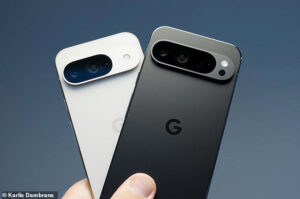
Google’s Pixel phones are notable for their horizonal camera bar along the back. Pictured, the Google Pixel 9 and Pixel 9 Pro XL released in 2024
The new renders are CAD (computer-aided design) files, which are given to third-party manufacturers of iPhone cases ahead of a device’s launch.
‘iPhone 17 Lineup CAD’, Bu said in his X (Twitter) post, which has more than 400,000 views and 200 comments.
The image was published by MacRumours, which said authenticity of the renders is backed by ‘Weibo-based leakers’ in China – where iPhones are produced.
Apple plans to ‘significantly revamp the camera design’ on its upcoming iPhone 17 Pro models,’ MacRumours claims, citing recent reports.
‘[The company is] moving away from the familiar square camera bump to a distinctive aluminum camera bar that spans the device’s width.’
From the image, it seems the iPhone 17 Air – the slim variant set to replace the Plus model – is expected to have a single rear camera.
Meanwhile, the iPhone 17 Pro and Pro Max will both have three camera lenses in an ‘arrow’ alignment – much like previous iPhone Max models.

The difference is that the ‘camera bump’ – the raised section on the back – will stretch across the width of the device, rather than being a square shape.

One X user said: ‘can you term

iPhone 17 Pro and Pro Max will both have three camera lenses in an ‘arrow’ alignment – much like previous iPhone Max models. Pictured, iPhone 16 Pro
It suggests Apple is needing more space on the back of the phone to pack in camera components for its high-end models.
According to the renders, the standard iPhone 17 model, featuring two rear camera lenses, will be the only one not to have the Pixel-esque bar.
The Pro and Pro Max models also have bizarre red areas – which denotes a glass section for the logo area integrated into an overall metal frame, MacRumours suggests.
One commentator on X posted: ‘Pro lineup actually looks horrible, I hope they blend in the materials together for a uniform texture and looks.’
MailOnline has contacted Apple regarding the rumour, although the tech giant is notoriously tight-lipped about any upcoming product.
Fans already know Apple is likely to release a new slimmed-down iPhone model to go alongside the Pro and Pro Max variations this year.
Veteran Apple analyst Mark Gurman says the ‘iPhone 17 Air’ or ‘iPhone 17 Slim’ is expected to be a lighter, thinner option with less powerful hardware.
It will tie in with Apple’s range of ‘Air’ MacBook computers, which are touted for their light and thin design.
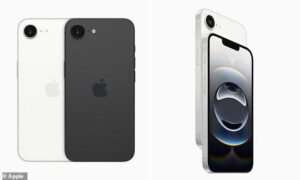
It has the Action button – a little button above the volume controls on the edge of the phone that can turn a chosen setting on or off
Apple’s newest smartphone, the iPhone 16e, is due for release on February 28 – offering a cheaper option for Apple fans.
The device runs Apple Intelligence features, including a ChatGPT integration with smart assistant Siri and the ability to make ‘Genmoji’ (AI-generated emoji).
It also includes a 6.1-inch display, a two-in-one camera system, an ‘extraordinary’ battery life, and the return of the ‘notch’ at the top of the display.
iPhone 16e costs £599/$599 – making it £200 cheaper than the flagship iPhone 16 which was released last autumn.
Apple Intelligence: The best features
Apple Intelligence is essentially a snazzy brand name for Apple’s new-found focus on AI, triggered by the huge success of the ChatGPT.
Here’s a look at some of the best features of Apple Intelligence, which comes to the UK via the new iOS 18.2 operating system.
ChatGPT-Siri integration
Surely the biggest part of Apple Intelligence is the integration of OpenAI’s hugely popular chatbot ChatGPT with Siri, Apple’s in-built virtual assistant.
With better ‘language-understanding capabilities’ enabled by ChatGPT, Siri will help you across multiple apps and ‘accelerate everyday tasks’, Apple said.
You’ll be able to press and hold the side button to activate Siri as normal, but with ChatGPT behind it Siri will be able to ‘answer thousands of questions about how to do something’ that it couldn’t before.

iOS 18 users will be asked before any questions are sent to ChatGPT, along with any documents or photos, and Siri then presents the answer
For example, you could say, ‘Play that podcast that Jamie recommended’ and Siri will locate and play the episode, without the user having to remember whether it was mentioned in a text or an email.
Or you could ask, ‘When is mum’s flight landing?’ and Siri will find the flight details and cross-reference them with real-time flight tracking to give an arrival time.
AI-generated emoji
If you can never quite find the emoji you’re looking for during chat conversations, Apple has the answer.
One of the more fun parts of Apple Intelligence is AI-generated emoji, which Apple has called ‘Genmoji’ (a mix of ‘generated’ and ’emoji’).
In the Messages app, you can type a short description of the emoji you want – such as ‘smiley relaxing wearing cucumbers’ or ‘squirrel DJ’.
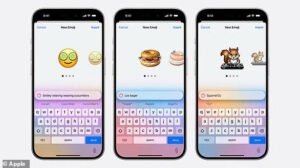
AI-generated emoji: In the Messages app, users can type a short description (e.g. ‘smiley relaxing wearing cucumbers’) to get a unique emoji to send to someone
Similar to AI tools that just need a few words to create weird artworks, from that single prompt Genmoji returns an AI-generated approximation of what you had in mind.
If you don’t like what the AI has made for you, there are a few back-up options for you to choose from.
Clean Up
Apple’s Clean Up tool for the Photos app makes ultra-clean edits to photos – without any telltale signs that the snap has been tampered with in any way.
It lets users remove ‘distracting objects’ from the background of a photo – for example a photobomber in the background of a family snap.
Clean Up is very similar to Google’s photo-editing technology ‘Magic Eraser’ for its Pixel phones, heavily promoted in Google adverts in recent years.

The new Clean Up tool in Apple’s Photos app can identify and remove ‘distracting objects’ in the background of a photo
But the technology has been described by some as ‘Orwellian’ as it can distort reality and ‘create a false memory’.
Referring to Clean Up, one commenter said it ‘can be misused’ because it ‘makes deleting evidence easy’.
Image Playground
AI also powers a new image-generating tool called ‘Image Playground’, which is available on multiple apps, including Messages and Pages.
With Image Playground, users can create images in a few seconds, choosing from three styles – ‘animation’, ‘illustration’ and ‘sketch’.
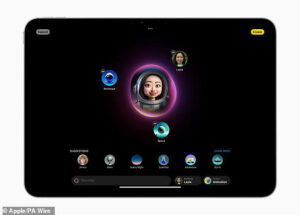
Image Playground allows users to create fun images in seconds, choosing from three styles – Animation, Illustration and Sketch
A promo image appears to show a photo of a person being turned into a video game-style 3D avatar wearing a spacesuit in the ‘animation’ setting.
Rather like Genmoji, this ‘exciting’ image creation tool will help iPhone owners ‘communicate and express themselves in new ways’, the company says.
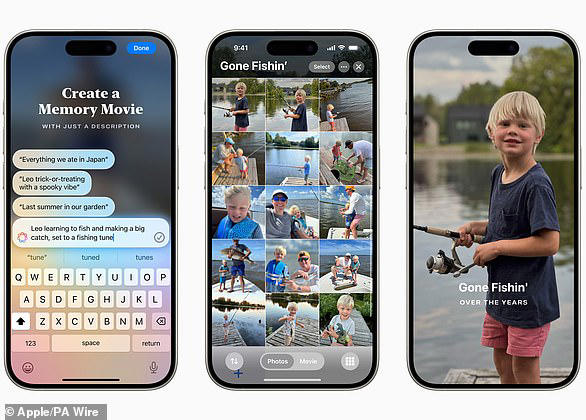
Movie Memories
The vast media storage capabilities of an iPhone means its always tempting to look back through your photos and video for a burst of nostalgia.
Recognizing this, Apple has come up with ‘Movie Memories’, an AI tool that creates the perfect home movie to watch on your device.
By typing a short description – for example ‘last summer in our garden’ – the AI can search your media library and and arrange photos and clips into a movie ‘with its own narrative arc’.

Movie Memories picks out the best photos and videos based on a user’s description and arranges it all into a movie with its own narrative arc
This article may contain affiliate links that Microsoft and/or the publisher may receive a commission from if you buy a product or service through those links.











A jury in Los Angeles has ruled that tech giants YouTube and Meta are liable for negligence in a closely watched case involving a young woman who said she became addicted to their platforms from childhood.
The panel awarded the plaintiff $3 million in compensatory damages, assigning 70 percent of the liability to Meta. Jurors also determined that both companies could face additional punitive damages, with a decision on that yet to be made.
The lawsuit, filed in 2023, alleged that platforms such as Instagram were deliberately designed to create addictive user experiences, particularly for young audiences. According to court filings, the plaintiff began using YouTube at age six and Instagram at nine.
During the trial, a therapist who treated the woman testified that prolonged social media exposure contributed to significant mental health challenges, including social phobia and body image issues.
Both companies have rejected the verdict. Meta argued that teen mental health is influenced by multiple factors and cannot be attributed to a single platform. YouTube, meanwhile, maintained that its service is not inherently addictive.
Legal experts expect both companies to appeal the decision, setting the stage for a potentially influential battle over the responsibility of tech platforms in safeguarding young users.
Google is acquiring energy infrastructure company ‘Intersect’ for $4.75 billion (approximately 7 trillion Korean won) to secure the power needed for its AI (artificial intelligence) data centers. The move aims to address the power issue, the biggest hurdle in expanding data centers. Google, which developed the ‘Gemini’ AI, is a so-called ‘AI full-stack’ company equipped with all AI-related technologies and services, including AI chips and cloud (virtual servers). The strategy is to directly manage the energy infrastructure needed to actually operate AI as well.
Reuters reported on the 22nd (local time) that Google is acquiring Intersect for $4.75 billion in cash. Google already holds a minority stake in Intersect, and through this acquisition, it will also secure the gigawatt (GW)-level energy and data center projects that Intersect is developing and constructing. Intersect is expected to be responsible for building Google’s data center power infrastructure in the U.S., based on its technology linking power generation facilities and power grids.
Sundar Pichai, CEO of Google and Alphabet, said, “Intersect will enable us to build power infrastructure more quickly and flexibly in line with the increasing demand for AI data centers,” adding, “It will also be an important partner in strengthening America’s energy innovation and technological leadership.”
Bloomberg reported that Intersect’s energy assets currently in operation or under construction in the U.S. amount to $15 billion (approximately 22.2 trillion Korean won).
◇Google increasing energy investments
Google has recently been increasing its investments in the energy sector. Although the company possesses AI chips (TPUs), Gemini, and search and cloud services, stable energy supply is essential to support these businesses.
To this end, Google is also investing in nuclear power technology. In October of last year, it signed a long-term cooperation agreement with small modular reactor (SMR) startup ‘Kairos Power’ to secure up to 500 MW (megawatts) of power. It is noted as the first case among big tech companies to publicly declare securing SMR-based power. Additionally, in August, Google and Kairos Power announced plans to build the next-generation SMR ‘Hermes 2’ in Oak Ridge, Tennessee. The goal is to commence operation in 2030.
Google is also restarting previously shut-down nuclear power plants to secure energy. In October, it announced that it will collaborate with ‘NextEra Energy’ to restart the Duane Arnold Nuclear Generating Station in Iowa, which was closed in 2020. The target restart period is between 2028 and 2029.
Google is also investing in renewable energy such as geothermal power. Since 2023, it has been supplying power to data centers through geothermal power generation with ‘Fervo Energy’ in Nevada, U.S.
Google is also actively investing in next-generation energy technologies that are not yet commercialized. In 2022, it made a large-scale investment in ‘TAE Technologies,’ which possesses nuclear fusion technology. Nuclear fusion power generation is a technology that applies the principle of energy creation in the sun, combining atomic nuclei to produce energy. It is called the ‘dream energy’ because it has abundant fuel resources, emits no carbon, and, unlike conventional nuclear power plants, does not produce high-level nuclear waste. However, it is assessed that more time is needed for commercialization due to technical challenges. Recently, TAE Technologies has accelerated the commercialization of fusion energy by merging with Trump Media Group (TMTG).
Tech
“I Lost $1.2 Million To Hackers On One Of My Apps. I Caught One Of The Hackers, And Instead Of Handing Him Over To The Police, I Employed Him To Work For Me.”- BLord

Anambra Born tech entrepreneur and businessman Linus Williams, popularly known as BLord, has shared an unusual story about how he handled a major cyberattack on one of his applications.
According to BLord, he lost $1.2 million to hackers who infiltrated one of his digital platforms. In the course of tracking the incident, he successfully identified one of the individuals involved in the breach.
Rather than handing the suspect over to security agencies, BLord said he made a strategic decision: he employed the hacker.
He explained that the hacker’s skills, though misapplied, were exceptional and could be redirected towards strengthening his company’s cybersecurity systems.
BLord noted that the decision was driven by a desire to turn a negative experience into an opportunity for growth and to better secure his business infrastructure.

Bandits behind Ogbomoso school abduction will face full wrath of the law- President Tinubu

PDP to screen Goodluck Jonathan on Tuesday as its sole Presidential aspirant For 2027 race

Oshiomhole wins Edo APC senatorial primaries unopposed

-
Business2 years ago
US court acquits Air Peace boss, slams Mayfield $4000 fine
-

 Trending2 years ago
NYA demands release of ‘abducted’ Imo chairman, preaches good governance
-

 Politics2 years ago
Mexico’s new president causes concern just weeks before the US elections
-

 Politics2 years ago
Putin invites 20 world leaders
-

 Politics2 years ago
Russia bans imports of agro-products from Kazakhstan after refusal to join BRICS
-
Entertainment2 years ago
Bobrisky falls ill in police custody, rushed to hospital
-
Entertainment2 years ago
Bobrisky transferred from Immigration to FCID, spends night behind bars
-
Education2 years ago
GOVERNOR FUBARA APPOINTS COUNCIL MEMBERS FOR KEN SARO-WIWA POLYTECHNIC BORI