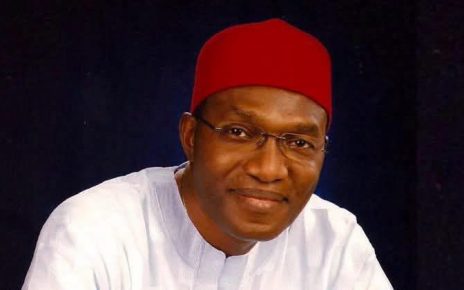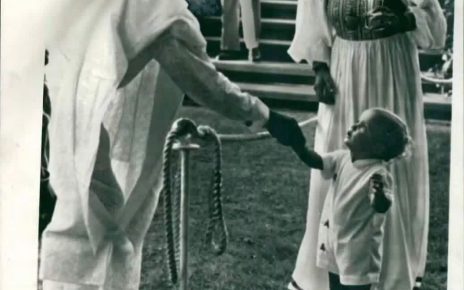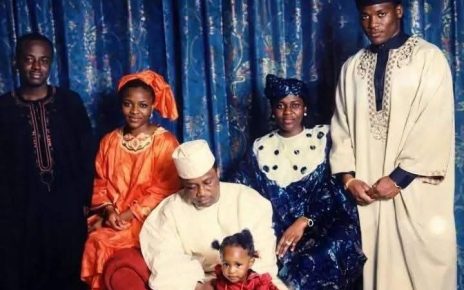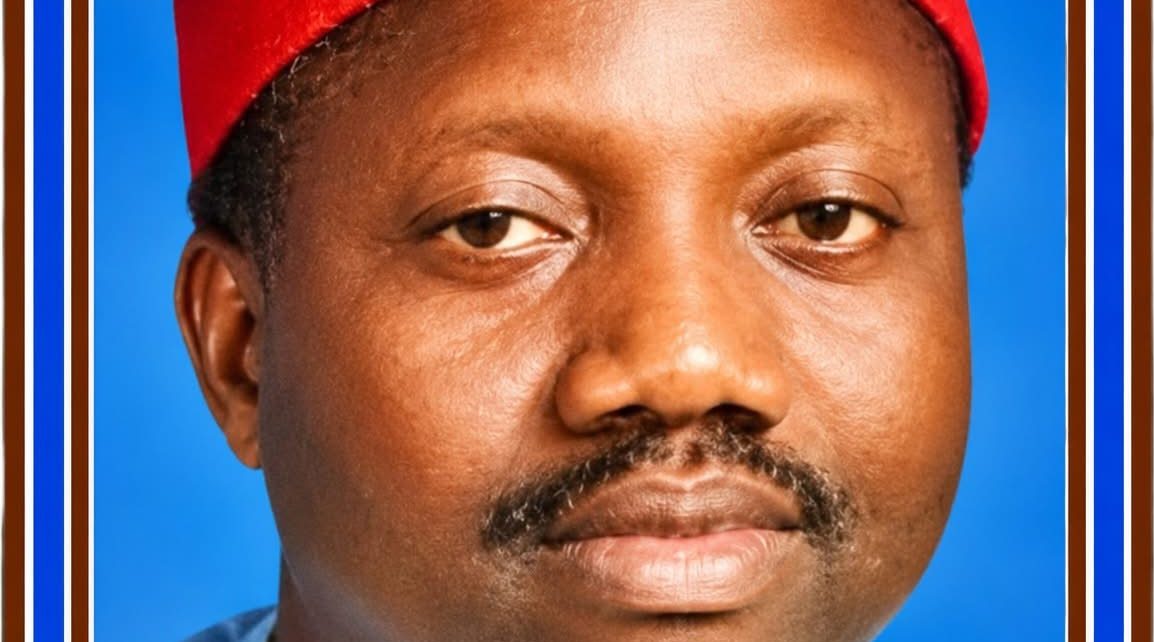
Today we remember Chief Maurice Obasi Ibekwe (1952–2004).
Former Member, House of Representatives, Okigwe North.
A man who served his constituency and left his mark on his generation.
22 years on and we still remember. May his soul rest in peace.
Chief Maurice Obasi Ibekwe (1952–2004) was a well known Nigerian businessman, a philanthropist and a politician from Okwelle in the Onuimo LGA of Imo State. He was best known as the founder of Okwelle Holdings Limited and as a former member of the Federal House of Representatives. His career was one of the first high profile cases to be pursued by the EFCC.
Born 13th June 1952, Ibekwe has a diploma from the Institute of Journalism.
He built his reputation in the trading world in the ’80s with Okwelle Holdings Limited, Rosemoore Nigeria Limited and Okwelle Finance Company Limited. He was a bank director from 1992 to 1993. He was widely known as Akuchinyere Nwata 1 of Okwelle. A very prominent socialite and philanthropist. Legendary Igbo highlife man Oliver De Coque has a whole song in praise of him and his company called “Akuchinyere Nwata”.
Ibekwe entered federal politics in the 1990s and was elected in 1999 under the PDP to represent the Okigwe North (Isiala Mbano/Okigwe/Onuimo) Federal Constituency in the 4th National Assembly. He served as Chairman of the House Committee on Police Affairs during his time in the House of Representatives.
Ibekwe was arrested shortly after the EFCC was established in 2003 on a 1992 “419” advance fee fraud. He was being prosecuted along with an associate, Augunous Okoro, for having defrauded a German businessman (Klaus Munch of Firm System Organisation) of a sum of money through the use of forged documents in relation to a fictitious contract to supply equipment to the Abuja International Airport. He stood trial at the Lagos High Court in Ikeja and was denied bail on several occasions as his health declined. He died in custody on March 20, 2004 at the age of 51 from complications of a kidney illness. He was one of the first major political figures to die in EFCC custody while awaiting trial.
The story of Chief Maurice Obasi Ibekwe is one of big money, highlife culture, federal politics and the nascent days of the anti-graft drive in Nigeria. His story is a complicated one when you look at it in the light of his background, the mechanics of the fraud case that was brought against him and the controversy surrounding his death.
Born June 13 1952 to a father who was a prison officer, Ibekwe came from very modest beginnings. Prior to the private empire, he had worked with Nigerian Airways and had corporate and logistics experience in various postings including Enugu and Kaduna. In the early 1980s he set up Okwelle Holdings Limited which initially was in the tyre and general import business. He then branched out into finance and real estate with the creation of Rosemoore Nigeria Limited and Okwelle Finance Company Limited (a bureau de change) and the acquisition of several luxury properties in the prime areas of Lagos. He was a very extravagant spender and was known to be generous to the community in Imo State. He accrued a number of traditional titles including Akuchinyere Nwata 1 of Okwelle, Akukwesiri of Abba and Ọkaaka of Nkwere.
The case that eventually brought Ibekwe down began a decade before the EFCC existed:
• In 1992 a man using the alias “Dr Anthony Israel” (himself an accountant in the Nigerian Ministry of Transport and Aviation) got in touch with Klaus Munch (German head of Firm System Organisation – Muench System).
• “Dr Israel” claimed a local contractor had failed to deliver the computers, the radar and the landing lights for Abuja International Airport. He told Munch the Ministry absolutely had to get the 30% of a fake $30m contract out to the contractor before the military regime of General Ibrahim Babangida was gone.
• Munch was lured by the deal and went to Nigeria in 1993, paying the initial “sundry” and facilitation fees of $330,000 and 75,000 DM.
• When Munch realised he’d been had he went to the NPF anti-fraud unit in 1995. The police investigators tracked the alias ‘Dr Anthony Israel” right back to Maurice Ibekwe and his partner Augunous Okoro. A prosecutor was ready to bring proceedings in 1997 but the police never actually arrested him.
Ibekwe had been elected to the National Assembly in the aborted Third Republic in 1993. When democracy returned in 1999 he won the Okigwe North Federal Constituency seat under the PDP and was appointed Chairman of the House Committee on Police Affairs. It was widely observed and reported by the media that his direct legislative oversight of the police was what had effectively kept the 1995 fraud file under wraps. He was re-elected in 2003. President Olusegun Obasanjo had just set up the EFCC under Nuhu Ribadu to deal with international advance fee fraud (“419”). The EFCC reopened the cold police file and Ibekwe was arrested in 2003. He was the first sitting Federal Minister to be arrested by the EFCC.
Prior to his arrest, Ibekwe had had a failed medical operation overseas and was due to leave the country for a further operation (for a very serious kidney problem). He was picked up by operatives just two days before his flight.
They were both arraigned at the Lagos High Court in Ikeja alongside Augunous Okoro and his legal team kept on applying for bail on medical grounds. Both the EFCC and the court refused bail, considering him a flight risk in the context of the government’s very aggressive anti-419 drive. As his kidney condition deteriorated while in detention he was eventually moved under guard to the Lagos University Teaching Hospital (LUTH) where he died on 20th March 2004 at the age of 51. Hon. Mike Ohia took over from him in the House of Reps following his death and Augunous Okoro remained in court on the 38 count amended charge for over 10 years afterwards.
To anti-corruption historians, Ibekwe is one of the very first icons of the “419’ era (so to speak) alongside men like Emmanuel Nwude and Fred Ajudua. To a good many of his fellow Imos in the state though, the charges from a decade ago were simply a ploy by political opponents to stop him from running for Governor of Imo State (he was widely rumoured to be in the running), and he is remembered in those circles as a very generous community man.
The final chapter of Chief Maurice Ibekwe’s story was played out long after his death in March 2004, over a period of more than ten years of court delays, political wrangling and continuing cultural memory.
Ibekwe died in a coma at the LUTH in Lagos in the early hours of March 20th 2004 and the prison authorities initially wouldn’t release his body, holding onto it whilst they waited for clearance from Abuja. His family and his defence lawyer Olalekan Ojo were very vocal about the delay before the body was eventually released. When he was finally buried in his native Okwelle in Imo State the burial was a huge one with huge crowds, all the way from the top of the political ladder down to the traditional rulers and musicians. To the people of his community he was a fallen hero rather than a suspect.
As the deceased defendant couldn’t be prosecuted, the EFCC removed Ibekwe’s name from the charge sheet in May 2004 and went on to file an amended 38-count charge against his co-accused, the Lagos hotelier Augunous Okoro. (A third suspect, Chief E.O. Okoro (alias “Bello Musa”), had already escaped and remained at large.) Augunous Okoro was in the same boat as Ibekwe in terms of health and was granted bail which in turn resulted in a number of adjournments over the years. The case was further delayed when the original trial judge, Justice Joseph Oyewole, was promoted to the Court of Appeal and the case was then reassigned and re-tried before Justice Oluwatoyin Ipaye in 2014.
Over 23 years after the 1992 scam, the trial was still going on in 2016. An EFCC forensic document examiner was testifying in Ikeja at that time and said the government letters and the contract papers which were used to fool Klaus Munch were in fact forgeries. The case became a classic example of how a high profile corruption trial in Nigeria could go on for decades without any closure whatsoever.
Prior to his death the order refusing Ibekwe bail (delivered by Justice Kudirat Kekere-Ekun who subsequently became Chief Justice of Nigeria) was quite telling. The court ruled that the fact that he was a newly re-elected federal member of parliament who needed to be sworn in at the National Assembly did not in any way confer upon him special immunity or give him automatic grounds for bail in a fraud trial. Okwelle Holdings of course went under after his death, but Ibekwe’s name is very much alive in Nigerian popular culture. Oliver De Coque’s classic highlife song “Akuchinyere Nwata” is still played all over the southeast of Nigeria and it’s a song that keeps the image of the flamboyant philanthropist at the peak of his power and wealth.