
Columns
Olusegun Obasanjo and Samuel Bilewu Joseph Oshoffa Sharing a Meal, 1978

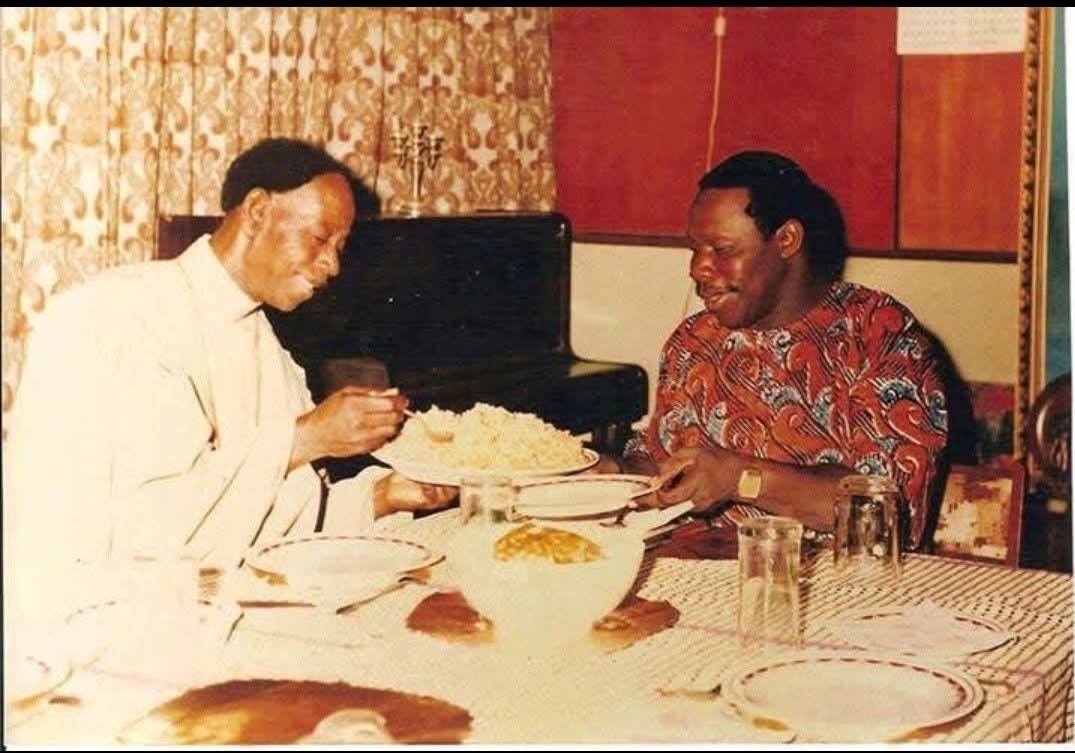
This historic photograph captures a unique moment in Nigerian history, featuring Olusegun Obasanjo, then a prominent political figure, sharing a meal with Samuel Bilewu Joseph Oshoffa, the revered founder of the Celestial Church of Christ (CCC).
Historical Context
Olusegun Obasanjo had served as Nigeria’s military Head of State from 1976 to 1979 and later became civilian President from 1999 to 2007. His leadership during the late 1970s was marked by the transition from military to civilian rule.
Samuel Bilewu Joseph Oshoffa founded the CCC in 1947 in Benin City. By the 1970s, the church had grown into one of Nigeria’s most influential spiritual movements, with followers across West Africa and the diaspora.
Significance of the Meeting
The photograph symbolizes the intersection of political power and spiritual authority in Nigeria. Such meetings were common during this period as political leaders often sought the counsel, endorsement, or blessing of influential religious figures, reflecting the deep intertwining of faith and governance in Nigerian society.
The image reportedly dates to 1978, during Obasanjo’s tenure as military Head of State, a time when the CCC was expanding its presence both nationally and internationally.
It shows a rare, informal interaction, highlighting the personal rapport and mutual respect between a political leader and a spiritual icon.
Legacy
This moment stands as a visual reminder of Nigeria’s political and religious history, demonstrating how leadership and faith communities interacted during critical periods of nation-building. Both men left enduring legacies: Obasanjo in politics and governance, and Oshoffa in shaping spiritual life across Nigeria and beyond.
Sources
Falola, Toyin, and Matthew M. Heaton. A History of Nigeria. Cambridge: Cambridge University Press, 2008.
BBC News archives, Nigerian political and religious history features.







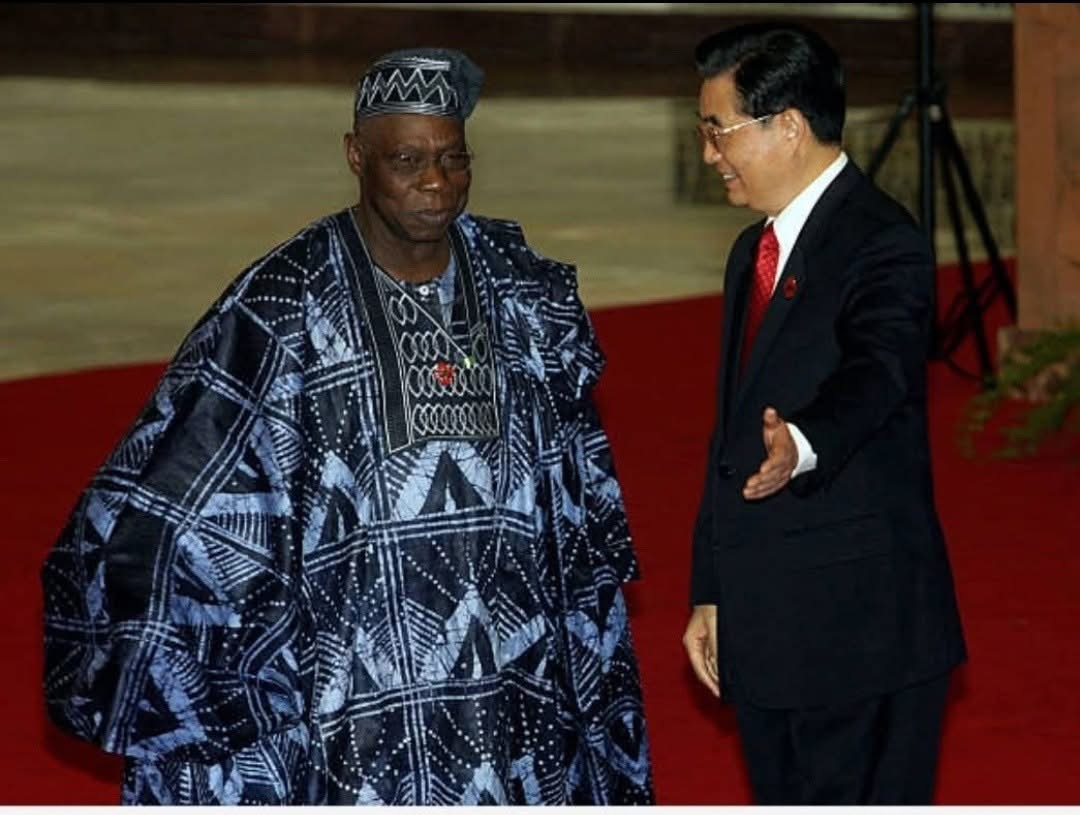
The 2006 diplomatic meeting that strengthened economic cooperation between Nigeria and China
A historic photograph from 2006 captures an important diplomatic moment between Nigeria and China. The image shows Olusegun Obasanjo, then President of Nigeria, meeting with Hu Jintao, President of the People’s Republic of China, during an official visit to Abuja, Nigeria’s capital.
The meeting symbolised a growing partnership between the two nations and marked a period when Nigeria began deepening its economic and political cooperation with China. Discussions during the visit focused on trade, infrastructure development, and energy collaboration, particularly in the oil sector.
Background: Nigeria–China Relations
Relations between Nigeria and China date back to 1971, when both countries formally established diplomatic ties. However, cooperation between the two nations expanded significantly during the early 2000s.
During Obasanjo’s presidency from 1999 to 2007, Nigeria pursued stronger economic partnerships with emerging global powers, including China. The strategy was aimed at attracting investment into critical sectors such as infrastructure, energy, telecommunications, and transportation.
China, on the other hand, was expanding its presence in Africa as part of its global economic engagement strategy, investing heavily in natural resources and infrastructure across the continent.
The 2006 State Visit to Abuja
In April 2006, President Hu Jintao embarked on a state visit to Nigeria as part of a broader diplomatic tour of Africa. During the visit, he held official talks with President Obasanjo in Abuja.
The discussions focused on strengthening bilateral relations, particularly in areas such as:
Energy cooperation
Infrastructure development
Trade and investment
Technological partnerships
The meeting culminated in the signing of several agreements aimed at boosting economic collaboration between the two countries.
Oil-for-Infrastructure Agreement
One of the most notable outcomes of the visit was an oil-for-infrastructure arrangement. Under this agreement, Chinese companies were granted oil exploration rights in certain Nigerian oil blocks.
In return, Chinese firms committed to investing in infrastructure development in Nigeria. One aspect of the deal involved Chinese participation in projects related to the Kaduna refinery, located in Kaduna, a major industrial centre in northern Nigeria.
The arrangement reflected a model China had begun using in other parts of Africa: providing infrastructure investments in exchange for access to natural resources.
Growing Economic Cooperation
Following the 2006 visit, economic ties between Nigeria and China expanded significantly. Chinese companies became involved in several large-scale projects across Nigeria, including:
Railway modernisation projects
Road construction and urban infrastructure
Telecommunications expansion
Power generation and industrial facilities
China also emerged as one of Nigeria’s largest trading partners, with trade volumes increasing rapidly in the years that followed.
Strategic Importance for Nigeria
For Nigeria, the partnership offered opportunities to address long-standing infrastructure deficits. Investments linked to the agreements helped finance projects that were difficult to fund through domestic resources alone.
The collaboration also allowed Nigeria to diversify its international partnerships beyond traditional Western allies.
However, the growing influence of Chinese investments in Africa has also generated debate among economists and policymakers about issues such as debt sustainability, local employment, and economic dependency.
Historical Significance
The 2006 meeting between Obasanjo and Hu Jintao is widely regarded as a milestone in Nigeria–China relations. It signalled a new phase of cooperation that would shape economic interactions between the two countries for decades.
Today, China remains one of Nigeria’s most important economic partners, with continued collaboration in infrastructure development, energy projects, and trade.
The photograph of the two leaders meeting in Abuja therefore represents more than a ceremonial moment; it reflects a pivotal step in the evolution of diplomatic and economic relations between Africa’s most populous nation and one of the world’s largest economies.
Sources
Nigerian Presidency archives on the 2006 state visit of Hu Jintao to Nigeria
Reports on Nigeria–China bilateral agreements (2006)
Historical records on Nigeria–China diplomatic relations since 1971
International coverage of China–Africa economic cooperation initiatives
Columns
Chief Remi Fani-Kayode: The Influential Western Region Politician Captured in a 1964 Drum Magazine Photograph
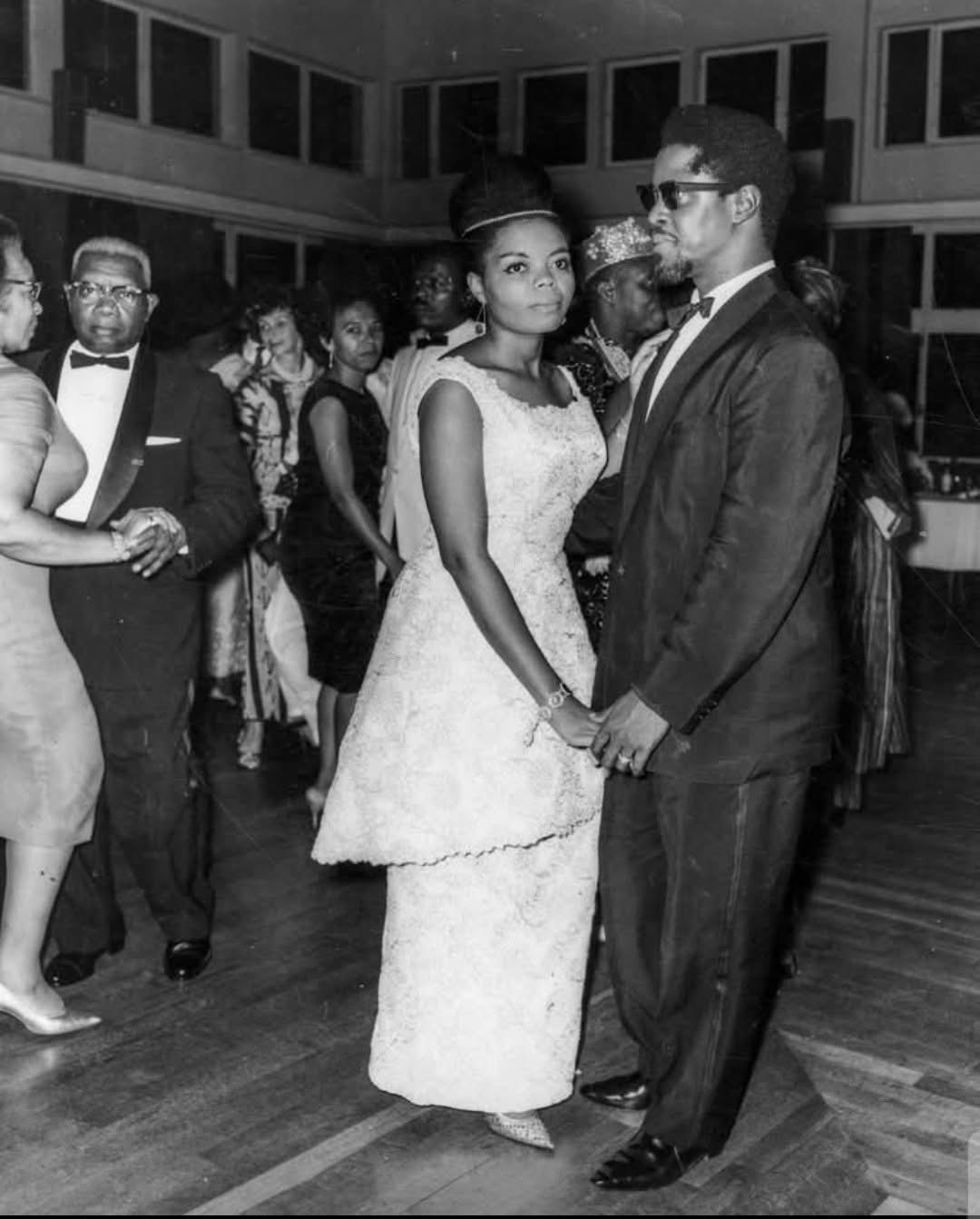
A glimpse into the political influence and public image of a powerful Nigerian leader during the First Republic
A photograph published in March 1964 by Drum Magazine captures an intriguing social moment involving Remilekun Adetokunbo Fani‑Kayode, popularly known as Chief Remi Fani-Kayode. The image shows the influential Nigerian politician taking time off from official duties to dance at a ball with Mrs Opral Benson, highlighting both his public stature and his presence in elite social circles during Nigeria’s First Republic.
At the time, Fani-Kayode served as Deputy Premier of the Western Region, one of the most powerful political positions in the regional government structure. According to the magazine’s commentary, if a public opinion poll had been conducted in Western Nigeria then, he would likely have emerged as the most powerful and popular politician in the region.
The photograph therefore offers more than a social snapshot; it provides insight into the political climate, leadership personalities, and cultural life of Nigeria in the early 1960s.
Political Background of Remi Fani-Kayode
Chief Remilekun Adetokunbo Fani-Kayode was born in 1921 in Lagos, into a distinguished Yoruba family. His father, Victor Babaremilekun Adetokunbo Fani‑Kayode, was a prominent legal practitioner and nationalist figure.
Fani-Kayode received a strong education both in Nigeria and abroad. He studied law in the United Kingdom and was called to the Bar before returning to Nigeria to pursue a career in law, politics, and public service.
During the period leading up to Nigeria’s independence and the early years that followed, he became deeply involved in regional politics in the Western Region of Nigeria, one of the three major regions that formed the country’s political structure at the time.
Role in Western Region Government
By the early 1960s, Chief Fani-Kayode had risen to become Deputy Premier of the Western Region, serving under Samuel Ladoke Akintola, the Premier of the region.
The Western Region was one of the most politically vibrant and economically significant parts of Nigeria during the First Republic. It had earlier been governed by the Obafemi Awolowo, whose administration implemented several pioneering social and educational programmes.
However, political divisions within the region intensified during the early 1960s, especially following conflicts within the ruling political party. The crisis led to the formation of new political alliances, and figures like Fani-Kayode became central actors in the unfolding political drama.
The Drum Magazine Feature
Drum Magazine was one of the most widely read publications across Africa during the mid-twentieth century. Known for its rich photography and cultural reporting, the magazine documented politics, entertainment, and social life across the continent.
In its March 1964 edition, the magazine published the photograph of Chief Fani-Kayode dancing with Mrs Opral Benson at a formal ball. The accompanying caption noted that the politician was “taking time off from work,” a remark that humanised a figure otherwise associated with intense political activity.
The magazine further observed that Fani-Kayode was widely regarded by the masses as a “saviour”, highlighting the level of public admiration he enjoyed at the time.
Such portrayals were common in mid-century African magazines, which often presented political leaders as charismatic personalities who combined authority with social charm.
Popularity and Political Image
The caption’s claim that Fani-Kayode would have topped a popularity poll reflects the perception of his influence in Western Nigerian politics during that era.
As Deputy Premier, he wielded significant power within the regional government. His political strength stemmed from several factors:
His close association with leading political figures in the region
His legal training and intellectual background
His strong connection with grassroots political networks
These attributes helped shape his image as a dynamic and influential leader in the Western Region’s political structure.
Social and Cultural Context of the Photograph
The image of a prominent politician dancing at a ball also reflects the social culture of Nigeria’s political elite during the early post-independence years.
Formal balls, receptions, and social gatherings were common among government officials, diplomats, and members of the professional class. These events served as spaces where politics, diplomacy, and social networking often intersected.
In this context, the photograph illustrates how political leaders were not only public administrators but also active participants in the social life of the elite.
Historical Significance
Although the photograph captures a seemingly casual moment, it reflects a period of intense political activity in Nigeria.
The early 1960s were marked by rising tensions in the Western Region, culminating in political crises that contributed to the eventual collapse of the First Republic. By 1966, Nigeria experienced its first military coup, bringing an end to the civilian government.
Images such as the one published in Drum Magazine therefore offer valuable glimpses into the personalities and atmosphere of Nigerian politics during the final years before this dramatic transformation.
Sources
Drum Magazine, March 1964 Edition
Bailey’s African History Archive
Historical studies on politics in the Western Region of Nigeria during the First Republic
Biographical records of Chief Remi Fani-Kayode
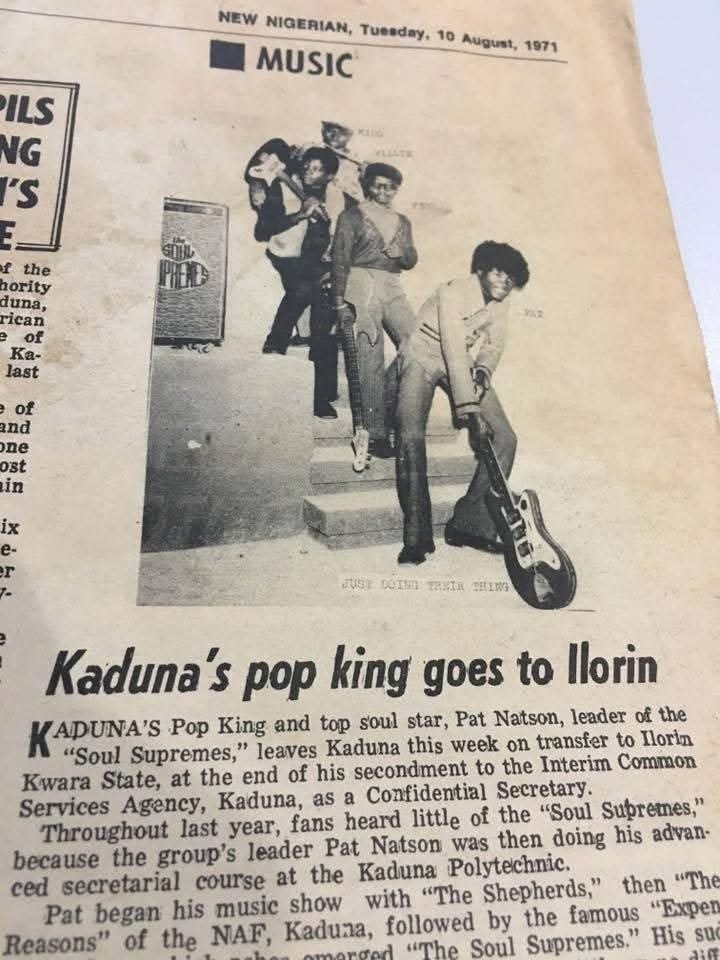
A New Nigerian newspaper report highlights the movement of a rising northern Nigerian pop musician in the early 1970s
In the early 1970s, Nigeria’s popular music scene was expanding rapidly across cities and regions. A newspaper report published in the New Nigerian on Tuesday, 10 August 1971, captured a moment in that vibrant musical era. The article focused on Pat Natson, a Kaduna-based musician widely known at the time as the “Pop King of Kaduna.”
The report revealed that Natson was relocating from Kaduna to Ilorin in Kwara State, a move that attracted attention because of his growing popularity as a bandleader and performer.
Although not as widely remembered today as some of Nigeria’s later music legends, Pat Natson’s career represents an important snapshot of the evolving pop and band culture that flourished across Nigerian cities in the post-independence era.
The Rise of Kaduna’s “Pop King”
During the late 1960s and early 1970s, Kaduna was one of northern Nigeria’s major urban centres and cultural hubs. The city had a lively entertainment scene that included nightclubs, live bands, and dance music performances.
Within this environment, Pat Natson gained recognition for his musical talent and leadership of the band Soul Supremes. According to the New Nigerian article, Natson had earned the nickname “Pop King of Kaduna”, reflecting his popularity among audiences and music lovers in the city.
Live band performances were central to Nigerian entertainment during this period. Before the rise of widespread electronic recording and mass music distribution, audiences often experienced popular music directly through live shows in clubs, hotels, and social events.
Bands like the Soul Supremes therefore played a crucial role in shaping the local music culture.
Early Musical Background
Before forming his own band, Pat Natson had already been involved with other musical groups. The New Nigerian report notes that he had previously been associated with bands known as “The Shepherds” and “The Reasons.”
Such band movements were common within Nigeria’s music scene at the time. Musicians frequently collaborated, moved between groups, and experimented with new styles of performance. These networks helped spread new sounds across the country.
Eventually, Natson formed Soul Supremes, which became the group most closely associated with his name and reputation.
The band contributed to the lively nightlife culture of Kaduna and helped maintain the popularity of Western-influenced pop and soul music styles that were widely enjoyed in Nigerian urban centres during the era.
Balancing Work and Music
Another interesting detail in the 1971 newspaper report was Natson’s professional background outside music.
Before becoming fully known as a bandleader, he reportedly worked as a Confidential Secretary while studying at Kaduna Polytechnic.
This reflects a common reality for many Nigerian musicians during that time. Unlike later generations who could rely more heavily on music as a full-time career, many performers in the 1960s and early 1970s balanced their artistic pursuits with regular employment or academic studies.
Music was often driven by passion, creativity, and community engagement rather than commercial success alone.
Transfer to Ilorin
The central news in the New Nigerian article was Natson’s transfer from Kaduna to Ilorin.
At the time, professional transfers were common in Nigeria’s civil service and corporate sectors, often requiring individuals to relocate to different states. Since Natson had been working in a secretarial role, the move to Ilorin, the capital of Kwara State, likely occurred through his professional employment.
This relocation would inevitably have affected his musical career and the activities of his band.
Moving to a new city meant building new audiences, establishing connections with local entertainment venues, and possibly forming new musical collaborations.
Such movements also helped spread musical influences between Nigerian regions, allowing different styles and performers to reach new audiences.
Nigerian Music in the Early 1970s
The period around 1971 was an important transitional era for Nigerian music.
The country had recently emerged from the Nigerian Civil War (1967–1970), and the cultural sector was beginning to rebuild and flourish once again. Urban centres such as Lagos, Kaduna, Ibadan, and Enugu hosted vibrant nightlife scenes where bands performed regularly.
Musicians experimented with a variety of styles including highlife, soul, jazz, funk, and early forms of Afro-influenced pop music.
Although the global recognition of Nigerian music would later be shaped by icons like Fela Kuti, many lesser-known performers contributed to the musical environment that allowed these movements to grow.
Artists like Pat Natson represent the countless bandleaders who helped sustain live music culture across Nigeria during this period.
The Role of Newspapers in Documenting Music History
The report about Pat Natson demonstrates how newspapers served as important historical records for Nigeria’s cultural life.
Publications such as the New Nigerian regularly covered entertainment news, including band performances, musician profiles, and developments in the music scene.
These archives provide valuable insights into artists who might otherwise be forgotten but who played meaningful roles in shaping local cultural history.
Through these newspaper records, historians can better understand the everyday entertainment landscape that existed across Nigerian cities during the post-independence decades.
Sources
New Nigerian Newspaper, Tuesday 10 August 1971
Archival image shared by Gharba Galadima’s historical page
Studies on Nigerian popular music culture in the 1960s and 1970s

Olusegun Obasanjo and Samuel Bilewu Joseph Oshoffa Sharing a Meal, 1978

Rivers Assembly invites commissioner nominees for screening on Monday

IGP APPOINTS DCP ANTHONY OKON PLACID AS FORCE PUBLIC RELATIONS OFFICER

-
Business1 year ago
US court acquits Air Peace boss, slams Mayfield $4000 fine
-

 Trending1 year ago
NYA demands release of ‘abducted’ Imo chairman, preaches good governance
-

 Politics1 year ago
Mexico’s new president causes concern just weeks before the US elections
-

 Politics1 year ago
Putin invites 20 world leaders
-

 Politics1 year ago
Russia bans imports of agro-products from Kazakhstan after refusal to join BRICS
-
Entertainment1 year ago
Bobrisky falls ill in police custody, rushed to hospital
-
Entertainment1 year ago
Bobrisky transferred from Immigration to FCID, spends night behind bars
-
Education2 years ago
GOVERNOR FUBARA APPOINTS COUNCIL MEMBERS FOR KEN SARO-WIWA POLYTECHNIC BORI