
Trending
An amphibious mouse, a blob-headed fish and a rain frog: Researchers discover 27 new species in Peru

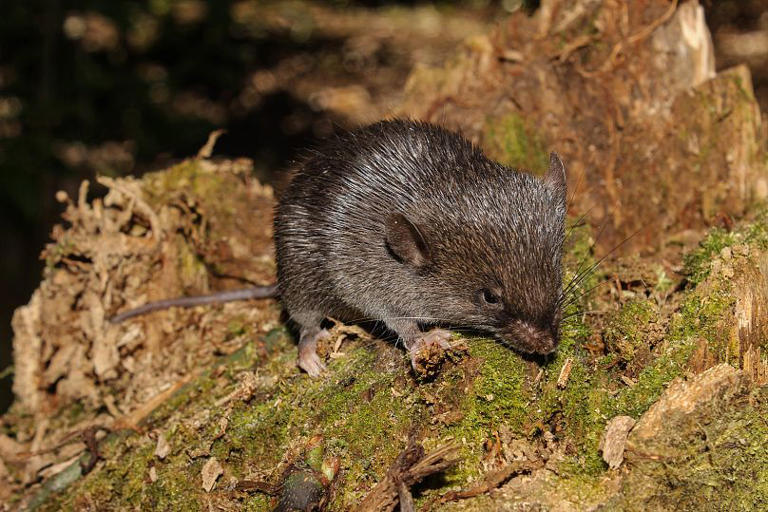
A total of 27 new species have been uncovered in the ‘human-dominated’ Peruvian rainforest.
Conservation International led the expedition into the Alto Mayo Landscape that discovered these new species. The list includes four mammals, eight fish, three amphibians and 10 butterfly species.
The team was joined in the field by Peruvian scientists from Global Earth and local experts with extensive traditional knowledge from the Indigenous Regional Federation of the Alto Mayo Awajun Communities.
“Discovering even one new species of mammal on an expedition would be extraordinary, but discovering four new mammal species, as well as eight new fishes and three new amphibians, is mind-blowing,” says Trond Larsen, who leads Conservation International’s Rapid Assessment Program (RAP).
What did researchers find in the Peruvian rainforest?
Once the 2024 fieldwork was complete, months of complex data analyses followed to confirm the discovery of new species and come up with conservation plans for them, explains Larsen.
Researchers found 151 mammals in total, four of them new to science, including a bat, a squirrel, and a spiny mouse. At least 12 of these species are threatened with extinction.
The team also found 68 fish species – with eight new to science – including a fish with a blob head that they don’t yet know the purpose of and that Larsen is “most excited” about, given his personal passion for aquatic creatures.
“It is truly exciting and amazing to encounter a species such as the blob-headed fish that is so bizarre and distinct, yet has never before been seen by scientists,” he says. “It’s fun to speculate and try to understand why this fish species possesses such an unusual structure on its head”.
Larsen is also “exhilarated” by the discovery of an incredibly rare amphibious mouse.
“This new species belongs to a group of semi-aquatic carnivorous rodents that are notoriously rare and difficult to encounter in the field,” he says.
The researchers also found 45 reptile and amphibian species, with three new to science: a rain frog, a narrow-mouthed frog, and a climbing salamander.
12 insects new to science were among the 289 they recorded in total. That is alongside 536 bird species and 955 plant species – including rare orchids and other flora only found in this area.
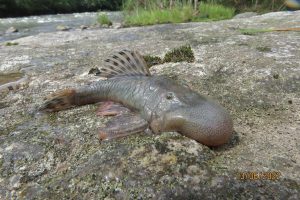
This ‘blob-headed’ fish (Chaetostoma sp.), is also new to science and was a shocking discovery due to its enlarged blob-like head. © Conservation International/photo by Robinson Olivera
Another 48 species of plants and animals observed during the expedition may also be new to science but require further research before this can be confirmed.
Of the incredible 2,046 different species researchers recorded, at least 34 of them appear to live only in the Alto Mayo Landscape of Peru’s San Martin region.
There are life-threatening risks associated with tropical expeditions
The team didn’t just use traditional methods for surveying plants and animals. They deployed technologies such as automated camera traps, bioacoustic sensors and environmental DNA (eDNA) to identify animals based on DNA they have shed into the water, explains Larsen.
“This expedition was probably the most complex and large-scale RAP we have ever done,” he adds. “The researchers worked non-stop and with little rest to achieve this massive task.”
Larsen, however, says that living in a tent in the tropical rainforest “feels like home.”
Fieldwork in remote tropical places around the world can pose many risks to health.
While Larsen emerged unscathed from this latest Alto Mayo RAP expedition, he’s previously picked up “a variety of diseases and parasites, including malaria, leishmaniasis (a flesh-eating disease), creeping eruption (parasitic worms that form inflamed tunnels as they burrow around just under the skin), botfly maggots that embed themselves into flesh and poke in and out of a breathing hole, and a multitude of intestinal parasites”.
He also now is “deathly allergic” to red meat and dairy after thousands of tick bites gave him a condition called alpha gal syndrome.
How are names selected for new species?
If a species is new to science, then it won’t yet have a common name.
“Researchers choose one based on the discovery’s most distinctive and unusual features,” explains Larsen, as is the case with the blob-headed fish. But also, he says, “common names can refer to the group of species to which the animal belongs, such as the mushroom-tongued salamander, for which other species in the same genus also share a similar yet distinctive tongue.”
Sometimes scientists give a name to other respected field researchers – and Larsen knows a thing or two about this, given that he has 10 beetles named after him.
“I feel grateful and humbled to be recognised and honoured by fellow scientists who have chosen to reward my hard work, dedication and passion for tropical ecology by naming species I have discovered after me.”
“The opportunity to explore new places and immerse myself in nature, discovering and learning more about the incredible diversity of life, is really what drives me and makes me feel happiest.”
Can nature coexist with humans?
The Alto Mayo Landscape is a region with incredible biodiversity despite its relatively high population density. The presence of humans has put major pressure on the local environment from deforestation and agricultural expansion.
But Conservation International has been working with Indigenous groups in the region, such as the Awajún people, as well as local communities and governments to support sustainable livelihoods and agricultural practices that balance the needs of people and nature in the region.
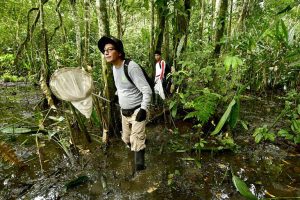
Members of the insect team survey a swamp forest using nets and various types of traps. © Trond Larsen
“The tremendous discoveries and unique biodiversity we found on the Alto Mayo RAP expedition are a testament to the fact that biodiversity can thrive alongside people,” says Larsen.
“These findings underscore that even in areas heavily influenced by people, biodiversity can persist but only if ecosystems are managed sustainably.”
Data from this expedition will help inform plans to connect the Alto Mayo Protected Forest with the Cordillera Escalera Regional Conservation Area and create an ecological corridor that will help species survive.
It will also help local communities to better protect the nature that surrounds them.
“This Rapid Assessment allows the Awajún to protect our culture, natural resources and our territory, as we have a deep connection with nature,” says Yulisa Tuwi, an Awajún woman who assisted with the research on reptiles and amphibians.
“Being part of this research has allowed me to better understand how plants, animals and ecosystems interact with each other, and how this is part of our Awajún cosmovision.”










Unidentified gunmen, suspected to be cultists, have k!lled a community leader and one other person in Anambra State.
The President-General of Ogidi community in Idemili North Local Government Area of Anambra State, Ikwuka Okoye, popularly known as Anumili (pictured above), was k!lled on Friday, Feb. 6.
The attack was alleged to have been carried out by members of a rival cult group in revenge for the de@th of their leader, who was arrested and k!lled by local security operatives.
During the attack, which took place at the School Field, Ogidi, another man whose identity has yet to be ascertained was also gunned down.
The spokesman for the Anambra State Police Command, SP Tochukwu Ikenga, confirmed the incident in a press statement on Saturday.
Ikenga said the incident is allegedly linked to the recent capture and k!lling of a known notorious cultist within the community.
He said, “The Anambra State Police Command regrets the murd£r of the President-General of the Ogidi community and one other person. The incident, which occurred on the evening of February 6, 2026, at the School Field, Ogidi, is allegedly linked to the recent capture and k!lling of a known notorious cultist within the community.
“Following the report, police operatives swiftly took over the scene of the incident and commenced investigations. The command is currently working with eyewitness accounts and other available intelligence to identify and arrest the perpetrators.
“The Anambra State Police Command assures members of the public that all efforts are being intensified to bring those responsible to justice.
“Residents are urged to remain calm and cooperate with the police as investigations continue.
“Further developments will be communicated in due course.”


Men of the Police Special Fraud Unit (PSFU), Lagos, have apprehended three suspects who allegedly run a cyber blackmail and extortion scheme in the state.
According to the spokesperson of the unit, DSP Ovie Ewhubare, the suspects get a hold of their victims explicit photos and then threaten to release them if a ransom is not paid.
He said that the suspects, two males and a female, were apprehended after a petition was filed by a complainant who reported being repeatedly threatened by unknown individuals demanding money.
“The complainant received several phone calls in which the callers threatened to release her nude photographs to the public if she failed to pay them. Acting out of fear and emotional distress, she transferred money to the suspects.
The situation escalated when the suspects demanded an additional N10 million, prompting her to formally petition the police,” he said
The police imagemaker state dthat upon receipt of the complaint, the Commissioner of Police, PSFU, Mr Kayode Ojapinwa, ordered the immediate deployment of operatives to investigate the matter.
“The investigation led to the arrest of the three suspects. Investigations revealed that one of the suspects gained unlawful access to the complainant’s mobile device and fraudulently transferred her nude photographs to his own device. Further findings indicated that he conspired with the other suspects and other accomplices currently at large to demand and receive money from the complainant in several tranches,” he said
According to him, the suspects are currently in police custody and are expected to be arraigned before a court of competent jurisdiction.
The image maker said that investigations were ongoing to apprehend other fleeing members of the syndicate and to recover all proceeds of the alleged crime.
Trending
Catholic Priest Collapses And D!es In Front Of Congregation While Walking To Tabernacle To Return Holy Communion

A Catholic priest has tragically passed away after suddenly collapsing in front of the congregation during Sunday mass.
The tragic incident took place last Sunday, February 1 in Wiesmath in the district of Wiener Neustadt, Austria.
Shortly after administering Holy Communion, 59-year-old priest Raimund Beisteiner was about to return the host to the tabernacle when he “suddenly” collapsed, according to a statement from the Archdiocese of Vienna.
“Despite immediate professional assistance, he di£d in the church,” the statement said.
The mayor of Wiesmath, Erich Rasner, had also attended the Mass with many other believers and witnessed the dramatic scenes.
The shock in Wiesmath at the loss of the popular priest is great. Beisteiner had shaped the spiritual life of the parish for almost two decades and was highly regarded far beyond the community.
Rasner praised him as an “extremely conscientious, sensitive priest” and also emphasized the personal loss of a friendship that had grown over many years.
A prayer service was organized at short notice for the late priest. It was attended by numerous priests from the deanery as well as Archbishop Josef Grünwidl.



Why APC removed Uzodimma as convention chair

Olusegun Obasanjo’s Daughter Declares For Ogun Governorship, Joins APC

Nigerian Pharmacist D!es While Donating Kidney To Save His Cousin’s Life

-
Business1 year ago
US court acquits Air Peace boss, slams Mayfield $4000 fine
-

 Trending1 year ago
NYA demands release of ‘abducted’ Imo chairman, preaches good governance
-

 Politics1 year ago
Mexico’s new president causes concern just weeks before the US elections
-

 Politics1 year ago
Putin invites 20 world leaders
-

 Politics1 year ago
Russia bans imports of agro-products from Kazakhstan after refusal to join BRICS
-
Entertainment1 year ago
Bobrisky falls ill in police custody, rushed to hospital
-
Entertainment1 year ago
Bobrisky transferred from Immigration to FCID, spends night behind bars
-
Education1 year ago
GOVERNOR FUBARA APPOINTS COUNCIL MEMBERS FOR KEN SARO-WIWA POLYTECHNIC BORI