
Columns
Dangote Group New Year Advertisement – January 2, 1986

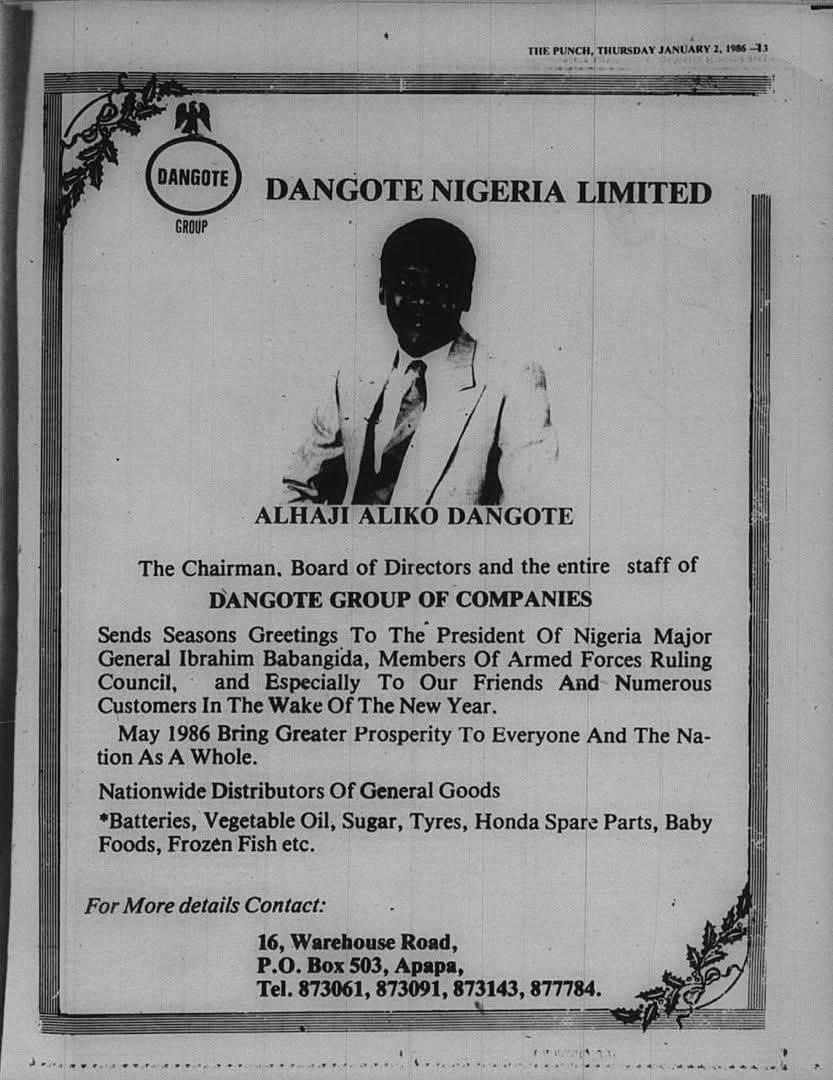
Alhaji Aliko Dangote and his team extend New Year greetings while showcasing their growing business in Nigeria.
This newspaper advertisement, published on January 2, 1986, features Alhaji Aliko Dangote and the staff of the Dangote Group of Companies sending New Year greetings to both the President of Nigeria and their customers.
At the time, Dangote Group was emerging as a nationwide distributor of general goods.
Products and services listed in the ad included food items, tyres, and spare parts, demonstrating the company’s early diversification.
The advertisement provides contact details for the company’s Apapa, Lagos office, reflecting its operational hub during the 1980s.
Historical Context
In 1986, Aliko Dangote was building his business empire in Nigeria, focusing on trading and distribution.
This advertisement illustrates how Dangote positioned his company as both customer-oriented and politically aware, acknowledging the President while promoting commercial services.
Such public greetings and newspaper placements were common strategies among Nigerian businessmen of the era to strengthen visibility and credibility.
Significance
The ad highlights Dangote’s early entrepreneurial efforts before he expanded into cement, sugar, and other industrial sectors.
It reflects the business culture of Nigeria in the 1980s, where local companies were establishing nationwide recognition through print media.
The combination of greetings and product promotion showcases the founder’s strategic approach to brand building and customer engagement.
Source
Newspaper archive, January 2, 1986





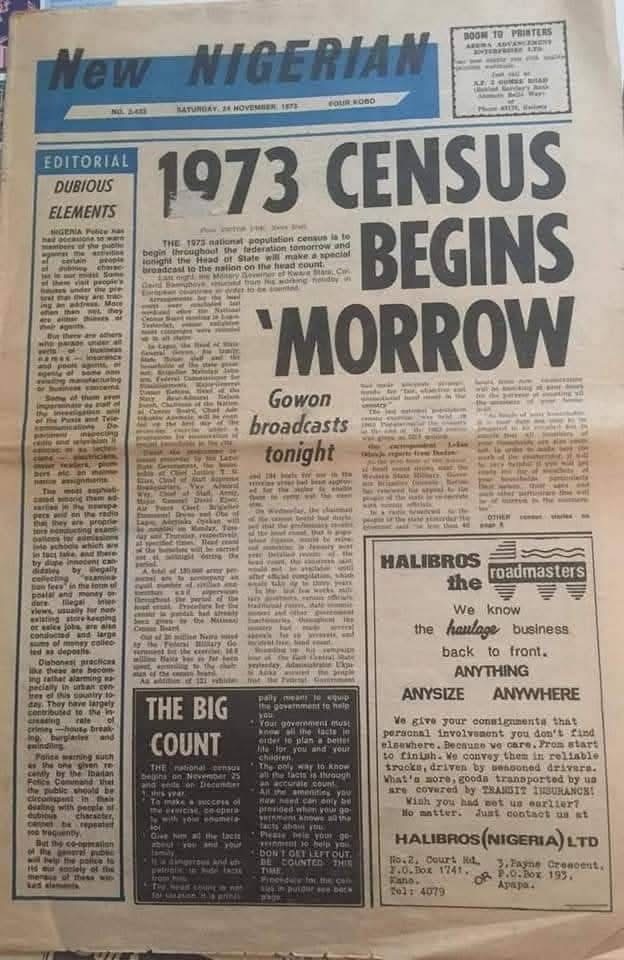
Nigeria’s last military-conducted census and its political and historical significance.
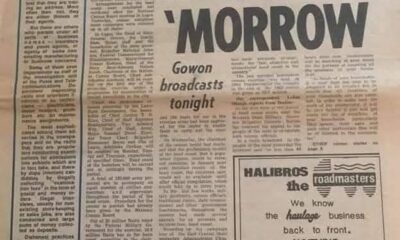
This front page of New Nigerian Newspapers dated November 24, 1973 captures the lead-up to Nigeria’s national census, set to begin the following day, November 25, 1973. The cover price was 4 kobo, reflecting the newspaper’s accessibility at the time.
The headline read:
“1973 CENSUS BEGINS ‘MORROW”
This announcement marked the start of what was officially termed the “Big Count,” a military-led population census under Head of State General Yakubu Gowon.
Context
Purpose: The government intended the census to provide accurate demographic data to inform economic planning, representation, and resource allocation.
Controversy: Despite its official goals, the 1973 census quickly became contentious, with widespread debates about the accuracy of figures reported by different regions. Critics claimed that political and ethnic considerations influenced the final results, fuelling distrust in official statistics.
National Broadcast: General Gowon addressed the nation on the evening of November 24, 1973, signaling the government’s emphasis on national participation and transparency.
Newspaper Features
Advertisements: The front page also included business ads, such as HALIBROS (Nigeria) Ltd, a haulage and transport company operating in Kano and Apapa.
Editorial Focus: Articles highlighted the scale of the census, urging Nigerians to cooperate and emphasizing the significance of reliable data for national development.
Historical Significance
The 1973 census is remembered as the last conducted under a military regime in Nigeria. Its results continue to be cited in discussions of demographic growth, federal resource allocation, and electoral representation, despite longstanding disputes over its credibility.
It remains a stark reminder of the challenges Nigeria has faced in conducting nationwide population exercises amid political pressures.
Source
New Nigerian Newspapers, 24 November 1973

A glimpse into Nigeria’s automotive and economic history: Ford Escort MK I sold for ₦2,290 in 1974.
The Advertisement
In 1974, Nigerians could purchase a Ford Escort MK I saloon car for ₦2,290—a figure that today evokes surprise given the current cost of automobiles. The ad, published in the Daily Times, was designed to attract middle-class buyers looking for a reliable, modern vehicle.
The car was sold through J. Allen & Company Limited, a major automotive dealer at the time, known for importing and distributing popular foreign car brands to Nigeria’s growing urban centers.
Historical Context
The 1970s were a golden period for Nigeria’s economy, fueled by the oil boom. While cars were still a luxury for many, affordable models like the Ford Escort provided middle-class families access to personal transportation.
For perspective, ₦2,290 in 1974 would have had substantial purchasing power, allowing buyers to acquire a brand-new vehicle with modest financing options, which is almost unimaginable today given inflation and the high cost of imported cars.
Legacy
This vintage advertisement is more than just a marketing relic; it captures a snapshot of Nigeria’s economic and social life in the 1970s. It reflects a time when personal mobility was becoming increasingly attainable and illustrates the dramatic shift in prices and economic conditions in the decades that followed.
Today, such an ad serves as a reminder of the need for economic reforms and sustainable growth, prompting reflection on how far Nigeria has come—and how far it still needs to go.
Source
Daily Times, 1974
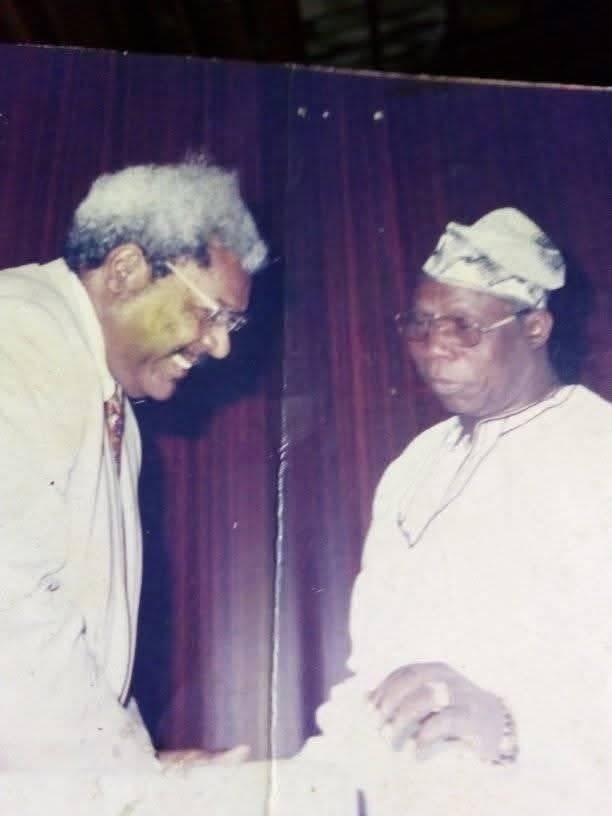
A historic meeting in Abuja between the legendary American boxing promoter and Nigeria’s former head of state.
The Meeting
In the year 2000, American boxing promoter Don King, renowned for promoting legendary fights and fighters such as Muhammad Ali and Mike Tyson, visited Chief Olusegun Obasanjo, former President of Nigeria, at the State House, Abuja.
The visit, documented by the now-defunct Concord Newspapers, was a courtesy call and symbolized the growing intersection of international sports, diplomacy, and Nigerian leadership.
Historical Context
Don King was at the peak of his influence in the boxing world, having promoted some of the most significant boxing matches in history.
Olusegun Obasanjo had returned to democratic rule in 1999 after previously serving as military head of state from 1976 to 1979. His administration sought to enhance Nigeria’s global visibility and foster relationships with influential global figures.
Such meetings were not just social visits; they often explored opportunities for sports development, business partnerships, and international collaboration.
Legacy
The photo of Don King and Obasanjo stands as a historical marker of Nigeria’s engagement with prominent global personalities at the turn of the millennium. It reflects the intersection of politics and international sports diplomacy, emphasizing Nigeria’s stature on the world stage at the time.
Source
Concord Newspapers (defunct), 2000

CBN Releases New Age Limit, Guidelines On BVN Operation.

Dangote Group New Year Advertisement – January 2, 1986

Mother-of-five stranded at Ogun hospital after delivering quadruplets.

-
Business1 year ago
US court acquits Air Peace boss, slams Mayfield $4000 fine
-

 Trending1 year ago
NYA demands release of ‘abducted’ Imo chairman, preaches good governance
-

 Politics1 year ago
Mexico’s new president causes concern just weeks before the US elections
-

 Politics1 year ago
Putin invites 20 world leaders
-

 Politics1 year ago
Russia bans imports of agro-products from Kazakhstan after refusal to join BRICS
-
Entertainment1 year ago
Bobrisky falls ill in police custody, rushed to hospital
-
Entertainment1 year ago
Bobrisky transferred from Immigration to FCID, spends night behind bars
-
Education2 years ago
GOVERNOR FUBARA APPOINTS COUNCIL MEMBERS FOR KEN SARO-WIWA POLYTECHNIC BORI