Columns
Dr. Abubakar Olusola Saraki: The Beginnings of a Political Dynasty

On 17 May 1933, Abubakar Olusola Saraki was born in Ilorin, in present-day Kwara State, Nigeria. Though he would later become one of the most influential political figures in Northern Nigeria, his first foray into politics was marked by defeat rather than triumph.
The 1964 Federal Election: A First Attempt
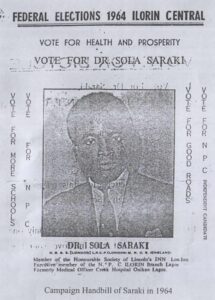
A campaign handbill from the 1964 Nigerian federal elections captures the earliest chapter of Saraki’s political journey. In that election, Dr. Saraki contested for the Ilorin Central constituency seat as an independent candidate aligned with the Northern People’s Congress (NPC), the dominant political party in Northern Nigeria at the time.
Despite his professional reputation as a London-trained medical doctor and a respected figure within the Ilorin community, Saraki was unsuccessful in securing the parliamentary seat. The 1964 elections themselves were fraught with controversy, marred by political tension, boycotts, and widespread allegations of irregularities, reflecting the instability of Nigeria’s First Republic.
Following this electoral setback, Saraki withdrew from active politics and returned to his thriving medical practice in Lagos.
Return to Politics: The Second Republic
Dr. Saraki remained largely outside partisan politics until 1978/79, when Nigeria began its transition from military rule to civilian governance, ushering in the Second Republic. During this period, he joined the National Party of Nigeria (NPN) and successfully won election as a Senator representing Kwara State in 1979.
His political influence grew significantly during the Second Republic (1979–1983), where he emerged as a key power broker in Kwara State politics. Over time, Saraki became widely regarded as the architect of Kwara’s political structure, earning a reputation as a formidable strategist and kingmaker.
Traditional Title and Influence
Beyond elective office, Saraki held the prestigious traditional title of Waziri of the Ilorin Emirate, further cementing his status within both political and traditional institutions. His influence extended across decades, shaping the political direction of Kwara State well beyond his time in office.
Legacy
Although his first political outing in 1964 ended in defeat, that campaign marked the beginning of a long and consequential career. Dr. Olusola Saraki’s trajectory—from an unsuccessful independent candidate to a dominant political figure—illustrates the evolving nature of Nigerian politics from the First Republic through the Second Republic and beyond.
He remains a central figure in discussions of Kwara State’s political history and the foundations of one of Nigeria’s most enduring political families.
Sources
Northern People’s Congress historical records on First Republic elections.
National Party of Nigeria party archives and Second Republic election results (1979).
Profiles and biographical records of Abubakar Olusola Saraki in Nigerian political history publications.

Nigerian Federal Election reports, 1964.