
Business
Edo Refinery Struggles with Crude Shortage, Calls for NNPC to Fulfill Supply Agreements

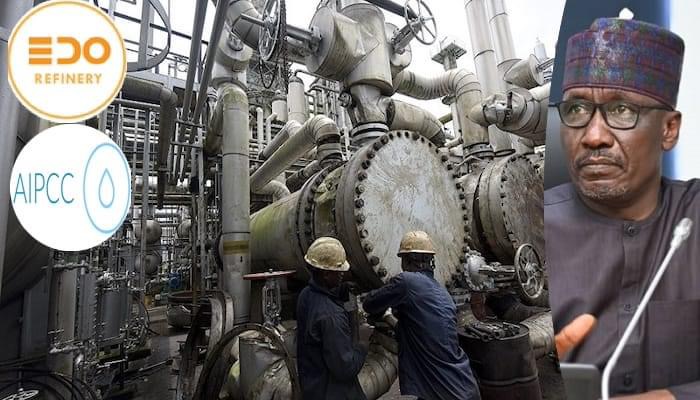
Edo Refinery has raised alarm over crude supply issues despite agreements with NNPC, operating below capacity due to persistent shortages.
The management of AIPCC Energy Limited, operators of the Edo Refinery and Petrochemicals Company Limited (ERPCL), on Sunday raised the alarm over the persistent lack of crude despite being a full functional 1,000 barrels per day stream crude oil refinery.
It said in spite of the disclosure by the Dangote Refinery on the refusal of the Nigerian National Petroleum Company Limited (NNPC) and the directive by President Bola Tinubu that the company should supply crude oil to Dangote Refinery and other Modular Refineries in the country in Naira denomination, the Edo Refinery was yet to get any from the relevant authorities.
Speaking to journalists in Benin-City at the weekend, the management of Edo Refinery situated at Ologbo in Ikpoba-Okha local government area of Edo State, said it was facing significant challenges due to persistent lack of crude oil supply.
Representative of the company, Segun Okeni, who spoke at the event, said the refinery, which requires 1,000 bpd stream crude can barely function at full installed capacity.
Okeni said though the company has had existing crude oil supply agreements with Seplat and ND Western since 2022, bureaucratic bottlenecks had prevented the refinery from accessing the much-needed resource.
He alleged that in 2021, ERPCL’s addressed a letter to the Group Chief Executive Officer of NNPC, Mele Kyari, after a series of meetings and constant communication with him did not hear much fruit.
“On August 18, 2021, our team led by our chairman, met with the NNPC GCEO and its top management team to discuss our intention to buy crude oil from NNPC and we immediately wrote seeking crude supply.
“In July 2022, the representatives of NNPC visited our facility for site inspection and to confirm the mechanical completion of the Edo refinery. In September 2022, we were invited for a commercial negotiation meeting with the NNPC head of terms, after which we sent a follow-up letter identifying the oil fields from which we can offtake crude oil.
“In March 2022, we also wrote to the Ministry of Petroleum Resources, informing it of our refinery status, future projects and our challenges of lack of crude oil supply to our refinery.
“We had also written and had a meeting with the NNPC Exploration and Production Limited (NEPL) between November 2022 and March 2023, indicating our severe need for crude oil supply from oil fields where NEPL has equity stakes,” he stated.
The ERPCL representative however, noted that despite the meetings, correspondences and communications with NNPC over the past three years on the issues of crude oil supply, nothing was done.
Besides, he identified other key issues encountered by the refinery as the inability of NNPC to assign any of the preferred fields to allocate crude to the company since it started having engagement with the management August 18, 2021.
He pointed out that even with the options given to allocate crude to the refinery from ND Western, First Hydrocarbon, and Seplat, nothing happened till date.
“ERPCL also has a Crude Oil Supply Agreement with ND Western to lift crude oil from the Ughelli Pumping Station (UPS) owned by NEPL and operated by Shoreline.
“We have held several meetings with Shoreline and Heritage Oil and indicated our readiness to make modifications needed to offtake crude oil from the UPS but no progress has been made till date,” the company added.
On the way forward, ERPCL said NNPC and other producers need to put loading infrastructure in place to allow for truck loading, decrying why Dangote would be getting 30,000 bpd because it opened up to the public, while smaller refineries are not being served which he likened to lack of respect for small people who can also grow the economy alongside the big players.
The representative of ERPCL therefore sought Kyari’s intervention as group GCEO of NNPC a d implement the Seplat-ERPCL agreement to enable Edo refinery to start lifting crude oil from Oil Mining License (OML).
Describing the past two years as frustrating for the establishment, he said: “If we local investors can’t get crude even as small as we are, how can foreign investors be encourage to invest in the country.
“The total daily demand of all modular refineries is not up to 2 per cent of the daily crude oil production. Our lifting from the pumping station, will even reduce pipe line losses,” he added.
Okeni argued that the advantage of loading from NNPC pumping stations to the expert terminal was that it costs less because the cost of pipeline export terminal charges and loss will be saved.
According to him, this will make the modular refineries more competitive than the offshore refineries who come to the export terminal to take the crude, thereby making cost savings to trickle down to Nigerian consumers.
“If the smallest refinery is not getting crude, it will discourage investors in that area” Okeni said, contending that because of lack of crude, OPAC Refinery operates less than 3 per cent of its installed capacity and Edo Refinery less than 10 per cent of installed capacity.
He noted that Nigeria loses millions of dollars following the inability of NNPC to supply modular refineries over the past three years which has a total installed capacity of less than 30,000bpd.









The Trade Union of Nigeria, TUC, has raised the alarm that the price of Premium Motor Spirit aka Petrol may climb to about N2,000 per litre if urgent measures are not taken to cushion the impact of rising global crude prices and the depreciating naira.
Speaking to newsmen on Thursday, April 9, the president of the TUC, Festus Osifo, called on the Federal Government to immediately deploy 60 percent of excess crude oil revenue above the 2026 budget benchmark to subsidise crude feedstock supplies to the Dangote Refinery and other modular refineries, a move it says will slash pump prices of petrol, diesel, and jet fuel within two weeks
“Today, comrades, we are seeing that the cost of petrol is edging towards N2,000 per litre depending on the part of the country that you are. Nigerian workers are already passing through excruciating pain as we speak.
The same way it is affecting transportation, it is also affecting manufacturing. The cost of diesel has also gone northward, meaning that the cost of production has increased. When production costs rise, the final price of goods on the shelves will also skyrocket.
If this continues unchecked, the inflation that we are currently celebrating as going downwards will reverse and start moving up again,” he stated.
Osifo outlined the proposal as an urgent intervention to cushion Nigerian workers from excruciating pain caused by petrol prices edging towards ₦2,000 per litre in some parts of the country
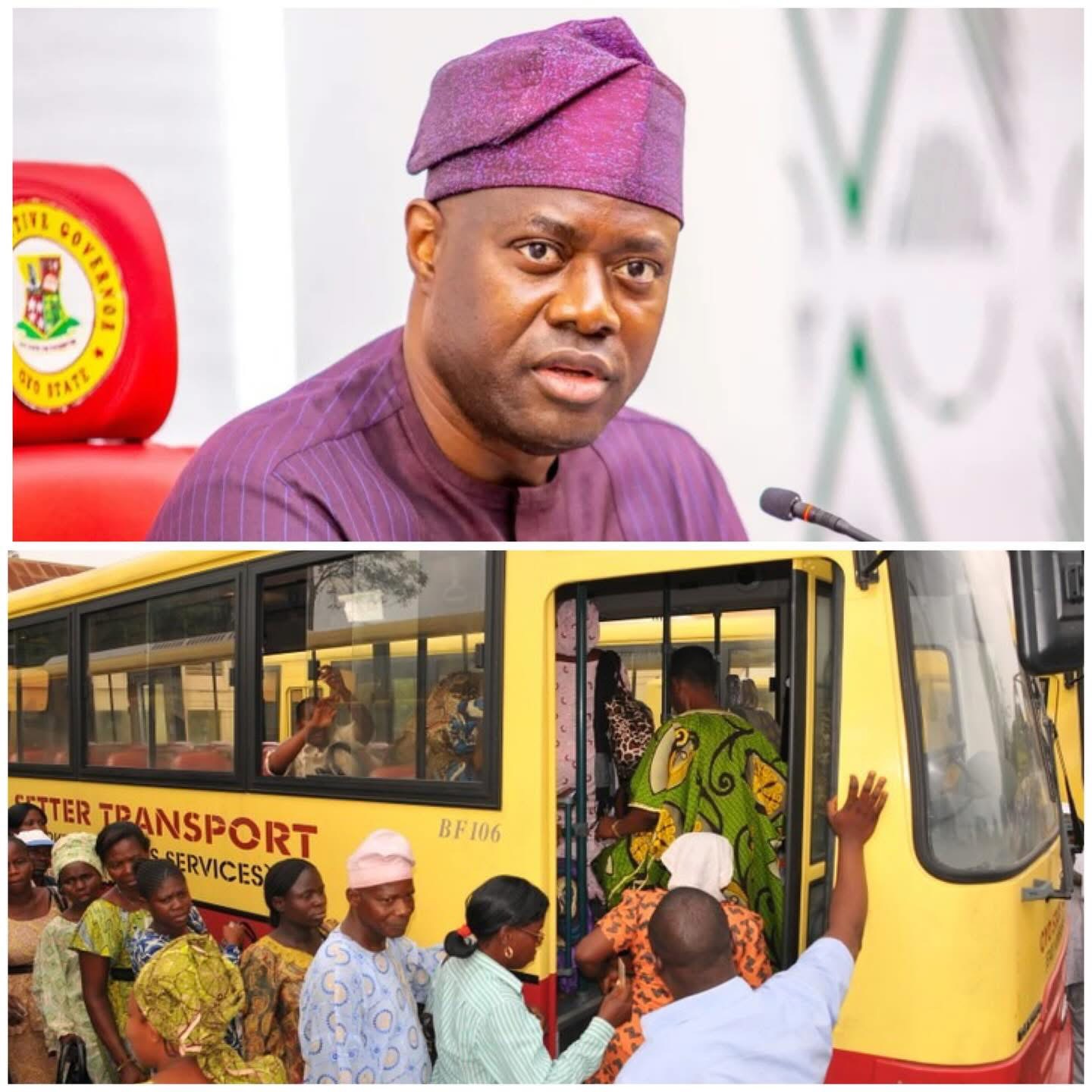
The governor of Oyo state, Seyi Makinde, has approved a N10,000 transportation allowance as a palliative for the state workforce to cushion the effects of the increase in the pump price of Premium Motor Spirit, otherwise known as petrol.
The Chairman of the Nigeria Labour Congress (NLC), Oyo State chapter, Kayode Martins, in a statement released on Monday, March 23, disclosed that the governor has granted the request of the union on the issue of transportation allowance.
The statement read
“Following the intervention and formal request made by the State Council of the Nigeria Labour Congress (NLC) earlier this morning, the state government has approved a N10,000 transportation allowance for all workers in the state.
The newly approved allowance is set to take effect from April 2026, providing much-needed relief to workers grappling with rising transportation costs amid current economic challenges.
This development comes as a direct response to sustained advocacy by the state NLC, aimed at cushioning the impact of increased living expenses on the workforce.
Further details on implementation are expected to be communicated by the relevant government authorities in due course.”
The Central Bank of Nigeria (CBN), has declared that banks and financial institutions must establish and maintain a temporary watch-list for Bank Verification Numbers (BVN) implicated in suspected fraudulent transactions.
According to the CBN in a circular dated March 12, 2026 and signed by its Director of Payments System Policy Department, Musa I. Jimoh, the apex bank said such a suspected BVN may remain on the temporary watchlist for a maximum period of twenty-four (24) hours during which the owner would be contacted to make clarifications.
The circular explained that the move is part of several new measures under a revised regulatory framework aimed at enhancing financial system stability.
“A BVN may remain on this temporary Watchlist for a maximum period of twenty-four (24) hours, during this period, the BVN owner shall be contacted to provide clarification regarding the identified transaction(s),” the circular stated.
The circular also sets an age requirement for BVN enrolment, restricting registration to individuals who have attained eighteen (18) years and above.
The CBN also added that amendments to phone numbers linked to a BVN shall be allowed only once.
“Amendments to phone numbers linked to a BVN shall be allowed only once,” the circular noted.
The apex bank stated that access to BVN databases will remain tightly controlled.
“Access to the BVN databases shall be exclusively granted to Central Bank of Nigeria (CBN) licensed financial institutions.
“Notwithstanding this provision, the Central Bank of Nigeria (the Bank) reserves the right to approve access to the BVN databases in extenuating circumstances and in accordance with the provisions of extant laws,” the circular said.
Financial institutions are expected to comply with the new requirements, and customers may be contacted by their banks if their BVNs are temporarily flagged during the new fraud monitoring process.
The new policy, as stated by the CBN, takes effect from May 1, 2026.

Breaking: Tinubu Appoints 39 Year Old Professor As New Jamb Registrar

Desmond Elliot Withdraws from APC Lagos Assembly Primaries, Cites Intimidation

Political Shockwave in Rivers as Fubara Pulls Out of APC Governorship Race, Backs Party’s Candidate

-
Business2 years ago
US court acquits Air Peace boss, slams Mayfield $4000 fine
-

 Trending2 years ago
NYA demands release of ‘abducted’ Imo chairman, preaches good governance
-

 Politics2 years ago
Mexico’s new president causes concern just weeks before the US elections
-

 Politics2 years ago
Putin invites 20 world leaders
-

 Politics2 years ago
Russia bans imports of agro-products from Kazakhstan after refusal to join BRICS
-
Entertainment2 years ago
Bobrisky falls ill in police custody, rushed to hospital
-
Entertainment2 years ago
Bobrisky transferred from Immigration to FCID, spends night behind bars
-
Education2 years ago
GOVERNOR FUBARA APPOINTS COUNCIL MEMBERS FOR KEN SARO-WIWA POLYTECHNIC BORI