
Business
Fabergé egg given as Easter gift to mother of Russia’s last emperor sells for record £22.9m

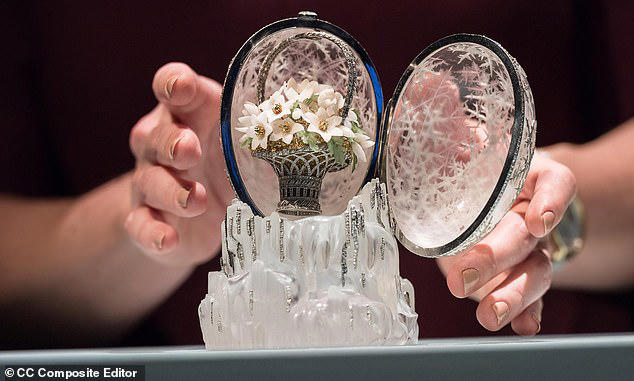
A diamond-encrusted Fabergé egg that Russia‘s last emperor gave to his mother as an Easter gift has sold for nearly £23million.
Tsar Nicholas II gifted the Winter Egg to Dowager Empress Maria Feodorovna in 1913, five years before he was murdered along with his wife and children after the Russian Revolution.
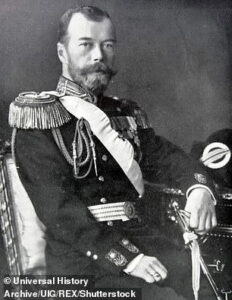
Tsar Nicholas II
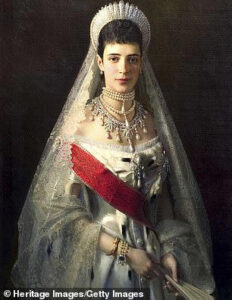
Dowager Empress Maria Feodorovna
The egg went under the hammer at Londonauction house Christie’s yesterday.
An unnamed buyer stumped up £22,895,000, smashing the previous global record of £8.9million that was set in 2007 when the famous Rothschild Egg was sold.
Carved from delicate rock crystal, the Winter Egg is an icy-looking orb studded with around 4,500 rose-cut diamonds, and stands at only five-and-a-half inches (14 centimetres) tall.
Carl Fabergé, the master jeweller whose creations bedazzled Russia, created 50 Imperial Easter Eggs for the then-ruling Romanov family over a 31-year period, making them incredibly rare and valuable.
They were commissioned as Easter gifts in a tradition started by Tsar Alexander III in the 1880s.
Nicholas II, Alexander’s son, had an annual standing order for two Easter eggs to be made for his mother and his wife, until the fall of the Romanovs in the 1917 Russian Revolution.
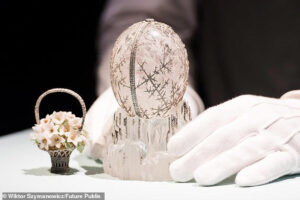
A diamond-encrusted Fabergé egg that Russia ‘s last emperor gave to his mother as an Easter gift has sold for nearly £23million
Today, only 43 of the Imperial Easter Eggs remain, with seven missing.
The ‘exquisite’ Winter Egg had a pre-sale estimate of more than £20million.
Christie’s Margo Oganesian said: ‘Today’s result sets a new world auction record for a work by Faberge, reaffirming the enduring significance of this masterpiece.’
She added the sale celebrated ‘the rarity and brilliance of what is widely regarded as one of Faberge’s finest creations, both technically and artistically’.
The imperial eggs have enjoyed renewed interest on the art market in recent decades, mainly among wealthy Russians keen to acquire a piece of their country’s history.
Beyond its opulence, it is the ‘technique and craftsmanship’ that makes the Winter Egg exceptional, according to Ms Oganesian.
‘The Winter Egg is truly one of the rarest items that you can find,’ she explained. ‘It’s really hard to comprehend how Faberge created it.’
The egg and its base are sculpted from crystal featuring diamond-encrusted platinum snowflakes.

Carved from delicate rock crystal, the Winter Egg is an icy-looking orb studded with around 4,500 rose-cut diamonds, and stands at only five-and-a-half inches (14 centimetres) tall. Inside, it contains a bouquet of flowers made of white quartz anemones held by gold wire stems, gathered in a platinum basket

The egg and its base are sculpted from crystal featuring diamond-encrusted platinum snowflakes

Tsar Nicholas and his wife, Empress Alexandra, with their five children. They were all murdered in 1918
Inside, it contains a bouquet of flowers made of white quartz anemones held by gold wire stems, gathered in a platinum basket.
Like many other Romanov possessions, the egg bears witness to Russian history. It was transferred from Saint Petersburg to Moscow in 1920 after the revolution.
As with many other Imperial Eggs, it was sold by the Soviet government to generate foreign currency and was acquired by London jeweller Wartski between 1929 and 1933, according to Christie’s.
The Winter Egg was subsequently part of several British collections but was considered lost from 1975, the auction house said in an essay attached to the sale lot online.
‘For 20 years, experts and specialists lost sight of it until 1994, when it was rediscovered and brought to Christie’s for sale in Geneva,’ said Ms Oganesian.
Eight years later, in 2002, it was sold again for a record $9.6 million in New York.











The Trade Union of Nigeria, TUC, has raised the alarm that the price of Premium Motor Spirit aka Petrol may climb to about N2,000 per litre if urgent measures are not taken to cushion the impact of rising global crude prices and the depreciating naira.
Speaking to newsmen on Thursday, April 9, the president of the TUC, Festus Osifo, called on the Federal Government to immediately deploy 60 percent of excess crude oil revenue above the 2026 budget benchmark to subsidise crude feedstock supplies to the Dangote Refinery and other modular refineries, a move it says will slash pump prices of petrol, diesel, and jet fuel within two weeks
“Today, comrades, we are seeing that the cost of petrol is edging towards N2,000 per litre depending on the part of the country that you are. Nigerian workers are already passing through excruciating pain as we speak.
The same way it is affecting transportation, it is also affecting manufacturing. The cost of diesel has also gone northward, meaning that the cost of production has increased. When production costs rise, the final price of goods on the shelves will also skyrocket.
If this continues unchecked, the inflation that we are currently celebrating as going downwards will reverse and start moving up again,” he stated.
Osifo outlined the proposal as an urgent intervention to cushion Nigerian workers from excruciating pain caused by petrol prices edging towards ₦2,000 per litre in some parts of the country

The governor of Oyo state, Seyi Makinde, has approved a N10,000 transportation allowance as a palliative for the state workforce to cushion the effects of the increase in the pump price of Premium Motor Spirit, otherwise known as petrol.
The Chairman of the Nigeria Labour Congress (NLC), Oyo State chapter, Kayode Martins, in a statement released on Monday, March 23, disclosed that the governor has granted the request of the union on the issue of transportation allowance.
The statement read
“Following the intervention and formal request made by the State Council of the Nigeria Labour Congress (NLC) earlier this morning, the state government has approved a N10,000 transportation allowance for all workers in the state.
The newly approved allowance is set to take effect from April 2026, providing much-needed relief to workers grappling with rising transportation costs amid current economic challenges.
This development comes as a direct response to sustained advocacy by the state NLC, aimed at cushioning the impact of increased living expenses on the workforce.
Further details on implementation are expected to be communicated by the relevant government authorities in due course.”
The Central Bank of Nigeria (CBN), has declared that banks and financial institutions must establish and maintain a temporary watch-list for Bank Verification Numbers (BVN) implicated in suspected fraudulent transactions.
According to the CBN in a circular dated March 12, 2026 and signed by its Director of Payments System Policy Department, Musa I. Jimoh, the apex bank said such a suspected BVN may remain on the temporary watchlist for a maximum period of twenty-four (24) hours during which the owner would be contacted to make clarifications.
The circular explained that the move is part of several new measures under a revised regulatory framework aimed at enhancing financial system stability.
“A BVN may remain on this temporary Watchlist for a maximum period of twenty-four (24) hours, during this period, the BVN owner shall be contacted to provide clarification regarding the identified transaction(s),” the circular stated.
The circular also sets an age requirement for BVN enrolment, restricting registration to individuals who have attained eighteen (18) years and above.
The CBN also added that amendments to phone numbers linked to a BVN shall be allowed only once.
“Amendments to phone numbers linked to a BVN shall be allowed only once,” the circular noted.
The apex bank stated that access to BVN databases will remain tightly controlled.
“Access to the BVN databases shall be exclusively granted to Central Bank of Nigeria (CBN) licensed financial institutions.
“Notwithstanding this provision, the Central Bank of Nigeria (the Bank) reserves the right to approve access to the BVN databases in extenuating circumstances and in accordance with the provisions of extant laws,” the circular said.
Financial institutions are expected to comply with the new requirements, and customers may be contacted by their banks if their BVNs are temporarily flagged during the new fraud monitoring process.
The new policy, as stated by the CBN, takes effect from May 1, 2026.

Bandits behind Ogbomoso school abduction will face full wrath of the law- President Tinubu

PDP to screen Goodluck Jonathan on Tuesday as its sole Presidential aspirant For 2027 race

Oshiomhole wins Edo APC senatorial primaries unopposed

-
Business2 years ago
US court acquits Air Peace boss, slams Mayfield $4000 fine
-

 Trending2 years ago
NYA demands release of ‘abducted’ Imo chairman, preaches good governance
-

 Politics2 years ago
Mexico’s new president causes concern just weeks before the US elections
-

 Politics2 years ago
Putin invites 20 world leaders
-

 Politics2 years ago
Russia bans imports of agro-products from Kazakhstan after refusal to join BRICS
-
Entertainment2 years ago
Bobrisky falls ill in police custody, rushed to hospital
-
Entertainment2 years ago
Bobrisky transferred from Immigration to FCID, spends night behind bars
-
Education2 years ago
GOVERNOR FUBARA APPOINTS COUNCIL MEMBERS FOR KEN SARO-WIWA POLYTECHNIC BORI