
News
ICPC warns NDDC staff against corrupt practices


The Independent Corrupt Practices and Other Related Offences Commission, ICPC, has warned Niger Delta Development Commission, NDDC, staff members against engaging in corrupt practices.
Mrs Ekere Usiere, ICPC Anti-Corruption Commissioner in charge of Rivers and Bayelsa state offices, gave the warning in a statement issued by NDDC’s Director of Corporate Affairs, Mrs Seledi Thompson-Wakama, in Port Harcourt on Friday.
According to the statement, Usiere spoke during the quarterly anti-corruption sensitisation workshop for NDDC staff and further warned that anybody caught in act would face the full wrath of law.
She acknowledged the critical role of the NDDC in the development of the Niger Delta region and stressed the importance of holding periodic meetings to sensitise staff against corrupt practices.
“NDDC staff must distance themselves from corruption, as anybody caught will be prosecuted in accordance with the law,” she stated.
Usiere explained that regular anti-corrupt workshops would enable NDDC employees to understand the impact of corruption on development and how to prevent it.
“This workshop themed, “Infractions/Offences in Anti-Graft Laws; Preventive Measures,” serves as an antidote to corrupt practices,” she said.
Also speaking, Dr Evans Peters, Head of Legal Department at ICPC in Rivers, urged the commission to strengthen its Anti-Corruption and Transparency Unit to enhance its effectiveness.
He further advised the NDDC to implement a system for continuous review of corruption-prone processes and procedures, and to develop a code of ethics that would include corruption prevention guidelines for staff.
According to Peters, it is an offence for an individual to inflate contracts, award contracts without budgetary provision, and frustrate investigations.
“In addition, any staff who make false statements and returns, fail to report bribery activities, and conspire to provide false information, or engage in similar acts will be prosecuted.
“Every public servant should take the ICPC Act as a Bible and internalise its tenets, as ICPC frowns heavily on gratification,” he said.
Peters further warned that proceeds from crime, or anything beyond a worker’s legitimate income, remained subject to seizure by the government, with the offender still liable to prosecution.
“Anyone caught in corrupt practices could be sent to jail. The law does not condone ignorance,” he added.
Earlier, Dr Samuel Ogbuku, Managing Director of the NDDC, emphasised the importance of adopting measures to tackle corruption and entrench transparency in public service.
Represented by Dr James Fole, NDDC’s Director III of Administration and Human Resources, Ogbuku stated that the workshop formed part of a broader strategy to enhance service delivery in the commission.
“We are passionate about service delivery; hence, we organised this workshop to educate our staff on the need to avoid corrupt acts.
“We want our staff to work with diligence and uprightness while carrying out their duties,” he advised.
Ogbuku noted that the NDDC Board and Management would spare no effort to ensure that ethics and values would be firmly entrenched in the commission.
News
Man in shock after lady he lodged with in a hotel in Abuja flees with his car and other valuables

A Nigerian man is currently in shock after a young lady identified as Precious Chinyere , whom he took to a hotel in the Asokoro area in the FCT for a romantic getaway allegedly fled with his car and other personal belongings on Thursday, February 5,
The distraught man and Precious had visited the hotel and opted for a short time stay. Things took a different in the evening when the man noticed Precious had left the hotel room without notifying him and took along with her some of his personal belongings including phones and laptop and also his car.
The victim immediately reported the incident to the police.
When contacted, the spokesperson of the FCT police command, SP Josephine Adeh, told LIB that the matter is currently being investigated and that efforts are being made to apprehend the suspect.
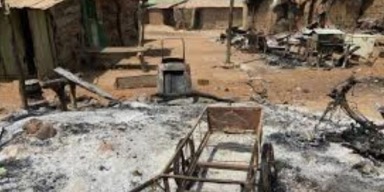
The United States Mission in Nigeria has condemned the k!lling of more than 200 civilians in recent attacks on communities in Kwara State.
Recall that terrorists launched de@dly attacks on Woro and Nuku communities in Kaiama Local Government Area of the state on Tuesday night, k!lling unsuspecting citizens.
It was gathered that the gunmen invaded the villages, opened fire on residents and burned homes.
According to reports, the de@th toll from the unfortunate incident hit 200 on Thursday night.
Reacting, the US Mission Nigeria condemned the k!lling via a post on its official X handle.
The post reads, “The United States condemns the horrific attack in Kwara state in Nigeria, which claimed the lives of more than 160 people, with the de@th toll still unconfirmed and many still unaccounted for.
“We express our deepest condolences to the families of those affected by this senseless violence.
“We welcome President Tinubu’s order to deploy security forces to protect villages in the area and his directive to federal and state officials to provide aid to the community and bring the perpetrators of this atrocity to justice.”
News
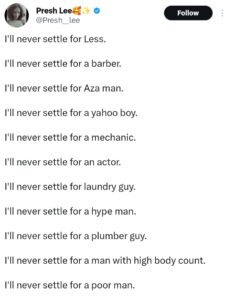
“I’ll never settle for a barber, yahoo boy or a poor man” — nail tech’s list of men she says she can’t marry sparks reactions online

A Nigerian nail technician has set social media talking after openly listing the kind of men she says she can never settle for.
In a now-viral post, she stated clearly that she refuses to “settle for less” and went on to mention professions and traits she considers a no-go area.
According to her, she can never settle for a barber, an aza man, a yahoo boy, a mechanic, an actor, a laundry man, a hype man, or a plumber. She also added that she wouldn’t marry a man with a high body count or a poor man.

“I Know It Sounds Strange” – Pastor’s Daughter Shares 4 Reasons She Doesn’t Want to Marry A Pastor (Video)

No Network In 9 States – Senate President, Akpabio Justifies Senate Decision On Electronic Transmission

Cubana Chief Priest appointed Imo director of City Boy Movement

-
Business1 year ago
US court acquits Air Peace boss, slams Mayfield $4000 fine
-

 Trending1 year ago
NYA demands release of ‘abducted’ Imo chairman, preaches good governance
-

 Politics1 year ago
Mexico’s new president causes concern just weeks before the US elections
-

 Politics1 year ago
Putin invites 20 world leaders
-

 Politics1 year ago
Russia bans imports of agro-products from Kazakhstan after refusal to join BRICS
-
Entertainment1 year ago
Bobrisky falls ill in police custody, rushed to hospital
-
Entertainment1 year ago
Bobrisky transferred from Immigration to FCID, spends night behind bars
-
Education1 year ago
GOVERNOR FUBARA APPOINTS COUNCIL MEMBERS FOR KEN SARO-WIWA POLYTECHNIC BORI