Connect with us

Health

I’m a sleep expert – there’s a daytime posture mistake millions make that’s causing insomnia

Published

on

I'm a sleep expert - there's a daytime posture mistake millions make that's causing insomnia

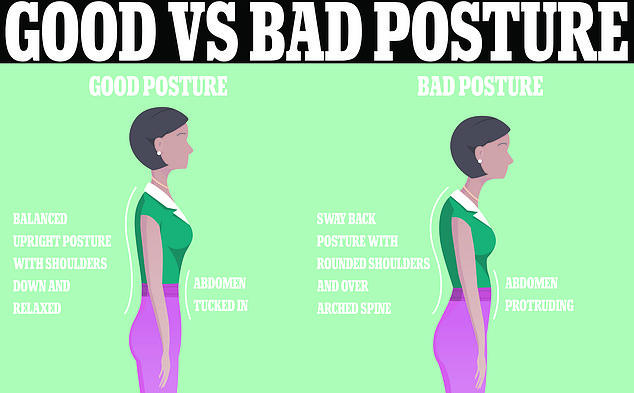
The next time you’re struggling to fall asleep, don’t blame your lumpy pillows—it could be down to how you’ve been sitting and standing all day.

A leading sleep expert says hours spent hunched over screens are putting strain on the body’s musculoskeletal system, disrupting rest and fuelling insomnia.

Lisa Artis, Deputy CEO of The Sleep Charity, told the Daily Mail: ‘Poor posture from daytime screen use can have lasting effects, into the night.

‘If your neck is out of line after a day spent hunched, or looking down, you’re more likely to toss and turn and wake up feeling worse.

‘If you’re already in pain, you’re also less likely to reach the deep sleep your body needs to recover—it’s a vicious cycle.’

Her comments come as new research from Simbarevealed millions of Britons are suffering from ‘tech neck’, a term for tension in the upper back caused by being slumped over as we stare at our phones, tablets and computers.

But the effects of tech neck don’t vanish once we’ve put our phones away for the night.

A survey carried out by the mattress brand found that half of Britons are in regular neck or back pain that ruins their rest.

Because of the unnatural positions we’ve spent hours in, it’s not uncommon for aches and twinges to begin in earnest the moment our body gets the chance to unfurl.

These can be painful, and stop us from lying down flat on our backs in a natural way, prompting us to pick up equally problematic positions once we’ve hit the sack.

Ms Artis explained: ‘If your neck and shoulders are tight from phone use, sleeping on your stomach makes things worse by twisting the spine and straining the shoulders.

‘Side sleeping without good pillow support can also exaggerate tech neck.

‘The best positions are lying on your back or side with the head, neck, and spine aligned.’

It’s estimated that around a third of Britons experience insomnia, and with more and more studies linking poor sleep with a plethora of life limiting conditions and diseases, including kidney and heart disease, high blood pressure, diabetes and stroke.

Insomnia has also been shown to negatively impact memory and the ability to retain new information, which has been linked to the development of dementia.

This is because during sleep, the brain clears out daily metabolic toxins and transfers short-term memories into long-term storage, solidifying learning.
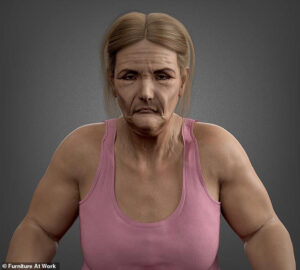
In 2023, Furniture At Work revealed what home-workers could look like by the year 2100, because of consistent use of technology, screen exposure and poor posture
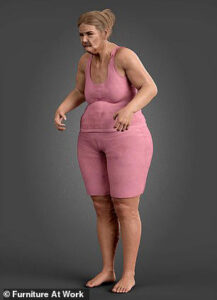
Their model, dubbed Anna, has a hunchback, dark, swollen eyes
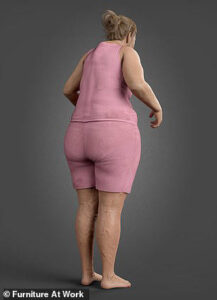
Their model, dubbed Anna, has fallen victim to weight gain, a weak immune system thanks to insufficient fresh air, anxiety and depression

Their model, dubbed Anna, has fallen victim to weight gain, a weak immune system thanks to insufficient fresh air, anxiety and depression

Inadequate sleep disrupts these critical processes, which is why chronic sleep loss is strongly linked to an increased risk of neurodegenerative diseases like Alzheimer’s.

Poor sleep, getting the wrong amount or having a sleep disorder like sleep apnea can shorten a person’s lifetime, with some studies showing it shaves off 4.7 years for women and 2.4 years for men.

The idea that looking at our phones can cause structural issues in our bodies might seem outlandish, but holding your head upright puts around 5kg of pressure on your neck.

Meanwhile, tilting your head to look at your phone can pile up to 22kg of extra strain on the vertebrae between your skull and shoulders.

Ms Artis added that the extra weight and pressure can trigger a negative ripple effect all the way down to your pelvis.

She said: ‘Spending hours hunched over a phone puts extra strain on the neck, shoulders and spine.

‘When you crane forward to check your phone, it’s not just your neck and shoulders working harder—your lower back is pulled out of position too.

‘Slouching in the lower spine shifts the body’s balance upward, creating tension in the shoulders and neck.

‘This chain reaction means shoulder pain can actually be a symptom of poor posture in the lower back, caused by too much time bent over screens.

‘Over time, this can lead to chronic pain, headaches, reduced mobility, and poor circulation.’

Thankfully you can improve your posture, but it takes commitment and—if your tech neck is particularly bad—some discomfort.

Ms Artis said: ‘Good posture helps counteract these effects, keeping the spine neutral, muscles balanced, and energy levels higher.

‘Sitting still for too long tightens everything up—especially around your neck and shoulders.

‘Take mini movement breaks every 45 minutes to an hour. Stand up, stretch, or roll your shoulders.

‘You’ll boost blood flow and ease off the tension before it has a chance to build.’

Ms Artis firmly believes that making better daytime choices—in how we sit, move and use our electronic devices—sets our bodies up for better, deeper sleep.

But it’s important to note that excessive sleep can also bring its own problems.

Oversleeping also has links to heart disease, weight gain, diabetes, cognitive impairment and depression.

Spending excessive time in bed can also disrupt the body’s natural sleep-wake rhythms, causing a groggy and disoriented feeling upon waking.

 

Health

I’ve Been Diagnosed With Breast Cancer – Blessing CEO Confirms Cancer Battle, Solicits Financial Help (Video)

Published

on

Nigerian social media influencer and self-proclaimed relationship expert, Blessing CEO, has shared an update regarding her health.

In a post on her Instagram page, the relationship coach revealed that she has been diagnosed with breast cancer and that doctors have recommended urgent surgery to remove one or both breasts to stop the disease from spreading.

She explained that making the decision to undergo surgery was very difficult, describing the emotional toll and challenges she faces.

She also disclosed that her resources have been stretched, prompting her to seek financial help to cover the cost of the operation.

This development follows her earlier announcement that she would sell some of her personal belongings, including her car, wigs, and Lagos mansion, to raise funds for treatment.

She shared an account number in the video to receive contributions and asked her followers to support her in any way they can.

She said: “My name is Okoro Blessing Nkiruka and I’m popularly known as Blessing CEO. I’ve been diagnosed with breast cancer. At this point, an urgent surgery is needed for amputation to stop the spread or to know how far the spread has gone.

“If they’re taking off one of the breasts or both of it, trust me, it was a very hard decision to come here. But the truth is, when predicaments like this come for you, you become powerless. I might not be able to do anything, work, influence, resources has gone into this.

“And that’s why I’m here pleading. If I have ever touched you before, if my words have ever shown any positive in your life, if you ever say Blessing CEO I love you, this is the time to show it.

“Thank you so much for the love. My phone is buzzing. God bless every one of you. Nothing is too small. I just want to be fine. Thank you so much. I’m going to put an account number on this video, hoping to start up the surgery as fast as possible. Thank you so much to those of you who reposted, shared. God bless every one of you.

“Thank you so much. I love you guys. I need all the love, all the advice I’ve given to you guys. You’re going to have to give it back to me. Thank you so much. Thank you so much. I have never been this clueless all my life.

“I thought I was a jagaban. I thought I was so strong. I thought I was so strong. Being strong is now my biggest weakness. Thank you so much. God bless you.”

Continue Reading

Health

Jehovah’s Witnesses Review Blood Transfusion Policy On Members

Published

on

Jehovah’s Witnesses have announced an update on their long-standing position on blood transfusions.

In a video published on the group’s official website on Friday, the church stated that members are allowed to make personal decisions on the use of their own blood during medical procedures.

A member of the Governing Body, Gerrit Lösch, said the clarification is intended to help adherents navigate medical choices without departing from biblical teachings

The church, however, maintains that the prohibition on receiving another person’s blood still stands.

He explained that while the doctrine requiring Christians to abstain from blood remains unchanged, the scriptures do not directly address the use of one’s own blood in clinical settings.

“Regarding the use of one’s own blood…a Christian must decide for himself how his own blood will be handled in the course of a surgical procedure, medical test, or current therapy,” he said.

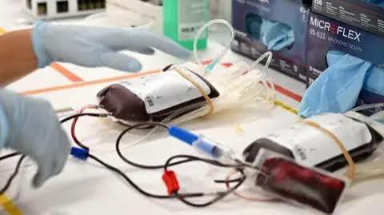
According to him, members are now free to decide whether to permit procedures where their blood is temporarily removed, stored, and later returned to the body.

“Some Christians may decide that they would allow their blood to be stored and then be given back to them. Others may object. Each Christian must make his personal decision on all matters involving the use of his own blood with regard to medical or surgical care,” Lösch added.

He noted that practices such as blood testing, dialysis, and the use of heart-lung machines have already been widely accepted among adherents.

Continue Reading

Health

Nigerian MSc Nursing student arrested for fra¥d in India

Published

on


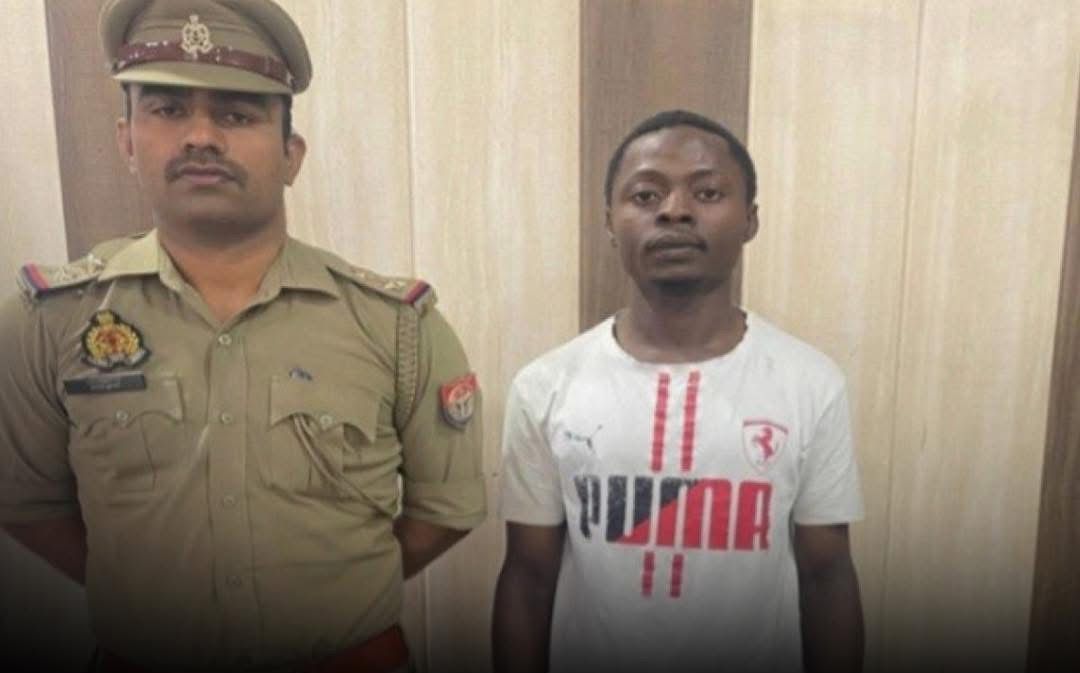
Meerut police in Uttar Pradesh have uncovered a major cyber fra¥d racket involving Nigerian students, arresting one suspect, Saifu Mayana Umar, an MSc Nursing student.

Victims across India were reportedly duped with promises of high returns through investments in foreign companies and stock markets. Investigations have linked Umar and his associates, including a Nigerian national named Yusuf, to at least 16 cyber fra¥d cases.

The gang allegedly used an organized network to lure victims, quickly withdrawing transferred funds through multiple bank accounts and ATMs to avoid detection. Authorities have traced transactions totaling approximately ₹45 lakh in Umar’s bank account, connected to cases mainly from southern states.

The probe involved cyber units from Telangana and Tamil Nadu, who coordinated with Meerut police to apprehend Umar from his hostel. During searches, police recovered electronic devices, ATM cards, bank passbooks, a SIM card, a passport, a cheque book, and mobile phones, all sent for forensic examination to trace the wider network.

Investigators noted that one associate attempted to des+roy banking documents, but some financial records were recovered for scrutiny. Transaction details are also being traced to follow international money flows.

During questioning, Umar admitted that some funds in his account were deposited by Yusuf and subsequently withdrawn. Other names have emerged in the investigation, and warrants are being sought, including potential international cooperation.

Umar has since been released on notice, with his passport confiscated and confinement to the university hostel.

Continue Reading

Trending