
News
Israel strikes heart of Beirut, killing at least six

By Timour Azhari and Ari Rabinovitch
BEIRUT/JERUSALEM (Reuters) -Israel bombed Beirut early on Thursday, killing at least six people, after its forces suffered their deadliest day on the Lebanese front in a year of clashes with Iran-backed Hezbollah.
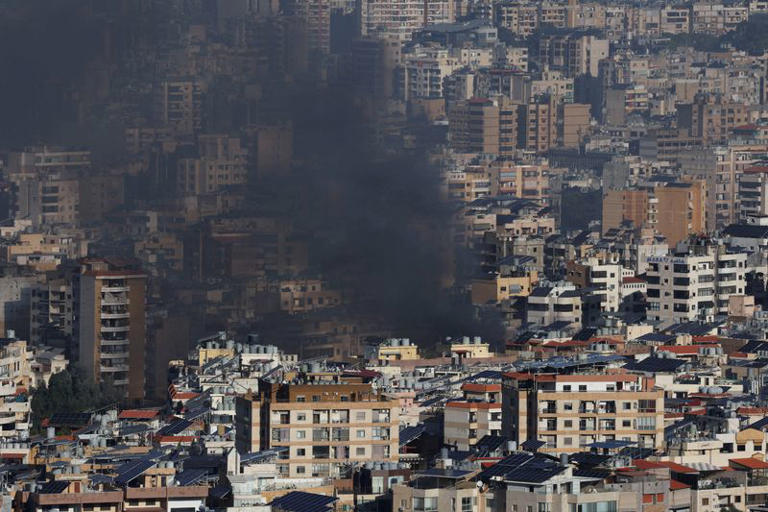
Israel said it had conducted a precise air strike on the Lebanese capital. Reuters witnesses reported hearing a massive blast, and a security source said it targeted a building in the district of Bachoura near parliament, the closest an Israeli strike has come to the central downtown district of Beirut.
At least six people were killed and seven wounded, Lebanese health officials said. A photo circulating on Lebanese WhatsApp groups, which Reuters could not immediately verify, showed a heavily damaged building with its first floor on fire.
“Another sleepless night in Beirut. Counting the blasts shaking the city. No warning sirens. Not knowing what’s next. Only that uncertainty lies ahead. Anxiety and fear are omnipresent,” U.N. special coordinator in Lebanon, Jeanine Hennis-Plasschaert, said on X on Thursday.Three missiles also hit the southern suburb of Dahiyeh, where Hezbollah leader Hassan Nasrallah was killed last week, and loud blasts were heard, Lebanese security officials said.
Smoke rises after a strike amid ongoing hostilities between Hezbollah and Israeli forces, in Beirut’s southern suburbs and its surroundings, as seen from Hadath, Lebanon October 3, 2024. REUTERS/Mohamed Azakir
© Thomson Reuters
The elimination of Nasrallah dealt a major blow to the movement and removed Iran’s most powerful proxy in the Middle East.
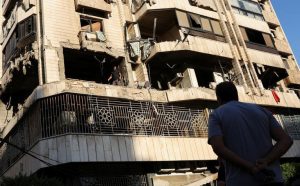
A man looks at a damaged building at the site of an Israeli strike on central Beirut’s Bachoura neighbourhood, amid ongoing hostilities between Hezbollah and Israeli forces, in Beirut, Lebanon October 3, 2024. REUTERS/Emilie Madi
© Thomson Reuters
Hezbollah and Iran’s other regional allies, Yemen’s Houthis and armed groups in Iraq, have launched attacks in the region in support of Hamas in its war with Israel in Gaza.
The Houthis, who have been carrying out attacks in shipping lanes in and around the Red Sea that have disrupted international trade, said on Thursday they attacked Israel’s commercial capital Tel Aviv with drones.
“The operation achieved its goals successfully by the arrival of the drones without being detected or shot down by the enemy,” the group’s military spokesperson Yahya Saree said.
Israel said it intercepted a suspicious aerial target in the area of central Israel early on Thursday.
The Israel Defense Forces (IDF) urged residents of Lebanese villages who have evacuated their homes not to return until further notice. “IDF raids are continuing,” spokesperson Avichay Adraee said on X on Thursday.
Fire and smoke rise over Beirut’s southern suburbs after a strike, amid ongoing hostilities between Hezbollah and Israeli forces, as seen from Sin El Fil, Lebanon, October 3, 2024. REUTERS/Amr Abdallah Dalsh © Thomson Reuters
A day after Iran fired more than 180 missiles into Israel, Israel said on Wednesday eight soldiers were killed in ground combat in south Lebanon as its forces thrust into its northern neighbour.
‘IRAN’S AXIS OF EVIL’
The Israeli military said regular infantry and armoured units joined ground operations in Lebanon on Wednesday as Iran’s missile attack and Israel’s promise of retaliation fanned concern of a wider conflict in the oil-producing Middle East.
Hezbollah said its fighters engaged Israeli forces inside Lebanon. The movement reported ground clashes for the first time since Israeli forces pushed over the border on Monday. Hezbollah said it had destroyed three Israeli Merkava tanks with rockets near the border town of Maroun El Ras.
Israeli Prime Minister Benjamin Netanyahu, in a condolence video, said: “We are at the height of a difficult war against Iran’s Axis of Evil, which wants to destroy us.
“This will not happen because we will stand together and with God’s help, we will win together.”
Iran said on Wednesday its missile volley – its biggest ever assault on Israel – was over, barring further provocation, but Israel and the United States promised to hit back hard.
However, U.S. President Joe Biden said he would not support any Israeli strike on Iran’s nuclear sites in response to its ballistic missile attack and urged Israel to act “proportionally” against its regional arch-foe.
Biden joined a call with other leaders of the Group of Seven major powers to coordinate a response, including new sanctions against Tehran, the White House said.
G7 leaders voiced “strong concern” over the Middle East crisis but said a diplomatic solution was still viable and a region-wide conflict was in no one’s interest, a statement said.
China urged the United Nations Security Council to take “urgent actions” to de-escalate the situation in the Middle East.
Western nations have drafted contingency plans to evacuate citizens from Lebanon after Tuesday’s dramatic escalation, but none have launched a large-scale military evacuation yet, though some are chartering aircraft as Beirut airport stays open.
1.2 MILLION LEBANESE DISPLACED
Israel’s addition of infantry and armoured troops from the 36th Division, including the Golani Brigade, the 188th Armoured Brigade and 6th Infantry Brigade, suggested that the operation might expand beyond limited commando raids.
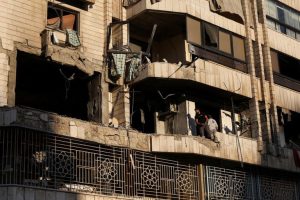
People inspect damage at the site of an Israeli strike on central Beirut’s Bachoura neighbourhood, amid ongoing hostilities between Hezbollah and Israeli forces, in Beirut, Lebanon October 3, 2024. REUTERS/Emilie Madi
© Thomson Reuters
The military has said its incursion is largely aimed at destroying tunnels and other infrastructure on the border and there were no plans for a wider operation targeting Beirut to the north or major cities in the south.
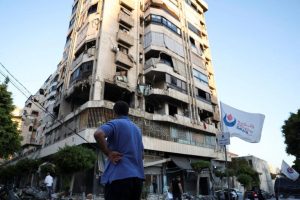
A person stands at the site of an Israeli strike on central Beirut’s Bachoura neighbourhood, amid ongoing hostilities between Hezbollah and Israeli forces, in Beirut, Lebanon October 3, 2024. REUTERS/Emilie Madi
© Thomson Reuters
Nevertheless, it issued new evacuation orders for about two dozen towns along the southern border, telling residents to head north of the Awali River, which flows east to west some 60 km (40 miles) north of the Israeli frontier.
More than 1,900 people have been killed and over 9,000 wounded in Lebanon in almost a year of cross-border fighting, with most of the deaths occurring in the past two weeks, according to Lebanese government statistics.
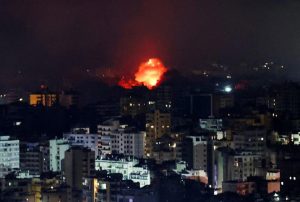
Fire and smoke rise over Beirut’s southern suburbs after a strike, amid ongoing hostilities between Hezbollah and Israeli forces, as seen from Sin El Fil, Lebanon, October 3, 2024. REUTERS/Amr Abdallah Dalsh
© Thomson Reuters
Caretaker Prime Minister Najib Mikati said about 1.2 million Lebanese had been displaced by Israeli attacks.
(Reporting by James Mackenzie and Steven Scheer in Jerusalem; Maya Gebeily and Timour Azhari in Beirut; Parisa Hafezi in Istanbul; Phil Stewart, Jeff Mason and Idrees Ali in Washington; Michelle Nichols in New York; Adam Makary, Jaidaa Taha and Enas Alashray in Cairo; and Tala Ramadan, Jana Choukeir and Jack Kim in Seoul and Matthias Williams in Berlin, Elwely Elwelly and Clauda Tanios in Dubai and Angelo Amante and Giuseppe Fonte in Rome and Parisa Hafezi in Dubai; Writing by Cynthia Osterman and Michael Perry and Michael Georgy; Editing by Deepa Babington, William Mallard and Gareth Jones)
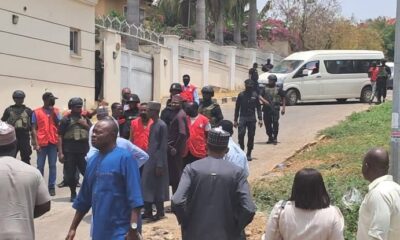






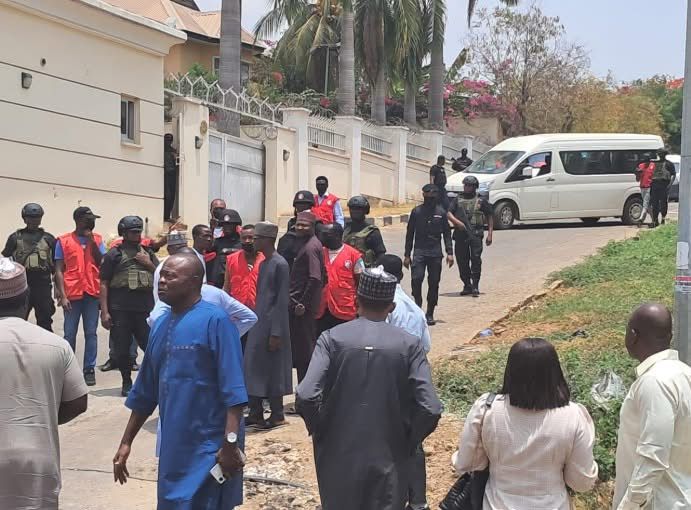
Former Attorney-General Abubakar Malami says Economic and Financial Crimes Commission operatives forcefully evicted him and his family from their Abuja residence despite ongoing court proceedings over the property’s forfeiture.
He described the action as unlawful and vowed to challenge it in court.

The governor of Oyo state, Seyi Makinde, has approved a N10,000 transportation allowance as a palliative for the state workforce to cushion the effects of the increase in the pump price of Premium Motor Spirit, otherwise known as petrol.
The Chairman of the Nigeria Labour Congress (NLC), Oyo State chapter, Kayode Martins, in a statement released on Monday, March 23, disclosed that the governor has granted the request of the union on the issue of transportation allowance.
The statement read
“Following the intervention and formal request made by the State Council of the Nigeria Labour Congress (NLC) earlier this morning, the state government has approved a N10,000 transportation allowance for all workers in the state.
The newly approved allowance is set to take effect from April 2026, providing much-needed relief to workers grappling with rising transportation costs amid current economic challenges.
This development comes as a direct response to sustained advocacy by the state NLC, aimed at cushioning the impact of increased living expenses on the workforce.
Further details on implementation are expected to be communicated by the relevant government authorities in due course.”
News
Former Acting Accountant-General of the Federation bags 72years imprisonment for diverting N868.46 million security funds
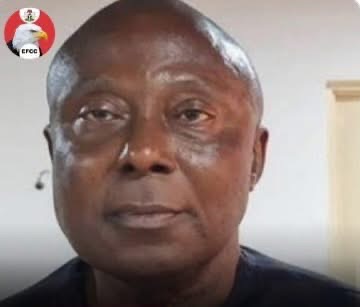
Justice James Omotosho of the Federal High Court in Abuja, on Monday, March 23, convicted and sentenced Chukwunyere Nwabuoku, former acting Accountant-General of the Federation (AGoF), to a 72-year jail term without an option of fine.
DailyTrust reports that in the judgment delivered, Justice Omotosho held that the Economic and Financial Crimes Commission (EFCC) had been able to prove the nine-count money laundering charge beyond reasonable doubt.
According to the judge, the defendant is hereby convicted as charged.
Justice Omotosho convicted Nwabuoku in all the nine counts and sentenced him to eight years imprisonment in each of the counts, making 72 years.
The judge, however, ordered that the counts shall run concurrently.
Justice Omotosho, who described Nwabuoku’s act of diverting funds meant for security and defence while he served as Director of Finance and Account in the Ministry of Defence as “appalling,” commended the EFCC for being detailed in its prosecution.
The judge observed that the evidence of the 9th prosecution witness that Nwabuoku voluntarily refunded part of the siphoned money of over N200 million during investigation was not controverted by the defence.
Nwabuoku served as the Director of Finance and Accounts in the Ministry of Defence between 2019 and 2021. He became acting Accountant General of the Federation in May 2022.

IMO STATE LABOUR PARTY DESCENDS INTO FACTIONAL WAR

EFCC evicts Malami from Abuja home amid forfeiture dispute

Fuel price hike: Gov Makinde announces N10,000 transport support for workers

-
Business1 year ago
US court acquits Air Peace boss, slams Mayfield $4000 fine
-

 Trending1 year ago
NYA demands release of ‘abducted’ Imo chairman, preaches good governance
-

 Politics1 year ago
Mexico’s new president causes concern just weeks before the US elections
-

 Politics1 year ago
Putin invites 20 world leaders
-

 Politics1 year ago
Russia bans imports of agro-products from Kazakhstan after refusal to join BRICS
-
Entertainment1 year ago
Bobrisky falls ill in police custody, rushed to hospital
-
Entertainment1 year ago
Bobrisky transferred from Immigration to FCID, spends night behind bars
-
Education2 years ago
GOVERNOR FUBARA APPOINTS COUNCIL MEMBERS FOR KEN SARO-WIWA POLYTECHNIC BORI