Columns
Ladoja Returns to Power: The 2006 Supreme Court Verdict That Shook Oyo Politics

How a historic Supreme Court ruling restored Rashidi Ladoja as governor of Oyo State and reshaped Nigeria’s 2007 political landscape.
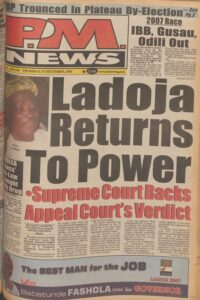

On December 7, 2006, the front page of P.M. News captured a defining moment in Nigeria’s democratic history. The bold headline, “Ladoja Returns to Power,” announced the reinstatement of Senator Rashidi Adewolu Ladoja as the governor of Oyo State following a landmark Supreme Court ruling. The decision, which upheld an earlier Court of Appeal judgment, marked the end of an eleven-month political crisis and reinforced judicial independence in Nigeria’s Fourth Republic.
The Political Storm in Oyo State
Rashidi Ladoja, who was elected governor of Oyo State in 2003 under the People’s Democratic Party (PDP), faced political turbulence just two years into his tenure. In January 2006, he was impeached by the Oyo State House of Assembly following a bitter feud with his political godfather, the late Chief Lamidi Adedibu—an influential Ibadan power broker and strong ally of former President Olusegun Obasanjo.
Ladoja’s impeachment was widely condemned as politically motivated. Only 18 of the 32 members of the House of Assembly reportedly participated in the proceedings, a number below the constitutional requirement. His deputy, Otunba Adebayo Alao-Akala, was subsequently sworn in as governor.
Judicial Battle for Justice
Determined to challenge what he described as an “unconstitutional removal,” Ladoja approached the courts. In November 2006, the Court of Appeal in Ibadan declared his impeachment illegal, null, and void, ordering his immediate reinstatement. The ruling cited a violation of due process and non-compliance with the constitutional provisions for impeachment.
The Oyo State government, led by Alao-Akala, appealed the decision, escalating the matter to the Supreme Court. On 7 December 2006, the apex court upheld the lower court’s verdict, affirming that the impeachment was unconstitutional. With that judgment, Rashidi Ladoja was officially restored to office as the legitimate governor of Oyo State.
The Return to Office
Following the Supreme Court’s ruling, the atmosphere in Ibadan was one of jubilation among Ladoja’s supporters. He resumed duties at the Government House, Agodi, amid tight security and widespread celebration. His return, however, came with significant challenges—political divisions, administrative disruptions, and the need to rebuild public trust after almost a year of political instability.
Despite the limited time remaining before the 2007 general elections, Ladoja sought to stabilise his government and reassert control. His reinstatement sent a strong signal about the power of judicial oversight in Nigeria’s democracy, setting a precedent for future constitutional and political disputes.
The 2007 Election Context
The P.M. News front page also reflected the growing tension surrounding Nigeria’s 2007 general elections. Alongside the Ladoja headline, the paper reported that key presidential aspirants—former military president Ibrahim Babangida (IBB), General Aliyu Gusau, and Governor Peter Odili—had withdrawn or been sidelined from the race.
At the same time, political attention in Lagos State was turning toward Babatunde Raji Fashola, the then Chief of Staff to Governor Bola Tinubu. The newspaper’s coverage identified him as a leading candidate for the Lagos governorship under the Action Congress (AC), foreshadowing his eventual emergence as governor in 2007.
A Turning Point for Nigeria’s Democracy
The Supreme Court’s verdict in favour of Ladoja became a judicial milestone. It reinforced the constitutional separation of powers and affirmed that no branch of government could act outside the law. Legal analysts hailed the decision as a victory for democracy and a warning to political actors against abuse of legislative authority.
For Oyo State, the reinstatement ended a protracted power struggle that had paralysed governance for months. Although Ladoja’s tenure would later be succeeded by his former deputy, Adebayo Alao-Akala, his comeback remains one of the most dramatic in Nigerian political history.
Legacy of the Ladoja Case
Nearly two decades later, the Ladoja impeachment saga stands as a lesson in constitutional democracy. It underscores the judiciary’s crucial role as the guardian of justice and a reminder that political loyalty must never override the rule of law.
The P.M. News headline from that day remains a historic snapshot—one that symbolises the triumph of legality over political manipulation and the enduring resilience of Nigeria’s democratic institutions.
References:
P.M. News, December 7, 2006 Edition
Supreme Court of Nigeria Judgement, Ladoja v. INEC & Ors (2006)
The Guardian Nigeria, “Supreme Court Restores Ladoja as Governor” (2006)
BBC News Africa, “Nigeria’s Ladoja Reinstated as Governor” (2006)
Vanguard Nigeria, “Ladoja’s Legal Victory and Its Impact on Oyo Politics”