Columns
Military Bicycle with Spring Wheels (Early 1900s)

The image shows a German military bicycle from the early 20th century, identified as a Herrenrad Victoria model used during World War I.
Spring Wheel Innovation
Instead of standard rubber tires, the bicycle features metal spring wheels.
The spring system functioned as a shock absorber, helping riders travel across rough terrain such as mud, gravel, and battlefield tracks.
These wheels were developed due to a severe rubber shortage in Germany during the war.
Military Adaptations
Equipped with a mounted rifle holder, carrying a Mauser rifle (standard German service rifle of the era).
Includes canvas pouches attached to the frame for:
Ammunition
Dispatch documents
Essential field supplies
These modifications transformed the bicycle into a compact, mobile military tool.
Historical Importance
Military bicycles played a crucial role in logistics, reconnaissance, and message delivery.
They provided silent movement, unlike motor vehicles.
More reliable than horses in certain terrains and required no fuel.
Particularly useful in areas where trucks and armored vehicles could not operate effectively.
Broader Context
During World War I, many European armies—including Germany, France, and Britain—experimented with bicycle infantry units. These units combined speed, efficiency, and low maintenance costs, making bicycles an important yet often overlooked part of early 20th-century military strategy.

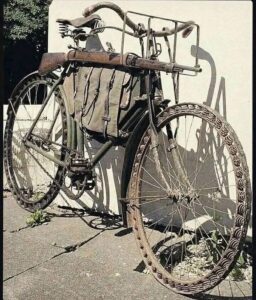
Spring Wheel Bicycle