
Business
N935/litre petrol: Labour faults new price, demands further reduction

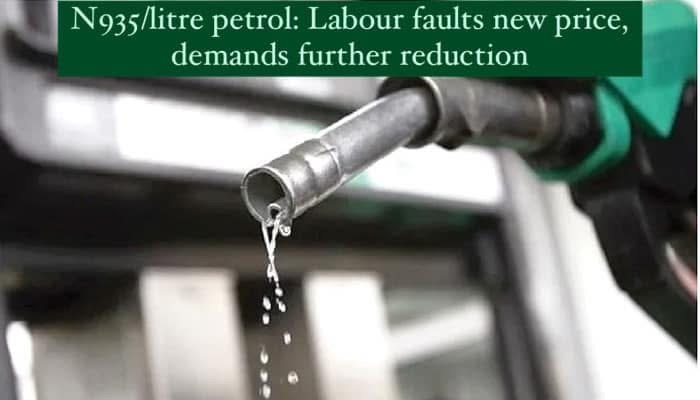
The Nigeria Labour Congress and Civil Society Organisations have called for further reduction in the pump price of Premium Motor Spirit (petrol), stressing that the recent drop in price to N935/litre is not satisfactory.
Dangote Petroleum Refinery in partnership with MRS recently announced a reduction in petrol price to N935/litre.
Before the announcement, the commodity sold for over N1,030/litre in Lagos and environs, while it cost more than N1,060/litre in Abuja and Northern states.
Recall that on Sunday, the Independent Petroleum Marketers Association of Nigeria said petrol was going to sell at N935/litre beginning from Monday based on the latest arrangement with the Dangote Petroleum Refinery.
IPMAN’s National President, Maigandi Garima, said the reduction in Dangote refinery’s ex-depot price for petrol and the uniform arrangement being put in place, would enable marketers to sell at N935 in their outlets nationwide, incurring a cost of N36 on logistics.
But the announcement did not excite the labour union and CSOs, as they insisted on Monday that the cost of petrol should drop further.
Speaking with The PUNCH, a senior official of the Nigeria Labour Congress, Chris Onyeka, rejected any applause for the Federal Government and the Nigerian National Petroleum Company Limited over the recent reduction in the pump price of petrol.
He argued that the current pricing mechanism does not reflect the true cost of the commodity.
“Do you want us to clap for them? How can we be okay with a price of N935/litre of PMS? This is not the right price for PMS. You cannot base the price on imported products when we have refining capacity in Nigeria,” he said.
He argued that the costs embedded in the current pricing framework—including foreign labour, freight charges, insurance, logistics, and profits accrued abroad—unfairly burden Nigerians.
“Products are refined in Nigeria, yet the price you give Nigerians is based on imported products. Why should we applaud that? It is akin to someone stealing your money and returning only part of it, then expecting you to clap. We cannot applaud this,” he stated.
Onyeka stressed that the only way to ascertain the correct price of PMS is by determining the actual cost of refining it domestically.
“We need to know how much it costs the NNPC to refine a litre of PMS in our local refineries, such as the Port Harcourt refinery. That is the price Nigerians should be paying,” he emphasised.
He called on the government to prioritise the welfare of Nigerians by ensuring that fuel pricing aligns with local realities.
This country belongs to all Nigerians. Let the government do the right thing that allows Nigerians to breathe. Let the poor breathe.
“The NLC’s position underscores growing discontent among Nigerians over the rising cost of living, with fuel prices being a major contributor to inflation and economic hardship,” he stated.
CSOs react
The Chairman, Centre for Accountability and Open Leadership, Debo Adeniran, said the reduced price of N935/litre was still expensive and unsatisfactory, noting that the government and private business could still give out free petrol to citizens.
“Well, we believe that if NNPC and the private sector actually give out PMS for free, they will still not run their business at a loss, because the other derivatives of petroleum products can still serve them, and can still make them to break even. So, even at that N900 and something, it’s still expensive.
“Dangote has kind of mooted the idea that it could drop to as low as N650. And if he has mulled this, then it means that it is the state, it is the NNPC that will have been the clog in the wheel of such progress. And you know also that we expected that fare prices, especially PMS prices, will drop below N200 when Dangote was expected to come on stream.
“So, it’s unfortunate that we are still talking about over N900 and they want us to jump up and rejoice for that. That is not satisfactory. They should just let us see the breakdown of their production cost and why it’s still there. I mean, there are countries like Libya under Gaddafi that gave out PMS for free and they didn’t run anything at any loss. So, I believe that it can still go further down,” he said.
The Executive Director of the Civil Society Legislative Advocacy Centre, Ibrahim Rafsanjani, commended the reduction of fuel prices by the NNPC and Dangote, but said the government could still reduce the price.
“Dangote’s own is about N899 or something like that. Well first and foremost, we are happy that there is a little reduction in the prices. But also based on analysis and based on facts and evidences, we believe that it is possible for the Nigerian government to further reduce the prices.
“Because if a private company can reduce the price and it still makes profit, we wonder why government-owned enterprises cannot really pity its citizens,” he said.
Price reduction
The Nigerian National Petroleum Company Limited on Monday reduced the pump price of petrol at its retail outlets in the Federal Capital Territory to N965/litre, down from N1,040/litre.
This occurred as MRS filling stations implemented a new petrol price of N935/litre at all its retail service stations nationwide, in accordance with the agreement signed with the Dangote Refinery.
Checks by our correspondent revealed that the Nigerian National Petroleum Company Limited affected the new price across its retail outlets in the capital city, to the delight of customers.
The new amount is the second price drop of N95 in less than two weeks from N1,060 earlier this month.
At its mega station located along Wuse Zone 4 and Olusegun Obasanjo Way, Central Area, the price of the commodity was sold at N965 per litre with commuters scrambling to join the long queue.
The national oil firm also slashed the petrol price to N965 at its Lugbe and Gudu area opposite Prince and Princess Estate outlets.
Reacting, a motorist at the central area station, who confirmed the price drop, applauded the national oil firm but called for a uniform across all stations for easy access.
He said, “Yes, NNPC has reduced its price to N965. I bought it this morning, but the queue is too long. Maybe because other stations are selling at a different price.”
Another driver, Hassan, said the changes would reflect in cost of transport but didn’t give a specific date.
He said, “This change is good news. We are excited about this price reduction and it will show in transport costs. N95 is a lot of money and it means we can now buy more litres to fuel our car.”

The governor of Oyo state, Seyi Makinde, has approved a N10,000 transportation allowance as a palliative for the state workforce to cushion the effects of the increase in the pump price of Premium Motor Spirit, otherwise known as petrol.
The Chairman of the Nigeria Labour Congress (NLC), Oyo State chapter, Kayode Martins, in a statement released on Monday, March 23, disclosed that the governor has granted the request of the union on the issue of transportation allowance.
The statement read
“Following the intervention and formal request made by the State Council of the Nigeria Labour Congress (NLC) earlier this morning, the state government has approved a N10,000 transportation allowance for all workers in the state.
The newly approved allowance is set to take effect from April 2026, providing much-needed relief to workers grappling with rising transportation costs amid current economic challenges.
This development comes as a direct response to sustained advocacy by the state NLC, aimed at cushioning the impact of increased living expenses on the workforce.
Further details on implementation are expected to be communicated by the relevant government authorities in due course.”
The Central Bank of Nigeria (CBN), has declared that banks and financial institutions must establish and maintain a temporary watch-list for Bank Verification Numbers (BVN) implicated in suspected fraudulent transactions.
According to the CBN in a circular dated March 12, 2026 and signed by its Director of Payments System Policy Department, Musa I. Jimoh, the apex bank said such a suspected BVN may remain on the temporary watchlist for a maximum period of twenty-four (24) hours during which the owner would be contacted to make clarifications.
The circular explained that the move is part of several new measures under a revised regulatory framework aimed at enhancing financial system stability.
“A BVN may remain on this temporary Watchlist for a maximum period of twenty-four (24) hours, during this period, the BVN owner shall be contacted to provide clarification regarding the identified transaction(s),” the circular stated.
The circular also sets an age requirement for BVN enrolment, restricting registration to individuals who have attained eighteen (18) years and above.
The CBN also added that amendments to phone numbers linked to a BVN shall be allowed only once.
“Amendments to phone numbers linked to a BVN shall be allowed only once,” the circular noted.
The apex bank stated that access to BVN databases will remain tightly controlled.
“Access to the BVN databases shall be exclusively granted to Central Bank of Nigeria (CBN) licensed financial institutions.
“Notwithstanding this provision, the Central Bank of Nigeria (the Bank) reserves the right to approve access to the BVN databases in extenuating circumstances and in accordance with the provisions of extant laws,” the circular said.
Financial institutions are expected to comply with the new requirements, and customers may be contacted by their banks if their BVNs are temporarily flagged during the new fraud monitoring process.
The new policy, as stated by the CBN, takes effect from May 1, 2026.
NNPC Reduces Fuel Price
The Nigerian National Petroleum Company Limited has reduced the pump price of Premium Motor Spirit, also known as petrol, at its retail stations in Lagos and Abuja.
The adjustment took effect on Wednesday as the national oil company reduced the price to N1,130 per litre in Lagos and N1,165 per litre in Abuja.
The new price means motorists in Lagos are now paying N100 less than the previous pump price of N1,230 per litre.
In Abuja, the new rate represents a reduction of N95 from the former price of N1,260 per litre.
Checks showed that the new price was already in place at several NNPC filling stations in Lagos, including outlets located along Isheri Oshun Road, Apple Junction and Ago Palace Way.
The same adjustment was also recorded in the Federal Capital Territory, where NNPC stations in areas such as Jabi and Wuse began selling petrol at N1,165 per litre.
The reduction comes at a time when many private oil marketers have not yet adjusted their pump prices to match the recent drop in the gantry price announced by the Dangote Petroleum Refinery.
Dangote Refinery had earlier lowered its gantry price for petrol by N100 per litre, bringing it down to N1,075 per litre.
The change followed a fall in international crude oil prices.
Global oil prices had earlier risen sharply due to tensions in the Middle East involving the United States, Iran and Israel.
The crisis raised fears of possible disruption to oil supply, especially around the Strait of Hormuz, an important route for global crude shipments.
Prices later began to fall after the President of the United States, Donald Trump, indicated that the conflict might end soon.

Fuel price hike: Gov Makinde announces N10,000 transport support for workers

Former Acting Accountant-General of the Federation bags 72years imprisonment for diverting N868.46 million security funds

Benita Enwonwu in the 1970s: Model, Actress, and Daughter of Ben Enwonwu

-
Business1 year ago
US court acquits Air Peace boss, slams Mayfield $4000 fine
-

 Trending1 year ago
NYA demands release of ‘abducted’ Imo chairman, preaches good governance
-

 Politics1 year ago
Mexico’s new president causes concern just weeks before the US elections
-

 Politics1 year ago
Putin invites 20 world leaders
-

 Politics1 year ago
Russia bans imports of agro-products from Kazakhstan after refusal to join BRICS
-
Entertainment1 year ago
Bobrisky falls ill in police custody, rushed to hospital
-
Entertainment1 year ago
Bobrisky transferred from Immigration to FCID, spends night behind bars
-
Education2 years ago
GOVERNOR FUBARA APPOINTS COUNCIL MEMBERS FOR KEN SARO-WIWA POLYTECHNIC BORI