
Education
N’Assembly cautions WAEC on planned CBT rollout


Lawmakers in the National Assembly have cautioned the West African Examinations Council to tread carefully in its planned introduction of Computer-Based Testing for the West African Senior School Certificate Examination, warning that any glitch in the 2026 rollout could jeopardise the future of millions of Nigerian students.
WAEC had earlier given firm assurance that the new computer-based examination would be accessible to students in every part of the country, regardless of location or access to technology.
Head of the WAEC National Office, Dr. Amos Dangut, made the pledge on Tuesday in Abuja during a sensitisation session organised for members of the National Assembly Committees on Education.
He explained that a phased approach was already being implemented, starting with objective questions before expanding to theory and practical components, to allow schools and candidates to adapt.
But several senators and members of the House of Representatives, while commending the initiative, expressed deep concerns about the country’s uneven access to technology, persistent infrastructural deficits, and low levels of digital literacy among students in rural communities.
The Vice Chairman of the Senate Committee on Education (Basic and Secondary), Senator Ekong Sampson, warned that rushing the nationwide rollout could “create more problems than it solves.”
Similarly, Senator Victor Umeh stressed the importance of fairness and inclusivity, warning that students must not be disadvantaged because of their backgrounds.
Umeh said, “There will be a national outcry across the country over the exam. People who have completed secondary education are assumed to be knowledgeable enough to take it. They go and answer questions on the computer, and then a result is produced. If there’s a glitch, Nigeria must be very careful. Whatever we want to do, we must prepare adequately to ensure the application delivers a positive outcome.”
Umeh stressed that WAEC must take cognizance of the large number of candidates, adding that for a start, the CBT should be combined with the old process.
He said, “Considering the large number of our children who will sit for the exam—more than those taking JAMB—those proposing this policy should seriously consider these issues. We must ensure our students are well-prepared. Teachers should prepare students to be ready for the exam so they are not disenfranchised after being taught, especially if they are not computer literate. But if you give them the opportunity to combine the old order with the new one, those who are not sufficiently literate in computer skills can choose to take their exams in the traditional way.”
A House of Representatives member, Oboku Oforji (Yenagoa/Kolokuma/Opokuma Federal Constituency, Bayelsa State) also emphasised the need for “proper groundwork” before the 2026 deadline. He specifically urged the government to establish at least one fully functional CBT centre in each of the 774 local government areas to bridge the digital divide.
“Such centres would ensure inclusivity, fairness and accessibility, giving students in rural areas the same opportunities as their urban counterparts,” Oforji said. He further disclosed that the Minister of Education, Dr. Tunji Alausa, has been scheduled to appear before the House Committee on Basic Education to provide detailed explanations on the implementation strategy and infrastructural provisions.
Other lawmakers at the session echoed similar concerns, proposing that the programme should first be piloted in cities where basic facilities such as electricity, internet connectivity and reliable computer access are available, before extending it nationwide.
In response, Dr. Dangut reassured the lawmakers that WAEC was committed to equity, transparency and fairness. He noted that centres were being mapped out in every local government area to reduce travel burdens and costs on parents. He stressed that the CBT model would help combat malpractice, speed up result processing, and strengthen the credibility of the examination system.
The Minister of Education, Dr. Tunji Alausa, also assured parents, teachers, and students that “no child will be left behind in this digital transition.”
Stakeholders in the education sector equally lent their voices. The National President of the All Nigeria Confederation of Principals of Public Schools, Muhammad Musa, and the National President of the National Association of Proprietors of Private Schools, Dr. Samira Jibir, both expressed support for the initiative but emphasised that adequate preparation and infrastructural support were indispensable for success.
Collectively, the lawmakers emphasised that while embracing digital tools in education is both necessary and inevitable, WAEC and the Ministry of Education must avoid a rushed nationwide rollout that could risk glitches, marginalise rural students, and trigger nationwide discontent.










The National Association of Nigerian Students (NANS) has vowed to take urgent action against some persons it said are cooking up and sponsoring falsehood against the Federal University of Technology, Owerri (FUTO) and its leadership.
NANS took the position in a release signed by Comr. Olushola Oladoja, NANS President, and Comr. Nduka Chibueze (Paparazzi), NANS Director of Travel and Exchange, and made available to the media on Saturday.
“The leadership of the National Association of Nigerian Students (NANS) has observed with deep concern the activities of some unscrupulous and mischievous elements who appear to be acting in concert to tarnish the image and credibility of our institution, the Federal University of Technology, Owerri (FUTO), and its leadership through the circulation of false, misleading and malicious information across various online platforms.
“These individuals, whose actions clearly suggest a calculated agenda driven by selfish interests and external influence, have continued to propagate unfounded claims capable of bringing the institution into disrepute and misleading members of the public.
“It is unfortunate that certain persons have chosen to allow themselves to be used as instruments of propaganda and destabilization against an institution that represents the collective pride and aspiration of thousands of students and alumni.
“We wish to state categorically that such coordinated attempts to blackmail, ridicule, or undermine the institution and its leadership will not be tolerated henceforth. The university’s integrity and reputation must not be sacrificed on the altar of personal interest, sponsored misinformation, or politically motivated attacks.
“The leadership of the National Association of Nigerian Students (NANS) remains committed to protecting the image, unity, and values of the Federal University of Technology, Owerri (FUTO), and will continue to resist every desperate attempt aimed at causing disaffection within the institution, using every legitimate mechanism and arsenal within our disposition.
“We have activated the forces of Aluta to identify and expose the charlatans involved. Our aim is to deal with them in a manner that serves the overall interest of our institution. This should act as a deterrent to anyone whose actions are aimed at destroying the institutional reputation we all worked to build. Forewarned is forearmed,” NANS maintained.

An official of the National Youth Service Corps (NYSC) in Ogun State, Abass Olalekan, has been arrested in connection with the de@th of a female corps member.
The corps member, Victoria Ariyo, serving under the Abeokuta South Local Government Area (LGA) of the NYSC, reportedly d!ed last Tuesday after undergoing abortion.
It was gathered that the corps member had terminated her pregnancy and d!ed from complications that followed the procedure.
Her remains were buried at Kobape Cemetery on Kobape-Sagamu Road in Abeokuta.
According to Daily Trust, Ariyo’s d3ath came barely a month after another female corps member, Adeleye Mary, d!ed in what has been described as mysterious circumstance.
Mary, who was serving under the same Abeokuta South LG, was attached to the Ogun State Television (OGTV) as her Place of Primary Assignment (PPA).
A source told the publication that both deceased corps members were friends.
“The first lady d!ed at her residence, which is not far from her PPA. They found her lifeless body in the apartment and, up till now, nobody can tell the cause of her d3ath,” the source said.
However, the second corps member who d!ed on Tuesday was said to have died from complications arising from an abortion procedure.
It was alleged that the NYSC official, who is the Local Government Inspector (LGI) for Abeokuta South, Abass Olalekan was culpable in the process leading to the corps member’s d3ath.
Sources told the publication that the LGI was allegedly involved in a romantic relationship with the deceased, which eventually led to pregnancy, and it was the termination that led to her d3ath.
“That is the fact in issue,” a police source who confirmed the NYSC official’s arrest told Daily Trust on Thursday.
The police source said the development raises questions about the legality of romancing “someone that should be in your care.”
Confirming Olalekan’s arrest, the source said, “He is in our custody at the command’s headquarters, Eleweran, Abeokuta.”
The police source, however, said there is no connection between the current incident and the one that occurred last month.
Spokesperson for the police in the state, DSP Oluseyi Babaseyi, confirmed death of Ariyo and said that the investigation was ongoing.
However, he failed to respond to questions on the arrest of the LGI and the alleged involvement.
“I can confirm that the case of the demise of Victoria Ariyo is under investigation by the State Criminal Investigation Department,” Babaseyi said in a terse statement.

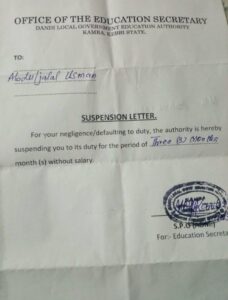
A classroom teacher in Kebbi State, Abduljalal Usman, has reportedly been suspended for three months without salary after rejecting a Ramadan palliative reportedly distributed by the state government.
The teacher allegedly declined the offer of one mudu of maize and one mudu of millet and also criticized what he described as poor governance in the state.
According to claims circulating online, the action was taken under the administration of Nasir Idris, prompting criticism from some commentators who described the suspension as an attempt to silence dissent and punish a public worker for speaking out.
Critics argue that educators deserve better working conditions, fair compensation, and respect, rather than disciplinary action for expressing their views.
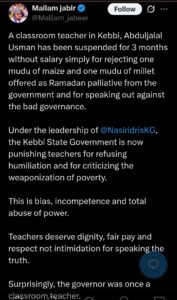
@Mallam_jabeer who shared the report, said …
“A classroom teacher in Kebbi, Abduljalal Usman has been suspended for 3 months without salary simply for rejecting one mudu of maize and one mudu of millet offered as Ramadan palliative from the government and for speaking out against the bad governance.
Under the leadership of
@NasiridrisKG
, the Kebbi State Government is now punishing teachers for refusing humiliation and for criticizing the weaponization of poverty.
This is bias, incompetence and total abuse of power.


2027: More Than 50 Lawmakers Lose APC Reps Tickets in Major Primary Election

Bandits behind Ogbomoso school abduction will face full wrath of the law- President Tinubu

PDP to screen Goodluck Jonathan on Tuesday as its sole Presidential aspirant For 2027 race

-
Business2 years ago
US court acquits Air Peace boss, slams Mayfield $4000 fine
-

 Trending2 years ago
NYA demands release of ‘abducted’ Imo chairman, preaches good governance
-

 Politics2 years ago
Mexico’s new president causes concern just weeks before the US elections
-

 Politics2 years ago
Putin invites 20 world leaders
-

 Politics2 years ago
Russia bans imports of agro-products from Kazakhstan after refusal to join BRICS
-
Entertainment2 years ago
Bobrisky falls ill in police custody, rushed to hospital
-
Entertainment2 years ago
Bobrisky transferred from Immigration to FCID, spends night behind bars
-
Education2 years ago
GOVERNOR FUBARA APPOINTS COUNCIL MEMBERS FOR KEN SARO-WIWA POLYTECHNIC BORI