
Columns
Nigerians not the only ones facing poverty — President Tinubu

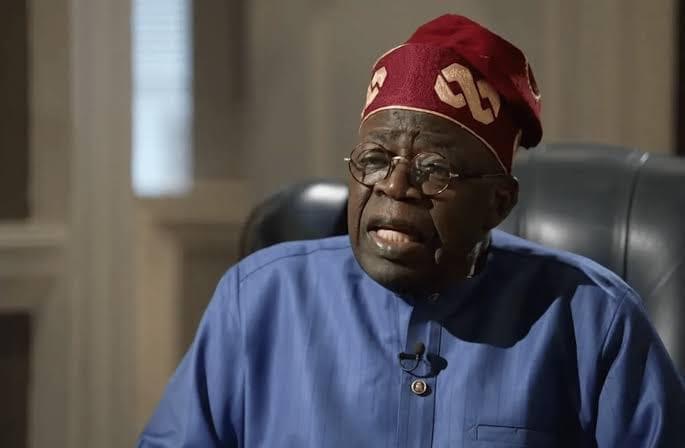
President Bola Tinubu has stated that while poverty and suffering exist in the country, Nigerians are not the only ones facing these challenges.
The President said this in Lagos when he received a delegation from the National Assembly who came to felicitate with him on the occasion of Eid-el Kabir on Monday evening.
The delegation, led by the President of the Senate, Sen. Godswill Akpabio, included the Deputy Senate President, Sen. Jibrin Barau, and deputy speaker of the House of Representatives, Hon. Benjamin Kalu, among others.
“Yes, there is poverty; there is suffering in the land. We are not the only people facing such, but we must face our challenges. We must find a way to eliminate banditry and terrorism so that farmers can bring out food from the farmland.
If you do not have good roads to bring the food to the population, even if you grow the food and you are losing 60–70 per cent to damages, you will pay the price,” said Tinubu.
Tinubu also restated his commitment not to turn his back on the country despite the challenges. “Good economics at a harsh time is the challenge that we must face. As I said in my speech, no matter how difficult it is and how challenging it can be, I will not turn my back on Nigeria,” Tinubu said.
He challenged citizens to have a change of mindset about Nigeria if the nation is to overcome its current challenges. “The need (for some citizens) to change the rent-seeking mindset and become more productive to the economy is a challenge. There is a need to stop smuggling and all economic sabotage. Why should we have people removing rail tracks and all that, stealing electric cables, and sabotaging the economy?






Columns
What is acute myocardial infarction? Ozzy Osbourne’s cause of death explained as death certificate is released

Ozzy Osbourne‘s cause of death has been confirmed—but what is an acute myocardial infarction?
It was one of three things listed on the 76-year-old Black Sabbath rocker’s death certificate, which was released yesterday afternoon.
The document cited out of hospital cardiac arrest, acute myocardial infarction and coronary artery disease, and Parkinson’s disease with autonomic dysfunction as the dad-of-five’s cause of death.
An acute myocardial infarction is a medical term for a heart attack, and in Mr Osbourne’s case it was connected to coronary artery disease.
Coronary artery disease is when fatty deposits (plaques) build up in the arteries.
This substance can narrow the arteries—a process called atherosclerosis—which reduces blood flow and increases the risks of heart attacks.
Furthermore, chunks of this plaque, which is made predominantly of cholesterol and other fat cells, can break off and cause obstructions, which can also trigger a heart attack if it affects the blood’s movement through the body.
Out of hospital cardiac arrest refers to falling ill outside of hospital—in Mr Osbourne’s case he became unwell while at home—and according to the British Heart Foundation, this is a medical emergency which fewer than 1 in 10 people survive.
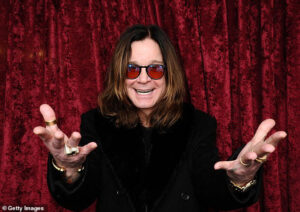
The Black Sabbath star died aged 76 at his Buckinghamshire estate
Mr Osbourne was diagnosed with Parkinson’s disease in 2019, and autonomic dysfunction refers to bodily functions which are affected by the condition.
The British Heart Foundation claims that in the UK, coronary heart disease—which includes heart attacks—is the cause of 66,000 deaths each year.
This translates to roughly 180 deaths per day, or one death every eight minutes.
In England and Wales alone, over 55,000 deaths were attributed to coronary artery disease—also referred to as ischemic heart disease—in 2019.
While Parkinson’s Disease itself doesn’t kill, studies have linked it to an increased risk of cardiovascular disease—including coronary artery disease.
This is because Parkinson’s affects people’s ability to walk and move around, making it near impossible for them to maintain a basic level of fitness, which keeps the vascular system healthy and functioning.
His passing came just weeks after he appeared on stage for his farewell concert at Villa Park stadium in his native Birmingham.
Due to Parkinson’s-related mobility issues, he performed while seated on a giant black throne.
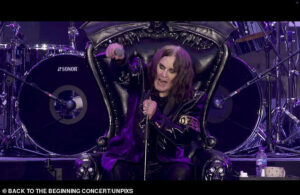
Due to mobility issues caused by Parkinson’s Disease, Ozzy performed seated on a throne
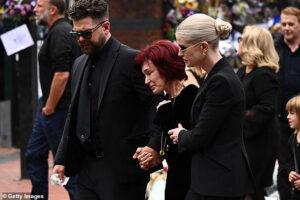
His grieving widow, Sharon, and two of his kids, Jack and Kelly, visit tributes in Birmingham
The concert, three weeks before his death, saw him reunite with his original Black Sabbath bandmates for the first time since 2005.
More than 42,000 fans packed into the venue for the Back To The Beginning show, during which he told the crowd in his final speech: ‘You’ve no idea how I feel – thank you from the bottom of my heart.’
There were more than 5 million sign-ups to the concert’s livestream, too.
The concert raised £140 million for charities close to Mr Osbourne’s heart, Cure Parkinson’s, Birmingham Children’s Hospital and Acorn Children’s Hospice.
In a statement shared last month, Ozzy’s family said he died ‘surrounded by love’, adding: ‘It is with more sadness than mere words can convey that we have to report that our beloved Ozzy Osbourne has passed away this morning.’
Mr Osbourne passed away on July 22 surrounded by his family at his Buckinghamshire Estate, where he was subsequently laid to rest last week.
The private funeral was attended by his family and a host of rock royalty.
His widow Sharon, 72, and their children, Aimee, Kelly and Jack, were joined by stars including Marilyn Manson and Ozzy’s lead guitarist Zakk Wylde during the event at the family’s 250-acre estate.
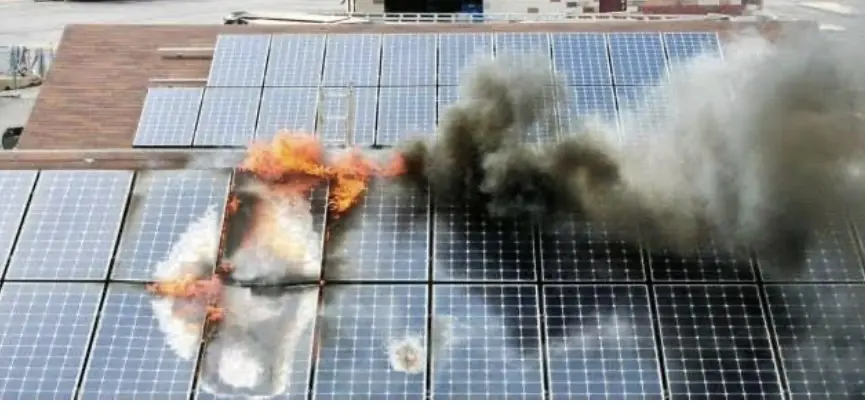
For the last two decades in Nigeria, there have been massive adoption of solar power systems as an alternative power source to the age long unstable power supply, high electricity bills and also as a profitable alternative to fossil fuel generating plant.
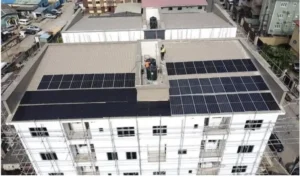
Generally, those that make the switch to this innovative solution have their solar panels installed on their roof tops in other to harvest adequate sunshine which is the source of energy that is DC (Direct Current). The direct current is then converted into AC (Alternating Current) used in powering their homes or business places.
In recent times, there have been videos circulating the internet showing houses on fire with captions such as, “solar panels burnt down the house”, “stop putting solar panels on your roofs” and so on. This has created panic in the solar sector and has become a cause of concern from some existing and intending solar users to use their roofs.
What is a solar panels?
A solar panel also known as photovoltaic (PV) panel is a major component of a solar system that converts photons from the sunlight into electrical direct current(DC) which is then used to power a house through an inverter or without an inverter if the appliances in use are DC appliances.
Solar panels are majorly made up of silicon solar cells, glass covering ,encapsulant, aluminum frame and junction box with extending short MC4 cables. So, can solar panels cause fire on your roof? Let’s find out in this article.
Why solar panels are installed on the roof?
As I earlier stated in the introduction, the primary reason for having solar panels on the rooftop is for better harvesting of sunlight and to avoid shadows as much as possible. This is why it has always been the general spot where residential and some commercial solar panels are installed.
Screenshot

A head of official announcement for the recruitment of Police cadet ASP, inspectors, the Police Service Commission has warned that it will deal decisively with anybody who intends to involve himself in any form of racketeering or fraud in the recruitment of qualified Nigerians into the Nigeria Police Force.

National Leadership Sides with Prof. James Okoroma as Imo ADC Chairman

Peter Obi: ‘They came with sweetener’ – Soludo defends ‘psychiatric evaluation’ comment

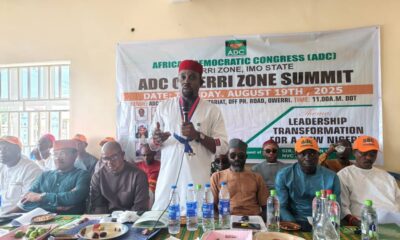
ADC Owerri Zonal Summit Concludes with Resounding Success

-

 Politics10 months ago
Mexico’s new president causes concern just weeks before the US elections
-
Business10 months ago
US court acquits Air Peace boss, slams Mayfield $4000 fine
-

 Trending10 months ago
NYA demands release of ‘abducted’ Imo chairman, preaches good governance
-
Entertainment10 months ago
Bobrisky falls ill in police custody, rushed to hospital
-
Entertainment10 months ago
Bobrisky transferred from Immigration to FCID, spends night behind bars
-

 Politics10 months ago
Russia bans imports of agro-products from Kazakhstan after refusal to join BRICS
-

 Politics10 months ago
Putin invites 20 world leaders
-
Education12 months ago
GOVERNOR FUBARA APPOINTS COUNCIL MEMBERS FOR KEN SARO-WIWA POLYTECHNIC BORI