








Watch the video below..
News
Nnamdi Kanu’s lawyer speaks on stabbing at Sokoto prison


Nnamdi Kanu, leader of the Indigenous People of Biafra (IPOB), is safe and has not been attacked or stabbed at the Sokoto Custodial Centre.
One of his lawyers, Maxwell Opara, confirmed this in a statement.
Kanu is serving a life sentence at the facility after being convicted by Justice James Omotosho of the Abuja Federal High Court.
The IPOB leader was transferred to Sokoto following his conviction.
Opara explained that claims of an attack on Kanu are false and that he remains in custody without any harm.
Opara also addressed Kanu’s appeal at the Court of Appeal in Abuja, which sought to move him to Kuje Correctional Centre.
The court dismissed the case, stating it was no longer relevant due to his conviction.
The lawyer said the move to Sokoto was based on the original court order, which specified that Kanu be kept in a protective custodial facility.
Efforts to clarify the reasons for transferring Kanu to Sokoto revealed that the custodial centre is considered appropriate for his sentence, as directed by Justice Omotosho.
Opara emphasized that all actions regarding Kanu’s custody are in line with the court’s directives, and he is receiving the required attention at the correctional centre.
“I want to start by telling you that nobody stabbed Nnamdi Kanu and nobody attacked him. He is here in the Correctional Centre in Sokoto.
“Secondly, there is this issue of his case that was struck out in the Court of Appeal, Abuja Division, last week. That case was filed in 2022 when we asked the court to order the DSS to transfer him back to a correctional centre so he could have access to a medical doctor. But we lost at the Federal High Court and then went to the Court of Appeal.
“When the matter came up, the court said it had become academic and struck it out.
“On the issue that relates to the one he filed at the Federal High Court so he could come back to Abuja to handle his appeal, that particular judgment relating to his conviction and sentence required that he be kept in a protective custodial centre in Nigeria, but he was taken to Sokoto Correctional Centre.
“So we tried to confirm from the correctional facility why they took him to Sokoto. Were they implying that Sokoto is more protective than Abuja?
“They said no. After indicating that in the judgment and in the remand warrant, the judge specifically mentioned Sokoto, and that’s why they took him there. Hence, he filed that motion at the Federal High Court,” he said.

The police in Delta state have arrested eleven more suspects over the sexu@l ass@ults recorded during what was described as a “r@ping festival” in Oramudu Quarters in Ozoro last Thursday, March 19.
In a statement released on Saturday, March 21, the spokesperson of the command, SP Bright Edafe, said the CP Special Assignment Team (CP-SAT) was tasked with conducting a detailed investigation into the incident.
Edafe said operatives of CP-SAT conducted a thorough analysis of available video evidence and intelligence, leading to the arrest of eleven additional suspects identified as Samson Atukpodo, Steven ovie, Ugbevo Samson, Afoke Akporobaro, Evidence Oguname, and six others. Edafe mentioned that these latest arrests bring the total number of suspects currently in police custody in connection with the incident to fifteen (15)
“The Command reiterates that preliminary findings indicate that the unfortunate incident was perpetrated by criminal elements who exploited the situation to engage in acts of sexu@l v!olence, which are in no way representative of any legitimate cultural practice.
The Commissioner of Police, Delta State Command, CP Aina Adesola, condemns these acts in totality and reassures the public that the Command remains resolute in its determination to ensure that all those involved are identified, arrested, and prosecuted in accordance with the law. Members of the public, particularly victims and witnesses, are once again encouraged to come forward with credible information that will aid ongoing investigations. The Command assures that all information provided will be treated with strict confidentiality.”the statement in part reads
News
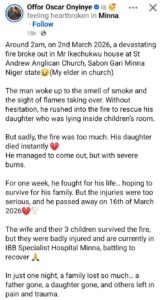
So Sad: Father Dies While Rescuing Daughter From Midnight Fire, Both Perish in Minna Tragedy (Photos)

A father’s ultimate act of love has ended in heartbreak after a devastating midnight fire claimed both his life and that of his six-year-old daughter in Minna, Niger State, leaving a family shattered and a community in mourning.
The tragedy struck at approximately 2am on March 2, 2026, when fire broke out at the residence of Ikechukwu Michael Njoku, 45, situated within the premises of St. Andrew Anglican Church in the Sabon Gari area of Minna.
According to accounts shared on Facebook by family acquaintance Offor Oscar Onyinye, Njoku was jolted awake by the smell of smoke and the sight of flames rapidly engulfing his home. Without pause for his own safety, he plunged into the inferno to rescue his young daughter, Esther, who was trapped inside the children’s room. Though he managed to pull himself out of the blaze, little Esther did not survive — she died instantly.
Njoku himself emerged from the fire with severe burns across his body. For nearly two weeks, he clung to life, battling his injuries at the IBB Specialist Hospital in Minna. His struggle ended on March 16, 2026, when he succumbed to his wounds — fourteen days after he had thrown himself into the flames for his child.
His wife and three other children survived the inferno but sustained serious injuries and remain hospitalised at IBB Specialist Hospital, where they continue to fight for recovery.
Father and daughter are to be laid to rest on March 27, 2026, in their ancestral hometown of Mebiokpa Okposi Ohozara in Ebonyi State.
“In just one night, a family lost so much — a father gone, a daughter gone, and others left in pain and trauma,” Onyinye wrote in a tribute that has since resonated widely across social media, with many describing Njoku as a hero whose love for his child knew no bounds.

News
I Thought It Was A Joke — Nigerian Man Recounts What He Witnessed During “R@ping Festival” In Delta (Video)

A video making rounds on social media has triggered widespread reactions after capturing a disturbing incident reportedly occurring in Ozoro, Delta State.
According to multiple posts online, there are claims that several women have been ass@ulted in the area during what some users are describing as a local gathering.
There are also warnings being shared online advising women and girls in the area to stay indoors, with concerns that those outside may be at risk. Some posts further allege that individuals who are unaware of the situation, including visitors and students, may have been affected.
Ozoro is home to Delta State University, and many online users have expressed concern about the safety of students and residents.
The situation has triggered widespread outrage, with many calling for urgent attention, proper investigation, and protection for those in the community.
Delta state police command, SP Bright Edafe, said the police has begun arresting some of the defaulting men.

Columns15 hours ago
Benita Enwonwu in the 1970s: Model, Actress, and Daughter of Ben Enwonwu

Trending20 hours ago
Kidnappers Took Loan With My Phone – Victim Recounts Ordeal

News1 day ago
11 more arrested over Ozoro “r@ping festival”

-
Business1 year ago
US court acquits Air Peace boss, slams Mayfield $4000 fine
-

 Trending1 year ago
NYA demands release of ‘abducted’ Imo chairman, preaches good governance
-

 Politics1 year ago
Mexico’s new president causes concern just weeks before the US elections
-

 Politics1 year ago
Putin invites 20 world leaders
-

 Politics1 year ago
Russia bans imports of agro-products from Kazakhstan after refusal to join BRICS
-
Entertainment1 year ago
Bobrisky falls ill in police custody, rushed to hospital
-
Entertainment1 year ago
Bobrisky transferred from Immigration to FCID, spends night behind bars
-
Education2 years ago
GOVERNOR FUBARA APPOINTS COUNCIL MEMBERS FOR KEN SARO-WIWA POLYTECHNIC BORI