
Columns
On 5 March 1986, three of Nigeria’s most celebrated literary figures — John Pepper Clark, Chinua Achebe, and Wole Soyinka — arrived at Dodan Barracks in Lagos.

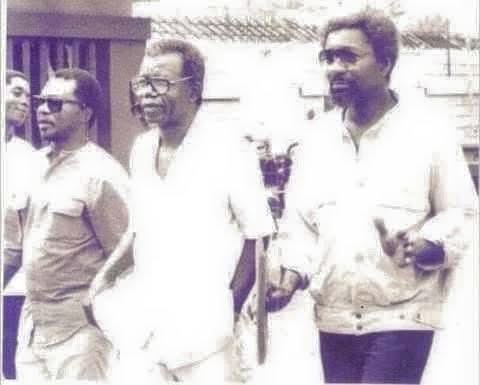
They went to appeal directly to Nigeria’s Head of State, Ibrahim Babangida, seeking clemency for their friend and colleague, Mamman Vatsa, a Major-General in the Nigerian Army.
Vatsa, who was also a poet and a long-time associate of Babangida, had been accused of involvement in a coup plot against the military government. Despite the intervention of the three writers — representing the moral voice of Nigeria’s intellectual community — the appeal was unsuccessful.
Major-General Mamman Vatsa was executed later that same day, marking one of the most controversial episodes of Nigeria’s military era. The event highlighted the limits of intellectual influence under military rule and remains a powerful symbol of the tension between power, friendship, and conscience in Nigeria’s history.
Source: History Ville




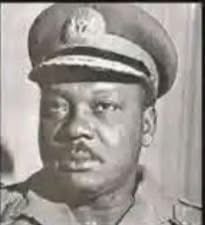
After his tor*ture and exe*cut*ion by soldiers led by Major Theophilus Danjuma, Major General Johnson Aguiyi-Ironsi, Nigeria’s first military Head of State, was buried in a shallow grave by his executors, who abandoned his remains in an unmarked grave.
With the whereabouts of the Head of State unknown, the Military Governor of the Eastern Region, Lieutenant Colonel Chukwuemeka Odumegwu Ojukwu, called on the most senior surviving officer, General Babafemi Ogundipe, to assume control and stabilize the situation. However, General Ogundipe fled the country. Lieutenant Colonel Yakubu Gowon was declared Head of State.
Ojukwu, refused to recognize Gowon’s authority or attend any meeting with him until the fate of General Aguiyi-Ironsi was formally clarified.
Eventually, Gowon confirmed that Aguiyi-Ironsi had been murd*er*ed. Following this confirmation, his remains were exhumed from the shallow grave and reburied in a cemetery in Ibadan, marking his second burial.
Lieutenant Colonel Ojukwu rejected this burial as humiliating and unacceptable. He insisted that, as a former Head of State and a Major General of the Nigerian Army, Aguiyi-Ironsi deserved a full state burial with military honours, and that, as an Igbo man, he should be laid to rest among his ancestors. The Federal Government refused this demand, but Ojukwu insisted on it.
This impasse formed part of the tensions preceding the Aburi meeting in Ghana between Lieutenant Colonel Yakubu Gowon and Lieutenant Colonel Ojukwu. Following the meeting, the remains of General Aguiyi-Ironsi were released to Ojukwu in his capacity as Military Governor of the Eastern Region.
Consequently, on 27 January 1967, General Aguiyi-Ironsi was accorded a dignified state funeral with full military honours in his hometown of Ibeku-Umuahia, where he was laid to rest for the third and final time.
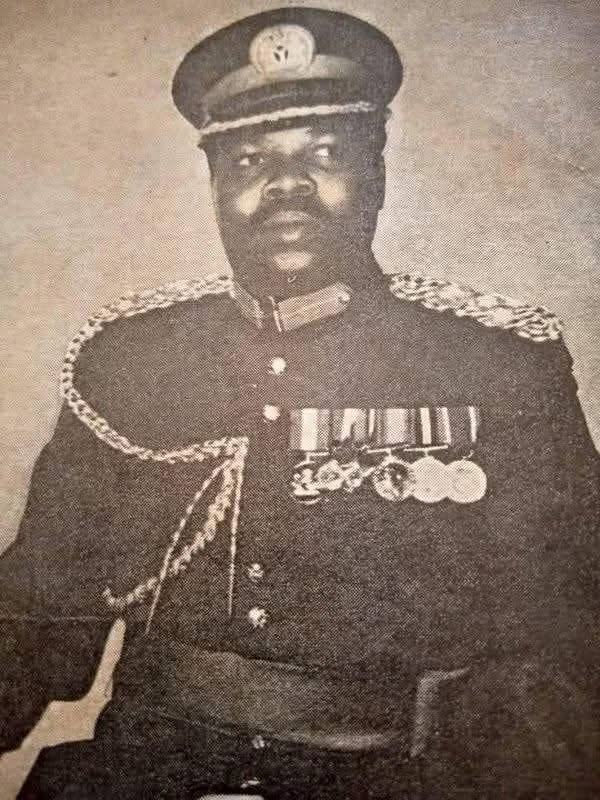
Brigadier Babafemi Olatunde Ogundipe occupies a pivotal yet often overlooked place in Nigeria’s military and political history. Hailing from Ago-Iwoye in present-day Ogun State, Ogundipe was Nigeria’s first Chief of Staff, Supreme Headquarters, a position that placed him at the heart of the country’s command structure during a turbulent era.
Early Military Career and Global Service
Ogundipe’s military career predated Nigeria’s independence and reflected the global reach of colonial-era soldiering. During the Second World War, he served with distinction in Burma and India, theatres that demanded discipline, adaptability, and courage. After the war, his experience was further broadened through international service as a United Nations peacekeeper in the Congo, where Nigerian troops played a stabilising role during one of Africa’s most volatile post-colonial crises.
These assignments marked Ogundipe as a seasoned professional soldier with exposure to multinational command environments—experience that would later prove crucial at home.
The Crisis of July 1966
Nigeria’s political fault lines widened dramatically after the July 29, 1966 counter-coup, which claimed the lives of Head of State Johnson Aguiyi-Ironsi and Western Region military governor Adekunle Fajuyi. In the immediate aftermath, Brigadier Ogundipe—by seniority—was constitutionally positioned to assume national leadership.
However, the reality on ground was stark. Ogundipe had no loyal troops directly under his command. Determined to restore order, he hastily organised a detachment led by Captain Ephraim Opara. The unit was ambushed around Ikeja, further weakening his authority. Attempts to assert command were openly rebuffed, even by lower-ranking soldiers—an extraordinary breach of military discipline that underscored the depth of the crisis.
Marginalisation and Exit
As events unfolded, it became clear that the political winds favoured a northern officer as Head of State. With Yoruba officers sidelined and command authority fractured, Ogundipe faced a bleak choice. Rather than preside over further bloodshed or serve as a figurehead without control, he left Nigeria, relocating to the United Kingdom.
Ironically, his junior in rank, Yakubu Gowon, soon emerged as Head of State. In a gesture that acknowledged Ogundipe’s seniority and service, Gowon appointed him Nigeria’s High Commissioner to the United Kingdom—a diplomatic role that kept him connected to national service, albeit away from the barracks.
Death and Legacy
Brigadier Babafemi Ogundipe died in London in November 1971. Over time, public memory has often reduced his story to what he did not become, rather than what he was: a pioneering Chief of Staff, a veteran of global conflicts, and a soldier who attempted—under near-impossible circumstances—to uphold order during one of Nigeria’s darkest hours.
Today, his contributions in India, Burma, the Congo, and Nigeria’s formative military years deserve renewed recognition. Far from weakness, Ogundipe’s restraint and decisions reflected a sober assessment of reality at a moment when reckless ambition could have plunged the nation deeper into chaos.
Source:
Nigeria: Guide to the National Military Government, 1966 (photo and historical reference)
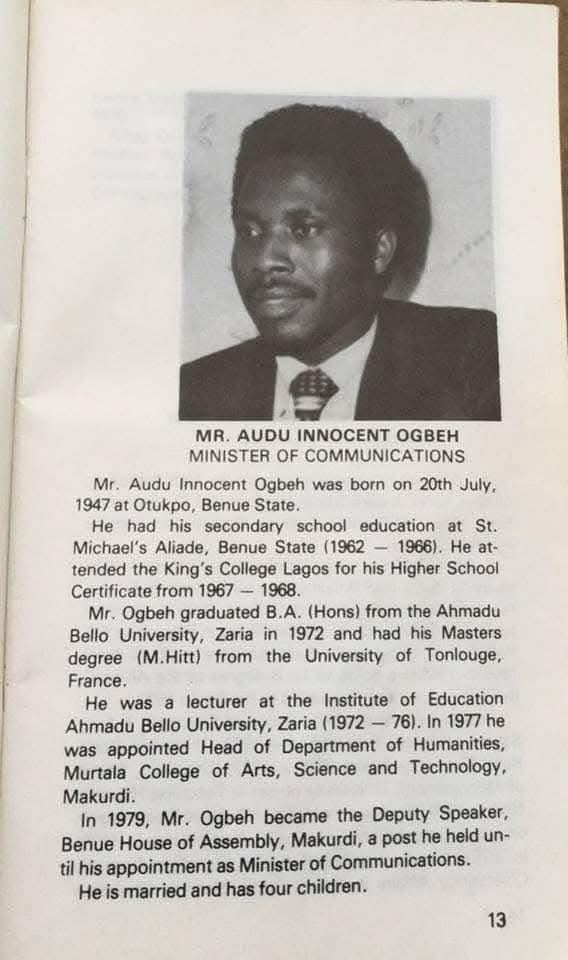
In 1982, Mr. Audu Innocent Ogbeh served as Nigeria’s Federal Minister of Communications, a role he held until 1983. His appointment came at a time when Nigeria’s communications sector was central to national administration and connectivity, and it crowned a steady rise through academia and public service.
Early Life and Education
Audu Innocent Ogbeh was born on 20 July 1947 in Otukpo, Benue State. He received his secondary education at St. Michael’s Aliade, Benue State (1962–1966), before proceeding to King’s College, Lagos, where he completed his Higher School Certificate (1967–1968).
He earned a Bachelor of Arts (Honours) degree from Ahmadu Bello University (ABU), Zaria, in 1972, and later obtained a Master’s degree (M.Litt) from the University of Toulouse, France.
Academic Career
Ogbeh began his professional life in academia. From 1972 to 1976, he was a lecturer at the Institute of Education, Ahmadu Bello University, Zaria. In 1977, he was appointed Head of the Department of Humanities at the Murtala College of Arts, Science and Technology, Makurdi, reflecting his growing reputation as an educator and administrator.
Entry into Politics and Legislative Service
In 1979, Ogbeh transitioned into politics and was elected Deputy Speaker of the Benue State House of Assembly, a position he held until 1982. His performance in the legislature paved the way for his elevation to the federal cabinet.
Federal Minister of Communications (1982–1983)
Ogbeh’s tenure as Minister of Communications placed him at the helm of a strategic sector responsible for postal services and telecommunications during Nigeria’s Second Republic period. Though brief, his service marked a key chapter in his public career.
Later National Roles
Beyond the 1980s, Audu Ogbeh remained a prominent national figure. He served as Chairman of the Peoples Democratic Party (PDP) from 2001 to January 2005, overseeing the party during a critical phase of Nigeria’s Fourth Republic. He later returned to the federal cabinet as Minister of Agriculture and Rural Development (2015–2019), where he focused on agricultural reform and rural development.
Personal Life
Mr. Audu Innocent Ogbeh is married and has four children.
A photograph from 1982 captures him during his time as Federal Minister of Communications, symbolising a career that bridged education, legislation, party leadership, and federal governance.
Source:
Ayatutu Media

President Tinubu To Visit Yola, Interact With Leaders, Inaugurate Completed Projects

NDLEA: Drug lord serving five-year jail term in Ikoyi prison attempts to export cocaine to UK

NPFL: Ikorodu stun Enyimba, Remo Stars falter again

-
Business1 year ago
US court acquits Air Peace boss, slams Mayfield $4000 fine
-

 Trending1 year ago
NYA demands release of ‘abducted’ Imo chairman, preaches good governance
-

 Politics1 year ago
Mexico’s new president causes concern just weeks before the US elections
-

 Politics1 year ago
Putin invites 20 world leaders
-

 Politics1 year ago
Russia bans imports of agro-products from Kazakhstan after refusal to join BRICS
-
Entertainment1 year ago
Bobrisky falls ill in police custody, rushed to hospital
-
Entertainment1 year ago
Bobrisky transferred from Immigration to FCID, spends night behind bars
-
Education1 year ago
GOVERNOR FUBARA APPOINTS COUNCIL MEMBERS FOR KEN SARO-WIWA POLYTECHNIC BORI