
Business
Shortages and price rises: US sanctions Serbia’s main oil supplier over Russian-majority control

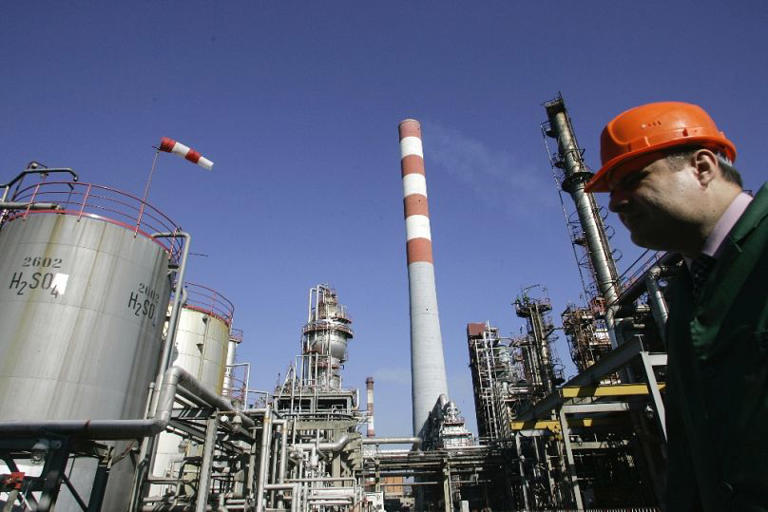
The US has sanctioned Serbia’s main oil supplier, which is majority-owned by Russia, the company confirmed on Thursday.
The sanctions against the Petroleum Industry of Serbia (NIS), which employs 5,000 people, took effect at 6 am on Thursday.
American authorities sanctioned the oil giant, which operates a refinery and 330 petrol stations in Serbia, because it is controlled by Moscow.
The move comes as part of the West’s crackdown on Moscow’s energy sector, following its full-scale invasion of Ukraine in February 2022.
NIS’ main shareholder is Russia’s Gazpromneft with 45%, and after a swap deal, the Gazprom Capital-related JSC Intelligence controls around 11%. The Serbian state holds 30%, while small investors hold the remaining shares, accounting for about 13-15%.
The Russian-majority ownership can only be resolved through a buyout or nationalisation. While there is no money for the former, Serbian President Aleksandar Vučić is unwilling to take the second option.
“Nationalisation could be the only way out of the sanctions, but it is the last thing I would do,” Vučić said on Thursday.
The Russian owners are not willing to withdraw from the market voluntarily, as they have “established a foothold” there, according to Vučić. They are also politically motivated to stay in a region they consider to be within their sphere of interest.
The sanctions, which were announced with a 45-day notice period, have been postponed six times at Belgrade’s request, but now even the Serbian president does not hope for another reprieve from Washington.
What are the immediate consequences?
Once the sanctions are enforced, deliveries via the Croatia-owned pipeline JANAF will immediately cease by force of law. The pipeline supplies crude oil to Serbia’s only refinery in Pančevo, which comes from Iraq and Gulf countries, not Russia.
JANAF was granted a delivery permit, which ended on Wednesday. It largely managed to meet Serbia’s needs independently.
Between 2023 and 2024, a total of 6.2 million barrels of crude were transported from the port of Rijeka to Pančevo, near Belgrade.
Losing a client like NIS is set to create serious sanctions in Croatia, sending ripples through JANAF’s largest owners including the state-owned asset management and pension fund, oil company INA, the Croatian state-owned electric utility company and the government itself, which owns 15% of its shares.
Motorists in Serbia will experience the effects of the sanctions immediately.
From 6 am on Thursday, the option to pay by card at the NIS chain of petrol stations will be discontinued. Terminals will no longer accept MasterCard or Visa cards, which operate on the US payment system.

Card payment terminal in New York AP Photo/Mark Lennihan
According to forecasts, purchases at NIS filling stations will only be possible with cash.
If banks stop cooperating with NIS, it “will not affect employees’ and consumers’ personal accounts”, said the company’s CEO, Kiril Tyurgyenev.
An immediate fuel shortage is not expected. However, if reserves run out, not only will queues form at petrol stations, but fuel price hikes will be inevitable.
Is there a stockpile of petrol in the country?
Waiting in line at petrol stations in Serbia has occurred before.
In March 2022, cars lined up at stations after the Serbian government froze fuel prices, and rumours spread rapidly on social media that the quantity of fuel allowed per fill-up would be limited, a measure that had occurred several times before.
Dušan Bajatović, director of Srbijagas, reassured the public on state television that fuel stocks in Serbia are “sufficient for six to eight months” and that there is “no threat of a price shock or fuel shortage”.
For a month or two, no one will feel the consequences of the sanctions, according to Bajatović in another broadcast of the same media outlet.
However, expert Miloš Zdravković claimed Serbia has “insignificant reserves” that “will not last long” after the sanctions are enforced.
He believes these reserves are “sufficient for a few months”, arguing that the Serbian oil industry will shut down because “it is impossible to transport the necessary amount of crude oil by Danube barges”.
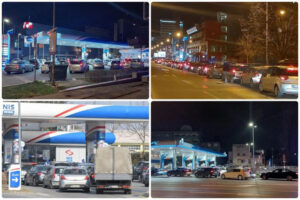
Queues at Novi Sad petrol stations, March 2022 Forrás: Nova, 021
“The company stores sufficient crude oil for processing, as well as enough oil derivatives to meet the current market demand,” NIS stated in a press release without giving further details, adding that its filling stations “are ready to meet consumers’ needs”.
If the sanctions are imposed, petrol station owners will increase the supply of imported fuel “above the usual quantity”, said the owner of the Knez Petrol petrol station chain, which sources half of its supplies from NIS.
“I believe there will be enough fuel until the end of the year, but afterwards, in the long run, the situation will probably be uncertain and tense,” said Jelena Radun, co-owner of the Radun Avia petrol station chain. She believes the most significant problem could be the lack of storage and port capacity.
Hungarian-owned MOL, which is not affected by the sanctions, operates 65 petrol stations in Serbia. At the end of February, it announced that it is ready to take over NIS’s role in the Serbian market.
Prior to the announcement, Hungarian Minister of Foreign Affairs and Trade Péter Szijjártó criticised the US sanctions, attributing them to the Biden administration’s retaliatory action against the sovereign policies of Hungary and Serbia, despite the new Trump administration having imposed the punitive measures.
Will there be any layoffs?
As a result of US sanctions, it is likely that NIS will eventually be forced to let some of its workers go.
“I hope the company will not lay off a large number of employees,” Vučić said.
“We will talk to the Russians because there is nothing left to discuss with the Americans,” he added.
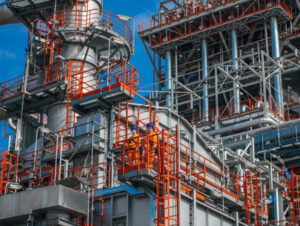
The Pančevo refinery Forrás: NIS
The company’s accounts with foreign banks are expected to be frozen, raising questions about how, for example, employee salaries will be paid. Since the sanctions were announced, salaries have been paid a month in advance as a preemptive measure, according to sources in Gazprom.
It is unclear even to experts how the giant company will operate in the future. Banks, for example, risk their own operations if they continue to do business with NIS.
This risk extends even to the state-owned Postal Savings Bank, which could remain the oil company’s only financial partner after the sanctions.
Some other companies maintained their cooperation with the Serbian oil company until this week, while others severed ties as early as January when the US first announced sanctions.
NIS a ‘lifeline’ to Serbia’s economy
The sanctions will have severe consequences because they will practically paralyse NIS’ operations, Ljubodrag Savić, a professor from the Faculty of Economics at the University of Belgrade told Euronews Serbia.
NIS contributes 11.9% to the state budget, and its production and operations account for 6.9% of GDP, said Savić, who suggested that the large company plays a “lifeline” role in the country’s infrastructure.
He pointed out that NIS employs 5,000 people, whose fate affects the lives of 20,000 family members.
NIS had already been operating with weaker results in the first half of this year, with its turnover falling by more than a quarter compared to the same period in 2024.
The situation is exacerbated by the fact that banks expect NIS to repay just over half a billion euros in loans, of which €180 million is due this year.
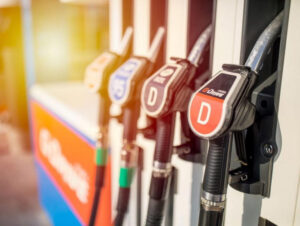
Will the supply dry up? – NIS’s fuel range Forrás: NIS
There is always the possibility that foreign banks will attempt to collect their debts immediately, according to the former secretary general of the Association of Serbian Banks Veroljub Dugalić.
Dugalić recalled that Washington had no problem seizing or freezing Russian assets abroad in the past.
“They won’t have a problem doing the same here,” Dugalić said.
Sanctions are easy to impose but hard to lift, warned Professor Savić, who added that Serbia would suffer the most collateral damage in what he described as the clash between the US and Russia.










The Trade Union of Nigeria, TUC, has raised the alarm that the price of Premium Motor Spirit aka Petrol may climb to about N2,000 per litre if urgent measures are not taken to cushion the impact of rising global crude prices and the depreciating naira.
Speaking to newsmen on Thursday, April 9, the president of the TUC, Festus Osifo, called on the Federal Government to immediately deploy 60 percent of excess crude oil revenue above the 2026 budget benchmark to subsidise crude feedstock supplies to the Dangote Refinery and other modular refineries, a move it says will slash pump prices of petrol, diesel, and jet fuel within two weeks
“Today, comrades, we are seeing that the cost of petrol is edging towards N2,000 per litre depending on the part of the country that you are. Nigerian workers are already passing through excruciating pain as we speak.
The same way it is affecting transportation, it is also affecting manufacturing. The cost of diesel has also gone northward, meaning that the cost of production has increased. When production costs rise, the final price of goods on the shelves will also skyrocket.
If this continues unchecked, the inflation that we are currently celebrating as going downwards will reverse and start moving up again,” he stated.
Osifo outlined the proposal as an urgent intervention to cushion Nigerian workers from excruciating pain caused by petrol prices edging towards ₦2,000 per litre in some parts of the country

The governor of Oyo state, Seyi Makinde, has approved a N10,000 transportation allowance as a palliative for the state workforce to cushion the effects of the increase in the pump price of Premium Motor Spirit, otherwise known as petrol.
The Chairman of the Nigeria Labour Congress (NLC), Oyo State chapter, Kayode Martins, in a statement released on Monday, March 23, disclosed that the governor has granted the request of the union on the issue of transportation allowance.
The statement read
“Following the intervention and formal request made by the State Council of the Nigeria Labour Congress (NLC) earlier this morning, the state government has approved a N10,000 transportation allowance for all workers in the state.
The newly approved allowance is set to take effect from April 2026, providing much-needed relief to workers grappling with rising transportation costs amid current economic challenges.
This development comes as a direct response to sustained advocacy by the state NLC, aimed at cushioning the impact of increased living expenses on the workforce.
Further details on implementation are expected to be communicated by the relevant government authorities in due course.”
The Central Bank of Nigeria (CBN), has declared that banks and financial institutions must establish and maintain a temporary watch-list for Bank Verification Numbers (BVN) implicated in suspected fraudulent transactions.
According to the CBN in a circular dated March 12, 2026 and signed by its Director of Payments System Policy Department, Musa I. Jimoh, the apex bank said such a suspected BVN may remain on the temporary watchlist for a maximum period of twenty-four (24) hours during which the owner would be contacted to make clarifications.
The circular explained that the move is part of several new measures under a revised regulatory framework aimed at enhancing financial system stability.
“A BVN may remain on this temporary Watchlist for a maximum period of twenty-four (24) hours, during this period, the BVN owner shall be contacted to provide clarification regarding the identified transaction(s),” the circular stated.
The circular also sets an age requirement for BVN enrolment, restricting registration to individuals who have attained eighteen (18) years and above.
The CBN also added that amendments to phone numbers linked to a BVN shall be allowed only once.
“Amendments to phone numbers linked to a BVN shall be allowed only once,” the circular noted.
The apex bank stated that access to BVN databases will remain tightly controlled.
“Access to the BVN databases shall be exclusively granted to Central Bank of Nigeria (CBN) licensed financial institutions.
“Notwithstanding this provision, the Central Bank of Nigeria (the Bank) reserves the right to approve access to the BVN databases in extenuating circumstances and in accordance with the provisions of extant laws,” the circular said.
Financial institutions are expected to comply with the new requirements, and customers may be contacted by their banks if their BVNs are temporarily flagged during the new fraud monitoring process.
The new policy, as stated by the CBN, takes effect from May 1, 2026.

2027: More Than 50 Lawmakers Lose APC Reps Tickets in Major Primary Election

Bandits behind Ogbomoso school abduction will face full wrath of the law- President Tinubu

PDP to screen Goodluck Jonathan on Tuesday as its sole Presidential aspirant For 2027 race

-
Business2 years ago
US court acquits Air Peace boss, slams Mayfield $4000 fine
-

 Trending2 years ago
NYA demands release of ‘abducted’ Imo chairman, preaches good governance
-

 Politics2 years ago
Mexico’s new president causes concern just weeks before the US elections
-

 Politics2 years ago
Putin invites 20 world leaders
-

 Politics2 years ago
Russia bans imports of agro-products from Kazakhstan after refusal to join BRICS
-
Entertainment2 years ago
Bobrisky falls ill in police custody, rushed to hospital
-
Entertainment2 years ago
Bobrisky transferred from Immigration to FCID, spends night behind bars
-
Education2 years ago
GOVERNOR FUBARA APPOINTS COUNCIL MEMBERS FOR KEN SARO-WIWA POLYTECHNIC BORI