
Education
South-East Students to EFCC: “We are Sorry for the Loss of your Officer”.


The National Association of Nigerian Students (NANS), South-East Zone have condoled with the Economic and Financial Crimes Commission, EFCC, on the loss of one of its operatives, Aminu Sahabi Salisu, stressing that his death caused them grief and regret.
Salisu, an Assistant Superintendent of the EFCC, ASE11 was killed in cold blood while on a legitimate duty by a suspected internet fraudster, Joshua Chukwubueze Ikechukwu on January 17, 2025.
The students expressed their grief and solidarity with the Commission on Friday, January 24, 2025 when a delegation, led by Comrade Charles Obinna Ijeomah paid a condolence visit to the EFCC’s Executive Chairman, Mr. Ola Olukoyede at the Commission’s corporate headquarters, Abuja.
While pledging the collaboration, cooperation and support of the entire Southeast students to the Commission, Ijeomah stated that “As the coordinator of the National Association of Nigeria Students (NANS), Southeast, the onus falls on me and my colleagues here to ensure that we sanitize and give proper orientation to our students not to indulge in anything that has to do with internet crime and we have been succeeding.
“We are very sorry for the incident that happened lately in Awka. Maybe you may have seen our comments, our stand, we condemned it. An operative was shot in the process of carrying out his official duty. Whatever that is going on in Southeast is being controlled by students and I am their leader. I cannot watch and see things go wrong. That is why we condemned the killing of that operative.
He stated further that, “we are here to let the authority of EFCC understand that we commiserate with you and to tell you not to judge the Southeast with what happened. Such acts are not in our blood. It is not in our nature. We are hardworking people. We don’t indulge in crime. Anybody that indulges in crime in the Southeast is not a true son of Igbo. We know how to make money but this idea of being in one room with a device to trick someone is not in our blood.
“We are sad for the loss of the operative. We say sorry to the Enugu Zonal Command and to the EFCC authority for what happened. We assure you that such a thing can never happen again. Our aim of coming here is to let EFCC know that Southeast students are with them and that we’re going to partner with you more to educate our students in the Southeast region to avoid any kind of internet crime. We are here to bring you the news that we are 100 percent open to any form of interaction, collaboration and cooperation between the students of South-east and the EFCC. We are promising you total collaboration. By the time I get to Enugu after this meeting, we will be visiting the Zonal Command and pay a courtesy visit there too to let them know that they are not alone, that we are with them. We are the people controlling the youth in the streets of the South-east.”
Speaking further, Ijeomah disclosed that the union had programmes and proposals that when implemented, will bring the EFCC closer to university campuses in the Southeast and help to further sensitize the students. “We are promising you that we are going to work with you. We want to let EFCC know that this also provides an opportunity for the Commission to come and give orientation to our students in the Southeast. We will welcome you with an open heart”, he said.
The Commission Secretary, Mr. Muhammad Hammajoda who received the delegation on behalf of the Executive Chairman expressed appreciation to the students on the condolence visit, noting that “every one of us is a stakeholder in the fight against corruption directly or indirectly. We don’t have any other country apart from Nigeria. You spent your personal money and time to be with us for you to understand what we are doing and to also be part of us. We appreciate you and we will continue to appreciate you. We will support you in trying to disseminate anti-corruption information.”
While urging the students to take advantage of the federal government’s Student’s Loan Scheme, he promised that the Commission will identify with all the noble programmes of the students in the zone if invited. “We will be there for you in all the programmes that you outlined. Please give us an invitation. We will be there. We will be there to be part of you.”
Hammajoda encouraged the students’ leaders on their crusade against students’ involvement in internet crime. “We are sinking day by day with corruption. So let’s educate ourselves that this cyber crime will not take you anywhere. All of us are victims. Nobody has protection against it. Anyone can be attacked. We have a very sound youth population with a very high IQ (intelligence quotient) and ingenuity to do many things,” he said.
While lending his voice against youths’ involvement in internet crime, Chief of Staff to the Executive Chairman, Commander of the EFCC, CE Michael Nzekwe noted that “cybercrime has done too much damage to us as a country. If you check and find out how much it affected us, you’ll be shocked. Internationally, the image of the country has been battered. When you travel outside the country they look at you in a certain way with your green passport. So, cybercrime is just one thing that all of us have to put our hands together and be deliberate and intentional to see that we eliminate. EFCC has done so much in ensuring that.”
Besides leveraging on NELFUND, Nzekwe reminded the students of the Credit Scheme of the federal government as a handy window of opportunity for meeting their needs. “There’s also the credit scheme that is available for students that this government has put in place. So take that as a message to your students that they can assess this fund and the issue of poverty will not even arise.”




Rather than diminish, he noted that the trend of internet crime is rather skyrocketing in the Southeast. “You said that in the Southeast that you are hard working people and traders, but can I be honest with you? the level of yahoo yahoo in the Southeast and other cybercrimes has skyrocketed, and it has not just skyrocketed, it has gotten to the level which they call yahoo plus. They have become ritualists and kidnappers. Why would you have a gun in the house and open fire on someone on a legitimate duty? We are glad that you realized that this is wrong. You have also seen our own Press Release. We have said it very clearly and with a strong voice, that EFCC will not condone that or tolerate that from anybody, whoever the person is, never again.
Visit www.efcc.gov.ng for more stories










The National Association of Nigerian Students (NANS) has vowed to take urgent action against some persons it said are cooking up and sponsoring falsehood against the Federal University of Technology, Owerri (FUTO) and its leadership.
NANS took the position in a release signed by Comr. Olushola Oladoja, NANS President, and Comr. Nduka Chibueze (Paparazzi), NANS Director of Travel and Exchange, and made available to the media on Saturday.
“The leadership of the National Association of Nigerian Students (NANS) has observed with deep concern the activities of some unscrupulous and mischievous elements who appear to be acting in concert to tarnish the image and credibility of our institution, the Federal University of Technology, Owerri (FUTO), and its leadership through the circulation of false, misleading and malicious information across various online platforms.
“These individuals, whose actions clearly suggest a calculated agenda driven by selfish interests and external influence, have continued to propagate unfounded claims capable of bringing the institution into disrepute and misleading members of the public.
“It is unfortunate that certain persons have chosen to allow themselves to be used as instruments of propaganda and destabilization against an institution that represents the collective pride and aspiration of thousands of students and alumni.
“We wish to state categorically that such coordinated attempts to blackmail, ridicule, or undermine the institution and its leadership will not be tolerated henceforth. The university’s integrity and reputation must not be sacrificed on the altar of personal interest, sponsored misinformation, or politically motivated attacks.
“The leadership of the National Association of Nigerian Students (NANS) remains committed to protecting the image, unity, and values of the Federal University of Technology, Owerri (FUTO), and will continue to resist every desperate attempt aimed at causing disaffection within the institution, using every legitimate mechanism and arsenal within our disposition.
“We have activated the forces of Aluta to identify and expose the charlatans involved. Our aim is to deal with them in a manner that serves the overall interest of our institution. This should act as a deterrent to anyone whose actions are aimed at destroying the institutional reputation we all worked to build. Forewarned is forearmed,” NANS maintained.

An official of the National Youth Service Corps (NYSC) in Ogun State, Abass Olalekan, has been arrested in connection with the de@th of a female corps member.
The corps member, Victoria Ariyo, serving under the Abeokuta South Local Government Area (LGA) of the NYSC, reportedly d!ed last Tuesday after undergoing abortion.
It was gathered that the corps member had terminated her pregnancy and d!ed from complications that followed the procedure.
Her remains were buried at Kobape Cemetery on Kobape-Sagamu Road in Abeokuta.
According to Daily Trust, Ariyo’s d3ath came barely a month after another female corps member, Adeleye Mary, d!ed in what has been described as mysterious circumstance.
Mary, who was serving under the same Abeokuta South LG, was attached to the Ogun State Television (OGTV) as her Place of Primary Assignment (PPA).
A source told the publication that both deceased corps members were friends.
“The first lady d!ed at her residence, which is not far from her PPA. They found her lifeless body in the apartment and, up till now, nobody can tell the cause of her d3ath,” the source said.
However, the second corps member who d!ed on Tuesday was said to have died from complications arising from an abortion procedure.
It was alleged that the NYSC official, who is the Local Government Inspector (LGI) for Abeokuta South, Abass Olalekan was culpable in the process leading to the corps member’s d3ath.
Sources told the publication that the LGI was allegedly involved in a romantic relationship with the deceased, which eventually led to pregnancy, and it was the termination that led to her d3ath.
“That is the fact in issue,” a police source who confirmed the NYSC official’s arrest told Daily Trust on Thursday.
The police source said the development raises questions about the legality of romancing “someone that should be in your care.”
Confirming Olalekan’s arrest, the source said, “He is in our custody at the command’s headquarters, Eleweran, Abeokuta.”
The police source, however, said there is no connection between the current incident and the one that occurred last month.
Spokesperson for the police in the state, DSP Oluseyi Babaseyi, confirmed death of Ariyo and said that the investigation was ongoing.
However, he failed to respond to questions on the arrest of the LGI and the alleged involvement.
“I can confirm that the case of the demise of Victoria Ariyo is under investigation by the State Criminal Investigation Department,” Babaseyi said in a terse statement.
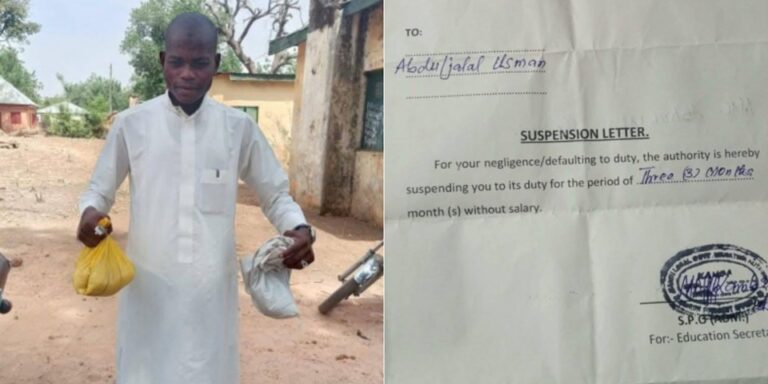
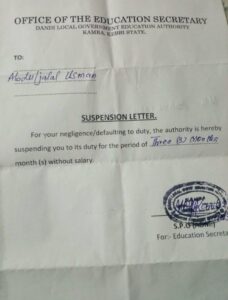
A classroom teacher in Kebbi State, Abduljalal Usman, has reportedly been suspended for three months without salary after rejecting a Ramadan palliative reportedly distributed by the state government.
The teacher allegedly declined the offer of one mudu of maize and one mudu of millet and also criticized what he described as poor governance in the state.
According to claims circulating online, the action was taken under the administration of Nasir Idris, prompting criticism from some commentators who described the suspension as an attempt to silence dissent and punish a public worker for speaking out.
Critics argue that educators deserve better working conditions, fair compensation, and respect, rather than disciplinary action for expressing their views.
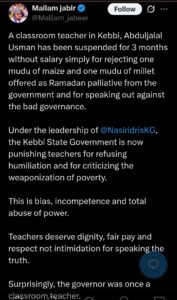
@Mallam_jabeer who shared the report, said …
“A classroom teacher in Kebbi, Abduljalal Usman has been suspended for 3 months without salary simply for rejecting one mudu of maize and one mudu of millet offered as Ramadan palliative from the government and for speaking out against the bad governance.
Under the leadership of
@NasiridrisKG
, the Kebbi State Government is now punishing teachers for refusing humiliation and for criticizing the weaponization of poverty.
This is bias, incompetence and total abuse of power.


2027: More Than 50 Lawmakers Lose APC Reps Tickets in Major Primary Election

Bandits behind Ogbomoso school abduction will face full wrath of the law- President Tinubu

PDP to screen Goodluck Jonathan on Tuesday as its sole Presidential aspirant For 2027 race

-
Business2 years ago
US court acquits Air Peace boss, slams Mayfield $4000 fine
-

 Trending2 years ago
NYA demands release of ‘abducted’ Imo chairman, preaches good governance
-

 Politics2 years ago
Mexico’s new president causes concern just weeks before the US elections
-

 Politics2 years ago
Putin invites 20 world leaders
-

 Politics2 years ago
Russia bans imports of agro-products from Kazakhstan after refusal to join BRICS
-
Entertainment2 years ago
Bobrisky falls ill in police custody, rushed to hospital
-
Entertainment2 years ago
Bobrisky transferred from Immigration to FCID, spends night behind bars
-
Education2 years ago
GOVERNOR FUBARA APPOINTS COUNCIL MEMBERS FOR KEN SARO-WIWA POLYTECHNIC BORI