
Education
Taliban bans women from studying nursing and midwifery

Women in Afghanistan will no longer be allowed to attend nursing and midwifery classes following an edict issued by the Taliban’s supreme leader, according to senior employees at institutions offering these courses.
Health officials conveyed the directive during a meeting with institute directors in Kabul on Monday, December 2, a public health ministry official told AFP. The official, who was not authorised to speak publicly, said, “There is no official letter, but the directors of institutes were informed in a meeting that women and girls can’t study anymore in their institutes. They were not provided with any details and justification and were just told of the order of the supreme leader and were asked to implement it.”
The ruling, which lacks formal documentation, has caused confusion among educational institutions. While some managers sought clarity from the health ministry, others have continued operations as usual, pending a written directive.
The ban marks another devastating blow to women’s education in Afghanistan, which has been increasingly restricted since the Taliban returned to power in 2021. Girls have already been barred from secondary schools and universities, forcing many to pursue health-related studies as one of the few remaining educational options.
Women now account for the majority of students in Afghanistan’s health institutes, which include 10 public and over 150 private institutions offering two-year diplomas in fields such as midwifery, anaesthesia, pharmacy, and dentistry. These institutes collectively serve around 35,000 women students.
Institute managers expressed concerns about the impact of the ban. “What are we supposed to do with just 10 percent of our students?” one manager questioned.
Aysha, a 28-year-old midwifery teacher in Kabul, said she was told by her institute’s management not to report to work until further notice. “This is a big shock for us. Psychologically, we are shaken. This was the only source of hope for the girls and women who were banned from universities,” she said.
The United Kingdom’s charge d’affaires called the reports “deeply concerning.”










The National Association of Nigerian Students (NANS) has vowed to take urgent action against some persons it said are cooking up and sponsoring falsehood against the Federal University of Technology, Owerri (FUTO) and its leadership.
NANS took the position in a release signed by Comr. Olushola Oladoja, NANS President, and Comr. Nduka Chibueze (Paparazzi), NANS Director of Travel and Exchange, and made available to the media on Saturday.
“The leadership of the National Association of Nigerian Students (NANS) has observed with deep concern the activities of some unscrupulous and mischievous elements who appear to be acting in concert to tarnish the image and credibility of our institution, the Federal University of Technology, Owerri (FUTO), and its leadership through the circulation of false, misleading and malicious information across various online platforms.
“These individuals, whose actions clearly suggest a calculated agenda driven by selfish interests and external influence, have continued to propagate unfounded claims capable of bringing the institution into disrepute and misleading members of the public.
“It is unfortunate that certain persons have chosen to allow themselves to be used as instruments of propaganda and destabilization against an institution that represents the collective pride and aspiration of thousands of students and alumni.
“We wish to state categorically that such coordinated attempts to blackmail, ridicule, or undermine the institution and its leadership will not be tolerated henceforth. The university’s integrity and reputation must not be sacrificed on the altar of personal interest, sponsored misinformation, or politically motivated attacks.
“The leadership of the National Association of Nigerian Students (NANS) remains committed to protecting the image, unity, and values of the Federal University of Technology, Owerri (FUTO), and will continue to resist every desperate attempt aimed at causing disaffection within the institution, using every legitimate mechanism and arsenal within our disposition.
“We have activated the forces of Aluta to identify and expose the charlatans involved. Our aim is to deal with them in a manner that serves the overall interest of our institution. This should act as a deterrent to anyone whose actions are aimed at destroying the institutional reputation we all worked to build. Forewarned is forearmed,” NANS maintained.

An official of the National Youth Service Corps (NYSC) in Ogun State, Abass Olalekan, has been arrested in connection with the de@th of a female corps member.
The corps member, Victoria Ariyo, serving under the Abeokuta South Local Government Area (LGA) of the NYSC, reportedly d!ed last Tuesday after undergoing abortion.
It was gathered that the corps member had terminated her pregnancy and d!ed from complications that followed the procedure.
Her remains were buried at Kobape Cemetery on Kobape-Sagamu Road in Abeokuta.
According to Daily Trust, Ariyo’s d3ath came barely a month after another female corps member, Adeleye Mary, d!ed in what has been described as mysterious circumstance.
Mary, who was serving under the same Abeokuta South LG, was attached to the Ogun State Television (OGTV) as her Place of Primary Assignment (PPA).
A source told the publication that both deceased corps members were friends.
“The first lady d!ed at her residence, which is not far from her PPA. They found her lifeless body in the apartment and, up till now, nobody can tell the cause of her d3ath,” the source said.
However, the second corps member who d!ed on Tuesday was said to have died from complications arising from an abortion procedure.
It was alleged that the NYSC official, who is the Local Government Inspector (LGI) for Abeokuta South, Abass Olalekan was culpable in the process leading to the corps member’s d3ath.
Sources told the publication that the LGI was allegedly involved in a romantic relationship with the deceased, which eventually led to pregnancy, and it was the termination that led to her d3ath.
“That is the fact in issue,” a police source who confirmed the NYSC official’s arrest told Daily Trust on Thursday.
The police source said the development raises questions about the legality of romancing “someone that should be in your care.”
Confirming Olalekan’s arrest, the source said, “He is in our custody at the command’s headquarters, Eleweran, Abeokuta.”
The police source, however, said there is no connection between the current incident and the one that occurred last month.
Spokesperson for the police in the state, DSP Oluseyi Babaseyi, confirmed death of Ariyo and said that the investigation was ongoing.
However, he failed to respond to questions on the arrest of the LGI and the alleged involvement.
“I can confirm that the case of the demise of Victoria Ariyo is under investigation by the State Criminal Investigation Department,” Babaseyi said in a terse statement.

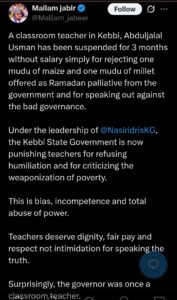
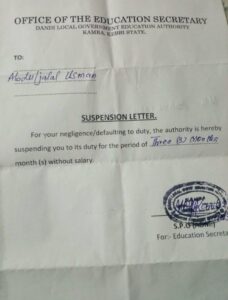
A classroom teacher in Kebbi State, Abduljalal Usman, has reportedly been suspended for three months without salary after rejecting a Ramadan palliative reportedly distributed by the state government.
The teacher allegedly declined the offer of one mudu of maize and one mudu of millet and also criticized what he described as poor governance in the state.
According to claims circulating online, the action was taken under the administration of Nasir Idris, prompting criticism from some commentators who described the suspension as an attempt to silence dissent and punish a public worker for speaking out.
Critics argue that educators deserve better working conditions, fair compensation, and respect, rather than disciplinary action for expressing their views.
@Mallam_jabeer who shared the report, said …
“A classroom teacher in Kebbi, Abduljalal Usman has been suspended for 3 months without salary simply for rejecting one mudu of maize and one mudu of millet offered as Ramadan palliative from the government and for speaking out against the bad governance.
Under the leadership of
@NasiridrisKG
, the Kebbi State Government is now punishing teachers for refusing humiliation and for criticizing the weaponization of poverty.
This is bias, incompetence and total abuse of power.


𝗛𝗢𝗡. 𝗧𝗢𝗦𝗞𝗔 𝗖𝗢𝗡𝗗𝗘𝗠𝗡𝗦 𝗧𝗛𝗘 𝗞𝗜𝗟𝗟𝗜𝗡𝗚𝗦, 𝗞𝗜𝗗𝗡𝗔𝗣𝗣𝗜𝗡𝗚𝗦 𝗔𝗡𝗗 𝗥𝗔𝗣𝗘𝗦 𝗜𝗡 𝗜𝗛𝗜𝗔𝗚𝗪𝗔, 𝗢𝗕𝗜𝗕𝗜𝗘𝗭𝗘𝗡𝗔, 𝗘𝗭𝗜𝗢𝗕𝗢𝗗𝗢, 𝗘𝗠𝗘𝗔𝗕𝗜𝗔𝗠, 𝗢𝗞𝗢𝗟𝗢𝗖𝗛𝗜, 𝗨𝗠𝗨𝗚𝗨𝗠𝗔, 𝗔𝗩𝗨 𝗔𝗡𝗗 𝗢𝗧𝗛𝗘𝗥 𝗖𝗢𝗠𝗠𝗨𝗡𝗜𝗧𝗜𝗘𝗦: 𝗖𝗔𝗟𝗟𝗦 𝗙𝗢𝗥 𝗜𝗠𝗠𝗘𝗗𝗜𝗔𝗧𝗘 𝗖𝗘𝗦𝗦𝗔𝗧𝗜𝗢𝗡

TENSIONS RISE IN OGUTA LGA AS CHAIRMAN MOVED AHEAD WITH Town UNION ELECTIONS AGAINST STATE DIRECTIVE

2027: More Than 50 Lawmakers Lose APC Reps Tickets in Major Primary Election

-
Business2 years ago
US court acquits Air Peace boss, slams Mayfield $4000 fine
-

 Trending2 years ago
NYA demands release of ‘abducted’ Imo chairman, preaches good governance
-

 Politics2 years ago
Mexico’s new president causes concern just weeks before the US elections
-

 Politics2 years ago
Putin invites 20 world leaders
-

 Politics2 years ago
Russia bans imports of agro-products from Kazakhstan after refusal to join BRICS
-
Entertainment2 years ago
Bobrisky falls ill in police custody, rushed to hospital
-
Entertainment2 years ago
Bobrisky transferred from Immigration to FCID, spends night behind bars
-
Education2 years ago
GOVERNOR FUBARA APPOINTS COUNCIL MEMBERS FOR KEN SARO-WIWA POLYTECHNIC BORI