








Watch the video below..
News
Taxing The Dead: Enugu State Government Faces Backlash For Imposing Mortuary Tax On Corpses


According to Nwoye, the tax amounts to N40 per day for each body, which he believes is not only insensitive but also inhumane.
Dr. Ben Nwoye, former chairman of the All Progressives Congress in Enugu State, has expressed his dismay over the state’s decision to tax dead bodies kept in mortuaries.
According to Nwoye, the tax amounts to N40 per day for each body, which he believes is not only insensitive but also inhumane.
Nwoye shared his personal experience of having to pay the tax when his mother-in-law passed away. “I didn’t understand it before until I had to pay N40 per day,” he said. “It’s not the amount that matters, but the concept. The idea that someone would think of taxing the bereaved as a means of raising funds is callous and inhumane.”
Nwoye, who spoke to SaharaReporters in an interview, questioned the logic behind taxing the dead when the living are still struggling to pay their taxes. “Have we finished taxing the living before we go into the dead?” he asked. “The living should pay their tax, those selling things they’re making money, you must have your tax paper, traders pay your income tax.”
The former APC chairman believes that the tax is insensitive and lacks a human face. “When you govern, you govern with a human face,” he said. “And I think that one lacks insensibility. It is insensitive, even if it is one kobo the tax.”
Nwoye emphasised that the tax is not just a financial burden but also an emotional one. “As Igbo, there is a way we relate with our dead, and if I’m told that for me to keep my deceased person for one day I have to pay N40, it gets to me,” he said.
He also pointed out that the mortuary attendants already pay taxes to the state and federal government. “The mortuary people are mortuary attendants, they also have to pay the state tax, they have to pay the federal tax,” Nwoye said. “Now we are taxing the bereaved.”
Nwoye believes that the state government should focus on taxing the living rather than the dead. “We raise funds by directly taxing the bereaved for keeping the body of their deceased loved ones?” he asked. “Then you pay N40. I don’t think it’s right.”
He, however, called on the state government to review and reconsider the tax. “So, it’s something they have to go back and review and look at it,” he said.
Nwoye also questioned the calculation behind the tax. “Someone must have made an attempt in doing calculation of how many bodies that are left, how many deaths we have per year,” he said. “Because you have to budget for this.”
He believes that the tax is a sign of insensitivity and lack of empathy. “It has to be in paper, the estimate that maybe 200 people or 1000 people will die this month and will be kept in the morgue, you have to write,” Nwoye said.
Nwoye emphasised that the tax is not acceptable in Igbo culture. “From our own concept, cultural concept, it is not acceptable,” he said. “Certain things don’t belong in this culture when you govern, you govern with a human face.”
He urged the state government to prioritise the welfare of its citizens over revenue generation. “I think the government should focus on providing essential services to the people rather than taxing the dead,” Nwoye said.
Nwoye’s statement has sparked a debate about the morality and feasibility of taxing dead bodies in Enugu State. Many are calling on the state government to reconsider the tax and prioritize the welfare of its citizens.
The state government has yet to respond to Nwoye’s statement, but the issue is likely to generate more controversy in the coming days.

The police in Delta state have arrested eleven more suspects over the sexu@l ass@ults recorded during what was described as a “r@ping festival” in Oramudu Quarters in Ozoro last Thursday, March 19.
In a statement released on Saturday, March 21, the spokesperson of the command, SP Bright Edafe, said the CP Special Assignment Team (CP-SAT) was tasked with conducting a detailed investigation into the incident.
Edafe said operatives of CP-SAT conducted a thorough analysis of available video evidence and intelligence, leading to the arrest of eleven additional suspects identified as Samson Atukpodo, Steven ovie, Ugbevo Samson, Afoke Akporobaro, Evidence Oguname, and six others. Edafe mentioned that these latest arrests bring the total number of suspects currently in police custody in connection with the incident to fifteen (15)
“The Command reiterates that preliminary findings indicate that the unfortunate incident was perpetrated by criminal elements who exploited the situation to engage in acts of sexu@l v!olence, which are in no way representative of any legitimate cultural practice.
The Commissioner of Police, Delta State Command, CP Aina Adesola, condemns these acts in totality and reassures the public that the Command remains resolute in its determination to ensure that all those involved are identified, arrested, and prosecuted in accordance with the law. Members of the public, particularly victims and witnesses, are once again encouraged to come forward with credible information that will aid ongoing investigations. The Command assures that all information provided will be treated with strict confidentiality.”the statement in part reads
News
So Sad: Father Dies While Rescuing Daughter From Midnight Fire, Both Perish in Minna Tragedy (Photos)
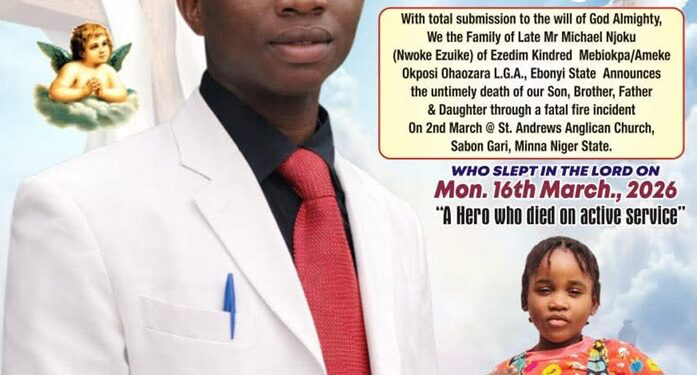
A father’s ultimate act of love has ended in heartbreak after a devastating midnight fire claimed both his life and that of his six-year-old daughter in Minna, Niger State, leaving a family shattered and a community in mourning.
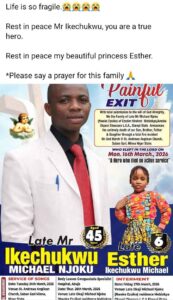
The tragedy struck at approximately 2am on March 2, 2026, when fire broke out at the residence of Ikechukwu Michael Njoku, 45, situated within the premises of St. Andrew Anglican Church in the Sabon Gari area of Minna.
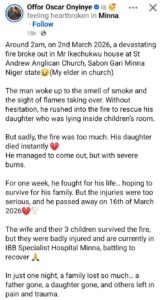
According to accounts shared on Facebook by family acquaintance Offor Oscar Onyinye, Njoku was jolted awake by the smell of smoke and the sight of flames rapidly engulfing his home. Without pause for his own safety, he plunged into the inferno to rescue his young daughter, Esther, who was trapped inside the children’s room. Though he managed to pull himself out of the blaze, little Esther did not survive — she died instantly.
Njoku himself emerged from the fire with severe burns across his body. For nearly two weeks, he clung to life, battling his injuries at the IBB Specialist Hospital in Minna. His struggle ended on March 16, 2026, when he succumbed to his wounds — fourteen days after he had thrown himself into the flames for his child.
His wife and three other children survived the inferno but sustained serious injuries and remain hospitalised at IBB Specialist Hospital, where they continue to fight for recovery.
Father and daughter are to be laid to rest on March 27, 2026, in their ancestral hometown of Mebiokpa Okposi Ohozara in Ebonyi State.
“In just one night, a family lost so much — a father gone, a daughter gone, and others left in pain and trauma,” Onyinye wrote in a tribute that has since resonated widely across social media, with many describing Njoku as a hero whose love for his child knew no bounds.
News
I Thought It Was A Joke — Nigerian Man Recounts What He Witnessed During “R@ping Festival” In Delta (Video)

A video making rounds on social media has triggered widespread reactions after capturing a disturbing incident reportedly occurring in Ozoro, Delta State.
According to multiple posts online, there are claims that several women have been ass@ulted in the area during what some users are describing as a local gathering.
There are also warnings being shared online advising women and girls in the area to stay indoors, with concerns that those outside may be at risk. Some posts further allege that individuals who are unaware of the situation, including visitors and students, may have been affected.
Ozoro is home to Delta State University, and many online users have expressed concern about the safety of students and residents.
The situation has triggered widespread outrage, with many calling for urgent attention, proper investigation, and protection for those in the community.
Delta state police command, SP Bright Edafe, said the police has begun arresting some of the defaulting men.

Columns1 day ago
Benita Enwonwu in the 1970s: Model, Actress, and Daughter of Ben Enwonwu

Trending1 day ago
Kidnappers Took Loan With My Phone – Victim Recounts Ordeal

News1 day ago
11 more arrested over Ozoro “r@ping festival”

-
Business1 year ago
US court acquits Air Peace boss, slams Mayfield $4000 fine
-

 Trending1 year ago
NYA demands release of ‘abducted’ Imo chairman, preaches good governance
-

 Politics1 year ago
Mexico’s new president causes concern just weeks before the US elections
-

 Politics1 year ago
Putin invites 20 world leaders
-

 Politics1 year ago
Russia bans imports of agro-products from Kazakhstan after refusal to join BRICS
-
Entertainment1 year ago
Bobrisky falls ill in police custody, rushed to hospital
-
Entertainment1 year ago
Bobrisky transferred from Immigration to FCID, spends night behind bars
-
Education2 years ago
GOVERNOR FUBARA APPOINTS COUNCIL MEMBERS FOR KEN SARO-WIWA POLYTECHNIC BORI