Columns
The 1947 Pan-African Federation Meeting in Manchester: Nigeria and Britain After World War II

A historic gathering where Nigerian nationalist leaders discussed economic cooperation between Britain and Nigeria in the post-war era.
A Historic Announcement from 1947
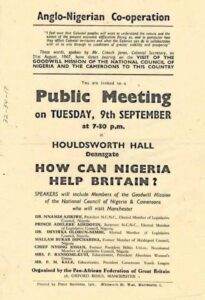
The vintage poster advertises a public meeting organised by the Pan-African Federation in Manchester on Tuesday, 9 September 1947.
The event, titled “How Can Nigeria Help Britain?”, was scheduled to take place at Houldsworth Hall, located along Deansgate.
The meeting formed part of a broader discussion about Anglo-Nigerian economic cooperation at a time when Britain was struggling to rebuild its economy after the devastation of World War II.
Britain’s Post-War Economic Crisis
In the years following the war, Britain faced serious economic challenges. Industrial infrastructure had been damaged, foreign reserves were depleted, and the country was heavily indebted.
Colonies across the British Empire, including Nigeria, were viewed as important economic partners that could support Britain through:
export of agricultural products
supply of raw materials
expansion of trade within the empire
The 1947 meeting therefore addressed a critical question of the time: how Nigeria could contribute to Britain’s recovery while also advancing its own economic development.
The NCNC Goodwill Mission
The event featured members of the National Council of Nigeria and the Cameroons (NCNC), who were visiting Britain as part of a Goodwill Mission.
The NCNC had emerged as one of the most influential political movements in Nigeria during the 1940s. The organisation advocated for:
constitutional reforms
political representation for Nigerians
eventual self-government
By engaging with British audiences, Nigerian leaders sought to present their perspectives on economic cooperation and political progress.
Distinguished Speakers
Several prominent Nigerian political figures participated in the Manchester meeting.
Among them was Nnamdi Azikiwe, one of Nigeria’s most influential nationalist leaders and a future President of Nigeria. Azikiwe was a central figure in the NCNC and played a major role in the struggle for independence.
Other speakers included:
Adeleke Adedoyin, a prince from Ile-Ife and prominent businessman
Ibiyinka Olorun-Nimbe, a medical doctor and political activist
Bukar Dipcharima, a northern Nigerian political leader
Nyong Essien, a nationalist figure from southeastern Nigeria
Funmilayo Ransome-Kuti, renowned feminist activist and political organiser
P. M. Kale, another member of the NCNC delegation
The diversity of speakers reflected Nigeria’s emerging national political consciousness, bringing together voices from different regions and social backgrounds.
Pan-African Connections in Britain
The meeting was organised by the Pan-African Federation, an organisation that played a key role in linking African and Caribbean activists living in Britain.
Following the famous Fifth Pan-African Congress, Manchester had become an important centre for Pan-African political discussions.
These gatherings allowed African leaders, students, and intellectuals to:
discuss colonial policies
share strategies for political reform
build networks that would later influence independence movements across Africa.
Nigeria on the Path to Independence
By 1947, Nigeria was still under British colonial rule, but nationalist movements were becoming increasingly organised.
Events like the Manchester meeting were significant because they allowed Nigerian leaders to engage directly with British audiences while presenting arguments for:
economic partnership based on mutual benefit
greater political autonomy
recognition of Nigerian leadership in shaping the country’s future.
Within little more than a decade, Nigeria would move toward independence, which was achieved in 1960.
Historical Significance of the Poster
Today, the 1947 announcement poster serves as an important historical document.
It captures a moment when Nigerian nationalists were actively participating in global political discussions while negotiating their country’s relationship with the British Empire.
The poster also highlights the collaboration between Nigerian political leaders and Pan-African activists in Britain—connections that helped shape the broader African independence movements of the twentieth century.
Sources

Archives of the Pan-African Federation
Historical records of the National Council of Nigeria and the Cameroons Goodwill Mission
Studies on post-war British economic policy and colonial relations
Documentation of Nigerian nationalist activities in Manchester during the 1940s.