
Columns
Three Nigerian Presidents in One Frame

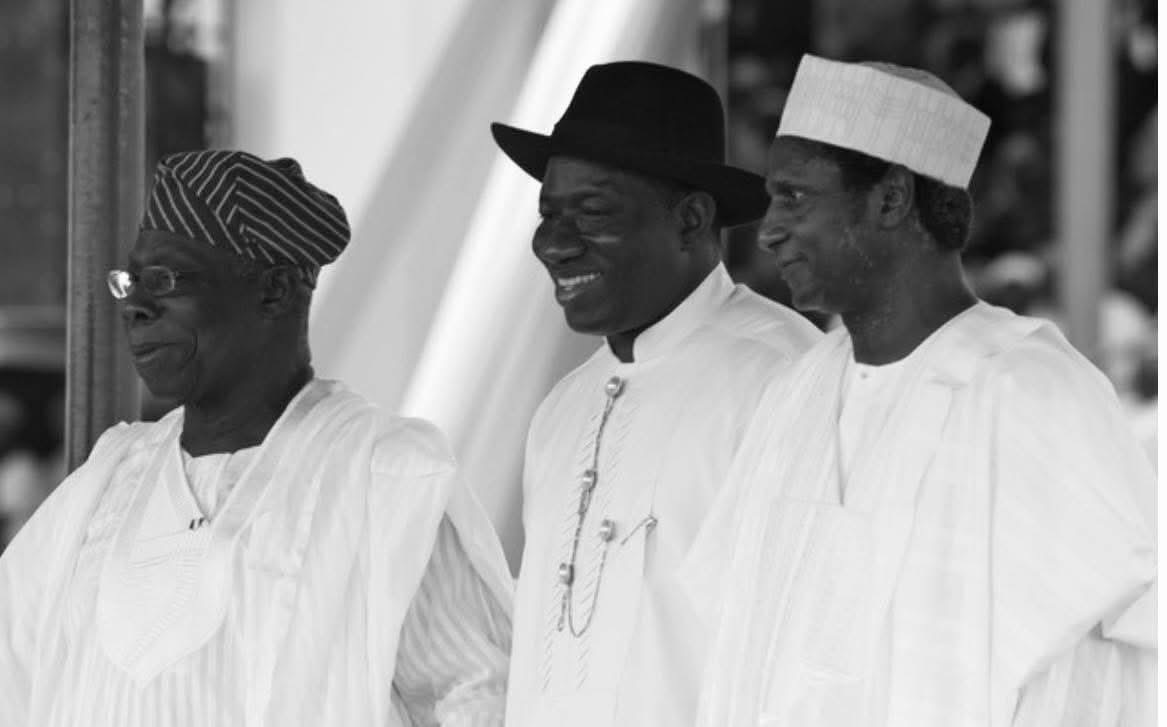
A rare moment capturing Olusegun Obasanjo, Umaru Musa Yar’Adua, and Goodluck Jonathan during Nigeria’s Fourth Republic leadership era.
political history: Olusegun Obasanjo, Umaru Musa Yar’Adua, and Goodluck Jonathan.
Seen from left to right, the image features Obasanjo, Jonathan, and Yar’Adua—leaders whose administrations shaped Nigeria during the early years of the Fourth Republic, which began in 1999 after the end of military rule.
Olusegun Obasanjo
Olusegun Obasanjo served as President of Nigeria from 1999 to 2007, becoming the first democratically elected president after the country’s long period of military governance.
His administration focused on:
Restoring democratic institutions
Economic reforms and debt relief negotiations
Strengthening Nigeria’s international diplomatic presence
Before his civilian presidency, Obasanjo had earlier served as military Head of State from 1976 to 1979, making him one of the few leaders in African history to govern both as a military ruler and as an elected president.
Umaru Musa Yar’Adua
Umaru Musa Yar’Adua became President of Nigeria in 2007, succeeding Obasanjo.
Prior to his presidency, he served as Governor of Katsina State from 1999 to 2007. His administration was known for emphasizing the rule of law, electoral reforms, and attempts to resolve the Niger Delta conflict through an amnesty programme for militants.
However, his presidency was cut short when he died in office on 5 May 2010, making him the second Nigerian leader to die while serving as head of state.
Goodluck Jonathan
Goodluck Jonathan served as Vice President of Nigeria from 2007 to 2010 under Yar’Adua. Following Yar’Adua’s death, he was sworn in as President in May 2010.
Jonathan later won the 2011 presidential election and served until 2015. His administration oversaw:
Electoral reforms
Expansion of telecommunications and digital sectors
Nigeria’s economic rebasing in 2014, which temporarily made the country Africa’s largest economy
He later became internationally recognised for conceding defeat peacefully in the 2015 election, a moment widely praised as a milestone for democratic maturity in Nigeria.
Historical Significance of the Photograph
This image symbolises an important leadership transition within Nigeria’s Fourth Republic.
Obasanjo handed power to Yar’Adua in 2007, marking Nigeria’s first civilian-to-civilian presidential transition.
Jonathan later assumed the presidency following Yar’Adua’s death in 2010, continuing the administration and maintaining constitutional order.
The photograph therefore represents continuity, political transition, and democratic governance in Nigeria’s contemporary political history.
Sources
Encyclopaedia Britannica – Biographical entries on Nigerian presidents.
National Archives of Nigeria – Records on Nigeria’s Fourth Republic leadership.
BBC News – Historical reporting on the administrations of Obasanjo, Yar’Adua, and Jonathan.






Columns
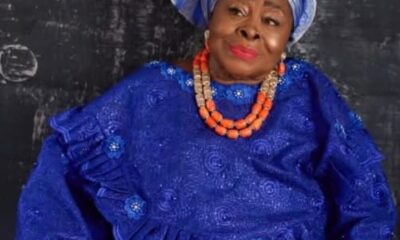
Grace Chijimma Ezema (née Ezekoka), born on June 30, 1942, in Port Harcourt, became Nigeria’s first female engineer when she graduated with a degree in Electrical Engineering from Ahmadu Bello University, Zaria, in 1966.
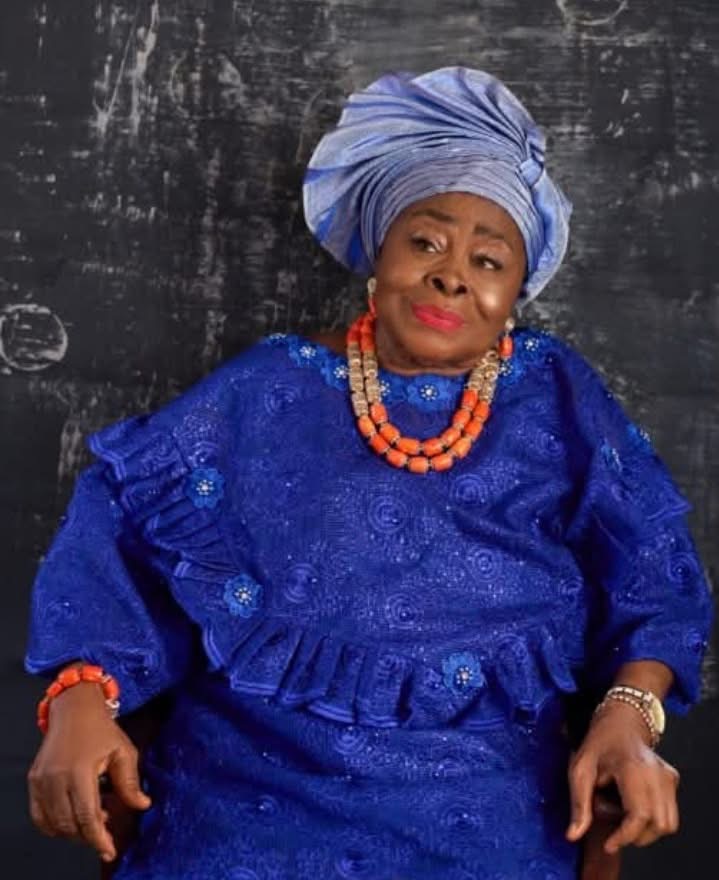
She began her education at Township School, Port Harcourt, before attending Queen’s School, Enugu, where she earned a Grade I pass in the West African School Certificate in 1962.
She later studied Pure Mathematics and Applied Physics at the Federal Science School, Lagos, before gaining admission to ABU in 1963 to study Electrical Engineering—an uncommon choice for women at the time.
Upon graduating in 1966, she joined the National Electric Power Authority (NEPA) as a Communications Engineer and went on to serve in various roles, including Research Engineer at Afam Power Station and Commercial Engineer in Lagos. In 1973, she obtained a management certificate from the Nigerian Institute of Management.
In 1974, she married Dr. Paul O. Ezema, a lecturer at the University of Nigeria, Nsukka, and the couple had four children. That same year, she was transferred to NEPA’s Enugu office, where she worked as Planning and Construction Engineer.
In 1978, Ezema left NEPA to establish Guftane Engineering Nigeria Limited, delivering rural electrification projects across Nigeria.
She also ventured into agriculture with Pisces Integrated Farms Limited and served on the Governing Council of the Institute of Management and Technology (IMT), Enugu.
Later in life, she joined IMT as a Senior Lecturer in Electrical and Electronics Engineering in 1998 and became Head of Department from 2004 until her retirement in 2006.
A registered member of the Nigerian Society of Engineers and COREN, she was also a founding member of the Association of Professional Women Engineers of Nigeria (APWEN).
Engineer Grace Chijimma Ezema passed away on May 8, 2024, at the age of 81, leaving behind a lasting legacy as Nigeria’s pioneering female engineer.
Columns
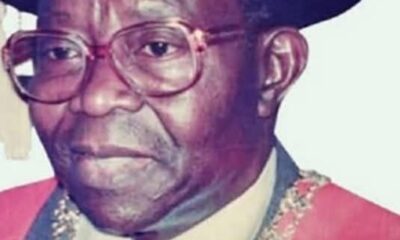
Sixty years ago, Theophilus Oladipo Ogunlesi became the first professor of medicine in Nigeria.
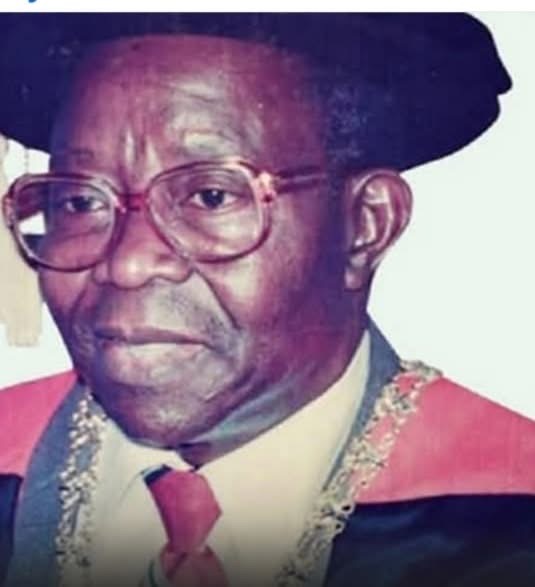
Born on July 12, 1923, in Sagamu, Ogun State, Ogunlesi emerged from modest beginnings to become a towering figure in Nigerian medicine. He began his education at St. Paul’s Primary School, Sagamu, progressed to CMS Grammar School, Lagos, and underwent pre-medical and medical studies at Yaba Higher College. His academic excellence earned him further training at the University of London and the University of Minnesota.
On returning home, Ogunlesi served as a medical officer within the Western Nigeria Civil Service from 1950 to 1956, carving a reputation for rare dedication. In 1961, he joined the University of Ibadan as a lecturer. Just four years later, in 1965, he achieved a historic milestone by becoming Nigeria’s first Professor of Medicine.
His influence extended far beyond his title. Professor Ogunlesi was the inaugural head of University College Hospital, Ibadan, and played a foundational role in the establishment of the National Postgraduate Medical College of Nigeria. A highly respected scholar, he authored influential academic works and mentored many who would go on to advance medicine both locally and internationally.
He was also a fellow of esteemed bodies, including the Royal Colleges of Physicians (London and Edinburgh) and the Association of Physicians of Nigeria, further cementing his status in the field.
After a distinguished career, Professor Theophilus Oladipo Ogunlesi retired in 1983 and was honoured with the title Professor Emeritus at the University of Ibadan’s College of Medicine, a position he held until his passing on January 19, 2023, six months before his 100th birthday. He was 99.
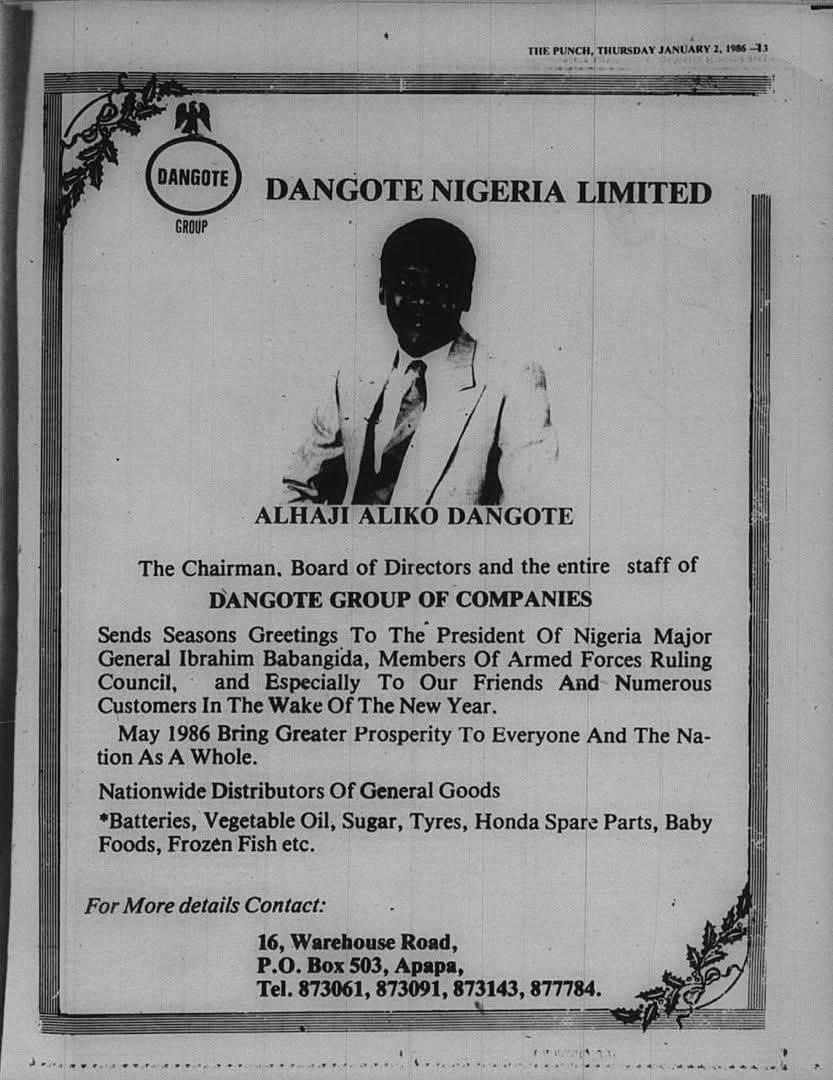
Alhaji Aliko Dangote and his team extend New Year greetings while showcasing their growing business in Nigeria.
This newspaper advertisement, published on January 2, 1986, features Alhaji Aliko Dangote and the staff of the Dangote Group of Companies sending New Year greetings to both the President of Nigeria and their customers.
At the time, Dangote Group was emerging as a nationwide distributor of general goods.
Products and services listed in the ad included food items, tyres, and spare parts, demonstrating the company’s early diversification.
The advertisement provides contact details for the company’s Apapa, Lagos office, reflecting its operational hub during the 1980s.
Historical Context
In 1986, Aliko Dangote was building his business empire in Nigeria, focusing on trading and distribution.
This advertisement illustrates how Dangote positioned his company as both customer-oriented and politically aware, acknowledging the President while promoting commercial services.
Such public greetings and newspaper placements were common strategies among Nigerian businessmen of the era to strengthen visibility and credibility.
Significance
The ad highlights Dangote’s early entrepreneurial efforts before he expanded into cement, sugar, and other industrial sectors.
It reflects the business culture of Nigeria in the 1980s, where local companies were establishing nationwide recognition through print media.
The combination of greetings and product promotion showcases the founder’s strategic approach to brand building and customer engagement.
Source
Newspaper archive, January 2, 1986

Three Nigerian Presidents in One Frame

Grace Chijimma Ezema (née Ezekoka), born on June 30, 1942, in Port Harcourt, became Nigeria’s first female engineer when she graduated with a degree in Electrical Engineering from Ahmadu Bello University, Zaria, in 1966.

Plateau: Court Affirms Four-Year Tenure For Elected LG Chairmen

-
Business1 year ago
US court acquits Air Peace boss, slams Mayfield $4000 fine
-

 Trending1 year ago
NYA demands release of ‘abducted’ Imo chairman, preaches good governance
-

 Politics1 year ago
Mexico’s new president causes concern just weeks before the US elections
-

 Politics1 year ago
Putin invites 20 world leaders
-

 Politics1 year ago
Russia bans imports of agro-products from Kazakhstan after refusal to join BRICS
-
Entertainment1 year ago
Bobrisky falls ill in police custody, rushed to hospital
-
Entertainment1 year ago
Bobrisky transferred from Immigration to FCID, spends night behind bars
-
Education2 years ago
GOVERNOR FUBARA APPOINTS COUNCIL MEMBERS FOR KEN SARO-WIWA POLYTECHNIC BORI