
Business
Tony Elumelu Reveals How Buhari, Abba Kyari Blocked His 2017 Oil Field Acquisition

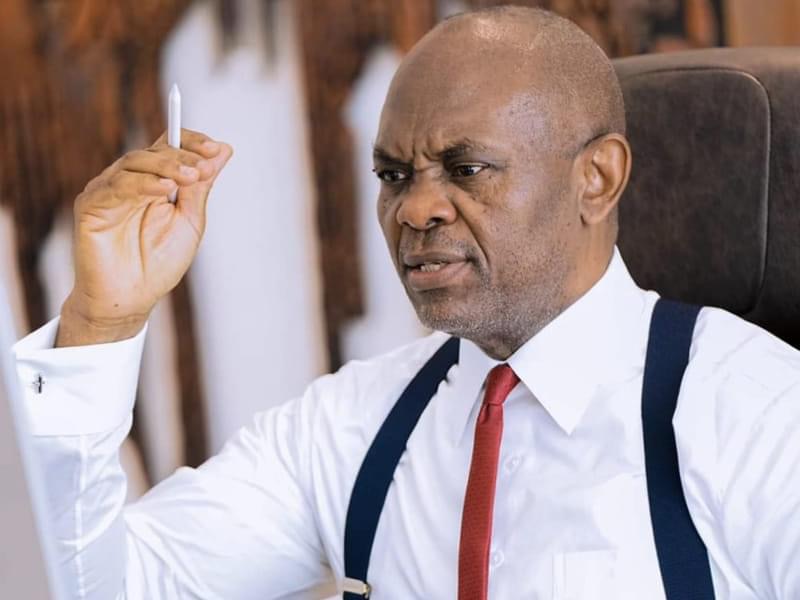
Tony Elumelu says Buhari and Abba Kyari blocked his 2017 oil field purchase, despite raising $2.5bn for the deal.
The Chairman of Heirs Holdings, Mr. Tony Elumelu, has disclosed how former President Muhammadu Buhari and his chief of staff, the late Abba Kyari, blocked his initial move to acquire an oil field in 2017.
Elumelu, who is also the Chairman of the United Bank for Africa Plc, said this in an interview in The Financial Times. According to him, Heirs Holdings was looking to purchase an oilfield since 2017, and had raised $2.5 billion to purchase one.
But he alleged that in a twist, Buhari and the late Abba Kyari, blocked the deal.
He said he was told that Nigeria couldn’t allow something of such strategic importance to fall into the hands of a private operator. This, according to Elumelu, defied logic since he would have been purchasing it from a foreign company.
However, Elumelu’s decision to buy a 45 per cent stake in an oilfield three years ago surprised many. International oil companies such as Shell, Total and Eni were selling off their shallow water assets in Nigeria, with local companies taking charge. In 2021, his Heirs Holdings acquired OML 17, an onshore oilfield as part of a deal that included $1.1 billion in financing from a consortium of global and regional banks and investors.
Shell, Total and Eni each had sold stakes in the OML 17 field, which has production capacity of 27,000 barrels of oil equivalent per day and estimated reserves of 1.2 billion barrels of oil equivalent, Heirs said.
When asked if he felt like getting in at the end of the party by buying an oil asset in the age of energy transition and environmental, social and governance investing, Elumelu said: “We wanted to become a Fortune 500 company and we estimated what we needed. It’s not naira, it’s huge dollars.”
Energy security is crucial for a country that doesn’t produce enough electricity for its roughly 200 million citizens, he added.
He said he discovered first-hand why international oil companies were partly divesting from onshore assets, after criminal gangs began stealing crude from his pipelines.
In 2022, when things got to a point where his company had to shut down production, Elumelu vented his frustration on social media, tweeting: “How can we be losing over 95 per cent of oil production to thieves?”
Today, though, business is looking up. Elumelu, according to the newspaper, showed the status updates he received on his phone from the field: 42,000 barrels of crude pumped out daily. Theft still takes away about 18 per cent of production, he said.
When asked who was behind oil theft in the country, he said: “This is oil theft, we’re not talking about stealing a bottle of Coke you can put in your pocket. The government should know; they should tell us. Look at America — Donald Trump was shot at and quickly they knew the background of who shot him. Our security agencies should tell us who is stealing our oil. You bring vessels to our territorial waters and we don’t know?”
The proponent of Africapitalism stressed the need for Africa’s private sector to actively contribute to the continent’s growth.
“We need to run government like a business,” is his formulation of how African governments should work, with administrations held accountable by legislatures as shareholders do chief executives.
Speaking about his career trajectory, Elumelu whose father was a builder and mother a caterer said: “I had a very fast career.”
At 26, having earned a masters in economics at the University of Lagos, he became a branch manager of the bank where he began his career. “It was unheard of. I like to take my destiny in my hands.”
Elumelu was at the helm of UBA for another five years until a central bank edict that turfed out long-serving bank bosses put him out of a job.
“2010 was a pivotal year for me,” he said while speaking about his ouster as UBA boss.
“The central bank ruling was a complete surprise . .Was it fair? Look, as someone who believes in governance, it probably makes sense, but it was a shock. But it was also liberating, catalysing,” he added.
By the end of that year, he had formed Heirs Holdings, the investment engine that launched the second act of his career and turned him from a banker to a multi-sector magnate.
“I don’t live for myself or my family alone, I know people look up to me,” he said of his fame outside of the boardroom.
“I try to make sure I don’t disappoint people. Young Africans need role models, they want people they can look up to,” he added.
If Elumelu is thriving, his country decidedly is not. Nigeria is in the grip of its worst economic crisis in a generation, with growth stalling and inflation at levels not seen in almost three decades.
Elumelu’s philosophy of “Africapitalism” is based on the premise that the continent cannot grow solely through the government, and that the private sector should actively invest even when — especially when — socio-economic conditions are tough.
“We can sit here today and the easiest part of the conversation would be to talk about all the things that have gone wrong, all the things that people have failed to do.
“But therein lies the philosophy of Africapitalism. For far too long, we have blamed foreign powers. We have blamed our own leaders. But what are we as the private sector doing to make things better? It’s a call on the private sector to stand up and show the way. Let us show the way through what is in our own power. We have the power to make investment decisions.”
With investments in 20 African countries and thousands of employees, he believes he is playing his own part. And through grants from his eponymous foundation, he says he is “democratising luck” for young entrepreneurs.
“I have my frustrations across the continent but I also have my wins . . . what I’m saying is we need to do something to have a better society.”
As a member of President Bola Tinubu’s presidential economic advisory committee, he is one of a handful of business leaders close to the administration. The reforms that Tinubu — whose “courage” Elumelu likes — has embarked on are necessary for long-term growth, Elumelu said, but he wonders if the sequencing of removing costly but popular fuel subsidies and a sharp devaluation of the naira currency could have been implemented better to first provide a social safety net for the most vulnerable in society.
“I support it, totally,” he says of skilled young Nigerians emigrating. “I don’t have a problem with people saying ‘I’m going to Canada, UK or US.’
“Joblessness is the betrayal of a generation. You’ve gone to school and come back with your dreams and aspirations and you don’t have the opportunity . . . People who decide to find solutions elsewhere, no one should stop them. But for those who decide to stay, they should try to create an impact and build a legacy.”
Be sure to follow ekwutosblog for confirmed updates

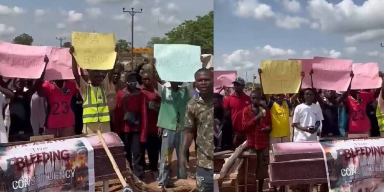


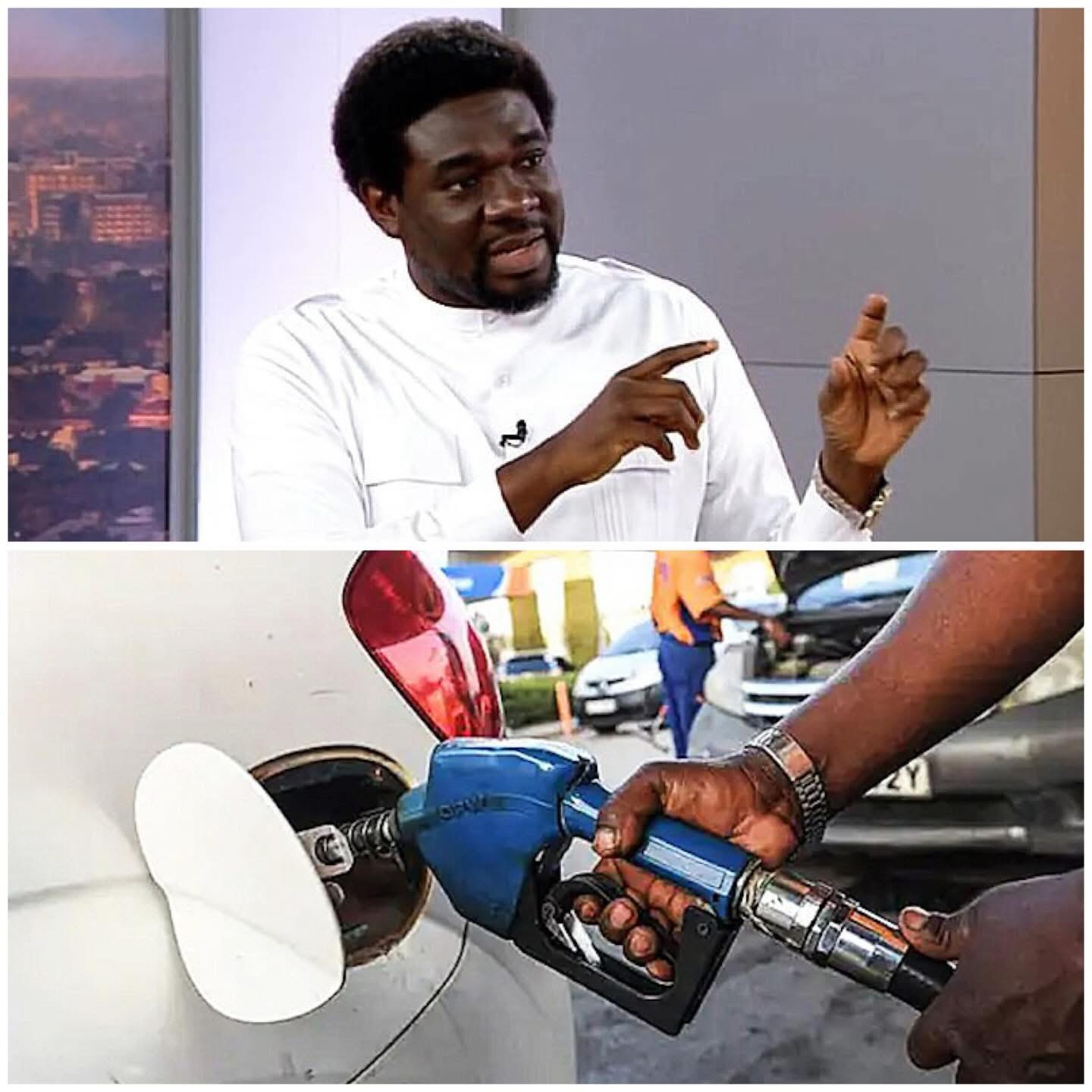
The Trade Union of Nigeria, TUC, has raised the alarm that the price of Premium Motor Spirit aka Petrol may climb to about N2,000 per litre if urgent measures are not taken to cushion the impact of rising global crude prices and the depreciating naira.
Speaking to newsmen on Thursday, April 9, the president of the TUC, Festus Osifo, called on the Federal Government to immediately deploy 60 percent of excess crude oil revenue above the 2026 budget benchmark to subsidise crude feedstock supplies to the Dangote Refinery and other modular refineries, a move it says will slash pump prices of petrol, diesel, and jet fuel within two weeks
“Today, comrades, we are seeing that the cost of petrol is edging towards N2,000 per litre depending on the part of the country that you are. Nigerian workers are already passing through excruciating pain as we speak.
The same way it is affecting transportation, it is also affecting manufacturing. The cost of diesel has also gone northward, meaning that the cost of production has increased. When production costs rise, the final price of goods on the shelves will also skyrocket.
If this continues unchecked, the inflation that we are currently celebrating as going downwards will reverse and start moving up again,” he stated.
Osifo outlined the proposal as an urgent intervention to cushion Nigerian workers from excruciating pain caused by petrol prices edging towards ₦2,000 per litre in some parts of the country
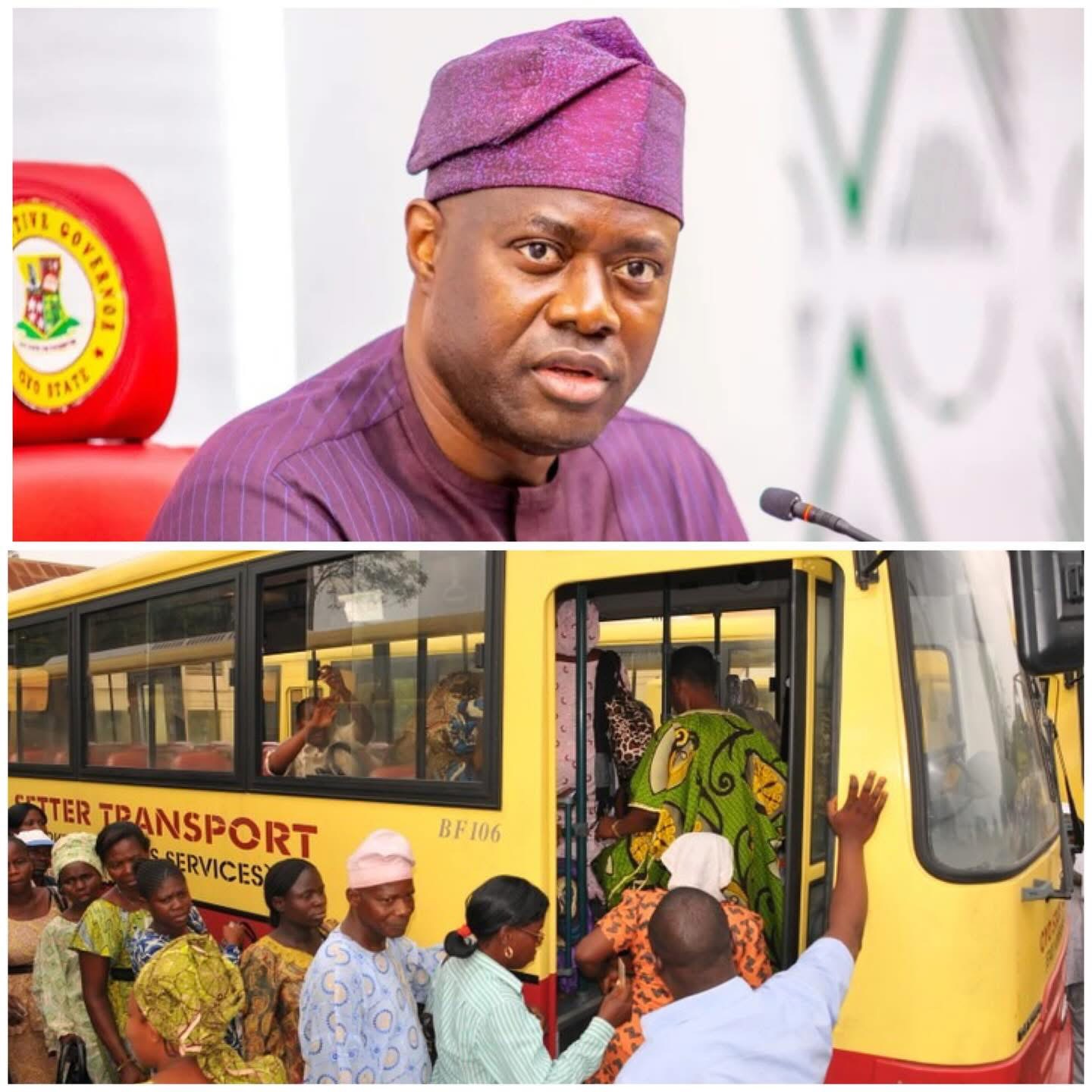
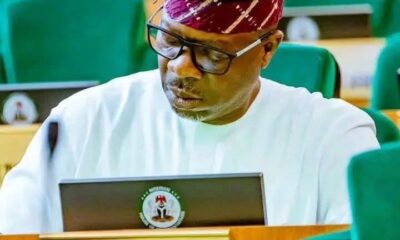
The governor of Oyo state, Seyi Makinde, has approved a N10,000 transportation allowance as a palliative for the state workforce to cushion the effects of the increase in the pump price of Premium Motor Spirit, otherwise known as petrol.
The Chairman of the Nigeria Labour Congress (NLC), Oyo State chapter, Kayode Martins, in a statement released on Monday, March 23, disclosed that the governor has granted the request of the union on the issue of transportation allowance.
The statement read
“Following the intervention and formal request made by the State Council of the Nigeria Labour Congress (NLC) earlier this morning, the state government has approved a N10,000 transportation allowance for all workers in the state.
The newly approved allowance is set to take effect from April 2026, providing much-needed relief to workers grappling with rising transportation costs amid current economic challenges.
This development comes as a direct response to sustained advocacy by the state NLC, aimed at cushioning the impact of increased living expenses on the workforce.
Further details on implementation are expected to be communicated by the relevant government authorities in due course.”
The Central Bank of Nigeria (CBN), has declared that banks and financial institutions must establish and maintain a temporary watch-list for Bank Verification Numbers (BVN) implicated in suspected fraudulent transactions.
According to the CBN in a circular dated March 12, 2026 and signed by its Director of Payments System Policy Department, Musa I. Jimoh, the apex bank said such a suspected BVN may remain on the temporary watchlist for a maximum period of twenty-four (24) hours during which the owner would be contacted to make clarifications.
The circular explained that the move is part of several new measures under a revised regulatory framework aimed at enhancing financial system stability.
“A BVN may remain on this temporary Watchlist for a maximum period of twenty-four (24) hours, during this period, the BVN owner shall be contacted to provide clarification regarding the identified transaction(s),” the circular stated.
The circular also sets an age requirement for BVN enrolment, restricting registration to individuals who have attained eighteen (18) years and above.
The CBN also added that amendments to phone numbers linked to a BVN shall be allowed only once.
“Amendments to phone numbers linked to a BVN shall be allowed only once,” the circular noted.
The apex bank stated that access to BVN databases will remain tightly controlled.
“Access to the BVN databases shall be exclusively granted to Central Bank of Nigeria (CBN) licensed financial institutions.
“Notwithstanding this provision, the Central Bank of Nigeria (the Bank) reserves the right to approve access to the BVN databases in extenuating circumstances and in accordance with the provisions of extant laws,” the circular said.
Financial institutions are expected to comply with the new requirements, and customers may be contacted by their banks if their BVNs are temporarily flagged during the new fraud monitoring process.
The new policy, as stated by the CBN, takes effect from May 1, 2026.

Bandits behind Ogbomoso school abduction will face full wrath of the law- President Tinubu

PDP to screen Goodluck Jonathan on Tuesday as its sole Presidential aspirant For 2027 race

Oshiomhole wins Edo APC senatorial primaries unopposed

-
Business2 years ago
US court acquits Air Peace boss, slams Mayfield $4000 fine
-

 Trending2 years ago
NYA demands release of ‘abducted’ Imo chairman, preaches good governance
-

 Politics2 years ago
Mexico’s new president causes concern just weeks before the US elections
-

 Politics2 years ago
Putin invites 20 world leaders
-

 Politics2 years ago
Russia bans imports of agro-products from Kazakhstan after refusal to join BRICS
-
Entertainment2 years ago
Bobrisky falls ill in police custody, rushed to hospital
-
Entertainment2 years ago
Bobrisky transferred from Immigration to FCID, spends night behind bars
-
Education2 years ago
GOVERNOR FUBARA APPOINTS COUNCIL MEMBERS FOR KEN SARO-WIWA POLYTECHNIC BORI