Health
Trump proposes radical healthcare shake-up that would hand cash directly to millions of Americans

President Donald Trump proposed a radical new healthcare plan for Senate Republicans to consider as the longest government shutdown in history continues over the future of healthcare for American citizens.
Trump, 79, took to Truth Social on Saturday to recommend Republicans stop sending federal funds to ‘money-sucking insurance companies in order to save the bad healthcare provided by Obamacare.’
His proposal suggested sending the money ‘directly to the people so that they can purchase their own, much better healthcare, and have money left over.’
‘In other words, take from the BIG, BAD insurance companies, give it to the people, and terminate per dollar spent.’
He reiterated that he believes Obamacare is the ‘worst healthcare anywhere in the world.’
It is unclear how exactly Trump’s plan would work.
Private healthcare is typically offered through employers or through the Affordable Care Act (ACA), also known as Obamacare.
It is also unclear who is eligible to receive the money Trump is proposing, how to obtain it, or how much each recipient would receive.

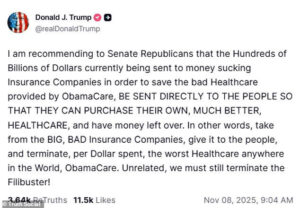
It is unclear how exactly Trump’s plan would work or who would be eligible for the money
The Daily Mail has reached out to the White House for comment.
The ACA got its nickname when former President Barack Obama signed it into law in 2010. It allows citizens under the age of 26 to stay on their parents’ insurance, as well as prohibiting insurers from denying coverage based on pre-existing conditions.
It’s most well-known for allowing people who do not have access to healthcare to purchase ACA-compliant plans, as well as expanding who was eligible for Medicaid to include low-income adults.
The government has been shut down since October 1 – for a total of 39 days as of Saturday – making it the longest in US history. The second-longest shutdown happened during Trump’s first term, lasting 35 days.
Democrats are asking Republicans for a one-year extension to the ACA subsidies package, as the GOP’s plan could affect millions.
Trump has refused to negotiate with Democrats over their demands to salvage expiring health insurance subsidies until they agree to reopen the government.
But Democrats are skeptical over whether he will keep his word, particularly after the administration restricted SNAP food aid despite court orders to ensure funds are available to prevent hunger.
On Tuesday – election day – Republicans saw many major losses in big races, including in the New York City mayoral race, which saw Democratic Socialist Zohran Mamdani take the win in the Big Apple.

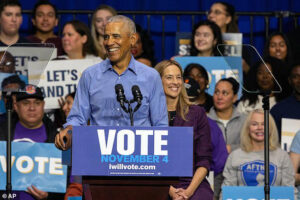
The ACA got its nickname when former President Barack Obama signed it into law in 2010. It’s most well-known for allowing people who do not have access to healthcare to purchase ACA-compliant plans, as well as expanding who was eligible for Medicaid
Mikie Sherrill also pulled a win in neighboring New Jersey, beating her Republican counterpart Jack Ciattarelli.
Virginia also elected a Democrat and its first female governor when Abigail Spanberger won. And California’s controversial Proposition 50 also won, allowing it to redistrict and making it easier to send five more Democrats to Congress.
The major losses for the Republican Party had the conservative president reconsidering his party’s strategies about the shutdown, which he considered played a big role in the letdown.
‘I think if you read the pollsters, the shutdown was a big factor – negative for the Republicans,’ the president said.
The ACA subsidies at the center of the shutdown are income-based and help partially cover premium costs for some enrollees.
Subsidies are paid on a sliding scale between those who make 100% to 400% over the federal poverty line (FPL), which currently stands at $15,650 for an individual and $32,150 for a family.
Most states allow those who make under 100% of the FPL to enroll in Medicaid, the Committee for a Responsible Federal Budget said.
The American Rescue Plan and the Inflation Reduction Act increased the subsidies starting in 2021 and are set to expire at the end of this year. The extra subsidies covered 100% of the premiums for those making between 100% and 150% of the FPL.