Questions surrounding the state of the Eastern Orthodox Church in Ukraine and its links to the Kremlin have made it descend from the spiritual realm into a fierce political arena replete with malign influence, propaganda and deception, just like during the Soviet times.
The political controversy that has been highlighted by Russia’s full-scale invasion of Ukraine in early 2022 came to the fore last August, when Kyiv enacted a bill set to restrict the activities of the Ukrainian Orthodox Church under the Moscow Patriarchate.
“The archives documents that can prove these ties and that were accessible to the historians concern only the Soviet times,” said Christine Dugoin-Clément, a researcher at the Risk Chair of the Sorbonne Business School and at the French National Gendarmerie Officers’ School.
However, “the (Russian Orthodox) Church has an extremely widespread network on the Ukrainian territory that can gather information directly from the field. During a war, any information can have tactical military relevance and, at a later stage, strategic importance.”
Dozens of priests belonging to the Ukrainian Orthodox Church of the Moscow Patriarchate have been convicted by Ukrainian courts for collecting military information and passing it to the Russian military intelligence agency GRU.
Some of these priests have been swapped with Ukrainian war prisoners and sent to Russia.
National security and religious freedom
The Ukrainian bill on protecting the country’s constitution in religious affairs has a clear and openly defined target: banning the Moscow church’s activities in Ukraine due to its links to the Kremlin and its role as a supporter of its war in the neighbouring country.
“Given that the Russian Orthodox Church is an ideological continuation of the regime of the aggressor state, an accomplice to war crimes and crimes against humanity committed on behalf of the Russian Federation and the ideology of the ‘Russian World’, the activities of the Russian Orthodox Church in Ukraine are prohibited,” the law states.
This has caused concern among some of the Christian faithful abroad, who are afraid that this law could set a dangerous precedent for all religious freedoms.
In its defence, the Ukrainian government has recently pointed out that the restrictions will not be imposed on Moscow’s Patriarchate worshippers in Ukraine who are willing to officially and openly condemn the Russian invasion and the Kremlin regime’s policies.
The Ukrainian Greek-Catholic Bishop of Saint Volodymyr the Great in Paris, Hlib Lonchyna, told Euronews that the Ukrainian bill doesn’t violate religious freedom.
“it aims to protect our country against a country that is waging a war on us. And the bill is set to crack down on and forbid the (hostile) activities carried out in Ukraine by the religious organisations, bishops and priests that are directly connected to the war,” he said.
“Some of these people communicate to the enemy the strategic positions of the Ukrainian army and of the location of the Ukrainian infrastructures.”
The Vatican opines
Blessed by Byzantine rites like the Orthodox Church, yet led by the Roman Catholic pontiff, the Greek-Catholic Church in Ukraine actually knows what it means to be in Moscow’s crosshairs and what a free Kyiv offers to its faithful.
With its stronghold in Lviv and parts of western Ukraine, the Christian confession was officially suppressed in 1946 under the rule of Josef Stalin, having its historical dioceses’ properties and premises handed over to the Moscow Orthodox Patriarchate.
After its priests and faithful returned from exile in the late 1980s, the Greek Catholics revamped, becoming strong proponents of Ukrainian independence.
Yet, for the church, Pope Francis’ criticism of the Ukrainian ban against the Moscow Patriarchate, saying he “feared for the freedom of those who pray,” also resonated strongly.
However, Bishop Lonchyna remains sceptical about the pope’s fears.
“There is a very strong Muscovite lobby in Rome (at the Vatican). And the Holy Father has many advisers,” he explained.
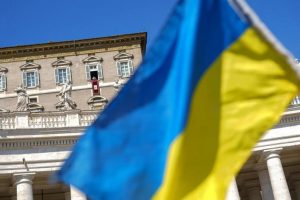
A person waves a Ukrainian flag as Pope Francis recites the Angelus noon prayer from the window of his studio overlooking St.Peter’s Square, at the Vatican Andrew Medichini/Copyright 2022 The AP. All rights reserved
He was quick to point out that matters are not that black-and-white: not all Ukrainian Orthodox worshippers that remained under the Moscow Patriarchate are pro-Kremlin, he said.
“Among the soldiers serving in the Ukrainian army there are Orthodox worshippers from the Moscow Patriarchate and from the Kyiv Patriarchate, Greek and Roman Catholics, Protestants, along with Muslims and Jews. They are all fighting loyally for the independence of Ukraine,” Bishop Lonchyna explained.
Why does Moscow think it should still have a say in Ukraine?
Unlike Catholics, who are all ruled by the Vatican, Eastern Orthodox Christians can ask for an independent jurisdiction from other Orthodox churches, known as autocephaly.*
This form of independence is granted when the Orthodox church in any country — especially in newly-independent states — asks for the seal of the autocephaly (also known as the Tomos) from the Ecumenical Orthodox Patriarchate in Istanbul and its recognition by the other independent Orthodox churches.
“According to an ecumenical principle established more than 10 centuries ago, a change of the political status of a territory should bring a change of its ecclesiastical status,” Dr Nikos Kouremenos, a theologian from the University of Athens, told Euronews.
This ancient principle has been applied at the birth of most independent countries with a significant Eastern Orthodox population in the last two centuries.
This means that until 1991, Ukraine, as well as the rest of the Soviet Union, was formally — in the eyes of the Orthodox world — under the Patriarch of Moscow.
However, when Ukraine declared independence, the question of its ecclesiastic autocephaly became a highly controversial issue entwined with the Ukrainian struggle to escape Russia’s desire for control.
At the same time, Kyiv carries significant spiritual meaning for many Eastern Slavs.
Prior to the existence of Russia and Moscow, Kyivan Rus was the centre of the Slavic world and Eastern Orthodoxy as the first Eastern Slav state, which then converted to Christianity under the Grand Prince of Kyiv Volodymyr the Great in the 10th century.
The Kyivan Rus Orthodox faithful constructed a number of holy places of key historical significance, such as the Monastery of Pechersk Lavra and the Cathedral of Saint Sophia.
Prince Volodymyr was baptised by Byzantine priests in Chersonesos, then a Greek city near today’s Sevastopol in Crimea.
As the autocephalous Orthodox Church of Ukraine rose to prominence post-independence, it was places like Pechersk Lavra where the Moscow Patriarchate tried to flex its influence and maintain control over, particularly after the 2014 Maidan Revolution.
Its attempts on influencing matters in Kyiv were on full display when, early on in Russia’s full-scale invasion of Ukraine, in March 2022, the Ukrainian security agency SBU raided the catacombs’ labyrinths of Pechersk Lavra, searching for pro-Russian weapons hideouts.
The Tomos and the ‘Thermos’
It took almost three decades of intense talks amid the Moscow Patriarchate’s subversion for Kyiv’s church to receive a Tomos declaring its autocephaly from the Ecumenical Patriarch Bartholomew.
On Epiphany, in January 2019, the Tomos was delivered to the Ukrainian Metropolitan Epiphanius I under the proud watch of then-Ukrainian President Petro Poroshenko.
The former Ukrainian head of state boasted that the autocephaly for the Kyiv Church was his personal diplomatic success.
Volodymyr Zelenskyy, then his political rival, derided the Tomos by calling it the “Thermos”, taking a jab at Poroshenko’s ecclesiastical enthusiasm amid a fiesty presidential election campaign.
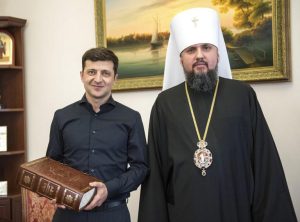
April 30, 2019, Volodymyr Zelenskiy, left, poses for a photo with Metropolitan Epiphanius, head of the Orthodox Church of Ukraine, in Ki AP/AP
However, Kyiv’s autocephaly has been recognised only by a minority among the 15 official Orthodox Churches: Cyprus, Greece, and Alexandria of Egypt. Moscow still regards it as a “schismatic group”.
“The Orthodox world is clearly divided when it comes to the Ukrainian religious question,” Kouremos explained.
“For instance, some Orthodox churches that can be considered as satellites of Moscow, like the Serb and the Syrian Patriarchates of Belgrade and of Antioch respectively, have openly rejected the idea of an autocephalous Kyiv Orthodox Church,” he added.
“The rest of the patriarchates, like the Georgian and the Romanian ones, have not taken any formal step toward the recognition of the (Orthodox) Church of Ukraine. They have abstained.”
As a result, many Ukrainian Orthodox worshippers have been hesitant to leave the church under the Moscow Patriarchate and join the independent Orthodox Church of Ukraine, fearing a potential excommunication for being schismatics.
Yet, this turned into a schism of its own.
After the beginning of the war, thousands of Ukrainians left the Ukrainian church under the Moscow Patriarchate to join Kyiv’s autocephalous church, while many others are still worshippers of the first, despite being staunch Ukrainian patriots.
The bill banning the Moscow Patriarchate’s work in Ukraine is also a practical solution to encourage those hesitant to adhere to the autocephalous Church of Ukraine, especially in the occupied territories, Ukrainian Archimandrite Cyril Hovorun explained.
“The Russian Patriarchate has its own direct structures on the occupied territories and on the free territories,” he told Euronews.
“All the Ukrainian Patriarchate churches that were brought uncanonically (by force during the occupation) under the Moscow patriarch are immediately classified as illegal. This is the most evident and most important effect of the Ukrainian ban”.
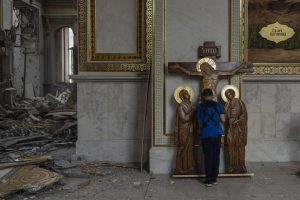
A boy kisses the statue of Jesus while helping clean up inside the Odesa Transfiguration Cathedral after the church was heavily damaged in Russian missile attacks in Odesa, Uk Jae C. Hong/Copyright 2023 The AP. All rights reserved
As for the Russian churches on the Ukrainian-controlled territory, the new law cannot avoid a much longer constitutional procedure before sanctioning them.
“According to the Ukrainian legislation the churches does not have a legal personality. Only the communities have a legal personality,” Archimandrite Hovorun said.
“These communities are registered in an ad hoc state record. And on the basis of this registration they enjoy some privileges, like, for example, discounted price for gas and electricity, or they can use for free municipal or state property”.
Proving a religious community’s affiliation with a patriarchate can be “a very difficult process that must go through the courts up to the European Court of Human Rights”, he said.
“And even if the Moscow affiliation of the community will be proven the worst sanction they willl have to pay is to be stripped of the rights to rent public property buildings,” concluded Archimandrite Hovorun from his residence in Kyiv.
Hovorun is now a scholar of ecumenism and International Relations at Sankt Ignatios, an intra-orthodox university college in Sweden.
He was a member of the Ukrainian Church under the Moscow Patriarchate. He used to work with the Russian Patriarch Kirill but was forced to quit after witnessing the Russian Orthodox Church’s increasing support for the Kremlin’s expansionistic ideology.
Hovorun was defrocked by the Russian patriarch himself, and as an academic researcher, he now responds only to the Ecumenic Patriarch of Constantinople.
‘Russian World,’ a case of hubris-meets-heresy
The Ukrainian law concerning the activities of the Moscow Patriarchate explicitly names one particular issue: “the danger of the ideology of the ‘Russian World’”.
The much-talked-about doctrine is seen as a blueprint for the Russian state and its proxies, providing cultural and ideological foundations for political action to bring Ukraine, Belarus, Moldova, and other eastern European communities under the Kremlin’s political control, either through territorial annexations or by extending the Russian sphere of influence.
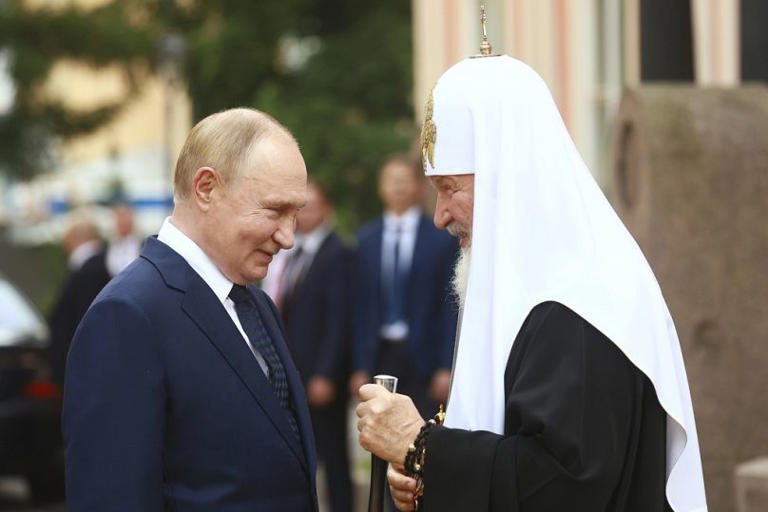
Through his sermons, the current Moscow Patriarch, Kirill, has backed the doctrine by justifying Russian military aggressions and religious propaganda against neighbouring states — a de facto way to whitewash and justify the use of force by invoking Christian moral principles.
More than a thousand Orthodox Christian theologians and scholars from various countries have strongly condemned the “Russian World” idea:
“We reject the ‘Russian world’ heresy and the shameful actions of the government of Russia in unleashing war against Ukraine, which flows from this vile and indefensible teaching with the connivance of the Russian Orthodox Church, as profoundly un-Orthodox, un-Christian and against humanity,” they said in a statement in March 2022.
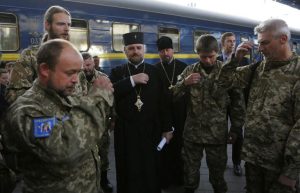
Ukrainian orthodox chaplains of Ukrainian Armed Forces pray as they prepare to leave Kiev Sergei Chuzavkov/AP
Although not outright banned, most Orthodox churches were closely monitored by Soviet authorities, especially during the Cold War.
Even the exiled religious communities based in the West were infiltrated by priests acting as undercover agents.
The alliance between President Vladimir Putin and Patriarch Kirill has rebooted those practices in the name of the “Russian World”.
While the Ecumenical Patriarch of Constantinople Bartholomew maintained extremely warm relations with the US since the Cold War, Patriarch Kirill actively used the church’s spiritual and ecclesiastical role to justify Russian expansionism.
Nonetheless, “no Orthodox church has condemned Kirill as a heretic, and one of the reasons is that problem with nationalism is rooted in almost all the Orthodox churches,” Dr Kouremos explained.
“If we try to accuse Kirill as a heretic because he’s a nationalist, we don’t know where we can stop because also in other churches, in Romania, in Georgia, in Serbia, we can find some traces of nationalism.”