
EVENTS
Union to mark 80th anniversary of Hiroshima and Nagasaki bombings with a number of special events

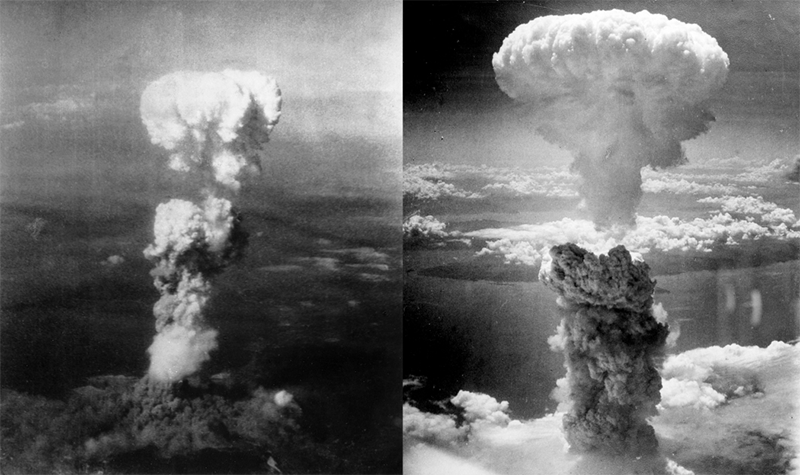
In August 1945, the United States dropped two atomic bombs on Japan, one on Hiroshima and one on Nagasaki.
The bombings on these cities several days apart killed more than 210,000 and led to a lifetime of serious health issues for thousands of others.
The devastating attack led to the end of World War II, when shortly afterward, Japanese Emperor Hirohito announced that Japan would surrender.
As the 80th anniversary of the bombings approaches, there are a number of ways that Union will connect with this consequential moment in world history.
These include movie screenings, guest speakers and course material across interdisciplinary offerings.
“We are bringing science and humanities together in a powerful way to highlight a critical moment in our history,” said Jennifer Matsue, professor and chair of music, Asian studies and anthropology. She is helping coordinate all events.
“We need to keep reminding people to be fully aware of the dangers of atomic weaponry at a time when we are experiencing heightened global conflict.”
The first event is a free private screening for the campus community at 6:30 p.m. Monday, Feb. 3, of the documentary, “Okurimono” at Bowtie Movieland. The Canadian director, Laurence Lévesque, will host a Q & A after the screening.
The film tells the story of Noriko Oi, who decides to reconstruct the past of her mother, Mitsuko, a survivor of the atomic bomb, in the hope of passing down her cultural heritage to her children and healing the dark reminiscences of a tragic past.
“The film ‘Oppenheimer’ failed to transport audiences to the sites of devastation,” said organizer Jim de Sève, senior artist-in-residence, film studies, and co-director of the Film Studies program, sponsor of the event. “Okurimono does. And it does it with heart, civility and thoughtfulness.”
Co-sponsors are Asian studies, the Templeton Institute and the departments of History and Music.
Other films to be shown during winter term include “Gojira” in Matsue’s class, From Bombs to Buddhism: Fatalism, Technology and Modern Japanese Culture, and “Black Rain,” in Remembering World War II in Asia, a class taught by Joyce Madancy, professor of history.
A 1954 classic by the director Ishiro Honda, “Gojira” is the original appearance by Godzilla and considered a metaphor for the end of World War II and the detonation of nuclear weapons onto Hiroshima and Nagasaki.
“Black Rain” is a 1989 masterpiece from Shohei Imamura that centers on the aftermath of the atomic bombing of Hiroshima and its effect on a surviving family.
Also, 1983’s “Barefoot Gen,” an animated film from director Mori Masaki, will be discussed in Madancy’s class and Japanese Manga and Anime, taught by Junko Ueno, professor of Japanese. The film “revolves around the life of 6-year-old Gen Nakaoka, who must grow up quickly due to the harsh reality of living through wartime food shortages and constant air raids in Hiroshima.”
Zakuro-Daiko, the Japanese Drumming and Global Fusion Band, will premiere a new musical work commemorating the 80th anniversary of the bombings at its winter concert Friday, Feb. 28, at 7 p.m. and Saturday, March 1, at 1 p.m. in Emerson Auditorium in the Taylor Music Center
The ensemble (whose name translates to Garnet Drums) was established in 2007 by Matsue to bring Japanese music and culture to life on campus. The group performs a type of Japanese ensemble drumming that is popular in Japan and throughout the world.
In the spring, Joshua Pilzer, award-winning author of “Quietude: A Musical Anthropology of ‘Korea’s Hiroshima,’” will speak to students in Music and Trauma in World War II, a new class taught by Jin Byun, director of music performance. Details are being finalized.
Union’s expansive focus on the anniversary of the bombings follows the awarding of last fall’s Nobel Peace Prize to Nihon Hidankyo, a Japanese group of atomic bomb survivors that was recognized for its efforts to rid the world of nuclear weapons.
Matsue acknowledged today’s students may not be aware of the first — and so far, only — wartime atomic bombings. But she believes it’s imperative to raise awareness of the dangers of nuclear war, in hopes of never repeating the atrocities of the past.
“As educators, it’s important for us to get our students to think about that what’s happened in the past is relevant to what’s happening today,” she said. “That story can be told so much better through humanity.”









Governor Babajide Sanwo-Olu of Lagos State on Friday participated in a wreath-laying ceremony marking the 50th anniversary of the death of the late General Murtala Ramat Muhammed, GCFR.
The event was attended by notable dignitaries, including Senator Daisy Danjuma, wife of retired Lt. General Theophilus Danjuma; Dr Aisha Muhammed Oyebode, daughter of the late General and CEO of the Murtala Muhammed Foundation; her husband, Gbenga Oyebode; and Hon. Bola Oladunjoye, Chairman of Ikoyi-Obalende LCDA, among other officials and guests.

Wreaths were laid at the cenotaph in honour of General Muhammed, celebrating his life, leadership, and enduring contributions to Nigeria.
General Murtala Ramat Muhammed served as Nigeria’s Head of State from July 1975 until his assassination on February 13, 1976.

His leadership was abruptly ended when his convoy was ambushed in Ikoyi, Lagos, during a failed coup attempt, resulting in his death alongside his driver and aide-de-camp.
Following his assassination, leadership passed to his deputy, Lieutenant General Olusegun Obasanjo, who continued the transition to civilian governance.
Fifty years later, commemorative activities are being held throughout February 2026, including exhibitions, policy dialogues, memorial gatherings, and wreath-laying ceremonies, highlighting General Muhammed’s legacy and enduring impact on Nigeria’s history.

EVENTS
GOVERNOR SOLUDO’S ULTIMATUM AND THE BATTLE FOR ANAMBRA’S MONDAYS, SHUTS DOWN ONITSHA MAIN MARKET FOR A WEEK

By Christian ABURIME
Anambra State Governor, Prof Chukwuma Charles Soludo has ordered the immediate shut down of the Onitsha Main Market for one week, following defiance of the market leadership to open, against government directive.
Governor Soludo’s order for a one-week shutdown of the sprawling market is more than an administrative penalty. It is the latest, and perhaps most drastic, salvo in a protracted war over who controls time and economic life in Southeast Nigeria on mondays. The enemy is the long-standing, fear-enforced Monday sit-at-home order, a ghostly mandate from non-state actors that has strangled businesses and normalized weekly monday sit-at-home for years.
The Governor’s move is a direct response to what the government sees as baffling defiance. Despite repeated assurances of enhanced security and appeals to reclaim public spaces, many traders at the iconic market again chose to keep their stalls locked. Their absence was a quiet rebellion, but one that spoke volumes about the lingering climate of apprehension.
“The government cannot stand by while a few individuals willfully undermine public safety and disregard official directives meant to restore normalcy, this is plain economic sabotage. We are not going to allow this”, Governor Soludo stated, framing the closure as a protective measure for the “law-abiding citizen.” But his subsequent warning carried the weight of an escalating ultimatum: if the market does not reopen for business after this one-week shutdown, it will be sealed for a month. “And so on and so forth,” he added, drawing a line in the sand.
“You either decide that you are going to trade here or you go elsewhere. I am very serious about this”, the Governor insisted.
The scene at the market was one of tense enforcement. A joint task force of police, army, and other security personnel moved swiftly to secure the perimeter, turning away the few hopefuls who approached.
For the Soludo administration, the solution is unwavering enforcement to break a psychological barrier. The strategy is clear: make the cost of compliance with the illegal sit-at-home order higher than the fear that drives it. By targeting the economic heart of the region, the government aims to trigger a collective shift in behavior, betting that the traders’ desire to trade will ultimately outweigh their fear.
As the gates remain locked this week, the standoff in Onitsha encapsulates the broader struggle in the Southeast. It is a fight over normalcy, authority, and the fragile psyche of a populace caught between enforced directives and imposed orders. When the gates are scheduled to reopen next Monday, all eyes will be on the traders. Will they return to their stalls, emboldened by the state’s show of force? Or will the silent, empty aisles deliver a different verdict?
The answer will determine not just the fate of a market, but the rhythm of life in Anambra for Mondays to come.
https://www.instagram.com/reel/DT-PAX-DIAi/?igsh=bzVxOGgzcTF0OG5k

A Nigerian man has gone viral on X (formerly Twitter) after sharing throwback photos of himself and his wife from when they were both still children.
In the post, @Sadeeq_Malo revealed that he has loved his wife for 17 years, describing her as his uncle’s daughter, a statement that immediately caught the attention of social media users.
Sharing the photos, he wrote:
“17 years of love. I fell in love with her from the day she was born — my uncle’s daughter, now my bride. Allahummah Barik.”
The old photos, which show the couple as children, were shared alongside recent pictures of them as a married couple, sparking massive engagement online.
The post has since divided opinions on social media. While some users defended the union noting that cousin marriages are culturally acceptable in some communities, others focused on the unusual wording of his declaration.


Reacting, one user wrote, “Fell in love from the day she was born? That sentence alone is wild.” Another commented, “People should calm down. Cousin marriage is normal in many cultures.”
Despite the mixed reactions, the man appears unfazed, celebrating what he describes as a 17-year journey of love that eventually led to marriage.
Check post below….


Police bust syndicate behind nude photo blackmail in Lagos

Man in shock after lady he lodged with in a hotel in Abuja flees with his car and other valuables

US Reacts As De@th Toll In Kwara Terror Attacks Hits 200

-
Business1 year ago
US court acquits Air Peace boss, slams Mayfield $4000 fine
-

 Trending1 year ago
NYA demands release of ‘abducted’ Imo chairman, preaches good governance
-

 Politics1 year ago
Mexico’s new president causes concern just weeks before the US elections
-

 Politics1 year ago
Putin invites 20 world leaders
-

 Politics1 year ago
Russia bans imports of agro-products from Kazakhstan after refusal to join BRICS
-
Entertainment1 year ago
Bobrisky falls ill in police custody, rushed to hospital
-
Entertainment1 year ago
Bobrisky transferred from Immigration to FCID, spends night behind bars
-
Education1 year ago
GOVERNOR FUBARA APPOINTS COUNCIL MEMBERS FOR KEN SARO-WIWA POLYTECHNIC BORI