
Education
Unity schools: Reopening without measures puts students at risk – Security expert tells Nigerian govt


A security analyst, Amb. Capt. Abdullahi Bakoji Adamu (rtd), has warned that the Nigerian government’s decision to reopen the 47 Unity Colleges earlier closed due to security threats must be backed by concrete, long-term security measures, not official assurances alone.
Speaking in an exclusive interview with Ekwutosblog on Friday, Adamu said reopening the schools is a delicate but necessary policy choice.
He stressed that education remains a critical national asset that should not be disrupted for long periods.
“Education is too important to be sacrificed indefinitely. Prolonged closure of Unity Schools threatens national development, social cohesion, and youth stability,” he said.
He noted that from this perspective, the government’s decision to reopen the schools aligns with its constitutional responsibility to guarantee access to education.
However, the retired security expert cautioned that optimism must not override security realities.
“The original closure of these schools was based on real and credible threats such as kidnappings, banditry, and attacks on educational institutions. These threats have not disappeared; they have only evolved,” he warned.
According to him, reopening schools without addressing the root causes of insecurity would expose students, teachers, and parents to serious danger.
“Security is not measured by announcements but by preparedness, deterrence, and response efficiency. If the reopening is based merely on assurances rather than verifiable security benchmarks, it risks repeating past tragedies and eroding public confidence,” he said.
From a professional security standpoint, he listed key conditions that must be met, including permanent security deployment around and within school premises, rather than temporary patrols.
“There must be integrated intelligence sharing between the military, police, DSS, and local security structures,” he said.
He added that intelligence gaps remain a major weakness.
Adamu also emphasized the need for rapid response capability.
“Response must be within minutes, not hours. Delayed response has cost lives in the past,” he noted.
He further called for secure school infrastructure, including controlled access points, perimeter surveillance, and reliable emergency communication systems.
Beyond formal security agencies, the analyst stressed the importance of community involvement.
“Host communities must be active partners in intelligence gathering and early warning. Without community engagement, security efforts will always fall short,” he said.
Adamu warned that reopening schools based only on verbal assurances could lead to a repeat of past tragedies and damage public trust in government decisions.
“If reopening is based merely on promises rather than verifiable security benchmarks, it risks eroding public confidence,” he said.
“In conclusion, while reopening the Unity Schools is a positive step toward restoring normalcy and safeguarding the future of Nigerian children, it must be treated as a security-led operation, not an administrative decision. The success or failure of this policy will depend entirely on whether security measures are proactive, adaptive, and sustained,” the expert added
Recall that the Federal Government recently announced the reopening of 47 Unity Colleges that were earlier shut down due to security concerns.
The Ministry of Education made the announcement in a statement on Thursday, reaffirming the government’s commitment to safeguarding students and ensuring continuity of learning.
According to the ministry, “after the strengthening of security architecture within and around the affected schools, academic activities have fully resumed.”
The statement added that students have returned safely to their campuses, with some concluding their December academic programs, while others have completed their examinations.
The ministry also assured parents, guardians, and the general public that the safety, welfare, and well-being of students remain a top priority.










An official of the National Youth Service Corps (NYSC) in Ogun State, Abass Olalekan, has been arrested in connection with the de@th of a female corps member.
The corps member, Victoria Ariyo, serving under the Abeokuta South Local Government Area (LGA) of the NYSC, reportedly d!ed last Tuesday after undergoing abortion.
It was gathered that the corps member had terminated her pregnancy and d!ed from complications that followed the procedure.
Her remains were buried at Kobape Cemetery on Kobape-Sagamu Road in Abeokuta.
According to Daily Trust, Ariyo’s d3ath came barely a month after another female corps member, Adeleye Mary, d!ed in what has been described as mysterious circumstance.
Mary, who was serving under the same Abeokuta South LG, was attached to the Ogun State Television (OGTV) as her Place of Primary Assignment (PPA).
A source told the publication that both deceased corps members were friends.
“The first lady d!ed at her residence, which is not far from her PPA. They found her lifeless body in the apartment and, up till now, nobody can tell the cause of her d3ath,” the source said.
However, the second corps member who d!ed on Tuesday was said to have died from complications arising from an abortion procedure.
It was alleged that the NYSC official, who is the Local Government Inspector (LGI) for Abeokuta South, Abass Olalekan was culpable in the process leading to the corps member’s d3ath.
Sources told the publication that the LGI was allegedly involved in a romantic relationship with the deceased, which eventually led to pregnancy, and it was the termination that led to her d3ath.
“That is the fact in issue,” a police source who confirmed the NYSC official’s arrest told Daily Trust on Thursday.
The police source said the development raises questions about the legality of romancing “someone that should be in your care.”
Confirming Olalekan’s arrest, the source said, “He is in our custody at the command’s headquarters, Eleweran, Abeokuta.”
The police source, however, said there is no connection between the current incident and the one that occurred last month.
Spokesperson for the police in the state, DSP Oluseyi Babaseyi, confirmed death of Ariyo and said that the investigation was ongoing.
However, he failed to respond to questions on the arrest of the LGI and the alleged involvement.
“I can confirm that the case of the demise of Victoria Ariyo is under investigation by the State Criminal Investigation Department,” Babaseyi said in a terse statement.

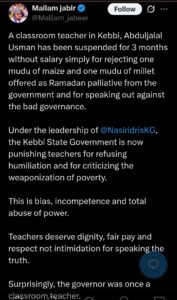
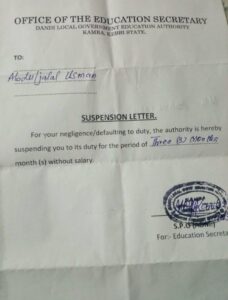
A classroom teacher in Kebbi State, Abduljalal Usman, has reportedly been suspended for three months without salary after rejecting a Ramadan palliative reportedly distributed by the state government.
The teacher allegedly declined the offer of one mudu of maize and one mudu of millet and also criticized what he described as poor governance in the state.
According to claims circulating online, the action was taken under the administration of Nasir Idris, prompting criticism from some commentators who described the suspension as an attempt to silence dissent and punish a public worker for speaking out.
Critics argue that educators deserve better working conditions, fair compensation, and respect, rather than disciplinary action for expressing their views.
@Mallam_jabeer who shared the report, said …
“A classroom teacher in Kebbi, Abduljalal Usman has been suspended for 3 months without salary simply for rejecting one mudu of maize and one mudu of millet offered as Ramadan palliative from the government and for speaking out against the bad governance.
Under the leadership of
@NasiridrisKG
, the Kebbi State Government is now punishing teachers for refusing humiliation and for criticizing the weaponization of poverty.
This is bias, incompetence and total abuse of power.


President Bola Tinubu has approved the appointment of Dr. Makoji Stephen as the new Rector of Federal Polytechnic Ugep in Cross River State.
The approval was granted by the Federal Government, and the appointment will take effect from March 17, 2026.
Dr. Stephen will serve a single term of five years in line with the Polytechnic Act 2019 as amended.
The decision is seen as part of efforts to strengthen leadership and improve the academic and administrative structure of the institution.
Before this new role, Dr. Stephen worked as a Chief Lecturer in the Department of Public Administration at Federal Polytechnic, Idah.
He also served as an Adjunct Faculty member in the Department of Public Policy and Administration at Miva Open University, Nigeria.
Dr. Stephen began his academic journey at Ahmadu Bello University, where he earned a Bachelor of Science degree in Public Administration in 1998 with Second Class Upper Division.
He later obtained a Master of Science degree in Public Administration from Benue State University.
In 2009, he earned another Master of Science degree in Human Resource Management from the University of Salford in the United Kingdom.
He further completed a Ph.D. in Business and Management with a focus on Human Resource Management at the University of Salford Business School in 2016.
His doctoral studies were supported by the Tertiary Education Trust Fund.

Benita Enwonwu in the 1970s: Model, Actress, and Daughter of Ben Enwonwu

Kidnappers Took Loan With My Phone – Victim Recounts Ordeal

11 more arrested over Ozoro “r@ping festival”

-
Business1 year ago
US court acquits Air Peace boss, slams Mayfield $4000 fine
-

 Trending1 year ago
NYA demands release of ‘abducted’ Imo chairman, preaches good governance
-

 Politics1 year ago
Mexico’s new president causes concern just weeks before the US elections
-

 Politics1 year ago
Putin invites 20 world leaders
-

 Politics1 year ago
Russia bans imports of agro-products from Kazakhstan after refusal to join BRICS
-
Entertainment1 year ago
Bobrisky falls ill in police custody, rushed to hospital
-
Entertainment1 year ago
Bobrisky transferred from Immigration to FCID, spends night behind bars
-
Education2 years ago
GOVERNOR FUBARA APPOINTS COUNCIL MEMBERS FOR KEN SARO-WIWA POLYTECHNIC BORI