
Politics
US election: Middle East conflict becomes key issue for Harris and Trump

With just two weeks until election day, the ongoing crisis in the Middle East has become a focal point in the US presidential race.
Vice President Kamala Harris and former President Donald Trump are each attempting to address the conflict’s complexities while fighting for crucial votes in battleground states like Michigan and Pennsylvania, which have large Arab American and Jewish populations.
Harris has been navigating a challenging line, expressing strong support for Israel while also condemning civilian casualties in Gaza and Lebanon.
This balancing act has drawn mixed reactions, including criticism from some who misinterpreted her remarks during a recent exchange with a pro-Palestinian protestor as agreeing with claims of Israeli “genocide.”
Harris’ campaign quickly clarified that her comments were focused on the broader humanitarian condition in Gaza.
The dynamics shifted a day earlier when Harris stated that the “first and most tragic story” of the conflict was the 7 October Hamas attack that resulted in the deaths of about 1,200 Israelis.
This statement upset those who felt she was not adequately addressing the deaths of over 41,000 Palestinians in Gaza, leading to further criticism of her stance.
Trump, on the other hand, has taken a more assertive approach, claiming the conflict would not have occurred under his leadership and promising an end to it if elected.
In recent interviews with Middle Eastern TV outlets and posts on his social media platform Truth Social, Trump claimed that a Harris administration would escalate the conflict, even suggesting the risk of World War III.
“If Kamala gets four more years, the Middle East will spend the next four decades going up in flames, and your kids will be going off to war, maybe even a World War III, something that will never happen with President Donald J Trump in charge,” Trump posted.
Can Harris and Trump navigate the Middle East crisis?
As Harris tries to align her messaging with President Joe Biden’s policies while striking a more emphatic tone, some in the Democratic Party express frustration over Trump’s unpredictable but bold foreign policy statements, which have gathered attention without much scrutiny.
Analysts note this contrast as a potential challenge for Harris in the final days of the campaign.
An AP-NORC poll indicates neither candidate holds a significant advantage on Middle East policy, with voters split on who would handle the situation better.
However, Harris faces some discontent within her party. Only two-thirds of Democrats say she would be the better candidate to address the conflict, while 8 in 10 Republicans back Trump on the issue.
In Michigan, home to the largest Arab American community in the US, the war’s impact is deeply personal. The community has called for a ceasefire and criticised the Biden administration for its stance on the conflict.
While Harris initially offered hope for change, many feel her policies have not diverged enough from Biden’s.
Despite both parties largely supporting Israel, much of the frustration and criticism has been directed towards Biden.
When Harris launched her campaign, Arab American leaders were initially hopeful. However, that hope quickly faded as the community felt she had not distanced her policies enough from Biden’s.
Meanwhile, ads funded by Future Coalition PAC, a group backed by Elon Musk, are targeting Arab American communities in Michigan and Jewish voters in Pennsylvania, each emphasising different aspects of Harris’ stance on Israel.
As election day nears, the Middle East crisis remains a critical issue both for the candidates’ messaging and the race’s outcome.




By Comrade Igboayaka O. Igboayaka
President OHANEZE YOUTH COUNCIL
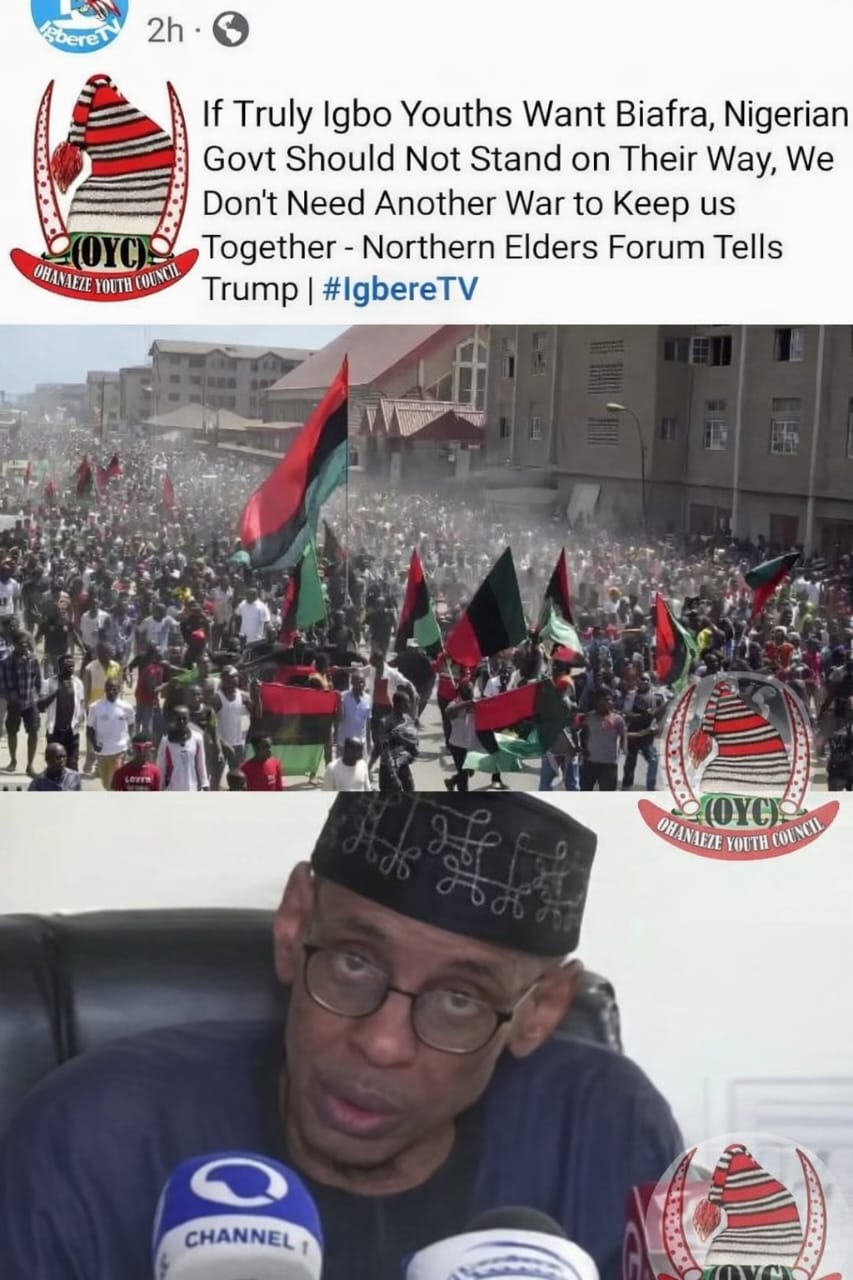
The Ohanaeze Youth Council (OYC) has formally replied to the recent statement credited to the Northern Elders Forum, wherein they suggested that if Igbo youths truly desire Biafra, the Nigerian government should not stand in their way.
While we acknowledge this rare moment of honesty, OYC states clearly and unequivocally:-Yes — Igbo youths want Biafra. And this desire is not born out of hatred, but out of decades of injustice, exclusion, and systemic oppression.
The agitation for Biafra is the direct consequence of Nigeria’s persistent failure to build an equitable and inclusive federation.
WHY IGBO YOUTHS ARE DEMANDING BIAFRA
Our position is anchored on undeniable realities:-
*1. Political Differences:-Nigeria’s political structure has consistently marginalized the Southeast. Since the return to democracy in 1999, the Igbo nation has been deliberately excluded from key leadership positions, particularly the Presidency and critical security offices. Federal appointments, resource control, and political representation remain grossly imbalanced against Ndigbo.The so-called federal system operates more like a unitary arrangement where certain regions dominate while others are reduced to spectators.*
*2. Social Differences:-Social integration in Nigeria has collapsed. Igbo citizens face profiling, harassment, and selective enforcement of laws across different parts of the country. Peaceful protests in Igboland are met with military brutality, while violent extremism elsewhere often receives negotiation and amnesty.This double standard has deepened alienation among Igbo youths.*
*3. Cultural Differences:-Our language, traditions, and values are neither protected nor promoted within the Nigerian framework. Instead, Igbo culture is routinely undermined and treated as inferior. A nation that fails to respect the cultural identity of its people cannot claim unity.*
*4. Religious Differences:-Religious intolerance has become normalized. Christian communities in the Southeast feel increasingly threatened in a country where religious bias influences policy, security response, and governance. The absence of genuine religious neutrality further widens the divide.*
*5. Ethnic Hate Against Ndigbo:- Anti-Igbo rhetoric has been openly displayed in national discourse. From threats of expulsion to hate speeches and coordinated attacks, Ndigbo have become targets within their own country. Properties belonging to Igbos are often destroyed during crises, with little or no compensation or justice.This persistent hostility sends a clear message;we are not wanted.*
*6. Systemic Marginalization:- From abandoned federal roads to exclusion from major infrastructure projects, from poor seaport development to economic strangulation, the Southeast remains deliberately underdeveloped. Igbo youths graduate into unemployment, poverty, and despair while watching other regions benefit disproportionately from national resources.*
*This is not accidental. It is structural.*
*OUR MESSAGE IS SIMPLE*
*Igbo youths are not asking for war.*
*Igbo youths are asking for dignity.*
*Igbo youths are asking for freedom.*
*Igbo youths are asking for self-determination.*
*If Nigeria cannot guarantee justice, equity, and equal opportunity for all, then the call for Biafra becomes not just legitimate — but inevitable.*
*To the Northern Elders Forum: we appreciate your acknowledgment. Now let the Nigerian state also have the courage to respect the democratic will of a people.*
*You cannot force unity where there is no justice.*
*Powered by OHANAEZE YOUTH COUNCIL (OYC)*
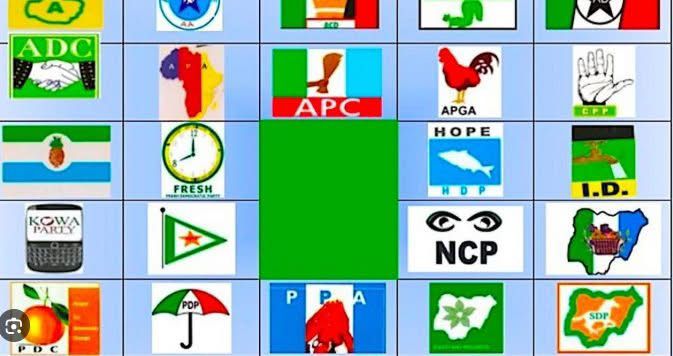
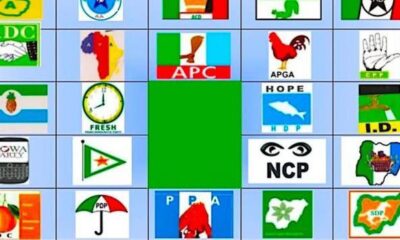
The Independent National Electoral Commission (INEC) has approved two new political parties ahead of the 2027 general elections, raising the total number of registered parties in Nigeria to 21.
INEC Chairman, Prof. Joash Amupitan (SAN), announced the approval of the Democratic Leadership Alliance (DLA) and the Nigeria Democratic Congress (NDC) in Abuja on Thursday. While DLA met all statutory requirements, NDC was registered following a Federal High Court order.
Full list of registered political parties in Nigeria:
All Progressives Congress (APC)
Peoples Democratic Party (PDP)
Accord (A)
Social Democratic Party (SDP)
Labour Party (LP)
All Progressives Grand Alliance (APGA)
African Democratic Congress (ADC)
Boot Party (BP)
Action Democratic Party (ADP)
African Action Congress (AAC)
Action Alliance (AA)
National Rescue Movement (NRM)
Zenith Labour Party (ZLP)
New Nigeria Peoples Party (NNPP)
Allied Peoples Movement (APM)
Peoples Redemption Party (PRP)
Action Peoples Party (APP)
Young Progressives Party (YPP)
Youth Party (YP)
Democratic Leadership Alliance (DLA) – new
Nigeria Democratic Congress (NDC) – new
INEC said the new parties were registered as part of efforts to deepen democratic participation and broaden political choices for Nigerians.
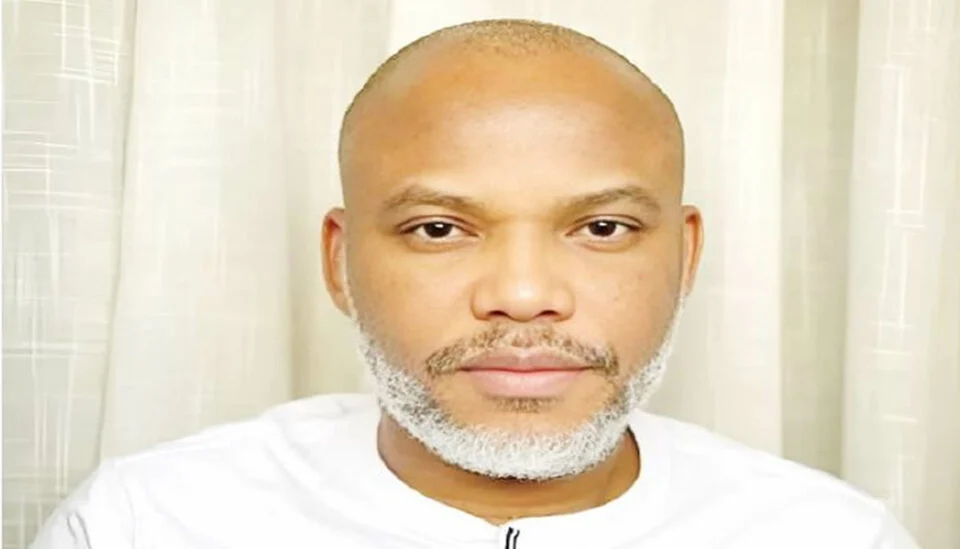
The detained leader of the Indigenous People of Biafra, Nnamdi Kanu, has filed a notice of appeal challenging his conviction and multiple sentences imposed by the Federal High Court in Abuja, insisting that the trial was riddled with fundamental legal errors and amounted to a miscarriage of justice.
In the notice of appeal dated February 4, 2026, Kanu said he was appealing against his conviction and sentences on seven counts, including terrorism-related offences, for which he received five life sentences and additional prison terms after being found guilty on November 20, 2025.
“I, Nnamdi Kanu, the Appellant, having been convicted and sentenced… do hereby give notice of appeal against my conviction,” the document stated.
Kanu was convicted for offences including “committing an act preparatory to or in furtherance of an act of terrorism,” “making a broadcast… with intent to intimidate the population,” and “being the leader and member of the Indigenous People of Biafra (IPOB), a proscribed organisation in Nigeria,” among others.
Justice James Omotosho of the Federal High Court, Abuja, delivered the judgment on November 20, 2025, sentencing Kanu to five life terms for terrorism-related offences, 20 years’ imprisonment for being the leader of the proscribed IPOB, and five years’ imprisonment with no option of fine for importing a radio transmitter without a licence.
In his grounds of appeal, the IPOB leader accused the trial court of failing to resolve what he described as a “foundational disruption of the original trial process” following the 2017 military operation at his Afara-Ukwu residence.
“The learned trial judge erred in law by failing to resolve the procedural and competence consequences of the foundational disruption of the original trial process in September 2017,” Kanu argued.
He also contended that the court proceeded to trial and judgment while his preliminary objection challenging the competence of the proceedings remained unresolved.
“The learned trial judge did not hear or determine the objection,” the appeal document stated, adding that judgment was delivered “while the objection remained pending and undetermined.”
Kanu further faulted the court for delivering judgment while his bail application was still pending, arguing that this affected the fairness of the trial process.
He also claimed that the trial court convicted him under a law that had already been repealed, stating that “the learned trial judge erred in law by convicting and sentencing the Appellant under the Terrorism Prevention (Amendment) Act, 2013, notwithstanding its repeal by the Terrorism (Prevention and Prohibition) Act, 2022, prior to judgment.”
Kanu further argued that he was subjected to double jeopardy, contrary to Section 36(9) of the 1999 Constitution, after being retried on facts he said had earlier been nullified by the Court of Appeal.
He also complained that he was denied fair hearing, claiming that he was not allowed to file or present a final written address before judgment was delivered.
Among the reliefs sought, Kanu asked the Court of Appeal to allow the appeal, quash his conviction and sentences, and “discharge and acquit the Appellant in respect of all the counts.”
He also informed the appellate court of his desire to be present at the hearing of the appeal, stating, “I want to be present at the hearing of the appeal because I may be conducting the appeal in person.”
Kanu is currently being held at a correctional facility in Sokoto State, after his application to be transferred to a different facility in either Niger or Nasarawa State was denied.

Bosso replaces Danjuma as Imo Police Command CP

After Bitten To De@th By Snake, Another Snake Reportedly Found Under Ambulance Carrying Nanyah’s Remains Back Home

OHANAEZE YOUTH COUNCIL REPLIES NORTHERN ELDERS FORUM: YES, IGBO YOUTHS WANT BIAFRA

-
Business1 year ago
US court acquits Air Peace boss, slams Mayfield $4000 fine
-

 Trending1 year ago
NYA demands release of ‘abducted’ Imo chairman, preaches good governance
-

 Politics1 year ago
Mexico’s new president causes concern just weeks before the US elections
-

 Politics1 year ago
Putin invites 20 world leaders
-

 Politics1 year ago
Russia bans imports of agro-products from Kazakhstan after refusal to join BRICS
-
Entertainment1 year ago
Bobrisky falls ill in police custody, rushed to hospital
-
Entertainment1 year ago
Bobrisky transferred from Immigration to FCID, spends night behind bars
-
Education1 year ago
GOVERNOR FUBARA APPOINTS COUNCIL MEMBERS FOR KEN SARO-WIWA POLYTECHNIC BORI